
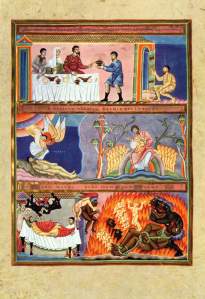
 19 “There was a rich man who dressed in purple garments and fine linen and dined sumptuously each day. 20 And lying at his door was a poor man named Lazarus, covered with sores, 21 who would gladly have eaten his fill of the scraps that fell from the rich man’s table. Dogs even used to come and lick his sores. 22 When the poor man died, he was carried away by angels to the bosom of Abraham. The rich man also died and was buried, 23 and from the netherworld, where he was in torment, he raised his eyes and saw Abraham far off and Lazarus at his side. 24 And he cried out, ‘Father Abraham, have pity on me. Send Lazarus to dip the tip of his finger in water and cool my tongue, for I am suffering torment in these flames.’ 25 Abraham replied, ‘My child, remember that you received what was good during your lifetime while Lazarus likewise received what was bad; but now he is comforted here, whereas you are tormented. 26 Moreover, between us and you a great chasm is established to prevent anyone from crossing who might wish to go from our side to yours or from your side to ours.’ 27 He said, ‘Then I beg you, father, send him to my father’s house, 28 for I have five brothers, so that he may warn them, lest they too come to this place of torment.’ 29 But Abraham replied, ‘They have Moses and the prophets. Let them listen to them.’ 30 He said, ‘Oh no, father Abraham, but if someone from the dead goes to them, they will repent.’ 31 Then Abraham said, ‘If they will not listen to Moses and the prophets, neither will they be persuaded if someone should rise from the dead.’” Continue reading
What we pursue: context
Reply
 13 No servant can serve two masters. He will either hate one and love the other, or be devoted to one and despise the other. You cannot serve God and mammon.”
 Final Thoughts (from Culpepper, 304-5)
 17 Coming to his senses he thought, ‘How many of my father’s hired workers have more than enough food to eat, but here am I, dying from hunger. 18 I shall get up and go to my father and I shall say to him, “Father, I have sinned against heaven and against you. 19 I no longer deserve to be called your son; treat me as you would treat one of your hired workers.” 20 So he got up and went back to his father. While he was still a long way off, his father caught sight of him, and was filled with compassion. He ran to his son, embraced him and kissed him. 21 His son said to him, ‘Father, I have sinned against heaven and against you; I no longer deserve to be called your son.’ 22 But his father ordered his servants, ‘Quickly bring the finest robe and put it on him; put a ring on his finger and sandals on his feet. 23 Take the fattened calf and slaughter it. Then let us celebrate with a feast, 24 because this son of mine was dead, and has come to life again; he was lost, and has been found.’ Then the celebration began.
 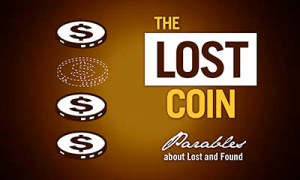 8 “Or what woman having ten coins and losing one would not light a lamp and sweep the house, searching carefully until she finds it? 9 And when she does find it, she calls together her friends and neighbors and says to them, ‘Rejoice with me because I have found the coin that I lost.’ 10 In just the same way, I tell you, there will be rejoicing among the angels of God over one sinner who repents.”
  1 The tax collectors and sinners were all drawing near to listen to him, 2 but the Pharisees and scribes began to complain, saying, “This man welcomes sinners and eats with them.” 3 So to them he addressed this parable
