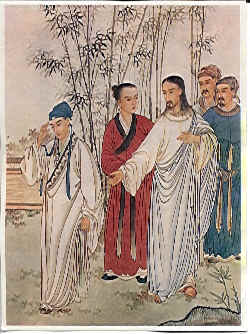
“The Time of Fulfillment” This phrase is only in Mark. The word for time is kairos; it is used in 11:13 and 12:2 to refer to the “time of harvest” – an image that usually refers to the time of judgment. It is also used in when “The Son of Man coming in clouds with great power and glory.” Yet this is something liminal about the moment. There is a part of us that wants an “epiphany” with the kingdom clearly present; there is a triumphalistic part of us that wants the kingdom to conquer all – here and now. Yet the world still seems very much intact. Instead of a kingdom epiphany, the second act opens with Jesus wandering by the sea, bidding some common laborers to accompany him on a mission. Still, here in Mark’s gospel we know when the time is. It is now – and yet we pray “Your kingdom come….” I appreciate Martin Luther’s explanation to the second petition of the Lord’s Prayer. “God’s kingdom comes on its own without our prayer, but we ask in this prayer that it may also come to us.” Continue reading
Category Archives: Scripture
Come after me: context
Mark 1:14 After John had been arrested, Jesus came to Galilee proclaiming the gospel of God: 15 “This is the time of fulfillment. The kingdom of God is at hand. Repent, and believe in the gospel.” 16 As he passed by the Sea of Galilee, he saw Simon and his brother Andrew casting their nets into the sea; they were fishermen. 17 Jesus said to them, “Come after me, and I will make you fishers of men.” 18 Then they abandoned their nets and followed him. 19 He walked along a little farther and saw James, the son of Zebedee, and his brother John. They too were in a boat mending their nets. 20 Then he called them. So they left their father Zebedee in the boat along with the hired men and followed him.
The Bigger Picture. The first major section of Mark’s Gospel extends from 1:14 to 3:6, and describes the initial phase of the Galilean ministry. Within this section the evangelist records the calling of the first disciples (1:16–20; 2:14), Jesus’ ministry in and around Capernaum (1:21–34), and a series of controversies (2:1–3:6) which are climaxed by the decision to seek Jesus’ death (3:6). Continue reading
Lamb of God: calling disciples
Andrew. Three times Andrew is doing something in John – ‘and each time he is bringing someone to Jesus. First, his brother, Simon (v.40). Then, a boy with five barley loaves and two fish (6:8); and finally, “some Greeks” (12:20-22), which signals the hour for the Son of Man to be glorified. Andrew is never mentioned just by himself. Twice he is called Simon Peter’s brother (1:40; 6:8). We are told that Philip came from the city of Andrew and Simon (1:44). Andrew and Philip go and tell Jesus about the Greeks (12:22). It may be that being named as the first follower of Jesus (in the Fourth Gospel) was the first time that he had ever been first in anything. It seems likely to me that he was always living under the shadow of his more flamboyant brother. It also seems to me that our parishes are full of more behind-the-scenes “Andrews” than flamboyant “Peters” who seem to get all the credit. (“Peter” occurs in 32 verses in John – ‘8 times as many as Andrew.) One doesn’t have to be a “Peter” to be an effective follower and witness to Jesus (Stoffregen) Continue reading
Lamb of God: come and see
In vv.19-34 we have seen John the Baptist bearing his witness (see commentary here). Now we find him sending some of his followers after the Lord. There are accounts of a “call” in the Synoptics (e.g., Mark 1:16–20), but they differ greatly from this. The Fourth Gospel tells of a call to be disciples; the Synoptics of a call to be apostles. John’s theme is not the calling of the apostles into office; it is their call to relationship with Christ. Strictly speaking, there is no “call” in this Gospel (except in the case of Philip, v. 43). Jesus does not call the disciples and John the Baptist does not send his disciples to Jesus; Jesus and his role as the Lamb of God is pointed out – or rather John’s witness. The English leaves a bit of room as to how to understand the disciples’ motivation. Are they curious, intrigued or do they perhaps recognize the Messiah and spontaneously follow. Continue reading
Lamb of God: context
This coming Sunday is the 2nd Sunday in Ordinary Time, Year B – the cycle of readings in which The Gospel according to Mark is the principal source of our Sunday gospels. That being said, our reading is from the Gospel According to John. In fact, regardless of which cycle of readings (A,B, or C), the “Second Sunday of Ordinary Time the Gospel continues to center on the manifestation of the Lord” with a gospel from John (General Introduction to the Lectionary, 105). It is done as a means of transitioning from the theme of “manifestation” highlighted in Epiphany to ordinary time readings – I suspect – because there are some years when the Baptism of the Lord is celebrated on the Monday following the Sunday celebration of Epiphany (when Epiphany Sundays falls on Jan 7th or 8th). The reading for the 2nd Sunday ensures the theme is continued in the simple verse: “We have Found the Messiah.” Continue reading
How Can This Be?
In response to this angelic announcement, Mary asks a question reminiscent of Zechariah’s query, “How can this be?” She had not had sexual relations with a man. Ultimately, the purpose of Mary’s question (v.34)—which leads to Gabriel’s answer (v.35) and the giving of a sign (v.36) and word of reassurance (v.37)—is to emphasize that all of this is God’s doing. Continue reading
Favored and Troubled
Confluence. Luke’s narrative style is on display as he deftly moves from the “annunciation” concerning John the Baptist to the one concerning the salvation of all humanity. There is a confluence of temporal and chronological markers, and the reappearance of Gabriel. The “sixth month” recalls v.24, and seems to imply that Elizabeth has only now come out of seclusion. This prepares for the sharing of the news of her pregnancy in v.36 and her subsequent welcome of Mary (vv.39–45). Yet geographically and socio-religiously we move away from the center (Jerusalem and the Temple) to the margins of the nations (Nazareth in Galilee). Gabriel, God’s messenger, is the connector, pointing to the God’s Word active in the world. Continue reading
Annunciations
Similar, yet… In many respects our gospel (Luke 1:26-38) is similar to the annunciation of the birth of John. The angel Gabriel appears to announce the birth of the child, and the annunciation follows the pattern of birth annunciations in the OT: The angel says, “Do not be afraid,” calls the recipient of the vision by name, assures him or her of God’s favor, announces the birth of the child, discloses the name of the child to be born, and reveals the future role of the child in language drawn from the Scriptures. After their respective announcements, Zechariah and Mary each ask a question, a sign is given, and the scene closes with a departure. The similarity of structure and content between the two scenes invites the reader to consider the differences between them all the more closely. For example, the first announcement came as an answer to fervent prayer; the second was completely unanticipated. John would be born to parents past the age of child bearing, but the miracle of Jesus’ birth would be even greater. Jesus would be born to a virgin. The announcement of Jesus’ future role also shows that at every point Jesus would be even greater than his forerunner. Watch how these nuances are developed in the course of the details of this scene. Note this narrative comparison also punctuates the beginning of Mark’s gospel which has no infancy narrative: John the Baptist is not the Christ, not Elijah, not the prophet to come, and not worthy to loosen the strap of the sandal of the one who is to come. Continue reading
The Annunciation – context
Luke 1:26-38 26 In the sixth month, the angel Gabriel was sent from God to a town of Galilee called Nazareth, 27 to a virgin betrothed to a man named Joseph, of the house of David, and the virgin’s name was Mary. 28 And coming to her, he said, “Hail, favored one! The Lord is with you.” 29 But she was greatly troubled at what was said and pondered what sort of greeting this might be. 30 Then the angel said to her, “Do not be afraid, Mary, for you have found favor with God. 31 Behold, you will conceive in your womb and bear a son, and you shall name him Jesus. 32 He will be great and will be called Son of the Most High, and the Lord God will give him the throne of David his father, 33 and he will rule over the house of Jacob forever, and of his kingdom there will be no end.” 34 But Mary said to the angel, “How can this be, since I have no relations with a man?” 35 And the angel said to her in reply, “The holy Spirit will come upon you, and the power of the Most High will overshadow you. Therefore the child to be born will be called holy, the Son of God. 36 And behold, Elizabeth, your relative, has also conceived a son in her old age, and this is the sixth month for her who was called barren; 37 for nothing will be impossible for God.” 38 Mary said, “Behold, I am the handmaid of the Lord. May it be done to me according to your word.” Then the angel departed from her.
Context. From the beginning of the Gospel according to Luke:
1:1 Since many have undertaken to compile a narrative of the events that have been fulfilled among us, 2 just as those who were eyewitnesses from the beginning and ministers of the word have handed them down to us, 3 I too have decided, after investigating everything accurately anew, to write it down in an orderly sequence for you, most excellent Theophilus, 4 so that you may realize the certainty of the teachings you have received.
The preface to the Gospel of Luke’s begins with the Greek (epeidēper) indicating a formal and important undertaking. And well Luke should write such as he intends to write of the things that God has fulfilled among the believers (among us). It establishes that the good news is already planted – not only in that others have already written their gospels – but that this is living tradition (handed down) among the community. These things have been fulfilled by God and part of his faithfulness to his promises.
Luke 1:5-2:52 forms the section referred to as the “Infancy Narratives.” Luke’s account of the conception, birth, and infancy of Jesus is one of his finest narratives. The Gospel of Mark, one of Luke’s sources does not have an infancy narrative to guide him. The Gospel of Matthew has an infancy narrative, but there is every indication that Luke and Matthew had no knowledge of each other’s work. Rather, they composed their accounts separately at a time when the church was reflecting back beyond Jesus’ public ministry to his earthly beginnings.
The traditional preaching outline began with Jesus’ baptism (as is evident in the sermons of Peter and Paul in Acts, and in the structure of Mark’s Gospel). The infancy stories were added to the front of that outline to serve as a prologue to the main narrative. A prologue announces the themes to be pursued in the body of the work. Both Luke and Matthew proclaim the good news in advance in a kind of mini-gospel based on the birth and infancy of Jesus. If Luke’s infancy narrative had been lost before his Gospel began to circulate, we wouldn’t know it had existed, because there are no clear references back to these chapters in the later account of the public ministry. But the reverse is not true — there are many references forward to the later developments. What we know about the infant Jesus comes from the teaching of the adult Jesus and the early church’s reflection on his life, death, and resurrection. Who is this child? He is Messiah and Lord (Acts 2:36). What does his coming mean? He will save his people from their sins (Luke 24:47). A reader’s understanding of the prologue depends on his or her understanding of the rest of the book. It means much more when read a second or third time after the entire book has been read. The infancy narrative grows in meaning the more the life, death, and resurrection of Jesus resound in the faith of the reader.
The immediate context of our passage is one of announcements:
- Luke 1:5-25: Announcement of John’s birth
- Luke 1:26-38: The Annunciation of Jesus’ birth
The next scene opens as though it will continue to tell of the birth of the child promised to Zechariah and Elizabeth. Instead, it tells of a greater miracle and the birth of one who would be even greater than John.
Photo credit: “The Annunciation” by Daniel Bonnell
What can you say about yourself?
The questioners from Jerusalem were in a difficult position. So far all they had elicited from John had been a string of denials; they had no positive statement to put in their report. Yet John was preaching, drawing crowds in the wilderness, and baptizing. They must have something to say about him. So they turn the matter over to John. Instead of making another suggestion they ask him what he thinks about himself. They must have some answer to take back to those who had sent them. Continue reading