Faith that saves: mercy

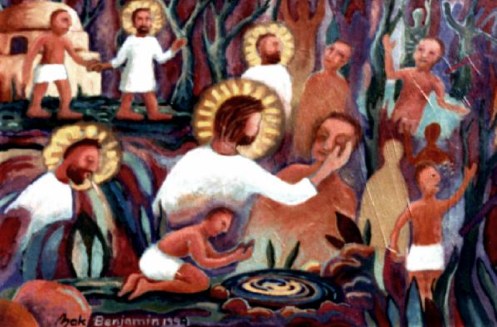
Jesus-healingA Cry for Mercy. In other healing scenes, the one healed is told to “go” and not say anything about the miracle. This phenomenon is described as the Mark’s “messianic secret.” There are many speculations as to why Jesus does not want word of his mighty deeds know far and wide. The one in which I hold to be more likely is the one in which Jesus does not want people’s perception of his Glory to be seen in the miracles and mighty deeds, but wants them to see the Glory fully revealed on the cross when they can see that God’s love for them has no limits. Now that they are close to the time of the cross, Jesus will not tell Bartimaeus to remain silent. Any attempt to silence the blind man falls to the crowd. Continue reading →

Faith that saves: on the way

Jesus-healingThe passage is the last healing and miracle in the Gospel of Mark. It is easily passed over as another miracle among many, but the story of Bartimaeus (bar-Timeaeus; lit. Son of Timeaus) is in some ways the most significant since it is the one miracle not recorded in the Hebrew Scriptures. There are general promises in Isaiah that promise healing and deliverance (Isaiah 29:1; 32:1-3; 35:1-10) along with specific promises that in the day of the Messiah the blind will have their sight restored (Is 42:18; 61:1-4). Continue reading →

Faith that saves: context

Jesus-healing46 They came to Jericho. And as he was leaving Jericho with his disciples and a sizable crowd, Bartimaeus, a blind man, the son of Timaeus, sat by the roadside begging. 47 On hearing that it was Jesus of Nazareth, he began to cry out and say, “Jesus, son of David, have pity on me.” 48 And many rebuked him, telling him to be silent. But he kept calling out all the more, “Son of David, have pity on me.” 49 Jesus stopped and said, “Call him.” So they called the blind man, saying to him, “Take courage; get up, he is calling you.” 50 He threw aside his cloak, sprang up, and came to Jesus. 51 Jesus said to him in reply, “What do you want me to do for you?” The blind man replied to him, “Master, I want to see.” 52 Jesus told him, “Go your way; your faith has saved you.” Immediately he received his sight and followed him on the way. (Mark 10:46-2) Continue reading →

Why He Came: ransom

serve-one-anotherServant and Slave. Rather, whoever wishes to be great among you will be your servant; 44 whoever wishes to be first among you will be the slave of all.

In these short verses, which in many ways parallels 9:35 (“If anyone wishes to be first, he shall be the last of all and the servant of all.”), there is one difference that Stoffregen notes. In v.44 he/she will be a servant [diakonos] of you (plural, indicating the Twelve), while v.45 is he/she will be a slave [doulos] of all. This is not a distinction that Matthew makes in his parallel (Mt 20:26-27). Continue reading →

Why He Came: Lord

serve-one-anotherAn Eager Response. They said to him, “We can.” Jesus said to them, “The cup that I drink, you will drink, and with the baptism with which I am baptized, you will be baptized; 40 but to sit at my right or at my left is not mine to give but is for those for whom it has been prepared.”

In response to their eager “We can” of v.39, Jesus divides the issue: You shall share in my cup, in my baptism, in my death. But it is up to someone else, my Father, to give out the seats of glory! (v. 40). The disciples have just been described as a fearful band following Jesus to Jerusalem, the confident assertion that they can share Jesus’ suffering must strike the reader as naive. However, Jesus predicts that they will share his suffering (v. 39), and, indeed, Acts 12:2 informs us that James was martyred in Jerusalem by Herod Agrippa (44 ce; Gal 2:9 suggests that John survived his brother). Jesus’ prophetic word was fulfilled. Continue reading →

Why He Came: cup and baptism

serve-one-anotherJesus Responds. It would be good to know Jesus’ tone of voice when he responds. Is it exasperation caused by their continuing blindness? Is it said as a tired sigh but with a willingness to again engage them and lead them to a deeper understanding and awareness? Does it have an edge? It might well be the simple inquiry to uncover what they understand: “Can you drink the cup that I drink or be baptized with the baptism with which I am baptized?”

There are several lines of interpretation regarding Jesus’ reply. Some scholars hold that the images offered (“drink” and “baptism”) do not hold the same significance for the disciples as they do for Jesus. In this line of thought, the cup and baptism point to Jesus’ voluntary obedience unto death for the sins of humanity; whereas, the images suggest the disciples moral participation in Jesus’ passion. [Lane, 379]. But the construct of the sentence is in the present tense. In other words, right at his moment, Jesus is drinking and being baptized. This seems to point to something other than a future moral participation in the Passion. Continue reading →

Why He Came: questioning

james-john-sons-of-zebedee35 Then James and John, the sons of Zebedee, came to him and said to him, “Teacher, we want you to do for us whatever we ask of you.” 36 He replied, “What do you wish (me) to do for you?” 37 They answered him, “Grant that in your glory we may sit one at your right and the other at your left.”

Asking Boldly. Even before the request is revealed, the very sound of the question seems brash: “whatever we ask.” It is as though they want a “blank check” from Jesus. Is it enthusiasm? Is it brazenness? Is it coming from a sense of “I deserve a reward for having followed you these many, many months?” Is it arising from a sense of “I have looked at the other 10 and we are the ones you should pick?” Hard to know, but in any event, Jesus simply asks them what they desire. Continue reading →

Why He Came: context

serve-one-another35 Then James and John, the sons of Zebedee, came to him and said to him, “Teacher, we want you to do for us whatever we ask of you.” 36 He replied, “What do you wish (me) to do for you?” 37 They answered him, “Grant that in your glory we may sit one at your right and the other at your left.” 38 Jesus said to them, “You do not know what you are asking. Can you drink the cup that I drink or be baptized with the baptism with which I am baptized?” 39 They said to him, “We can.” Jesus said to them, “The cup that I drink, you will drink, and with the baptism with which I am baptized, you will be baptized; 40 but to sit at my right or at my left is not mine to give but is for those for whom it has been prepared.” 41 When the ten heard this, they became indignant at James and John. 42 Jesus summoned them and said to them, “You know that those who are recognized as rulers over the Gentiles lord it over them, and their great ones make their authority over them felt. 43 But it shall not be so among you. Rather, whoever wishes to be great among you will be your servant; 44 whoever wishes to be first among you will be the slave of all. 45 For the Son of Man did not come to be served but to serve and to give his life as a ransom for many.” (Mark 10:35-45) Continue reading →

Inheriting the Kingdom:

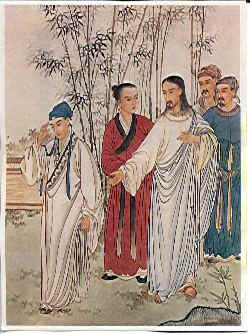
ChineseJesus-rich-manThe Rewards of Discipleship. 28 Peter began to say to him, “We have given up everything and followed you.” 29 Jesus said, “Amen, I say to you, there is no one who has given up house or brothers or sisters or mother or father or children or lands for my sake and for the sake of the gospel 30 who will not receive a hundred times more now in this present age: houses and brothers and sisters and mothers and children and lands, with persecutions, and eternal life in the age to come. 31 But many that are first will be last, and (the) last will be first.”

Earlier (3:35) Jesus had redefined his family. “(For) whoever does the will of God is my brother and sister and mother.” For many of the first believers, following Jesus meant leaving everything behind. What one gained by leaving the biological family behind was the faith-community, those who were doing the will of God. Continue reading →

Inheriting the Kingdom: wealth

ChineseJesus-rich-manProblem of Wealth? 23 Jesus looked around and said to his disciples, “How hard it is for those who have wealth to enter the kingdom of God!” 24 The disciples were amazed at his words. So Jesus again said to them in reply, “Children, how hard it is to enter the kingdom of God! 25 It is easier for a camel to pass through (the) eye of (a) needle than for one who is rich to enter the kingdom of God.” 26 They were exceedingly astonished and said among themselves, “Then who can be saved?” 27 Jesus looked at them and said, “For human beings it is impossible, but not for God. All things are possible for God.”

Before we address the question of wealth, the larger question is really “Who can be saved?” The answer in v.21 is clear – human beings cannot save themselves. Just can’t do it. But, nothing is impossible for God. Stoffregen writes: “The answer to ‘how hard?’ is ‘It’s impossible.’ Whenever we make it ‘possible’ to do with enough work or sacrifice, we miss the radical nature of Jesus’ comments; which were especially revolting because (1) it was naturally assumed that the wealthy were closer to God and were more likely to be saved than the common people and (2) it was naturally assumed that those who kept the commandments were closer to God and were more likely to be saved than the common people. The man in our text fulfilled both requirements — but doesn’t enter the kingdom — at least not based on his righteousness or wealth.” Continue reading →