
 John 3:16 – “For God so loved the world that he gave his only Son” It is perhaps the best-known bible verse here in the United States. It appears on bumper stickers and will no doubt appear during the upcoming NCAA basketball tournament. It’s everyone’s favorite Bible verse. Why not? God loves us. Swish – nothing but net. Game over. Nothing left to do but flood the court in unbridled joy!
The language and logic of the kingdom of God is Love. It is the calculus of the Kingdom by which God is “all in”: “For God did not send his Son into the world to condemn the world, but that the world might be saved through him.” That the world, the whole world might be saved. The ones whose team hit that game-ending three pointer. As well as the ones whose final shot air-balled, all hope vanishing in a moment. And God still comes. Still loves. Still saves.
But… I’ve wondered whether, if people thought about this verse for just a little longer it might just prove to be far less comforting and far more disconcerting. So let’s review…
 Did you know that our Christian brothers and sisters proclaim the gospel of the Transfiguration on the Sunday before Lent while we hear it this 2nd Sunday of Lent? For them it is the end of the liturgical season of Epiphany that starts with the first revelation of the Christ child to the world and end with the account of the divine glory of God being revealed in the person of Jesus. There is a lovely symmetry to that. On the first Sunday in Lent, both traditions proclaim Jesus’ temptation in the desert – and with the exception of this Sunday, both traditions proclaim the same Gospels for the remainder of Lent.
 “He shall dwell apart, making his abode outside the camp” – frightening and dreadful words. Spoken to leprous people in the wilderness, a people on the Exodus betwixt and between the slavery of Egypt and the promised land of Palestine. Words that ban, isolate, shun, and place someone beyond the connection to the community. These are words spoken to loved ones that pushed them from the routine of life into the wilderness. In modern life, we have our own words or lack of words that push people into a more modern wilderness where our loved ones are ghosted, cancelled, deleted, blocked and isolated – all this is a time when we all feel the effects of pandemic fatigue. Perhaps “outside the camp” sounds tempting during these safer-at-home days of the covid-19 pandemic. But this is different.
 The story of Job is the well-known biblical account in which a person’s life goes from prosperity and security, from joy to despair. He has lost his family, his possessions, his security – and Job is the one who asks aloud what some of us only whisper – where is God in all of this? Job watches while his life unravels losing prosperity, family and feeling that the entirety of his life under assault. He has looked into his life to see if he is being punished for sin. But he finds none. And the assault doesn’t stop. He grows sick and covered with sores. No wonder he laments: “My days … come to an end without hope. …. I shall not see happiness again.”
 In the Catholic tradition this is the Second Sunday in Ordinary Time. In the Protestant and Reformed traditions using the Revised Common Lectionary, this is the Second Sunday of the Season of Epiphany. I think I rather prefer that name. It keeps alive the celebration of Epiphany, the season of what is revealed. It keeps alive the challenge for us to continually see the truth. Even in the turmoil and unsettling times in which we live. We are not the first to live in such times.
 I can remember coming home from 3+ years of mission in Kenya, friends were driving me home, and as we wound through trees, I could see the porch light on at my home in the foothills of the Blue Ridge. Even from afar, it shone like a welcoming beacon. It was the sign I am home in a place I have always belonged. It was known, calm, and safe. It was far from the wildness and messiness of life of the slums of Kibera. It is the same moment we have seen on the evening news, in newspapers, on-line in the experience of our men and women serving overseas in foreign lands. Coming home writ large is the heavy bags dropped on the tarmac, the faces of unbridled joy, parents sweeping up children in their arms, a loved one embraced, and the moment they know: I am home.
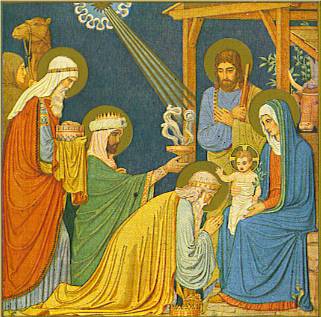 Last century (literally) I was researching for my master’s thesis on early Franciscan Missions. One of the really interesting aspects of the early Franciscan missions was the one to China. The friars arrived in China in 1292 and John of Montecorvino was the first bishop of Beijing. But all that is beside the point. In the course of my research, I ran across The Travels of Marco Polo in which he describes his travels in the far east. I was scanning the text to see if he had any mention of contact with the friars or the Christian monasteries that dotted the silk road in those days. While he had no mention of either – he did recount a most interesting rendition of the account of the Three Magi. Marco Polo wrote that he encountered this version in Persia (modern-day Iran). In that account there are three magi – but they are not traveling together. Each is on his own journey following the star to Bethlehem. Melchior is an older man, Balthazar is an adult in his middle years, and Gaspar is a young man just reaching adulthood.
 A lot of our life hoovers around the question, “What’s next?” A year ago, I don’t think any of us would have answered: pandemic. Yet life inexorably moved ahead in its journey through time and we still needed to prepare for tomorrow. For no one hoped for such times, but that is not for us to decide. All we have to decide is what to do with the time that is given us.
 friarmusings