51 I am the living bread that came down from heaven; whoever eats this bread will live forever; and the bread that I will give is my flesh for the life of the world.” 52 The Jews quarreled among themselves, saying, “How can this man give us (his) flesh to eat?” 53 Jesus said to them, “Amen, amen, I say to you, unless you eat the flesh of the Son of Man and drink his blood, you do not have life within you. 54 Whoever eats my flesh and drinks my blood has eternal life, and I will raise him on the last day. 55 For my flesh is true food, and my blood is true drink. 56 Whoever eats my flesh and drinks my blood remains in me and I in him. 57 Just as the living Father sent me and I have life because of the Father, so also the one who feeds on me will have life because of me. 58 This is the bread that came down from heaven. Unlike your ancestors who ate and still died, whoever eats this bread will live forever.”
But let’s place this in a larger perspective from the whole of the Discourse: He gave; bread from heaven; to eat. Let’s observe this happen.
He gave (vv. 26–34). In this first section, the emphasis lies on the giving. Jesus will give (vv. 27, 34), not as Moses gave (v. 32) a perishable manna food of mortality, but as the Father, source of eternal life, gives (v. 32). Thus far, Jesus appears as the giver of bread and therefore as the new and superior Moses.
bread from heaven (vv. 35–47). The insistence now shifts to the bread from heaven that Jesus not only gives but actually is (vv. 35, 38, 41, 42). It is important to note here that the operative verb is “believe.” Jesus as bread from heaven is accepted and consumed through the belief required in verses 35, 36, 40, 47. What this means is that this is a faith nourishment. Jesus is bread from heaven, feeding all believers, in the same sense that Old Testament wisdom nourished all who accepted it (Prov 9:1–5).
to eat (vv. 48–59). In this final section, the vocabulary changes radically. The significant words are “flesh,” “blood,” “eat, ” “drink.” Note the constant repetition of “eat” (phagein) in vv.49, 50, 51, 52, 53, 54, 58. “Feed on” (trōgein – an even more physical verb in the Greek than “eat”) occurs in v.57. These verbs become overwhelmingly insistent, as does the constant reference to flesh and blood, food and drink. The meaning of the discourse has changed. Where in the preceding section Jesus nourished through wisdom-revelation those who believed, the verb “believe” has now completely disappeared and is replaced by “eat,” “feed on.” This is language which clearly speaks of sacramental nourishment, of the food and drink that one eats and feeds upon, of the Eucharistic nourishment provided by the flesh and blood of the Son of Man (v. 53). The “Son of Man” phraseology tells us that this is not the physical flesh and blood of the earthly Jesus and that we are asked to eat and drink but the spiritual, Spirit-filled flesh and blood of the heavenly Son of Man. Verse 58 ties the discourse together by referring back to the central phrase of verse 31.
What this discourse has done, therefore, is to deliver a rich and multi-faceted exposition of the Jesus-as-Bread-of-Life theme.
Jesus is first of all the giver of the bread, a new Moses.
He is also the bread of wisdom and revelation who nourishes all who come to him in faith.
He is, finally, the Eucharistic source of eternal life for all who eat and drink the flesh and blood of the heavenly and glorified Son of Man.
Because John uses this Eucharistic material in this Bread of Life homily, it will not be too surprising — yet surprising enough — that the Eucharist will not be mentioned at the Last Supper. Its material has been transferred to this incident. John has also succeeded, with this transfer, to unite in this one chapter the essentials of Christian Eucharist, the word and the bread — the revealing word of vv.35–47 and the sacramental bread of vv.48–59.
Jesus gives his flesh to eat. The question that emerges from the dispute among “the Jews” is a rejection of Jesus’ outrageous suggestion: “How (ōs) can this man give us his flesh to eat?” (v. 52). But it allows Jesus to conclude his discourse on his perfection of the Mosaic gift of bread from heaven through his gift of himself as the true bread from heaven. Unable to go beyond the physical, “the Jews” by their question misunderstand Jesus’ promise. Jesus insists on a gift of flesh and blood for life by stating negatively (v.53) and positively (v.54) that whoever eats the flesh and drinks the blood of Jesus, the Son of Man, has eternal life now and will be raised up on the last day. The midrashic play on the verb “to eat” provided by the Exodus passage in v. 31 has reached its high point. “Flesh” and “blood” emphasize that it is the incarnate life and very real death of the Son that are life giving food. Only the physical body of a human being produces flesh and blood. The argument of vv. 25-51 continues into vv. 52-59, especially in Jesus’ words that point to the resolution of a series of promises (cf. vv. 12-13, 27, 35, 51c). Jesus will provide a food for the life of the world, and that food is his flesh and blood.
As the ancestors of Israel were nourished by the gift of the Torah, Jesus will nourish the whole world with the gift of himself.
The people of Israel were nourished by eating the manna, perennially recalled in the nourishment provided for them by their total receptivity to and absorption of the Law.
Now “the Jews” are told of the absolute need to eat the flesh and drink the blood of the Son of Man. Unless they eat the flesh and drink the blood (ean me phagete . . kai piete) of the Son of Man they have no life (v. 53); whoever eats the flesh and drinks the blood (ho treigōn . kai pinon) of Jesus has eternal life (v. 54).
The shift from the more respectable verb “to eat” (phagein) to another verb that indicates the physical crunching with the teeth (trōgein) accentuates that Jesus refers to a real experience of eating. Hints of the Eucharist continue to insinuate themselves into the words of Jesus. Flesh is to be broken and blood is to be spilled. Violence has been in the air since Jesus’ behavior on the Sabbath led “the Jews” to initiate a process that would lead to his death (5:16-18).
In today’s gospel, the Sadducees are testing Jesus by presenting a reductio ad absurdum argument based on levirate marriage. A woman is successively married to seven brothers. They ask: “At the resurrection when they arise whose wife will she be” – which is interesting since the Sadducees don’t believe in the Resurrection. Jesus responds with “When they rise from the dead, they neither marry nor are given in marriage, but they are like the angels in heaven.”
Most Christians recognize that it was not really a question and since levirate marriage is not practiced in modern life, that problem is no problem at all… but there is modern fallout with a question often framed as: “If there is no marriage in heaven, does that mean I am not married, won’t love my spouse, may not even know my spouse… what about my family?”
The Sadducees’ question assumes that the resurrection is simply a continuation of earthly life under the same social arrangements. Our modern concern is whether any aspect of these important earthly social arrangements persists into the life to come. But notice Jesus does not say that people cease to know one another or to love one another. He does not say that earthly relationships become meaningless or that spouses become strangers. However, He does seem to say that marriage as an institution in the way that we know it does not continue in the resurrection.
In Scripture, marriage has several purposes: mutual love and companionship, the procreation and raising of children, as a sign of God’s covenant with humanity, and as a sacramental image of Christ and the Church. Theologians offer that marriage is like a sacrament pointing beyond itself. Just as we do not need a road sign after arriving at the destination, the sacramental sign gives way to the reality toward which it points. Mutual love is perfected, life is eternal, death is no more, and the covenant is fulfilled, In the resurrection, the purposes of marriage have reached their fulfillment.
The key point is that in eternal life relationships are transformed by perfect union with God. John Chrysostom argued that relationships are purified and elevated in the resurrection. The love spouses shared is not lost but perfected. One could easily extend Chrysostom’s argument to include family ties. Augustine of Hippo taught that personal identity remains and what passes away is not love but the juridical bond of marriage. Thomas Aquinas taught that the sacrament of marriage belongs to this life. Its function ceases in heaven because its purpose has been fulfilled. Yet the love formed through marriage remains.
So will I see my spouse in heaven? From a Catholic perspective, the answer is emphatically yes, assuming both are united with God. The deeper question is: What kind of relationship will that be? The Church’s tradition consistently says that you will not love your spouse less; you will love your spouse more perfectly than ever before. All the selfishness, misunderstandings, possessiveness, fears, wounds, and limitations that affected earthly love will be gone. The love remains.
Heaven does not erase human love; it brings it to its fullest perfection.
As the posts in this series to this point have indicated, China views the South China Sea (SCS) as well within its territorial waters and not international waters (The 9-Dash Line,). The degree to which they enforce that claim depends on who and what is transiting the waters. During the week of May 24, 2026 the PLAN aggressively denied a Dutch warship entrance into the SCS while commercial traffic proceeded uninterrupted. The Chinese ability to enforce the claim is substantial and has been steadily enhanced in the passing years as this post will show. China’s ability to enforce its claims consists of:
A fleet of naval combatants ranging from aircraft carriers to frigates with a combined lethality of strike aircraft, vertical launch missiles, and naval rifles (5-inch and higher). As well their submarine force is quite capable.
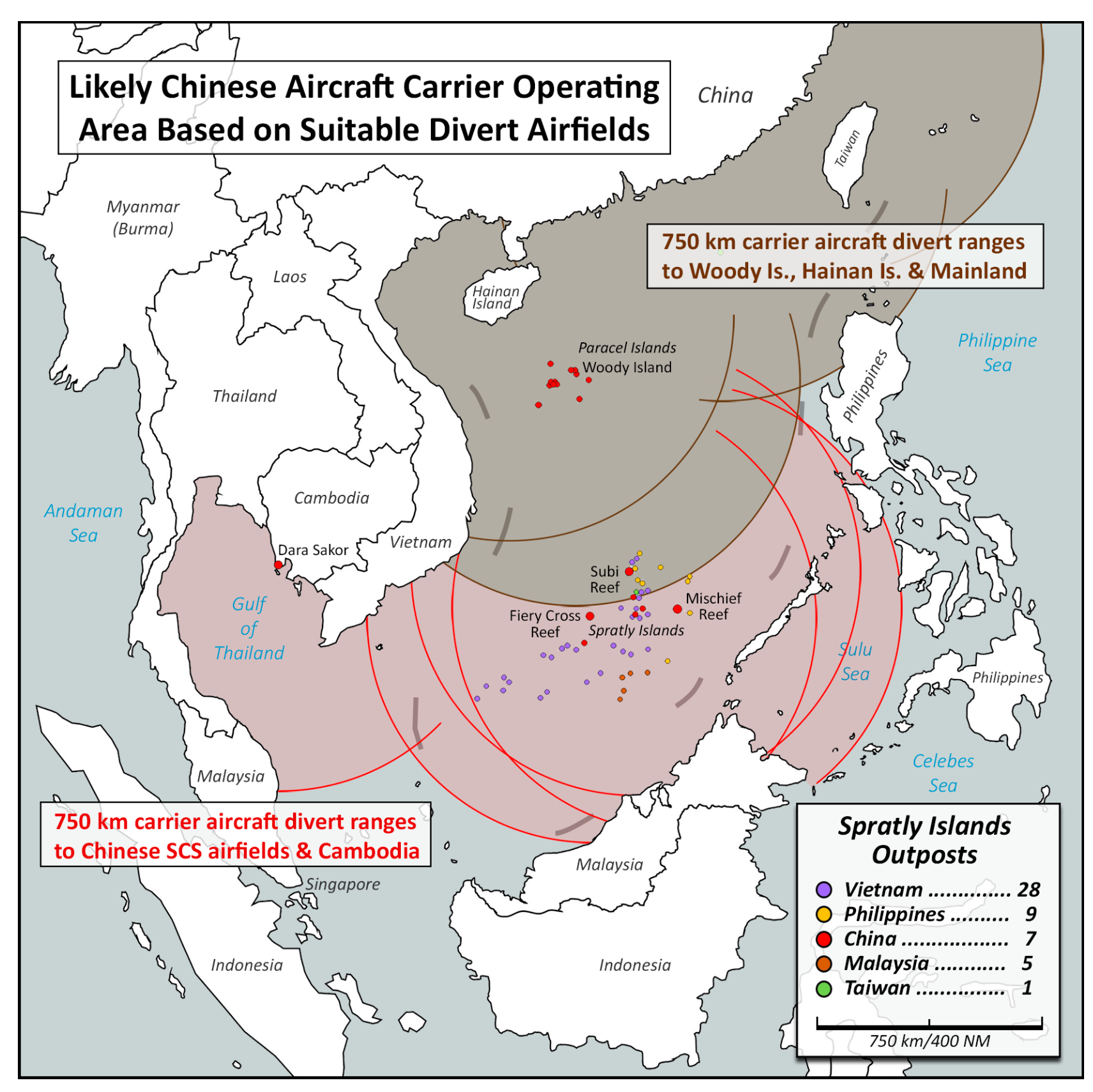
Chinese air force assets from the mainland with sufficient range to cover the entire region.
Buildup of islands and shoals into military installations all of which are believed to have vertical launch missiles and some able to support air operations (“unsinkable” aircraft carriers)
An extensive fleet of Coast Guard and maritime enforcement vessels, most armed.
All of the above bring to bear radar and other surveillance capability that results in an air and surface space that is hyper-monitored
Evidence that China has developed the Command, Control and Communications (C3) capability to integrate all into a well coordinated response.
Some Details. With the above being the executive summary, here are some of the details. A previous post, The 9-Dash Line, outlined the claims and counter-claims on islands and shoals in the CSC which are being methodically militarized.
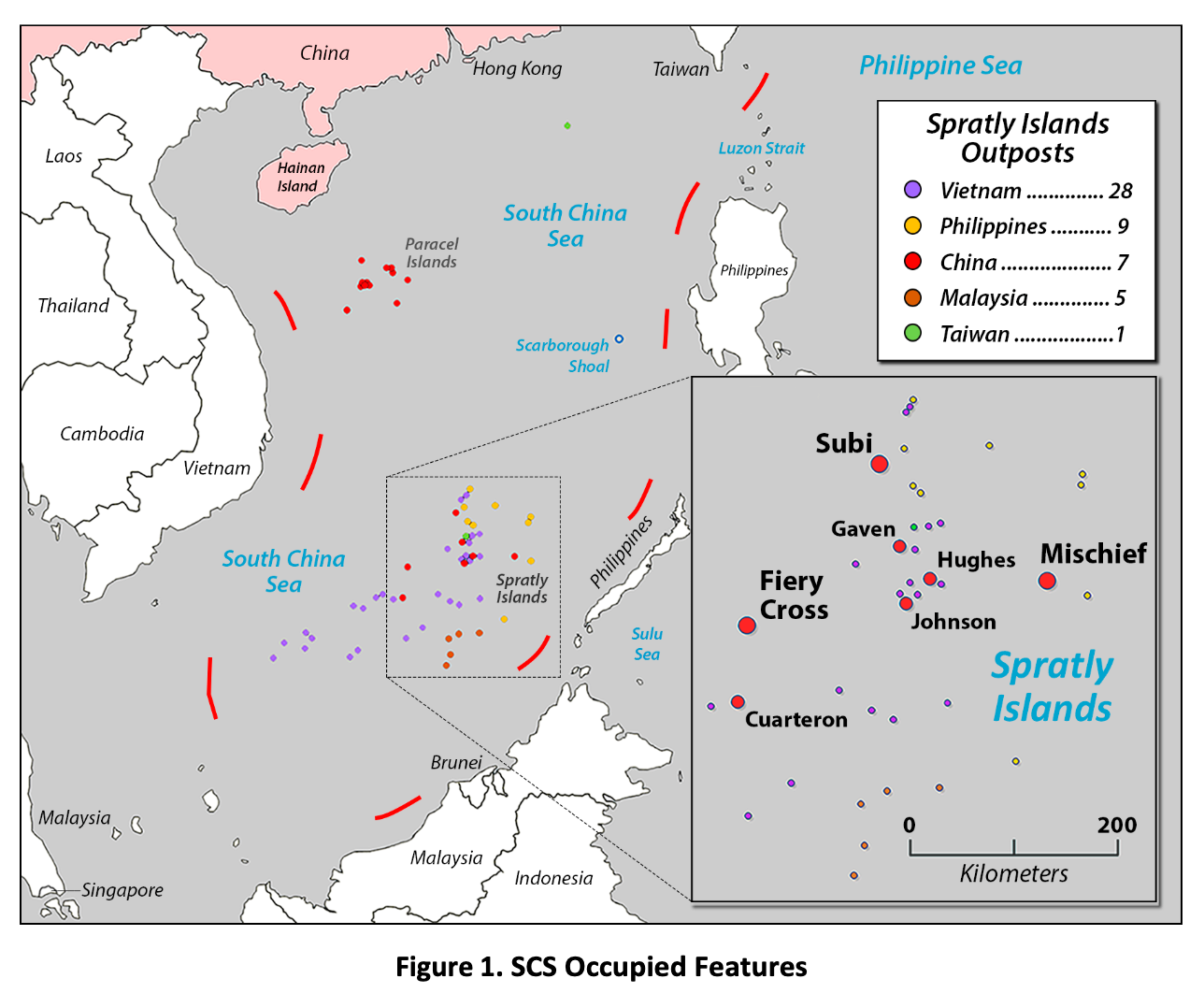
As mentioned in previous posts, China is not the only nation adding military capability to the SCS arena as seen in the above map.
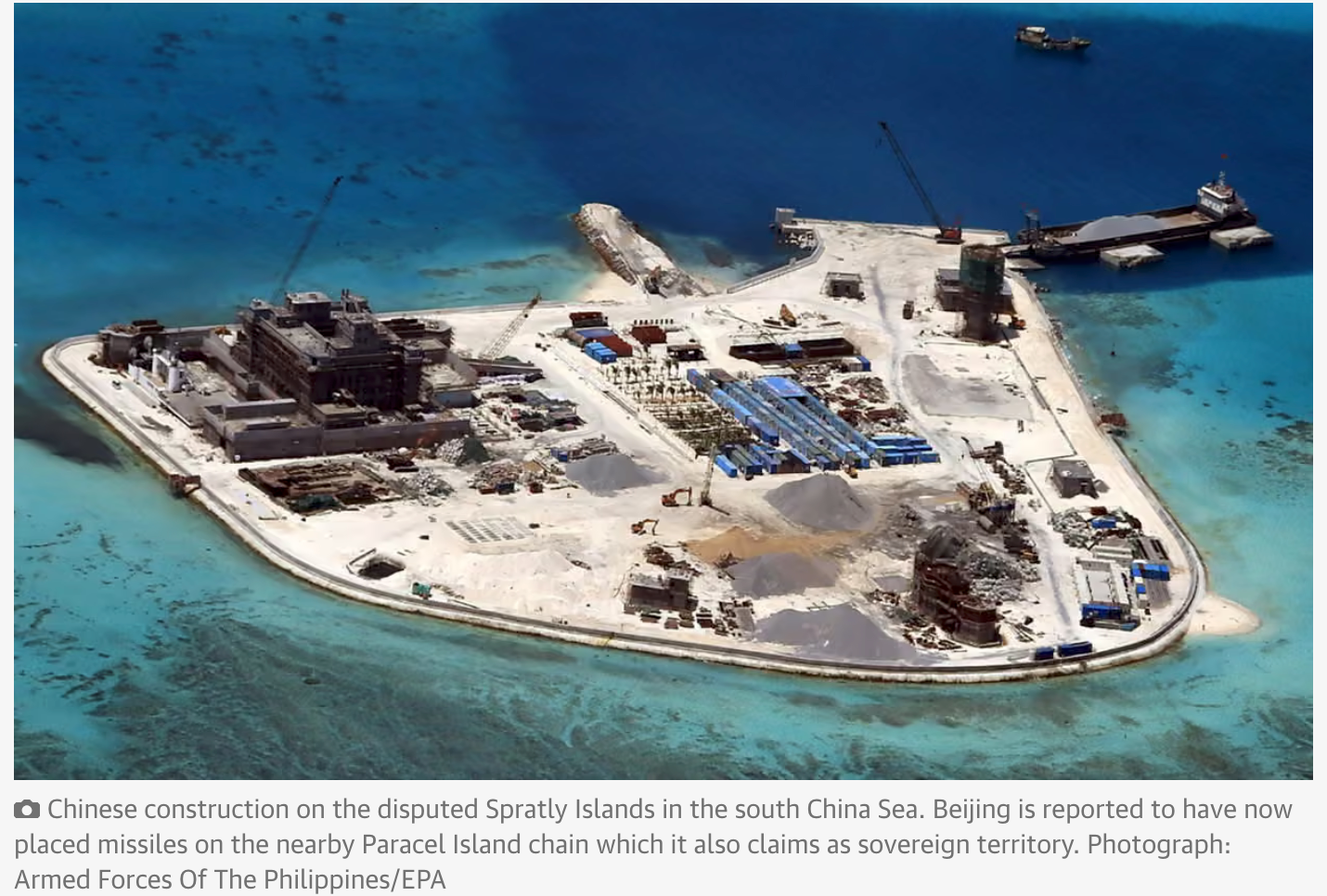
Spratly Islands: China has built up seven “islands”, with the most heavily developed being Subi Reef, Mischief Reef, and Fiery Cross Reef. These three feature significant airfields, missile shelters, and radar arrays – including YJ-62 and YJ-12B anti-ship cruise missiles
Paracel Islands: China controls about 20 outposts here, including Woody Island, which serves as a regional administrative and military hub. Since 2016, China has sent advanced HQ-9 surface-to-air missiles to the Paracel Islands. Woody Island frequently hosts H-6K nuclear-capable bombers, which are capable of launching missiles with range extending to Australia.
Scarborough Shoal: While no permanent structures have been built yet, China maintains a constant coast guard presence here to control the feature, according to the Center for Strategic and International Studies. Others are getting in on the trend of dredging and building island bases, especially Vietnam.
Military emplacements at Mischief Reef include advanced radar systems, missile storage facilities, and hangars for fighter planes. (Supplied: CSIS Asia Maritime Transparency Initiative/Maxar)
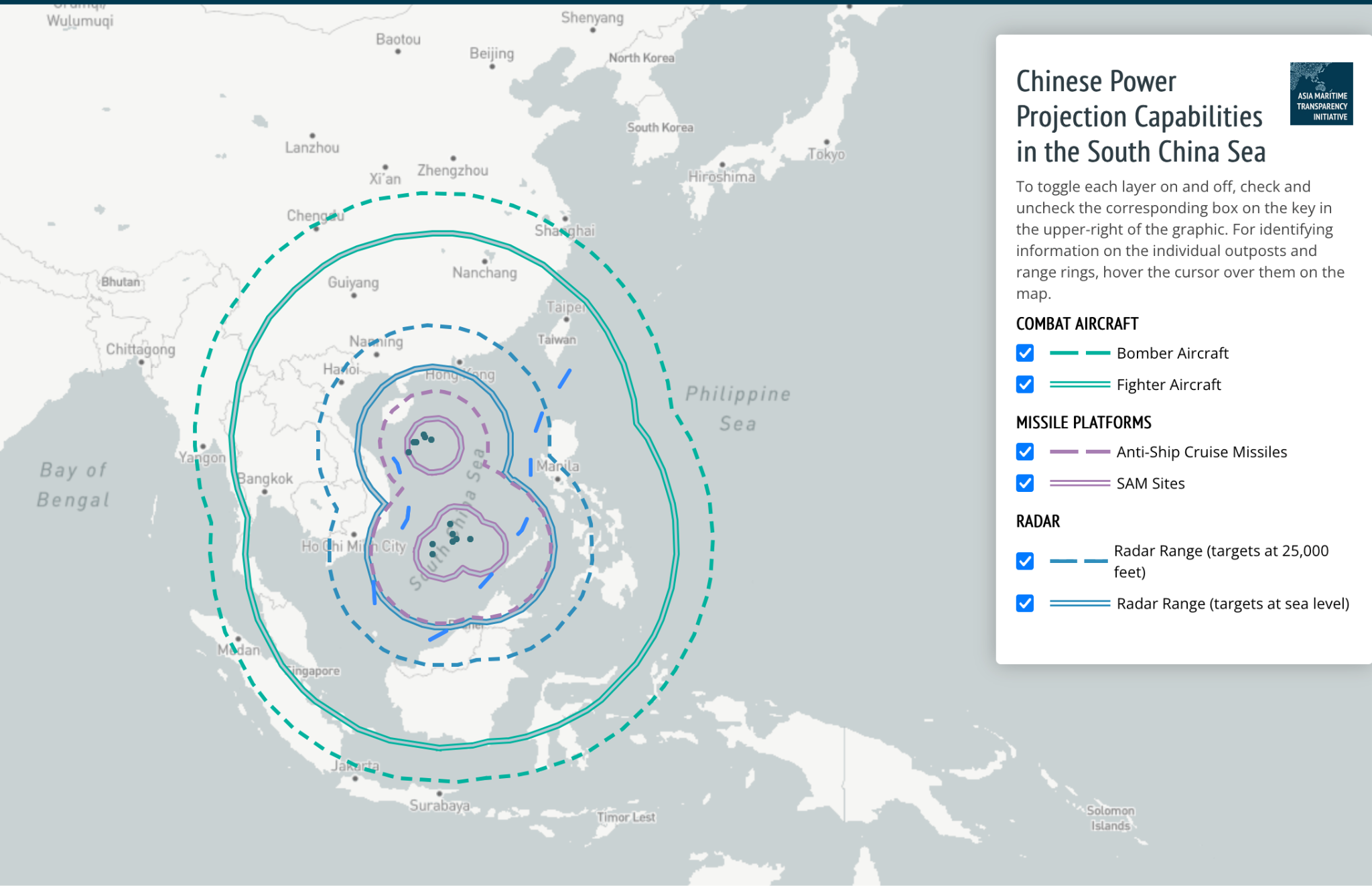
These installations, particularly on the “Big Three” reefs in the Spratlys (Fiery Cross, Subi, Mischief), allow China to project power deeper into Southeast Asia threatening maritime and air traffic. These deployments are part of an anti-access/area denial (A2/AD) strategy to contest US military presence in the region. The following image shows the ability of China to “project power” over the SCS area.
Even in the absence of a large-scale deployment of PLA weapons, the island-reefs have already been weaponized with significant information capabilities—command, control, communications, computers, intelligence, surveillance, and reconnaissance (C4ISR). When and if there is a large-scale deployment of weapons to the Chinese outposts, necessary conditions will have been established in the information domain. The island-reefs are equipped to provide the PLA with superior battlespace awareness and a decided information advantage in any future military conflict in the SCS.
Offensive and defensive strike capabilities on the island-reefs may best be described as “modular.” Infrastructure on the PLA outposts was built to accommodate close-in-weapons systems (CIWS), surface-to-air missiles (SAMs), surface-to-surface missiles (SSMs), large aircraft, fighter-sized aircraft, and helicopters. A vast majority of PLA weapons systems are road-mobile or relocatable. The major island-reefs—Fiery Cross, Subi, and Mischief Reefs—are large enough to accommodate virtually any mobile weapons system or aircraft in the PLA inventory. Delivered by ship or aircraft, future deployments of offensive or defensive lethal capabilities to the SCS island-reefs could occur with little or no warning.
China is currently engaged in a concerted effort to increase the PLAN’s capabilities in the undersea environment and perform acoustic reconnaissance from fixed arrays, ASW aircraft, and surface ships. However, even if the PLA Navy (PLAN) can detect an enemy submarine at long range, underwater weapons, such as torpedoes or depth charges, have very short ranges. Generally, once detected through acoustic or non-acoustic means, a submarine must still be localized by another submarine, a ship, or an ASW aircraft before that platform can prosecute the target with short-range underwater weapons.
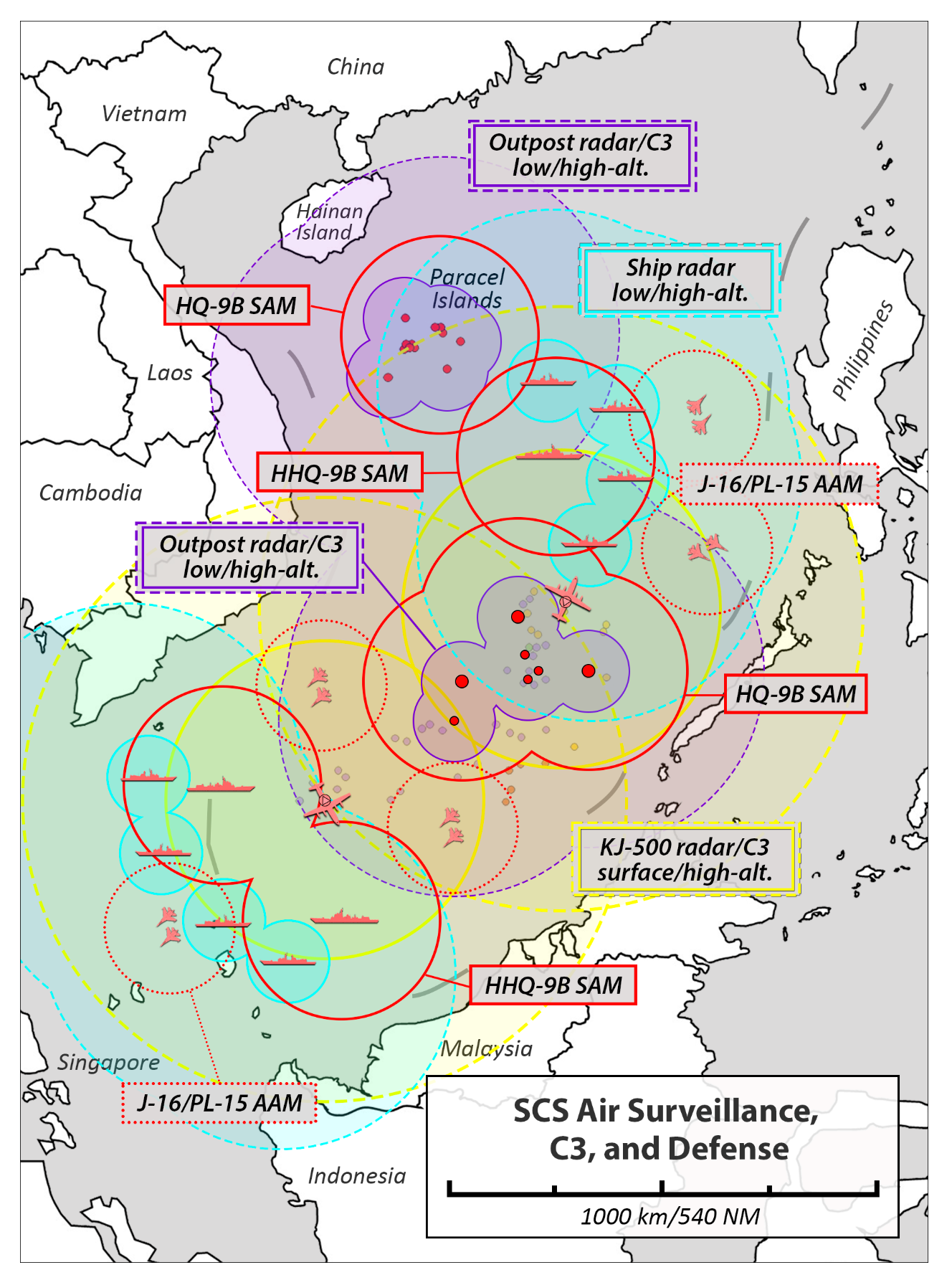
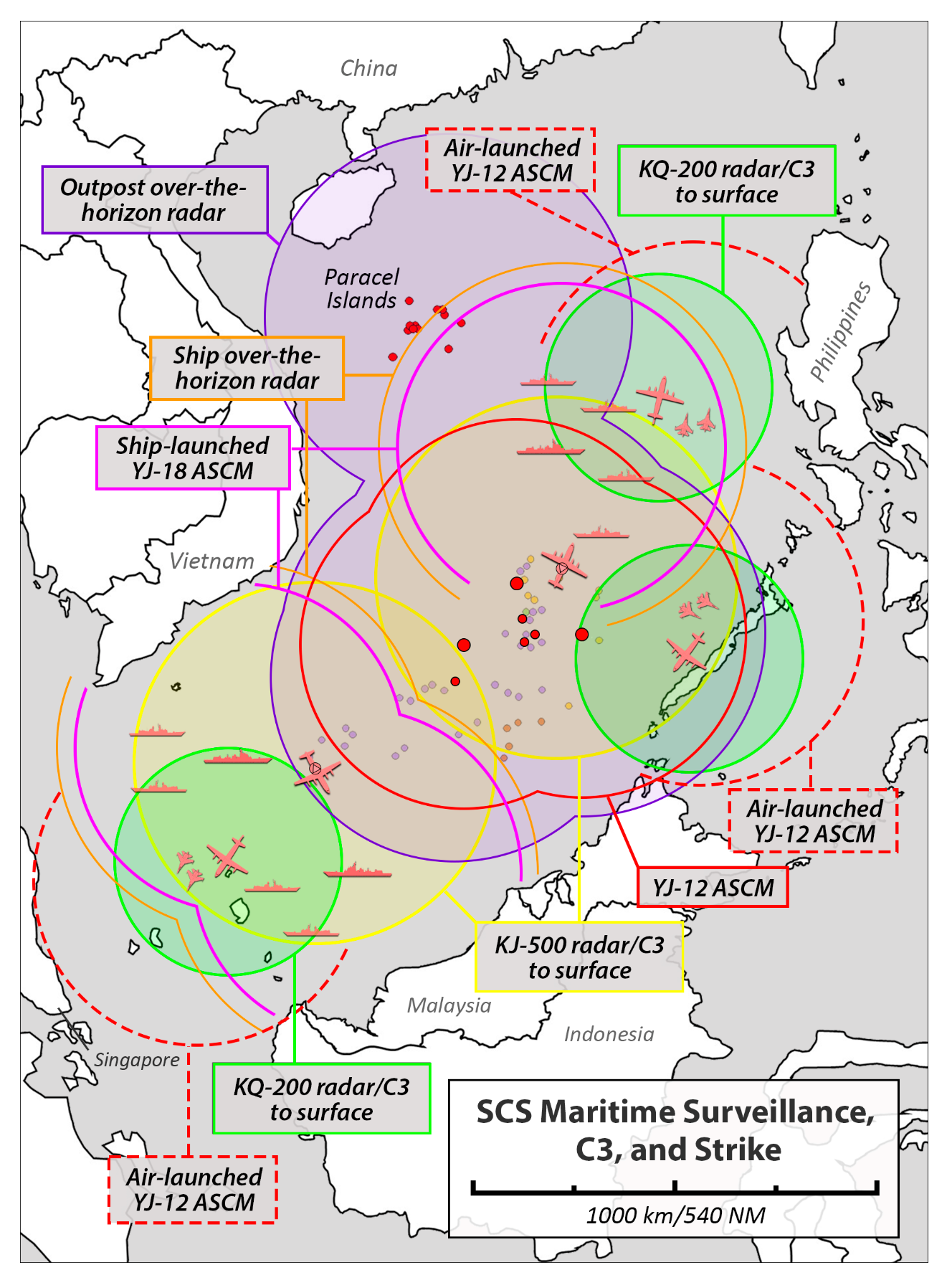
If a picture is worth a thousand words, the following images will give you an idea of the “threat environment” in the SCS:
Combat air coverage capability,
Depth of surveillance capability, and
Maritime strike capability.
The South China Sea is an “inland sea” over which China can exercise extensive anti-access/area denial (A2/AD) strategy to contest any foreign military presence in the region.
Today the Church Universal celebrates the feast of St. Charles Lwanga and the Ugandan martyrs. Likely you do not know much about him and the 21 people that were martyred along with him. Today’s celebration of St. Charles Lwanga and Ugandan martyrs is a major feast and holiday in East Africa. And a reminder to us that this truly is a church universal – katholica.
Lwanga was born in 1860 in Uganda. It was a time of Christian Missionary activity in a country that was still ruled by a tribal kings. Lwanga was born in the Kingdom of Buganda, the central and southern part of modern Uganda, and served as chief of the royal pages and later major-domo in the court of King Mwanga II of Buganda.
Christians were tolerated by the King Mutesa I, but his successor, Mwanga, launched a campaign against them. Mwanga was 18 years old at the time of his ascension to the throne. He believed that the Christian worldview undermined his authority. While the records are not clear, a major reason for his view was that the Christian court pages would not willing engage Mwanga in ritual sex. Mwanga first massacred the Anglican missionary bishop James Hannington and his colleagues in October 1885. Joseph Mukasa, an important member of the royal household and a Catholic, reproached the king for the massacre, and, on November 15 of that year. Mukasa was beheaded.
On May 25, 1886, the king called a court assembly in which he interrogated all present to see if any would renounce Christianity. Led by Lwanga, the royal pages declared their fidelity to their Catholic faith, upon which the king condemned them to death. Charles Lwanga was burned at the stake on June 3, 1886. He and the other 21 Catholic martyrs were canonized by Pope Paul VI in October 1964.
This coming Sunday is the Solemnity of the Body and Blood of Christ. In the previous posts in this series we have not yet commented on the verses that comprise the gospel. As noted earlier our verses (Jn 6:51-58) are part of the much larger Bread of Life Discourse (Jn 6:22-69). And so it is good to explore meaning in the verses that precede our gospel passage.
Jesus said to them, “I am the bread of life; whoever comes to me will never hunger, and whoever believes in me will never thirst. But I told you that although you have seen [me], you do not believe. Everything that the Father gives me will come to me, and I will not reject anyone who comes to me, because I came down from heaven not to do my own will but the will of the one who sent me. And this is the will of the one who sent me, that I should not lose anything of what he gave me, but that I should raise it [on] the last day. For this is the will of my Father, that everyone who sees the Son and believes in him may have eternal life, and I shall raise him [on] the last day.” (John 6:35-40)
In Jn 6:35-40 Jesus spells out the need of faith in himself, a faith that is an active movement of coming to him. The Jewish midrash literature identifies manna/bread as signifying the divine word or instruction – the memra. The Word was the means of the covenant, the means of salvation, the revelation of God, the agent of creation, and the same as God. Jesus clearly says that he is the Word made flesh and tells them of the rewards for those that believe. Much of the OT background for this discourse is found in the descriptions of the messianic banquet. In Jewish thought the joys of the messianic days are often pictured under the imagery of an intimate banquet with Yahweh or his Messiah. Is 55:1-3 echoes the command in Jn 6:27 not to work for perishable food and makes it clear that Yahweh’s invitation to eat is part of his promises to renew the covenant with David, and therefore a messianic banquet. The words of Is 55:3 – ‘Come to me heedfully, listen, that you may have life’ – are restated by Jesus, announcing that the banquet is at hand for those servants of Yahweh who believe in the one who Yahweh has sent.
In the following line Jesus says “But I told you that although you have seen [me], you do not believe”. The connection of these two passages recounts Amos 8:11-13 -‘Yes, days are coming, says the Lord God, when I will send famine upon the land: Not a famine of bread, or thirst for water, but for hearing the word of the Lord. They shall wander in…in search of the Word of the Lord, but they shall not find it.’ Israel has been given the opportunity to partake of the bread of life but has rejected it. In the closing lines of Jesus’ statement he clearly states that it is Jesus who mediates this divine life to believers and through whom we enter into a life giving communion with God, now and in eternity.
Like the people in the desert who refuse to believe Moses, In Jn 6:41-50, the crowd reject (‘murmured about him’) the bread from heaven. Afterall, the crowd knows his father and mother – how can he claim to come down from heaven? But Jesus does not let their lack of faith pass without comment. “Coming to” Jesus in faith is not only the will of the Father but it is also his work, for the Father draws believers to faith in Jesus. Consequently, to believe in Jesus is to be open to God. Moreover the prophets (Is 54:10-13 and Jer 31:33) had spoken of a new covenant when God would teach his people through a new law which would be more than an external message (‘I will place my law within them and write it upon their hearts’). In listening attentively to Jesus, one hears the Father for he is the source of the teachings of the Messiah. God then draws the believers to faith in Jesus in two ways: (a) through the message of Jesus and (b) as an interior teacher where he makes the message of Jesus an interior law of the heart.
Jesus restates his message in vv. 47-50 – he is the bread of life, without which there is no life.
“The heavens will be dissolved in flames and the elements melted by fire” (2 Peter 3:12). Yikes! That was a hard start to our first reading. To modern ears, the language sounds catastrophic, end of the world kind of stuff. “Frightening” would be a bit of an understatement. If we had not told you it was from 2 Peter you would have probably thought it was from Revelation.
Yet for Peter’s original audience, the passage was intended less as a threat than as a call to perseverance and hope. The letter is addressed to Christians who were growing weary because Christ had not returned as soon as they expected. Earlier in the chapter, Peter mentions scoffers who ask, “Where is the promise of his coming?” (3:4). Some were beginning to doubt whether God’s promises would ever be fulfilled. Peter responds in three ways:
First, God’s timetable is not ours. “The Lord does not delay his promise” (3:9). What seems like delay is actually divine patience. God is giving humanity time to repent. Just before our reading, Peter instructed the people that “With the Lord one day is like a thousand years and a thousand years like one day. The Lord does not delay his promise, as some regard delay, but he is patient with you, not wishing that any should perish but that all should come to repentance.” (2 Peter 3:8-9) Peter is likely echoing the psalmist: “A thousand years in your sight are as yesterday, now that it is past, or as a watch of the night.” (Ps 90:4)
Second, the present world is not ultimate. The imagery of fire is drawn from the Jewish prophetic tradition. Fire often symbolizes God’s judgment, purification, and renewal. Peter’s point is not to provide a scientific description of cosmic destruction but to proclaim that evil, injustice, and sin will not have the last word. The prophet Malachi writes: “He is like a refiner’s fire… He will sit refining and purifying silver.” (Malachi 3:2-3). A refiner does not throw silver into the furnace to destroy it. The fire burns away impurities so that the silver becomes what it was meant to be.
Third, Christians should live now according to the future God is preparing. Because believers await “new heavens and a new earth in which righteousness dwell” (3:13), they are called to holiness, peace, and steadfastness. The emphasis falls not on fear of destruction but on hope for renewal.
In our times we face a different challenge but a similar temptation. We often become discouraged when God’s kingdom seems slow to appear. Wars continue, injustice persists, and the Church itself experiences weakness and scandal. Like Peter’s audience, we can wonder whether God’s promises are really unfolding. Peter’s answer remains relevant:
God’s patience should not be mistaken for absence.
History is moving toward God’s purposes, even when we cannot see it.
Christians are called to live as citizens of the coming kingdom now.
The “new heavens and new earth” remind us that Christianity is not merely about escaping the world but about God’s intention to transform and renew creation.
There is an interesting contrast in the passage. Everything that appears permanent—the heavens, the earth, the structures of this world—will pass away. Yet the one thing that endures is what is rooted in God: faith, holiness, righteousness, and grace. Peter is essentially asking: If everything else is temporary, what kind of life is worth building? His answer comes at the end of the reading: “Grow in grace and in the knowledge of our Lord and Savior Jesus Christ” (3:18).
The Christian response to an uncertain future is neither fear nor speculation about the end times. It is growth in holiness, confidence in God’s promises, and faithful discipleship today. Things come and go, but we are called to keep our eyes fixed on the world God is bringing to birth.
Image credit: Created by ChapGPT, May 31 2026 | “The heavens will be dissolved in flames and the elements melted by fire” (2 Peter 3:12)
In the year 2024 China built more ships in their own yards – in one year – than the United States built, in total, since the end of World War II. At the end of that war the U.S. had approximately 11,000 logistic and auxiliary vessels – far, far more than we needed for peacetime. Post-war the surplus was sold or given to European allies to “jump start” their economies and shipyards. The same was done for Asian nations – including Japan. Today, China’s shipbuilding capacity is approximately 200 times that of the United States. That reflects the massive expansion of Chinese capacity and near extinction of a once great U.S. capacity. It wasn’t always that way.
This post walks the reader through the history of U.S. shipbuilding from the 1920s up until today. It describes the output as well as the supporting political action needed to build the needed war-time capacity for a two-ocean Navy. It does not take much to imagine the needed capital and political commitment to begin to restore U.S. shipbuilding.
U.S. Shipbuilding – a history
Following World War I and the Great Depression, America’s shipbuilding industry had severely atrophied. Between 1922 and 1937, U.S. shipyards produced almost no oceangoing dry cargo freighters. The few yards that did remain operational were mostly focused on occasional naval cruisers or tankers. In 1937, the United States possessed a mere 10 shipyards with the capacity to construct oceangoing vessels. However, by the conclusion of World War II in 1945, this industrial base had undergone a dramatic expansion, resulting in more than 80 major public and private shipyards operating nationwide to sustain the wartime fleet.
Between 1937 and 1945, U.S. shipyards produced a staggering total of over 14,000 major vessels, including approximately 5,200 large ocean-going merchant ships and nearly 9,000 naval combatants and major auxiliaries (excluding over 50,000 small landing craft).
Merchant and Cargo Fleet Production. Under the strategic direction of the U.S. Maritime Commission, the industry prioritized the production of commercial hulls essential to maintaining the global allied supply chain. This immense industrial effort yielded a total of 5,171 ocean-going merchant vessels, including:
Liberty Ships: A total of 2,710 built. These standard, mass-produced cargo vessels served as the indispensable backbone of allied wartime logistics.
Victory Ships: A total of 534 built. As faster and larger successors to the Liberty ship, these were designed to remain competitive in post-war merchant trade.
Standard Cargo Ships: approximately 700 built. These high-quality, turbine-driven vessels (comprising C1, C2, C3, and C4 designs) were utilized for both cargo transport and various military conversions.
Tankers: A total of 705 built. This figure includes 525 of the iconic T2 turbo-electric tankers, which were vital for the transport of fuel, oil, and aviation gasoline.
Minor/Specialized Merchant Hull Types: Approximately 522 built. This diverse category included refrigerated “Reefer” ships, Lakers, barges, and ocean-going tugboats.
Naval Combatant Production. The U.S. Navy underwent a historic expansion to become the most powerful fleet in human history, incorporating thousands of warships into its ranks. Major combat vessels constructed during this period included:
Aircraft Carriers (All Types): A total of 128 built. This included 22 fleet carriers (CVs), Light Carriers (CVLs) built on smaller hulls often converted from cruiser designs to rapidly put more flight decks into service and smaller escort carriers (CVEs or “jeep carriers”) converted from merchant hulls and primary used to transport aircraft from the U.S. to operating carriers or bases.
Battleships: A total of 8 built, representing the North Carolina, South Dakota, and Iowa classes. These served as fleet anti-craft platforms as well as shore bombardment ships.
Cruisers: A total of 48 built, including heavy (CA) and light cruisers (CL/CLAA). As the war in the Pacific progressed cruisers were part of the defence-in-depth screen for the aircraft carriers with enhanced anti-aircraft defense while still retaining surface combat capability.
Destroyers: A total of 352 built of which 175 were Fletcher class DDs that were the workhorse of fleet picket and anti-aircraft defence.
Destroyer Escorts: A total of 563 built. These were specialized anti-submarine warships tasked with convoy protection.
Submarines: A total of 203 built, primarily consisting of Gato, Balao, and Tench-class fleet submarines.
Auxiliary and Small Naval Craft. In addition to frontline combatants, American shipyards produced thousands of secondary and logistical naval hulls to support the fleet:
Frigates and Corvettes: Approximately 160 built, largely consisting of Tacoma-class patrol frigates.
Mine Warfare and Patrol Vessels: Over 2,500 built, including minesweepers, sub-chasers, and PT boats.
Amphibious Warfare Ships: Over 2,500 built, including large ocean-going amphibious vessels such as LSTs (Landing Ship, Tanks) and LSMs.
U.S. Shipbuilding Acts and Programs
The Roosevelt Administration was active as much as 8 years before the war. Early acts served dual purposes of economic stimulation during the Great Depression but also to keep the shipyards open and the skilled labor engaged.
Program / Act
Year
Core Objective
Key Combatant Impact
NIRA Executive Order
1933
Depression relief; initial modernization.
Funded USS Enterprise & Yorktown.
Vinson-Trammell Act
1934
Build up to maximum international treaty ceilings.
102 replacement warships (Cruisers/DDs/Subs).
Second Vinson Act
1938
20% expansion post-treaty collapse.
Shifted focus to Essex-class carriers & fast battleships.
11% Naval Expansion Act
1940
Emergency tonnage boost following the fall of France.
Accelerated fast carrier task force components.
Two-Ocean Navy Act
1940
70% fleet expansion; global naval dominance.
Laid down the massive fleet that fought from 1942–1945.
The point of this historical review is to show what was necessary in terms of supporting military operations at distances far from home ports – the dynamic that the U.S. faces in the Indo-China Region – an area that ranges from the Straits of Hormuz to the South China Sea.
U.S. Shipbuilding – 2026
At present, the United States maintains four public naval shipyards alongside approximately eight to nine active private facilities possessing the industrial capacity to construct large, deep-draft ocean-going merchant vessels or major naval combatants.
Public Naval Shipyards (4)
Operating under the direct supervision of the U.S. Navy via NAVSEA, these four public facilities are no longer utilized for new construction. Instead, their operations are dedicated exclusively to the intricate depot-level maintenance, refueling, and modernization of the fleet’s nuclear-powered aircraft carriers and submarines.
Norfolk Naval Shipyard (NNSY): Located in Portsmouth, VA, this yard manages the maintenance requirements for nuclear carriers and submarines.
Puget Sound Naval Shipyard & IMF (PSNS): Situated in Bremerton, WA, its primary focus remains nuclear vessel support and carrier maintenance.
Pearl Harbor Naval Shipyard & IMF (PHNSY): Positioned in Oahu, HI, this facility is strategically vital for Pacific Fleet submarine overhauls.
Portsmouth Naval Shipyard (PNSY): Located in Kittery, ME, this yard is specialized specifically in submarine modernization and overhaul.
Private Shipyards Capable of Large-Scale New Construction (8–9)
The defense industrial base relies on a highly consolidated group of private defense contractors—primarily dominated by General Dynamics and Huntington Ingalls Industries (HII)—alongside a limited number of commercial shipbuilders.
Naval Combatant Specialists. The following major yards are responsible for the construction of frontline combatants for the U.S. Navy and Coast Guard:
Newport News Shipbuilding: Located in Newport News, VA, this is the nation’s sole facility capable of constructing nuclear-powered aircraft carriers (the Gerald R. Ford class) and one of only two yards building nuclear-powered submarines.
General Dynamics Electric Boat: Situated in Groton, CT, this facility is dedicated exclusively to the design and construction of nuclear submarines, including the Virginia and Columbia classes.
General Dynamics Bath Iron Works: Located in Bath, ME, this yard primarily constructs surface combatants, with a focus on Arleigh Burke-class guided-missile destroyers.
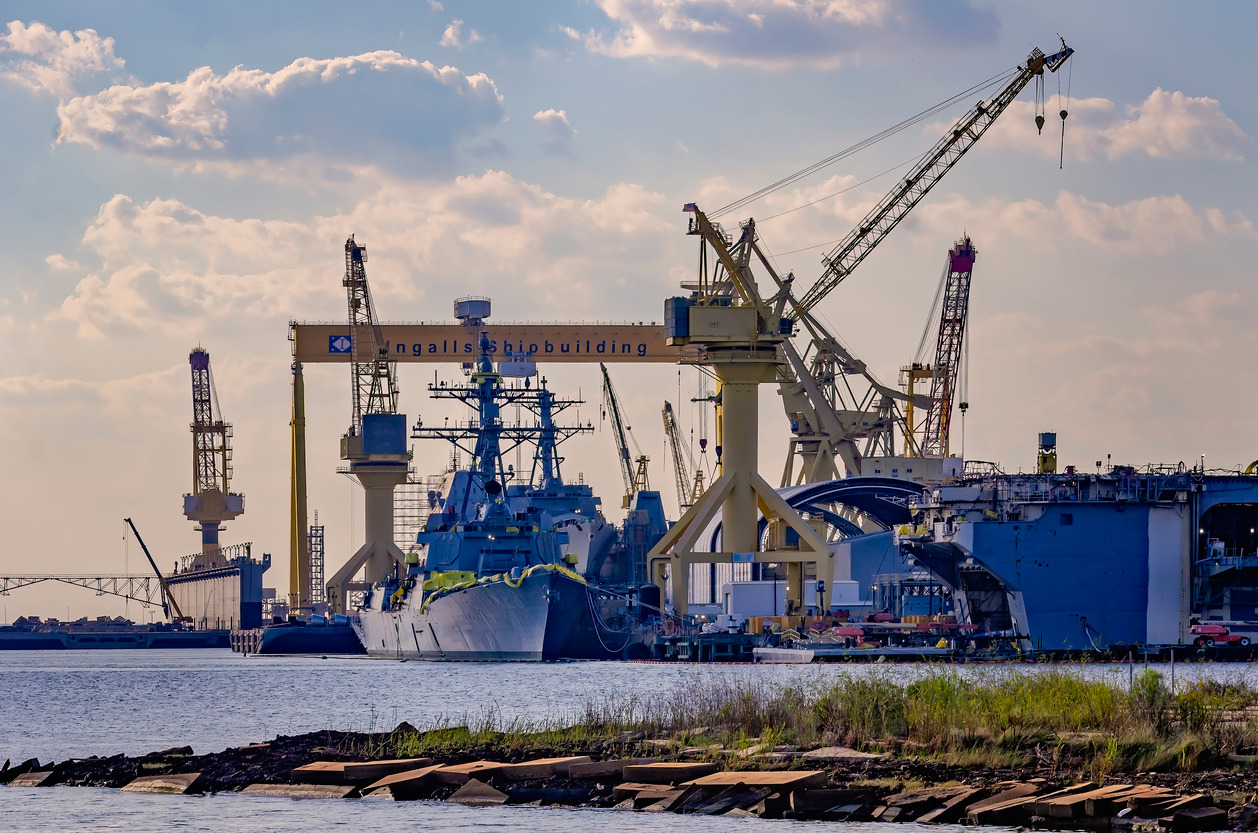
Ingalls Shipbuilding: Positioned in Pascagoula, MS, this yard builds amphibious assault ships, Arleigh Burke destroyers, and national security cutters for the U.S. Coast Guard.
Austal USA: Located in Mobile, AL, this facility specializes in aluminum and steel vessels, such as Littoral Combat Ships (LCS), expeditionary fast transports, and Coast Guard cutters.
Fincantieri Marinette Marine: Situated in Marinette, WI, this yard constructed the Freedom-class LCS and is currently tasked with the production of the Navy’s new Constellation-class guided-missile frigates.
Currently, the United States accounts for less than 1% of the world’s large commercial shipbuilding, producing only 3 to 5 deep-draft merchant vessels annually. As private builders are heavily optimized for the specific requirements of rigid naval contracts, the industry lacks the requisite “surge” capacity or infrastructure to absorb substantial merchant or naval losses during a prolonged geopolitical crisis.
Commercial Cargo & Dual-Use Yards
A select group of only two to three shipyards maintains the industrial infrastructure necessary for the construction of large, ocean-going commercial hulls. These facilities persist largely through the fulfillment of U.S. government auxiliary contracts, bridging the gap between civilian and military requirements.
General Dynamics NASSCO: San Diego, CA, this yard constructs large commercial product tankers and container ships while simultaneously producing Navy auxiliary supply ships, such as the T-AO fleet oilers.
Philly Shipyard: Philadelphia, PA, this facility has a historic record of building large commercial container ships and tankers; it was recently acquired by Hanwha Ocean of South Korea to support the production of national-security multi-mission vessels.
Keppel AmFELS: Brownsville, TX, this yard retains significant large-scale construction capability and occasionally delivers Jones Act-compliant commercial transport vessels to the domestic market.
The Hanwha Group and U.S. Shipbuilding
Hanwha Group has formally concluded its $100 million acquisition of Philly Shipyard, a transaction that signals a fundamental paradigm shift in the revitalization of the nation’s atrophied maritime industrial base through allied foreign investment. Prior to this landmark deal, the Philadelphia facility struggled with inconsistent order books, often delivering fewer than two vessels per year.
In a massive commitment to industrial modernization, Hanwha announced a $5 billion infrastructure plan dedicated to the comprehensive upgrade of the Philadelphia yard. This strategic capital injection will fund the construction of two additional dry docks, three quays, and a state-of-the-art block assembly facility. Through these enhancements, Hanwha aims to scale the yard’s industrial output from 1.5 ships annually to an unprecedented capacity of 10 to 20 vessels per year by 2035.
Central to this revitalization is the implementation of the “Smart Yard” concept, which integrates highly automated South Korean shipbuilding technologies—including robotic welding, automated inspections, and digital twin modeling—to address decades of stagnant productivity in American shipyards. Furthermore, the investment establishes a 36-month apprenticeship program designed to train over 1,000 new shipbuilders, ultimately supporting a workforce of up to 5,000 personnel in Pennsylvania.
This acquisition serves as the cornerstone of a broader $150 billion commitment by South Korea. Acknowledging that the United States lacks the organic capacity to match the industrial shipbuilding scale of China, Washington is increasingly viewing South Korea and Japan as vital industrial lifelines rather than mere trading partners.
While U.S. statutes historically prohibited the foreign construction of naval combatants, Hanwha’s strategy of acquiring and modernizing facilities on American soil effectively circumvents these restrictions while ensuring compliance with “Made in America” mandates. Consequently, the current administration has signaled that Hanwha will play an integral role in the future construction of Navy frigates and nuclear-powered submarines.
Current Initiatives
The administration has announced several major initiatives intended to rebuild and expand U.S. commercial and military shipbuilding capacity, largely in response to concerns about China’s dominance in maritime industry and naval production. The centerpiece is President Donald Trump’s April 2025 executive order, “Restoring America’s Maritime Dominance.” The administration directed multiple federal departments (Defense, Transportation, Commerce, Homeland Security, and Labor) to create a comprehensive strategy for rebuilding U.S. shipbuilding and merchant marine capability – a Maritime Action Plan (MAP). The February 2026-issued MAP focuses on expanding U.S. shipyard capacity, increasing the number of U.S.-built commercial ships, strengthening the maritime workforce, improving Navy and Coast Guard procurement efficiency, revitalizing the U.S.-flag merchant marine and rebuilding maritime supply chains.
Despite the ambitious rhetoric, significant obstacles remain.
U.S. shipyards lack large-scale commercial production capacity
Workforce shortages are severe
Shipbuilding costs in the U.S. remain far higher than in Asia
Many proposals require congressional appropriations
Rebuilding industrial supply chains may take a decade or longer
Some analysts have also questioned whether executive actions alone can reverse decades of industrial decline without sustained bipartisan funding and long-term policy continuity.
The Jones Act
The “Jones Act” is the common name for Section 27 of the Merchant Marine Act of 1920, a U.S. federal law governing domestic maritime commerce. The law requires that cargo transported between two U.S. ports must be carried on ships that are built in the U.S., owned by U.S. citizens or U.S. companies, registered (flagged) in the U.S. and crewed primarily by U.S. citizens or permanent residents. The law applies to “cabotage,” meaning domestic shipping between American ports, e.g.: Houston to New York, Los Angeles to Hawaii, Jacksonville to Puerto Rico, Seattle to Alaska, Long Beach to Guam.
The Jones Act was enacted after the First World War because the United States recognized that it lacked a sufficiently strong merchant marine and shipbuilding base to support wartime logistics. Congress concluded that the nation needed a domestic shipbuilding industry, a trained pool of mariners, and a reserve fleet that could support military mobilization – all national security issues. Many defense analysts, shipbuilders, labor unions, and maritime organizations argue that the Jones Act is essential for national security and industrial resilience. Critics argue that the Jones Act substantially increases shipping costs and contributes to inefficiency.
Military Sealift Command
The Military Sealift Command (MSC) is the primary organization responsible for strategic sealift, naval logistics, and ocean transportation for the United States military. It operates one of the world’s largest government-owned auxiliary fleets and is essential to sustaining U.S. global military operations.
MSC operates approximately 130 ships supported by roughly 5,000–5,500 civilian mariners supplemented by additional contract mariners and military personnel. MSC’s fleet is absolutely critical because it carries fuel, ammunition, vehicles, aircraft equipment, supplies, troops and general cargo. Without MSC, the U.S. military could not sustain large overseas operations.
MSC faces several serious challenges today. Many sealift ships are old, some average over 40 years in age which carries increasing maintenance costs as well as needed upgrades in navigation, communications, and security measures. Because of the diminished shipbuilding capability and budgetary constraints, the U.S. has struggled to replace ships quickly or at all.
The U.S. also faces shortages of qualified civilian mariners. Current assessments indicate that sustained wartime activation could exceed available crews. This issue is increasingly viewed as a national-security concern.
Potential conflict scenarios involving Taiwan or the western Pacific create enormous logistics challenges because of vast distances, missile threats, port vulnerability and limited sealift capacity.
This coming Sunday is the Solemnity of the Body and Blood of Christ. All the gospel writers describe the miracle of the fishes and loaves (Mk 6:33-46, Mt 14:13-23, Lk 9:10-17, and Jn 6:1-15). Through the dialogue that precedes and follows the miracle, Jesus teaches the disciples to trust in him whenever they meet with difficulties in their future apostolic endeavors. He teaches them that they should engage in using whatever resources they have even if they are clearly inadequate. He will supply what is lacking and underscores the meaning of the their continuing mission:
they are to nourish the people,
they will need God’s help in nourishing the people, and
their job is to distribute that which Christ provides.
In the account of the miracles, although Jesus orders the Apostles to feed the people, the main act is performed by Jesus alone. In a solemn, liturgical style, St John describes the scene as “Jesus then took the loaves, and when he had given thanks, he distributed them to those who were seated…” (Jn 6:11). Where the other gospels go on to describe more events, the fourth gospel pauses to theological reflect on the meaning of the miracle whose inner meaning is spelled out at length in Jn 6:25-59. These verses are known as the Bread of Life Discourse.
The best way to understand this discourse is to recognize that it centers on one biblical text, “He gave them bread from heaven to eat” (v. 31), and is therefore a conscious demonstration of the truth of 5:39, 46–47 that the Scriptures illuminate the person of Jesus. The pivotal text is an echo of many Old Testament verses:
Exod 16:4: “I will now rain down bread from heaven for you”;
Neh 9:15: “Food from heaven you gave them in their hunger”;
Ps 78:24: “He rained manna upon them for food and gave them heavenly bread”;
Ps 105:40: “ … and with bread from heaven he satisfied them.”
All of these verses are referring to the miracle of manna in the desert during the Exodus from Egypt. The first reading on Corpus Christi Sunday is taken from Dt 8 in which Moses reminds the people of what God had done for them: “…fed you with manna, a food unknown to you and your fathers, in order to show you that not by bread alone does one live, but by every word that comes forth from the mouth of the LORD.” (Dt 8:3)
This is a sign/miracle which discloses Jesus as the one who sustains us with his living word and with the gift of his own life in the Eucharistic bread. Not only the sign of the bread but also the reassuring words to the disciples, ‘It is I’ (John 6:20), along with the Christological ‘I am’ statements (vv. 25, 35, 41, 48-51), all draw our attention beyond the words of Jesus and beyond the Eucharist itself to the person of Jesus who communicated his life-giving power through them. For St. John, the point of this scene is that Jesus is the Moses-like prophet who feeds his people with a new bread. This new bread is Jesus’ word of revelation received in faith as well as his Eucharistic bread. But the crowd’s understanding is clouded by their messianic expectations because their hopes are tainted with politics and power. They do not see the spiritual nature of the messianic kingdom; only the outward signs.
The discourse is interrupted four times by dialogue from/within the audience. Lifted from the text and placed in order of occurrence it is easy to see the shifting reaction of the audience as their messianic expectations are not being met.
So they said to him, “What sign can you do, that we may see and believe in you? What can you do? Our ancestors ate manna in the desert, as it is written ‘He gave them bread from heaven to eat.’” (John 6:30-31)
So they said to him, “Sir, give us this bread always.” (John 6:34)
The Jews murmured about him because he said, “I am the bread that came down from heaven,” and they said, “Is this not Jesus, the son of Joseph? Do we not know his father and mother? Then how can he say, ‘I have come down from heaven’?” (John 6:41-42)
The Jews quarreled among themselves, saying, “How can this man give us [his] flesh to eat?” (John 6:52)
In Jn 6:4 we are told that the Passover was at hand. After that St John has little to directly say about the Passover and its relation to the Bread of Life Discourse. Many Catholic scholars believe that St John’s writing assumes that the reader is familiar with the synoptic Gospels. Consequently, St John does not recount the story of Jesus, rather, St John gives the theological perspective. Whereas the synoptic writers recount the Eucharistic institution in their Gospels, St John provides the theological basis for the event. Where the synoptic writers place their accounts in the proper historical setting, the Passover feast; St John provides the explanations in a different setting, following the miracle of the feeding of the 5,000. In this way he shows the prefiguring of Holy Eucharist in the OT via the Exodus account, as well as an immediate prefiguring here at another Passover.
But St John did not simply use the Passover setting as a backdrop. There is some evidence that in St John’s telling of the story he has captured very strong parallels to the Passover feast, just as in the Last Supper. In the Passover liturgy four children ask questions about what is enacted by the celebration. These questions have parallels in questions that the crowd asks of Jesus. The first question of the meal is about the works of God. The second question regards passages in Scripture. The mocking question in vv.41-42 is equated with the third question posed at the meal by the ‘wicked child’. The ‘sincere child’ asks the fourth question supposed to be a practical question paralleled in v.52.
In today’s first reading we are given a goal: “that you may come to share in the divine nature” (2 Peter 1:4). Wow! This is one of the most profound statements in the entire New Testament. It has played a central role in Christian theology, especially in the Eastern Christian tradition, where it is often called theosis or divinization. But the first thing to note is what Peter does not mean. He does not mean that human beings become gods by nature, cease to be creatures, or somehow merge into God’s essence. The distinction between Creator and creature remains. Yet Peter is saying something astonishingly positive: through Christ, human beings are invited into a real participation in God’s own life.
The fuller verse reads: “He has bestowed on us the precious and very great promises, so that through them you may come to share in the divine nature, after escaping from the corruption that is in the world because of evil desire.” Notice the contrast: corruption versus divine life, sin versus holiness, and death versus immortality. Peter is describing the restoration of humanity to the destiny God intended from the beginning. Human beings were created in God’s image (Genesis 1:26-27). Through Christ, that image is renewed and brought to fulfillment.
A helpful parallel is found in John’s Gospel: “To those who did accept him he gave power to become children of God” (John 1:12). And in Paul’s letters: “All of us… are being transformed into the same image from glory to glory” (2 Corinthians 3:18). The New Testament consistently teaches that salvation is not merely forgiveness of sins; it is participation in God’s own life.
The early Christian writers were remarkably bold in describing this mystery. Irenaeus of Lyons emphasized that Christ became what we are so that we might become what God intended us to be. He wrote: “The Word of God, our Lord Jesus Christ … became what we are, that He might bring us to be even what He is.” For Irenaeus, salvation is the restoration and completion of humanity.
Perhaps the most famous statement comes from Athanasius: “God became man so that man might become god.” This phrase can sound startling today, but Athanasius was not teaching that humans become divine beings independent of God. He meant that through union with Christ we share by grace what belongs to God by nature: immortality, holiness, righteousness, and communion with the Father.
Gregory of Nazianzus taught: “Let us become like Christ, since Christ became like us.” The Christian life is a process of transformation into Christ’s likeness. Augustine of Hippo also embraced this theme: “God became man, that man might become God.” For Augustine, participation in God means being drawn into the life of the Trinity through grace, not becoming divine in essence.
For Peter, sharing in the divine nature is not an abstract mystical concept. Immediately after this verse he lists virtues that should grow in the believer: faith, virtue, knowledge, self-control, endurance, godliness, mutual affection and love. The evidence of participation in God’s life is that a person increasingly reflects God’s character. One might say since God is love, holy, merciful, and faithful, then we are called to become those same things. The goal is not becoming less human but becoming fully human as God intended.
The Church Fathers provide a useful image: a piece of iron placed into a blazing fire. The iron remains iron. It does not become fire by nature. Yet it becomes glowing, radiant, and hot because it participates in the fire. So too, the Christian remains fully human. Yet through Christ, the sacraments, prayer, and the Holy Spirit, the believer becomes filled with the very life of God.
That is the astonishing promise Peter holds before his readers: salvation is not merely being rescued from something; it is being drawn into communion with God Himself, sharing by grace in what God is by nature. That is what Peter means by “share[ing] in the divine nature.”
Image credit: Created by ChapGPT, May 31 2026 | “Iron being heated and glowing in fire”
Opposed amphibious landings are difficult to say the least. Later this week we will remember the Normandy landings of June 6, 1944 which were, and remains, the largest amphibious invasion in history. The Allied Forces under the central command of General Dwight D. Eisenhower deployed nearly 7,000 naval vessels, over 11,000 aircraft, and enormous logistical support systems. The naval force included battleships, cruisers, destroyers, troop transports, and specialized landing craft. Over the course of the day more than 165,000 troops landed at five different beaches. Resistance ranged from intense at Omaha Beach to minimal at Utah Beach. This was made possible by complete domination of the sea and air – and a massive prepared logistic system in support from D-Day onward.
An opposed amphibious landing by China against Taiwan will be on the same order of magnitude. – and the Chinese have been practicing in plain sight for more than a decade.
This post describes the World War II logistic efforts to give the reader a sense of scope and complexity. The post goes on to describe China’s preparation for a potential amphibious landing. There are parallels to Normandy and there are massive differences.
D-Day at Normandy.
The landings were successful and then the logistic war needed to be won. The 165,000 soldiers needed to be resupplied with food, ammunition, and replacement soldiers. Heavy equipment such as artillery, tanks, trucks, etc. needed to be brought ashore. The inventory of what was needed to supply this massive invasion force is epic – and there were no ports, piers, heavy lift cranes/capacity and all the equipment that make up modern harbors. The Allies needed BYOH – bring your own harbors. And that is exactly what they did: the Mulberry Harbors.
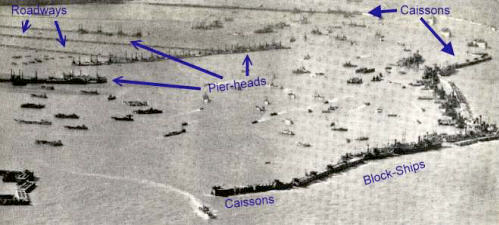
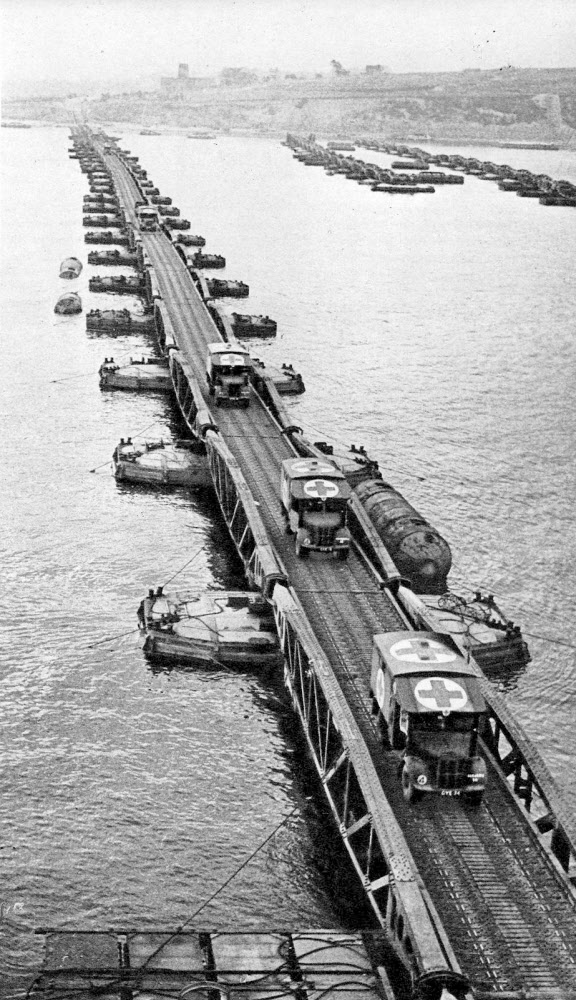
Mulberry harbours were two massive, prefabricated portable harbours designed by the British in World War II to supply Allied forces on the open beaches of Normandy immediately following the D-Day landings. Components were built in the UK in great secrecy and towed across the English Channel, featuring breakwaters made of concrete caissons and sunken ships to combat storms and the harsh seas of the English Channel. Within the breakwaters the Mulberrys featured floating roadways supported by pontoons connected to massive floating pierheads that adjusted to the tidal changes.
Normandy Mulberry Harbor and a Roadway
The vastness of the operation and the absolute necessity to move men, supplies, munitions and equipment to the right place at the right time are way beyond the logistics faced by the largest supermarket chains. It has been calculated that each soldier needed 6.5lb per day to sustain him in the field. On this basis the initial landing force needed 1,072,500 lbs per day – and that was just the initial landing force. As the size of the invading force grew, so did the daily demand for supplies. In addition, there were trucks, tanks, artillery pieces, ammunition, military field hospitals, mobile radar and communications units etc, etc. all of which had to be transported across the English Channel. More than 4,000 ships operated daily to provide the supplies.
Mulberry A at Omaha was destroyed by a massive English Channel storm 2 weeks after the landings. Mulberry B was used until the ports of Cherbourg and Antwerp became available.
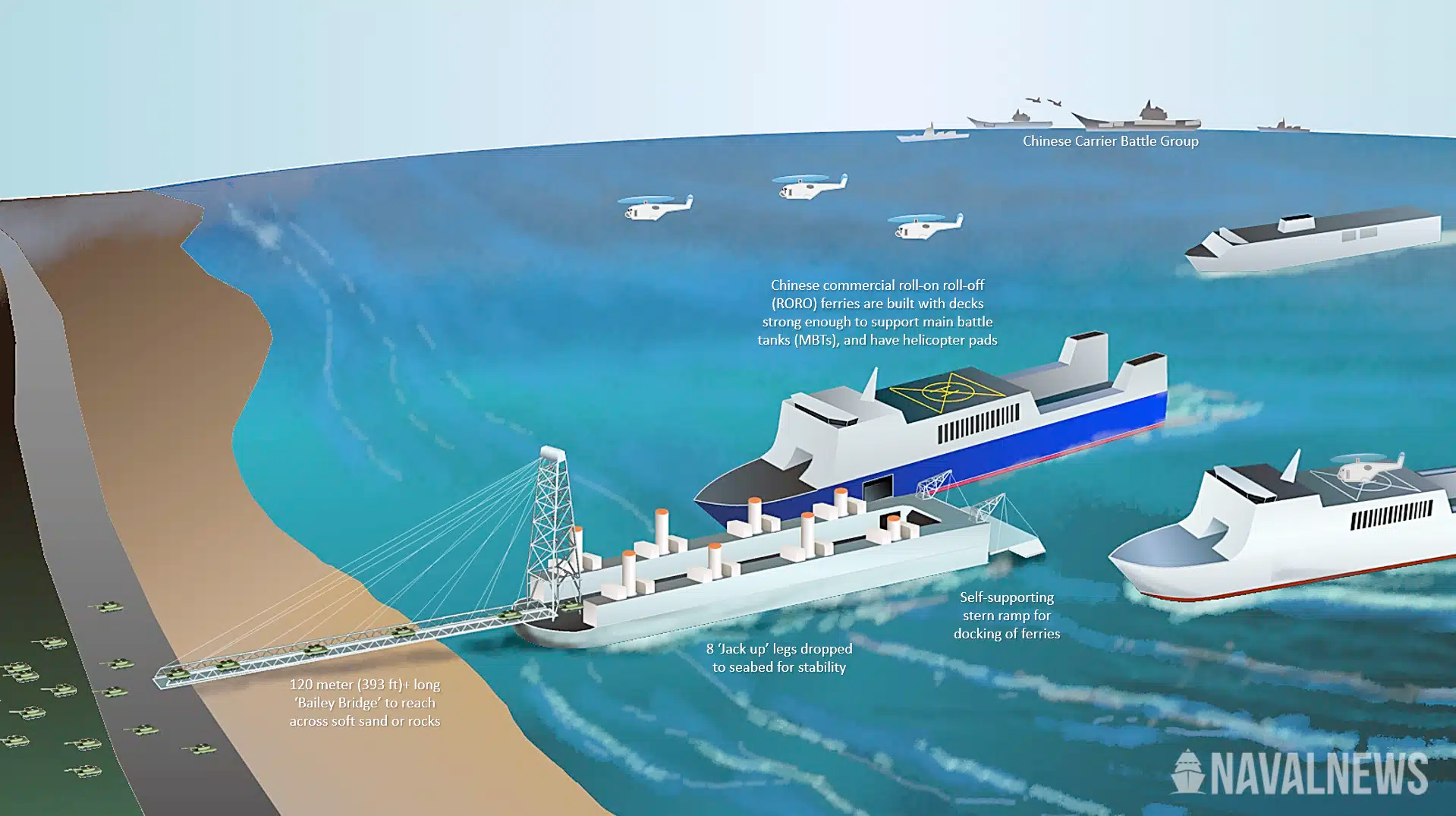
Anyone wondering what an invasion of Taiwan might look like now has a fresh visual clue. Defence analysts watching Chinese shipyards have noticed an increase in a particular type of vessel. China has rapidly developed specialized large-scale landing platforms, known as Shuiqiao-class barges (Type 071or Landing Platform Utility – LPU), designed for an invasion of Taiwan. Sighted in early 2025, these vessels can connect in strings of three, totaling over 820 meters (2,690 ft) in length to create massive temporary, floating piers for landing tanks and heavy military equipment directly on beaches. In the picture below, the orange capped vertical appendages are jack-up legs that extend down to anchor on the bottom specifically for stability against tides and currents as it lifts up the craft at the same time. These self-propelled landing platform utility (LPU) barges have telescoping Bailey bridges that produce a relocatable pier. There is no obvious commercial use case for these vessels. They are rather dedicated platforms for landing on beaches to deliver high volumes of wheeled and tracked military vehicles, together with associated personnel and material.
China has modified large commercial civilian roll-on/roll-off ferries to transport troops and armored vehicles to the beaches. The Shuiqiao barges will likely serve as landing platforms for these vehicles.
This article draws on the leading extant analysis, published by J. Michael Dahm and Thomas Shugart through the Naval War College’s China Maritime Studies Institute (CMSI)
Shuiqiao LPU, like the PLA-controlled ferries that would feed military vehicles through them, are not designed to be used during the initial assault phase against an opposing force, but rather as logistics support for second reinforcements. Like the Mulberrys, because of their vulnerability, they would be best employed only after a beachhead lodgment has been secured, in locations where the PLA Army and/or Marines already had solid, if not complete, control. To land the Shuiqiaos at an acceptable risk of loss, China’s military forces would first have to suppress Taiwanese defenders’ indirect and direct fire systems.
Expanded Amphibious Warfare Exercises
In August 2025, the People’s Liberation Army (PLA) troop and naval units conducted a large-scale exercise to simulate an invasion of Taiwan. This “capstone” amphibious exercise suggests that PL training and preparations for a future Taiwan campaign are becoming more focused, realistic, and sophisticated. The following information is taken a U.S. Naval War College China Maritime Report #52: Everything Everywhere All At Once: The Growing Complexity of PLA Amphibious Exercises.
“There has been much public discussion in recent years surrounding the PLA’s amphibious transport “gap” and China’s supposed inability to sustain a large-scale amphibious invasion of Taiwan. This discourse seems to have ignored the Chinese Communist Party’s decades-long strategy to obscure, obfuscate, and otherwise minimize its military intent and operational capabilities, hiding them from both the Chinese public and the international community. Satellite imagery reveals that in August 2025, the PLA executed a large-scale “capstone” amphibious exercise along China’s southeastern coastline, rehearsing an invasion of Taiwan. This exercise suggests that PLA training and preparations for a future Taiwan campaign are becoming more focused and sophisticated.”
Main Findings
The exercise consolidated elements from previous years into a single simulated operation. It integrated a floating causeway system, anti-landing barriers and obstacles, and amphibious Landing Craft Tank (LCT) vessels that landed forces directly onto beachheads.
For the first time observed, the PLA conducted a phased exercise with simultaneous amphibious landings in three distinct locations. Exercise areas incorporated civilian aquaculture obstacles like those expected to be found along Taiwan’s coastline, increasing environmental and tactical realism.
The exercise occurred at simulated “landing locations” opposite Taiwan, particularly within the Zhangzhou-Xiamen-Quanzhou littoral zone. The locations were distributed at distance intervals comparable to likely wartime beachheads along Taiwan’s western coastline. The total distance between discrete exercise locations was approximately 360 kilometers, roughly the distance between Taipei and Kaohsiung.
Not merely hypothetical in nature, the exercise reflected a specific geographical and operational focus. It appears to be part of a larger trend whereby the PLA is mapping its exercises onto analogous geography that reflects envisioned targets.
Future research should explore the potential applications and implications of PLA efforts to train with similar distances and geometries as would be found in prospective conflict zones.
Starting this summer, observers should scrutinize future capstone amphibious exercises to better understand the PLA’s strengths, weaknesses, and underlying operational assumptions.
Overall, the 2025 capstone exercise demonstrated meaningful progress toward the PLA’s ability to coordinate large-scale, dispersed amphibious operations using civil-military assets. The PLA probably leverages commercial, dual-use vessels to minimize its military logistics “signature” and can be expected to muster invasion forces in multifarious civilian ports. By intentionally blurring the line between civilian and military activity, the PLA raises uncertainty and increases the cost and effort of U.S. and Taiwanese monitoring, requiring additional sensors and analysts to interpret activity. The deployment of dual-use vessels obfuscates the PLA’s intentions, reduces indications and warning, and minimizes the amount of “executive decision time” available to non-PRC military and civilian officials prior to conflict, thus maximizing the probability of surprise.
The exercises also reinforce a broader trend: China is steadily moving from a coastal-defense navy toward a force capable of large-scale joint expeditionary and amphibious operations supported by immense commercial sealift capacity and rapidly expanding naval shipbuilding.
Operationally, the exercise makes sense within current PLA doctrine. Chinese planners increasingly appear interested in:
distributed amphibious entry points,
seizure of ports and airfields,
vertical helicopter envelopment,
and rapid inland penetration rather than a purely linear Normandy-style beach assault.
Multiple simultaneous landing zones could:
dilute Taiwanese defensive concentration,
create confusion about the main effort, and
accelerate operational collapse if successful.
The four-location concept is particularly notable because it suggests the PLA is practicing operational dispersion and synchronization at scale. Such operations would require:
advanced command-and-control,
very large amphibious logistics capacity,
secure communications,
coordinated naval and air cover,
and the ability to sustain forces ashore rapidly after initial landings.
It also highlights the importance of China’s growing fleet of Type 071 amphibious transport docks, Type 075 amphibious assault ship vessels, civilian roll-on/roll-off ferries, and large commercial sealift assets developed under China’s military-civil fusion strategy.
A closing thought
“Amphibious operations are among the most complex in modern warfare. They require effective command and control to synchronize an almost endless number of subcomponents into an effective whole. By increasing its flexibility and proficiency across relevant skill sets over time, the PLA is increasing the likelihood that it views (or will soon come to view) its ability to conduct a successful amphibious invasion of Taiwan as a viable option. The 2025 capstone exercise was conducted along the Zhangzhou-Xiamen-Quanzhou corridor, which closely matched the scale, spacing, and distances of plausible Taiwan invasion beachheads. Approximately 360 kilometers separated operational nodes in the exercise—comparable to the full north-south span of Taiwan’s western coastline. This scenario-specific rehearsal suggests the PLA is aligning its exercise designs with envisioned operational objectives, using geography and scale to refine campaign execution and facilitate its potential real-world application.” (CSMI Report #52)