John L. Allen, Jr. , Boston Globe and Cruxnow.com
Easter is my favorite holiday, not only because it recalls the central event in the Christian account of salvation history, meaning Christ rising from the dead, but also because it coincides with baseball’s Opening Day.
A few years ago I published a list of nine reasons – with the number, obviously, chosen to represent the innings in a typical game – why Catholicism is to religion what baseball is to sports. In honor of first pitch this year, here’s the list again:
- Both baseball and Catholicism venerate the past. Both cherish the memories of a Communion of Saints, including popular shrines and holy cards.
- Both feature obscure rules that make sense only to initiates. (Think the infield fly rule for baseball fans and the Pauline privilege for Catholics.)
- Both have a keen sense of ritual, in which pace is critically important. (As a footnote, that’s why basketball is more akin to Pentecostalism, since both are breathless affairs premised largely on ecstatic experience. I’d go into why football is pagan, but that’s a different conversation.)
- Both baseball and Catholicism generate oceans of statistics, arcana, and lore. For entry-level examples, try: Who has the highest lifetime batting average, with a minimum of 1,000 at-bats? (Ty Cobb). Which popes had the longest and the shortest reigns? (Pius IX and Urban VII).
- In both baseball and Catholicism, you can dip in and out, but for serious devotees, the liturgy is a daily affair.
- Both are global games especially big in Latin America. The Detroit Tigers are thought to have one of the most potent batting orders in baseball, featuring two Venezuelans, a Cuban, and six Americans of diverse ethnic backgrounds. Take a look at the presbyterates in many American dioceses, and the mix isn’t that different.
- Both baseball and Catholicism have been badly tainted by scandal, with the legacies of erstwhile superstars utterly ruined. Yet both have proved surprisingly resilient – perhaps demonstrating that the game is great enough to survive even the best efforts of those in charge at any given moment to ruin it.
- Both have a complex farm system, and fans love to speculate about who the next hot commodity will be in “The Show.”
- Both reward patience. If you’re the kind of person who needs immediate results, neither baseball nor Catholicism is really your game.
I threw in a bonus item, which was my argument as to why the American League is actually more Catholic because it permits a designated hitter. The National League’s refusal, I contended, smacks of a quasi-Calvinist fundamentalism, while the American League better embodies what Cardinal John Henry Newman once called the development of doctrine.
I conceded the irony that both the Padres and the Cardinals play in the more “Protestant” National League, which was seized upon by Catholic critics who found my case for the designated hitter almost heretical. I’m not sure I’ve ever written anything else that generated quite as much blowback.

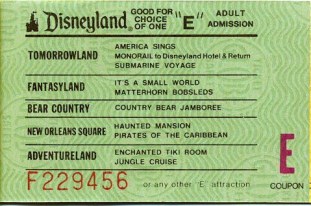 I don’t keep up with Disney World prices and perks, so what I am about to offer might be dated. The “we are all here together” days of Disney have long since faded into history. When the park first opened you received a booklet of tickets with your entry fee. If I recall you received two each of “A’ through “E” tickets, with “E” providing access to the post popular rides (e.g. Space Mountain – although I think that came later…). “A” tickets would garner a whirl on Dumbo’s ride. The gates were opened, you lined up on a first-come, first-served basis, and enjoyed the day.
  friarmusings