
 James Carville, the Ragin’ Cajun, is an American political consultant and author who has strategized for candidates for public office. Carville gained national attention for his work as the lead strategist of the Bill Clinton presidential campaign. Also interesting is that he is married to Mary Matalin, an American political consultant well known for her work with the Republican Party. They don’t talk politics at home. Continue reading
Vocations: Founder and Friars
1
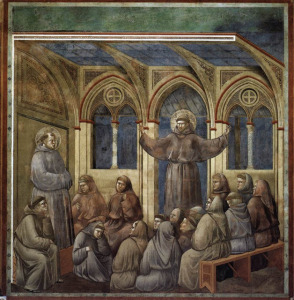 In the early summer of 1219, Francis left Assisi and traveled to Egypt, meeting with the Sultan of Egypt, Al-Malik al-Kamil. According to the Franciscan chronicler Jordan of Giano, informed by an eyewitness, a prophetess living in the Holy Land who was known as “the Tongue-that-Proclaims-the-Truth” declared to the friars: “Come back, come back, for the order is troubled by the absence of Brother Francis; it is divided and in the process of destroying itself.” Thus in May of 1220, the Poor Man of Assisi returned to Italy, where problems had been multiplying in his absence. In a prior article we mentioned some of the problems that had arisen, which Francis addressed. He then considered the future of the Franciscan movement. In September, 1220, he formally resigned his role as minister of the brothers. Continue reading
The pep talk
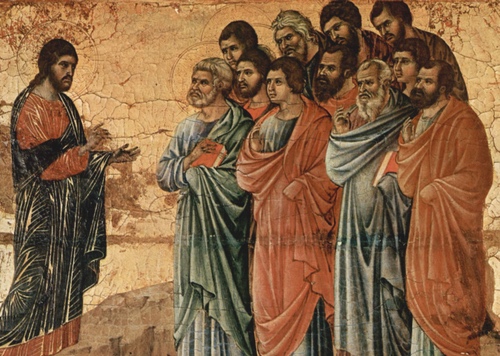 In today’s gospel, Jesus gives a “pep talk” to the twelve disciples he is sending out on mission. It has to be the worst pep talk ever – realistic, but grim.
16 “Behold, I am sending you like sheep in the midst of wolves; so be shrewd as serpents and simple as doves.17 But beware of people, for they will hand you over to courts and scourge you in their synagogues,18 and you will be led before governors and kings for my sake as a witness before them and the pagans.19 When they hand you over, do not worry about how you are to speak or what you are to say. You will be given at that moment what you are to say.20 For it will not be you who speak but the Spirit of your Father speaking through you.21 Brother will hand over brother to death, and the father his child; children will rise up against parents and have them put to death.22 You will be hated by all because of my name, but whoever endures to the end will be saved.23 When they persecute you in one town, flee to another. Amen, I say to you, you will not finish the towns of Israel before the Son of Man comes. (Matthew 10:16–23)
Same as it ever was?
 Back in 1983 the division of the company I worked for bought an IBM personal computer and hard drive (they were an add-on, were only 10 MB and were about as expensive as the computer.) That was going to be our “competitive edge” or so said one of the senior executives. I inwardly rolled my eyes knowing that the rapid advance in the personal computer world / emerging technology would transform the business world as performance improved and prices dropped. I had already purchased a portable computer (ok…”luggable” would be a better description) that came with word processing software, a spreadsheet, and a database – and 20MB hard drive and for 50% of the costs of the new office computer. To put this in context, there was no Microsoft or MS-DOS. Unix or CPM were the operating systems de jour. OK … enough history. My point is that there is this underlying belief that technology would make our lives better – especially in the world of business. Continue reading
A possible way ahead
 In today’s gospel, “As you enter a house, wish it peace. If the house is worthy, let your peace come upon it; if not, let your peace return to you. Whoever will not receive you or listen to your words— go outside that house or town and shake the dust from your feet.”
Shaking off the dust from the feet is an symbol of dissociation. Nehemiah 5:13 has a similar act as does Acts 13:51 (as Paul and Barnabus shake the dust of Antioch off their feet and move on to Iconium. In all its forms, one is calling it quits and they want nothing more to do with the place (Luke 10:11 spells it out more fully). Continue reading
Active Mission
 This coming Sunday is the 15th Sunday of Ordinary Time in Year B. The gospel for the day comes from Mark 6 and narrates the beginning of mission for the disciples.
The Message. 12 So they went off and preached repentance. 13 They drove out many demons, and they anointed with oil many who were sick and cured them.
The New American Bible (NAB) offers a translation that seems minimally functional – merely reporting that they set out on mission and what they did when they got there. A more literal translation of the verse is: “And the went out and proclaimed so that all might repent.” The second part of the verse is a hina clause in Greek, normally indicating purpose, aim, or goal. The purpose in their proclaiming is that people might repent, that is, have a change in mind/heart. Such preaching will include the demands from God and our failure to live up to them. It also includes the grace of God that accepts the law-breakers. It includes the mandate to speak the truth in such a way that it leads people to repent, to have a change in mind about their own sinfulness and about God’s gracefulness. Continue reading
The Mission and Instructions
 Knowing the Mission. I have two thoughts for you today. The first concerns “the twelve” while the second involves Jesus’ instructions: “Do not go into pagan territory or enter a Samaritan town. Go rather to the lost sheep of the house of Israel. As you go, make this proclamation: ‘The Kingdom of heaven is at hand.’” (Mt 10:5-6)
The Twelve. This is the first time in Matthew’s gospel that Jesus calls to himself a “select team” of disciples to whom he will assign a mission. Up to this point in time, the disciples were called one-by-one, witnessed Jesus’ proclamation of the Kingdom of heaven being at hand, and watched Him perform miracles. Now they are being sent out to proclaim the Kingdom. Continue reading
Mystery of human freedom
This coming Sunday is the 15th Sunday of Ordinary Time in Year B. The gospel for the day comes from Mark 6 and narrates the beginning of mission for the disciples.
Instructions for the Mission. 10 He said to them, “Wherever you enter a house, stay there until you leave from there. 11 Whatever place does not welcome you or listen to you, leave there and shake the dust off your feet in testimony against them.” Continue reading
Speaking of cows
 Apart from milking them, herding them, and delivering salt to the cows, there were two other interesting stories from my time in the west of Kenya that pertains to cows.
One of the traditions of the Luo people of western Kenya (at least where I was residing) was the use of cows as part of a funeral procession. I was told that there were two mainstays of the Luo funeral procession – only one of which I was witness to – and those are cows and mourners, both of which can be hired for the occasion. In the west of Kenya, cows are a mainstay of assets, and the procession of cows is a way to honor the deceased. When it comes to death, it has been a long tradition that evil spirits can play a role in someone’s passing. Mourners may wail, sing, and dance to scare away the evil spirits. To be fair, I have not done justice to the Luo death and funeral rituals which are far more traditional and extensive than the other tribes in Kenya. Still, it was a sight to behold in the one funeral procession I observed. Continue reading
That would be amazing

In today’s gospel, “A demoniac who could not speak was brought to Jesus, and when the demon was driven out the mute man spoke.” In Jesus’ day, deafness and dumbness usually went together in persons, who are deaf from their birth. They could not hear, and so they could not learn to speak. But this man seems to be unable to speak, not by nature, but through the possession of a demon, who had taken away, or restrained the use of his speech, out of demonic malice. Continue reading
 friarmusings