
 And he came down with them and stood on a stretch of level ground. A great crowd of his disciples and a large number of the people from all Judea and Jerusalem and the coastal region of Tyre and Sidon came to hear him and to be healed of their diseases; and even those who were tormented by unclean spirits were cured.
As you have already considered, this Lucan passage is very similar to Matthew’s “Sermon on the Mount” – the beginning part referred to as the Beatitudes. Both versions are (and will, no doubt, continue to be) the source of much scholarly inquiry and debate. Some ask whether this is a single-setting sermon or if this is a compilation of Jesus’ sayings arranged in a “sermon.” As we have been doing throughout our study of Luke, it is helpful to compare Luke with the parallel passages in Matthew to help understand Luke’s concerns here (there are no parallels in Mark or John, although some of the same sayings are found scattered throughout the books). While questions about origin, sources, and redaction of the text are certainly valid and interesting, it will probably be sufficient here simply to acknowledge the fact that Luke and Matthew differ in how they have constructed these sermons. Continue reading
 “Bless me Father, for I have sinned….” Among the most frequently confessed sins are anger, being judgmental, and impatience. “Patience is a virtue.” We’re all familiar with that expression. Patience is listed by St. Paul in Galatians 5:22-23 as among the fruit of the Spirit. So, there’s no disputing that the Christian ought to be patient. But is impatience a sin? W. H. Auden, the English-American poet, wrote “Perhaps there is only one cardinal sin: impatience. Because of impatience we were driven out of Paradise, because of impatience we cannot return.” Insightful about the human condition to be sure, but not sure that has standing in the world of moral theology.
  “from now on you will be catching men” Literally, the next line reads: “from the now, you shall be catching alive (zogreo) people.” The similar phrase in Matthew and Mark reads: “I will make you (to become) fishermen [halieus] of people.” (This word for “fishermen” is used in v. 2 of our text.)
 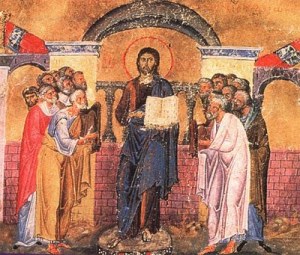 Things “went south” pretty quickly after Jesus read the words from the prophet Isaiah, told the crowd that those prophetic words were fulfilled in their hearing, and then just sat down. How did things get so out of hand so quickly – from prayer to attempted homicide. When they got home, I wonder if they reflected on the whole incident? Did they take it into prayer and search for the presence of God in the midst of all that turmoil?
  A couple of years ago, one of the parish staff members, Jennifer Williams, wrote a wonderful piece for this column. Here are some excerpts: “Catholics, in general, are reluctant to talk about their faith in the presence of others. Why? It is easy to talk about church issues and controversies or moral values but not about our relationship with Christ or about how we recognize God’s action in our lives. It seems socially ungracious to ‘talk religion’ around the water cooler or on the golf course or at the swimming pool.”
  friarmusings