Today’s readings place before us two parents, two children, and two very different outcomes of love.
In the first reading, we hear David’s cry — raw, unfiltered, and devastating: “O my son Absalom! My son, my son!” This is love stripped of dignity and defense. David’s grief is not only for a dead son, but for a relationship that was broken beyond repair when his son led a revolt against his father and king. Absalom’s life ends in violence and rebellion, and David is left with the agony of knowing that love alone could not save him.
This is the risk and tragedy of love; real, sincere, and yet powerless in the face of human freedom. David loved Absalom deeply, but Absalom chose a path that led to death. Scripture does not soften this moment. It allows grief to be heard in all its weight. It gives us pause to remember the risk and tragedy of the loves in our life, sometimes powerless before freedom.
The Gospel holds up another parent, another child, and another expression of love. Jairus comes to Jesus not as a ruler, but as a father who kneels. His day job is one punctuated by control and force, but his love leads him to surrender and trust. Even when he is told that his daughter has died, Jesus speaks words that change everything: “Do not be afraid; just have faith.”
The story of Jairus and his daughter is a love story that does not end in lament, but in life restored. Jesus takes the child by the hand and gives her back to her family. What King David could not do, bring his child back, Jesus does with the gentle authority of the Good Shepherd.
The contrast is not meant to judge David or glorify Jairus. It reveals something deeper: love alone is not enough unless it is entrusted to God. Love that clings, controls, or acts apart from God can break our hearts. Love that kneels, trusts, and places itself in God’s hands becomes a channel of life.
These readings speak honestly to our own experiences. We know both kinds of love. We have loved and lost, prayed and wept, trusted and waited. Sometimes, like David, we carry grief that will not be undone in this life. And Scripture does not rush us past that pain. But the Gospel insists on this hope: God’s final word is not tragedy, but life. Even when restoration does not come as we expect, Christ enters every loss, every death, and every broken relationship.
From tragic loss to restored life is the path Jesus walks. And he invites us to walk it too, loving deeply, trusting humbly, and believing that no love given to God is ever wasted. We are invited to place before the Lord both our laments and our hopes, trusting that the God who weeps with us is also the God of Life.
Image credit: The Daughter of Jairus (La fille de Zäire) | James Tissot, 1894 | Brooklyn Museum of Art | PD
In the previous post, it was noted that at the end of the First World War the Imperial Japanese Navy (IJN) had expectations but were realistic. They expected that their coalition work with the British in the Indian Ocean, Mediterranean, and taking on maritime security in the Pacific had earned them recognition, respect and parity with the western navies. They had just successfully operated as a “global navy.” They also recognized that maintenance and expansion of their fleet was directly tied to shipyard capacity, raw materials and industrial throughput. These were industrial limits impossible to ignore and were not limitations on either British or the Americans.
Japanese Naval Planning
The nation of Japan continued to struggle financially with the burden of Russo-Japanese war debt, expenditures on military replenishment, expenses on the build up and securing their footholds in Manchuria, Korea, and Liaodong. At the same time, like all nations post-WW1, there was a desire to return to a consumer economy after the deprivations of the war years.
The Navy’s planning division began to look ahead a decade to see what would be needed in the 1930s in order to support nascent plans for a Japanese-led Asia prosperity zone. The conclusion was that the Navy required two fleet groups, each consisting of 4 battleships and 4 heavy cruisers. Thus was born the 8-8 plan. The basis of the plan was the theory of sea power of Alfred Thayer Mahan which was the foundation of both Japanese and American naval strategy. One of the central theses of Mahanian thought was the “decisive battle” after which “control of the sea” would automatically default to the winner. The Japanese had to control the Western Pacific.
The problem was that in 1918-1919 Japan was experiencing a post-WW 1 economic depression making their 8-8 fleet plan financially impossible. Nishihara Hajime, Vice Minister of Finance noted to the Navy Minister Kato that not only would the capital budget for new construction consume 20-30% of the national budget, the outyear expenses for maintenance, operations, etc, for a fully operations 8-8 fleet would extend the budgetary consumption at similar percentage rates. It was not viable or sustainable. And the problem with that was the overall naval strategy was based on several premises:
The U.S. would not construct any fortifications/bases west of the Philippines or Guam.
So that in the event of a US-Japan conflict, the U.S. fleet would have to cross the Pacific for any hostile action against Japan.
Based on Mahan’s theory, the U.S. would lose 10% of its force effectiveness for every 1,000 miles of steaming – so after 3,000 miles of Pacific transit, the U.S. fleet would effectively be 70% of its original force structure.
Japan was in a position that it needed to understand what it could afford to build and maintain a 10:7 ratio of naval combatants. In other words, the two nations that had access to raw materials, finances, and shipyard capacity to outbuild Japan – they needed to be constrained to a limitation that fit within Japan’s strategic plan.
Forestalling an Arms Race
Meanwhile, there were growing tensions in East Asia over an unstable China, Japanese occupation of Shandong (former German territory), Manchuria, and more. Leaders in the international community sought to prevent the possibility of another war. Rising Japanese militarism and an international arms race heightened these concerns. Within the United States there were congressional calls for the U.S. to engage Britain and Japan in naval arms limitation negotiations.
In what must have seemed like a godsend to the Japanese in this era of growing tension, in 1921, U.S. Secretary of State Hughes invited nine nations to Washington, D.C. to discuss naval reductions and the situation in the Far East. This gathering is known as the Washington Naval Conference which produced three treaties: the Five-Power Treaty, the Four-Power Treaty, and the Nine-Power Treaty. Not terribly imaginative, but nonetheless descriptive.
The Five-Power Treaty, signed by the United States, the United Kingdom, Japan, France and Italy was the cornerstone of the naval disarmament program. It called for each of the countries involved to maintain a set ratio of warship tonnage which allowed the United States and the United Kingdom 500,000 tons, Japan 300,000 tons, and France and Italy each 175,000 tons. If you do the math the ratio between US/Britain and Japan was 5:3 (10:6 equivalent and not the 10:7 Japan desired)
In the Four-Power Treaty, the United States, France, the United Kingdom, and Japan agreed to consult with each other in the event of a future crisis in East Asia before taking action. This nullified the Anglo-Japanese Treaty of 1902, freeing Britain from coming to the aid of Japan in the event of war.
The Nine-Power Treaty, marked the internationalization of the U.S. Open Door Policy in China. The treaty promised that each of the signatories (the United States, the United Kingdom, Japan, France, Italy, Belgium, the Netherlands, Portugal, and China) would respect the territorial integrity of China. The treaty recognized Japanese dominance in Manchuria but otherwise affirmed the importance of equal opportunity for all nations doing business in China.
Japan and China also signed a bilateral agreement, the Shandong Treaty, which returned control of that province and its railroad to China. Japan had taken control of the area from the Germans during the First World War and maintained control of it over the years that followed. Combined with the Nine-Power Treaty the effect was meant to reassure China that its territory would not be further compromised by Japanese expansion. All of these treaties were set to expire in 1936.
The treaties of the Washington Naval Conference stabilized naval competition but ignored land-based conflicts. Rising Chinese nationalism with its own imperial privileges and Japanese ambitions. Manchuria remained unresolved as Soviet reemergence added strategic anxiety for Japan. Meanwhile, Western powers lacked capacity or will to enforce the system they had just created. East Asia was not at peace, it was balanced as long as there was restraint from all parties, but ready to topple once the first party was willing to move unrestrained.
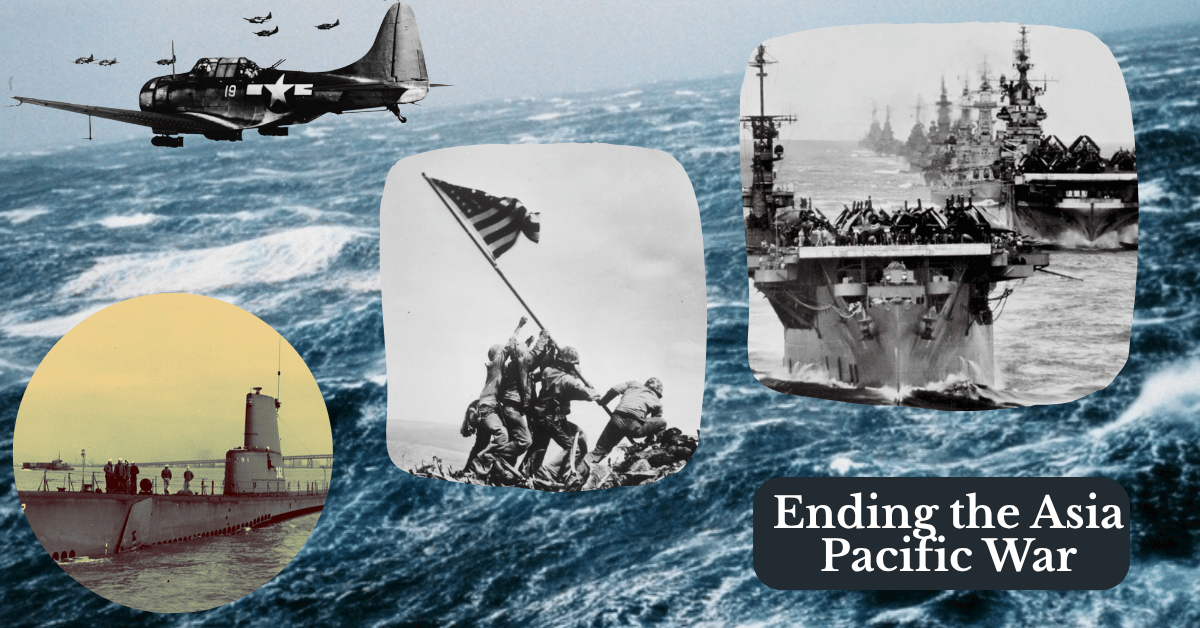
Image credit: various photographs from Naval Aviation Museum, National World War II Museum, and US Navy Archives.
This coming Sunday is the 5th Sunday of Ordinary Time, Year A. Our very short gospel passage (salt of the earth and light of the world) follows immediately after Matthew’s presentation of the Beatitudes. Verses 11-12 (not part of the Sunday gospel) are often called the 9th beatitude because of the opening phrase. But where vv.3-10 describes the good life, these verses bring it into contrast and begin to describe the cost (v.11) and remind the listener that you are simply joining a long tradition. The prophets who earlier proclaimed the kingdom and its demands were also persecuted.
Just as the prophets stood out and apart from “business as usual,” so too will the disciples who have committed themselves to Jesus. Here and in the next few verses the “you” that appears is always plural. The concern here is that the Christian community stand out, appear different, and become an alternative to the larger society. In Matthew’s account, the famous tune, “This Little Light of Mine” would read “This Little Light of Ours.” The community of disciples are called to be collective light and salt.
The salt/light metaphors (and possibly ‘city on the hill’) are only effective signs of the Kingdom to the extent with which the community is willing to use them, to bring them to bear. Salt, no matter how pure and tasty, if left in the cellar is not much use. A light locked away inside, will not illuminate anything in the world. In part, a goal of discipleship is to be noticed, to stand out, to be more than a curiosity, to be significant; in other words, to be distinctive and to be involved. The dangers of being a community too comfortable, too scared, or too closed off is seen in the Book of Revelation’s letter to the community of Laodicea: “To the angel of the church in Laodicea, write this: ‘The Amen, the faithful and true witness, the source of God’s creation, says this: “I know your works; I know that you are neither cold nor hot. I wish you were either cold or hot. So, because you are lukewarm, neither hot nor cold, I will spit you out of my mouth.”’” (Rev 3:14-16)
Image credit: Sermon on the Mount (1877) by Carl Heinrich Bloch | Museum of National History | Frederiksborg Castle, Public Domain
The Feast of the Presentation is, at first glance, a quiet scene. There is no miracle, no crowd, no proclamation from heaven. Like faithful, observant parents, another young couple brings a child to the Temple, offers the sacrifice of the poor, and blends into the ordinary rhythm of religious life. And yet, in the quiet of this setting, today’s readings tell us that everything depends on what kind of hearts are present in that moment.
In the first reading Malachi asked a piercing question: “Who will endure the day of his coming?” Who will be steadfast? Who will persevere waiting for what has been promised and hoped for, the coming of the Lord? And then the Lord comes to his Temple. Not with spectacle, but with the power to open and purify: “not [to] help angels but rather the descendants of Abraham.” The promised coming of the Lord was always a gift, but it is also a test: not of strength or knowledge, but of openness.
Simeon and Anna show us what open hearts look like. They have waited a lifetime. Simeon has lived with a promise that remained unfulfilled year after year. Anna has spent decades in prayer and fasting, largely unnoticed. Their faithfulness is quiet, patient, and unspectacular. They do not demand that God act on their timetable. They simply remain available with open hearts. And because they wait with open hearts, they recognize what others miss. That the long awaited Messiah arrived not as king or conqueror, but as a child. In that child, no doubt one of many that day, Simeon sees the salvation he has longed for. Waiting has sharpened his vision, not dulled it.
The king or conqueror works and lives at a distance. The Letter to the Hebrews reminds us God does not save from a distance. His only Son shares fully in our flesh and blood, entering weakness, suffering, and time itself. But such divine humility can only be received by hearts that are open and willing to be changed by what God has revealed. A closed heart demands certainty, control, and familiarity. An open heart allows God to arrive in unexpected ways.
The danger, of course, is that waiting can go wrong. It can harden into resignation or indifference as people go through the motions – slowly the heart closes. The Temple was full of people that day yet only a few truly saw. This feast gently asks us: What kind of waiting shapes our faith? Do we wait with expectation, or with guarded hearts? Have we allowed disappointment or fatigue to seal us off from surprise? Is God already present to us but unrecognized?
Simeon’s long faithfulness has taught him trust. He does not cling. He does not demand more signs. He receives, blesses, and lets go. Today we ask for that same grace: hearts that remain open, patient, and receptive; hearts refined in hope not by control. So those who wait with love will recognize the Lord when He arrives into the quiet of our lives.
Image credit: Giotto di Bondone, Presentation of Christ in the Temple | Lower Church in the Basilica of San Francesco, Assisi | PD-US
The first concerns itself with the international situation, particularly in regard to China. The second deals specifically with Japan and how this conflict affected it. At the time, World War I was widely regarded within Japan as “an opportunity that comes once every thousand years” because it produced assured profitability for the nation and for its industries, unprecedented industrial and financial opportunity, and minimal obligation and commitment. Japan, before 1914, was poor. The country was obliged to import British and German steel because it was cheaper than steel made in Japan, and there were very few shipyards that could build steel vessels of any size. It was not until 1905 that Japan laid down a battleship built with home-produced steel. As late as 1914 state spending, especially on the armed services, remained very low because of the debt that had been accumulated in the Russian war. A mark of the narrow margins on which Japan was forced to operate was the fact that before 1914 the greatest annual profit recorded by its largest shipping company, Nippon Yusen Kaisha, was about 6 million yen.
With the start of the war all the European powers were diminished in terms of Pacific presence and merchant traffic and trade. Merchant shipping, other than Japan’s, virtually disappeared from the Indian and Pacific oceans during this war. A mark of the impact of World War I was the fact that in 1918 Nippon Yusen Kaisha ran a profit of 86 million yen. In the course of World War I, Japanese shipping came to dominate Pacific routes, even dominating U.S. trade on the Pacific Coast – a fact that caused concerns in the U.S. and led directly to building the Mare Island shipyard and a post-war effort to reestablish U.S. trade and shipping in the Pacific.
Japan: post-war
Japan’s post-war economic policy shifted to focus on development of the civil sector, enhancement of light industry, and improvement of the economic lives of ordinary citizens. However, good intentions aside, the nation experienced a sharp economic downturn after its wartime boom, characterized by speculative bubbles bursting in 1920, leading to bank failures, widespread bad loans, and a chronic depression throughout the 1920s. A key event was the Great Kantō Earthquake (1923) which devastated Tokyo and surrounding areas, leading to huge reconstruction efforts and “earthquake bonds issued by the Bank of Japan to help overextended banks. This intervention, intended to rescue solvent but illiquid banks, was abused by already distressed institutions, accumulating a series of bad loans. When the government proposed redeeming the earthquake bonds in 1927, rumors of bank insolvency spread, causing nationwide bank runs and failure of major banks (the Shōwa Financial Crisis). Throughout this period there were shortages, price rises, and food riots especially in the 1920 crisis. The IJA was called in to quell the riots which hurt the army’s relationship with the civilian population in the home islands.
In parallel to this, encouraged by their far ranging naval activities during the war, Japan found itself with only one western power against which they could compare themselves: the United States. The Imperial Defense Policy statement of April 1907, was rewritten to change the most likely military opponent from Russia to the United States. It sanctioned the decisive battle doctrine, which stressed the importance of acquiring big ships with big guns through a program for the construction of eight 20,000-ton battleships and eight 18,000-ton battle cruisers. This was known as the 8:8 program.
The IJN proposal came during the war years but the Japanese Diet (house and senate equivalent) refused to authorize more than one battleship and two battle cruisers. This came at the same time when the United States was vociferously claiming the right to build a fleet “second to none.” Within the US, naval leaders proposed a theoretical threat of Germany in the Atlantic and Japan in the Pacific (as well as a German-Japanese alliance). This was the warrant for a two-ocean navy. The goal was less national defense than to protect overseas trade. Tohmatsu and Willmott note: “The least that could be said about such logic was that it grasped at the exceedingly unlikely in order to justify the manifestly unnecessary.”
Both countries had building programs that planned large increases in combatants by 1925, but the U.S. was capable of building far more than Japan because of its industrial capacity and financial strength. But in fact neither country was financially capable of implementing such grandiose plans. In Japan there was not enough capital, access to lines of credit, plus the ongoing financial problems. In the U.S. there was too much national debt associated with WW1 and a growing isolationist movement in Congress.
All of this led to the Washington Naval Conference of 1922. The simplest description of the conference: it was complicated. The agreements concluded at Washington were important because they provided the basis of how Japanese-American relations could be stripped of hostility and ill-intent. They halted what promised to be a disastrous naval race in the Pacific and put in its place arrangements for the scrapping of many existing warships and limitation of the size of fleets that could be retained. When allied with the ban on Britain fortifying any base beyond Singapore and on the Americans beyond the Hawaiian Islands, the agreements created a balance in the Far East – not only militarily but also commercially.
Japan’s acceptance of such arrangements was the result of a singular balanced vision championed by one person: Admiral Kato Tomosaburo, the Navy minister. He held that the only eventuality that could be worse for Japan than an unrestricted naval construction race with the United States would be war against that country. An unrestricted naval race could only result in the inevitable and irreversible erosion of Japan’s position relative to the United States because of the industrial power of the U.S. Kato believed that as a consequence, Japan had to seek security through peaceful cooperation and diplomatic negotiations rather than through international rivalry and conquest. While the IJN itself saw its role as a deterrent and, in the event of war, defensive, individuals such as Kato saw Japan’s best interest served not by confrontation and conflict with the United States but by arrangements that limited American construction relative to Japan and that provided the basis of future U.S. recognition and acceptance of Japan’s regional naval and commercial positions. The next post takes a “deeper dive” into the details of all the treaties that emerge from the Washington Conference.
The Next Generation
Germany’s loss in WW1 was seen as victory of democracy over militarism and came as a considerable surprise to many Japanese, especially those associated with the Imperial Army. But, for much of the 1920s there was no major military commitment that involved substantial taxation and financial sacrifice. The 1920s held out hope for the triumph of liberal democracy within Japan and the prospect of a better future.
But Japan had no long-term legacy of such a form of government. It is one thing to model your military on western models, but governance is a different matter. The Meiji Constitution’s implementation of parliamentary representation, separation of powers and independence of the judiciary, and accountability under the law, were relatively new – all still within the generation of the people whose culture and frame was the Tokugawa Shogunate. There was no more than a single lifetime of support and investment in them on the part of society.
The 1920s saw the passing of the genro, or elder statesmen, who had led the country since 1868 – and especially since 1898 when many significant changes were implemented. These men, in a sense, were not only the living memory of Meiji, but were the “glue” that held the reforms together and steered national and regional interests to a common goal. Their passing created a collective gap in leadership that the next generation prime ministers could not fill. What was lost was moderation and continuity of memory.
As Japan worked to transition politically, financially and culturally, the 1920s – despite its problems – was one of peace and slowly improving conditions. But there was a different sense within the Imperial Japanese Army (IJA). There were three overseas military commitments in this decade. The first was the intervention in the Russian civil war, which in effect ended in October 1922 when Japanese forces finally withdrew from Soviet mainland territory. The second was a deepening Japanese army involvement in China’s civil wars, most notably after 1926. The third, directly related to the second, was IJA operations inside Manchuria.
Notably, during IJA involvement in China’s civil war and Manchuria, the Japanese military was without guidance from Tokyo and as such set their own rules of engagement, as they decided which side to back in which province or area, and to do so without reference or consultation with Tokyo. The habit, once acquired, was never broken.
In 1924, the Prime Minister reduced the size of the IJA, involuntarily moving officers and senior enlisted personnel into retirement or simply discharged from the military. But for their loyal service many were directed into the state education administration in positions of supervision for a newly introduced scheme of compulsory military training for children. This was especially true outside urban areas and resulted in an imposition of military values on far less well educated children with little job prospects. When we arrived in the 1930s these youths found opportunity in military service as the IJA was expanded – and the veteran’s association became a powerful political voice in the nation..
By the time we reached the 1930s, the IJA had developed a culture of insubordination within the army. The most notable trait was gekokujo, the manipulation of senior officers by their subordinates. Among the most radical/nationalistic members of the IGA this led to the phenomenon of “government by assassination” as cabals of junior officers (colonel and below) assassinated civil leadership leading to the setbacks of nascent parliamentary democracy. Although the Japanese Constitution was amended in 1936 to mandate that four of the six key cabinet positions be occupied by active duty military personnel. By the late 1920s and early 1930s it was a practice politically necessary to form governments under the Prime Minister. The Meiji era civilian control of the military was eroding and beginning to exist in name only. Increasingly the real power belonged to the IJA and IJN.
The Rise of Nationalism
The 1930s saw a marked rise in nationalism within Japan. It is a complex topic whose details are too complex for this series particularly to attempt to explain in terms of cause and effect. But there are “snapshots” that mark the changes.
Prior to 1933 Japanese schoolbooks made reference to non-Japanese western historical figures associated with democratic movements in history, e.g. Washington and Lincoln. After 1933 virtually all western society references were removed. Key figures were replaced by Japanese national heroes. If there were mention of westerners, they tended to be famous military leaders such as Admiral Nelson or Napoleon Bonaparte. Overall the tone of the school curriculum became increasingly nationalistic and strident.
By 1936 the books that taught children to read were no longer based on nature and the richness of Japanese animal life. In their place came topics of the Emperor, soldiers, duty, loyalty to the nation and service/sacrifice. Even cartoon strips were not immune. The Japanese equivalent of Felix the Cat, a dog named Norakuro, joined a regiment of dogs in the army because in the country of the Sheep (Manchuria), the latter had been obliged, because of the aggressiveness of the Pigs (the Chinese), to call in the Dogs (the Japanese), which had chased out the Pigs and created a haven for the Sheep and the Goats (the Mongolians). And in the future the Dogs would have to stand guard because the Pigs had tried to enlist the support of the Bears. Significant? Make of what you will, but it and many other examples begin to paint a picture. Clearly something was afoot that made for a fundamental change of attitudes within Japanese society.
One example can be seen in the expected behaviors of soldiers. Thousands of Japanese soldiers taken prisoner during the Russo-Japanese war of 1904–05 when they were repatriated were seen as heroes and honored. Almost three decades later, in the course of the fighting at Shanghai in January 1932, the Chinese took prisoner a severely wounded and unconscious Japanese officer. He recovered and was exchanged, but he killed himself because of the dishonor he felt for having been made a prisoner. Only after his suicide did the national praise him because he had embraced real Japanese values. In the same conflict three soldiers blew themselves up during the fighting at Shanghai to provide a key action in the battle. They were afforded a degree of national veneration because they had embraced the honorable value of self-sacrifice. It was never determined if the action was accidental or intentional in fact, but it was clear how it was promoted.
Change was afoot across Japanese society.
What were the root causes? While arguable – and scholars all have different takes on the question – a short list of “what” generally includes:
The Great Depression’s economic devastation, the perceived failures of democracy, a rising belief in Japanese racial superiority, and military leaders’ desire for expansion to secure resources and power. These are some of the factors that led to a surge in ultranationalism, militarism, and imperialist ambitions that challenged both Western influence and Japanese civilian government.
The economic crises associated with the Great Depression. As elsewhere, following the 1927 banking crisis, the 1929 stock market crash devastated Japan’s export-dependent economy, causing widespread poverty, especially in rural areas, making radical, immediate solutions attractive.
Civilian governments struggled to handle the economic collapse, leading many to view democracy as weak and ineffective, paving the way for authoritarianism. It must be remembered that the Shogunate period and the local authoritarian leaders were only a few decades past. There was a romanticizing of the “good years” when leaders were strong.
The military, particularly the army, presented itself as the solution, gaining influence through successful campaigns (like invading Manchuria in 1931) and advocating for expansion as a path to economic security and national strength.
From all this a virulent nationalism emerged. The idea – already and always present – was promoted that the Japanese people were racially superior and divinely destined to lead Asia, with emperors as direct descendants of the Sun Goddess. In essentially one lifetime, national sentiment moved from the isolationist period of the Tokugawa Shogunate to a globalist vision of Japan’s destiny. Nationalists argued that imperialist expansion was necessary to overcome overpopulation and resource scarcity, providing Japan with economic security and a greater role on the world stage.
On the far right was the drum beat of the ultra-Nationalist Movements. They denounced democracy, big business, and Western influence, advocated a return to traditional values, loyalty to the Emperor, and warrior/samurai ethics. They were not restrained in the use of political violence and assassinations.
These are some of the factors combined to hollow out democratic institutions and shift Japan toward a militaristic, expansionist path by the mid-1930s, setting the stage for further aggression in Asia and another step to the broader Asia-Pacific War.
Image credit: various photographs from Naval Aviation Museum, National World War II Museum, and US Navy Archives. Source reference: Gathering Darkness: The Coming of War to the Far East and the Pacific, 1921-1941 by Haruo Tohmatsu and H.P. Willmott (War and Society Book 3)
This coming Sunday is the 5th Sunday of Ordinary Time, Year A. Our very short gospel passage (salt of the earth and light of the world) follows immediately after Matthew’s presentation of the Beatitudes (5:1-10) as part of the larger “Sermon on the Mount” as it is popularly known. It is a parallel text, in part, to Luke 6:20-49, the “Sermon on the Plain.” More importantly, this passage is part of the first of the five great discourses in the gospel. At a broad stroke, Matthew 5-7 are an expose of Jesus’ authoritative teaching; Chapters 8-9 are pericopes of his authoritative deeds.
With the chapters dealing with authoritative teaching, there are four primary themes that emerge (R.T. France, The Gospel of Matthew):
5:3-16 distinctiveness of Christian discipleship 5:17-48 disciples: fulfilling the Law 6:1-18 disciples: true and false piety 6:19-34 disciples: trust in God over material security
The majority of Chapter 7 is given to providing contrasting examples of these, with the culmination in Matthew 7:28-29: “When Jesus finished these words, the crowds were astonished at his teaching, for he taught them as one having authority, and not as their scribes.”
Although crowds are described at the beginning of Mt 5, the focus of this larger discourse is for the disciples who have already responded to Jesus (cf. 4:18-22) and now need to learn what life in the Kingdom really means. To understand the “Sermon on the Mount” as simply a general code of ethics, is to miss that Jesus is beginning to explicate the demands of the Kingdom that point towards a way of being in the world: “So be perfect, just as your heavenly Father is perfect.” (Mt 5:48) This is held in contradistinction from a simplistic following of the Law (5:21-48).
One of the points, lost in translation, is that the meaning of “Blessed are….” in the Beatitudes are a bit more subtle than would appear at first glance. The Greek word used in makarios. This does not mean “blessed by God” (bārûk in Hebrews, translated into Greek as eulogētos). The word “happy” in today’s English carries too much connotation of emotional and psychological well-being – and that is off the mark. The word “fortunate” gets closer, while some scholars the most idiomatic English expression which captures the sense in the Australian “good on yer.” Makarios is a description of the circumstances of a good life; a life well lived – even if it proves to come at a cost.
Image credit: Sermon on the Mount (1877) by Carl Heinrich Bloch | Museum of National History | Frederiksborg Castle, Public Domain
Note: this weekend the pastor is launching the Annual Lenten Appeal and so again I have a “homily holiday.” This is my homily from the 4th Sunday of Ordinary Time, 2023
Today’s first reading is from the Prophet Zephaniah. It is only three chapters long and it is filled with darkness, distress, destruction, death, doom, and despair. Yet, in the midst of all that – there is a message of hope, for a remnant of the people; people described as humble and lowly. People who take refuge in the Lord. People who remain faithful to God even as all around them crumbles and falls apart. A remnant who has already seen the Assyrian empire conquer most of the promise in the promised land. A remnant that can already see the Babylonian threat on the horizon. A remnant that even as they wonder how this all plays out in God’s plan, they are the faithful …. and hanging on. They recognize that they are blessed by God. It might be hard for us to see it, but they see it. And that challenges us just as the more famous beatitudes of today’s gospel also challenges us.
It is good to be a life-long learner in all parts of your life. I continue to read theology, scripture and areas that are part of my life as a Franciscan and priest. I keep up on technology because… well there is a part of me that remains a nerd. The same part that reads science blogs and what’s going on in mathematics. I read publications from the US Naval Institute because it is part of my story and my brother friars’ turn to me for expert commentary on all things navy and commercial shipping. And the life long learner in me receives an email each day from the good folks at Merriam Webster.
This week one of the “words of the day” was the expression “short shrift.” I knew the meaning of the word: to give something little or no attention or thought – as in, “My supervisor gave short shrift to my suggestion to improve our group’s work flow and processing.” The usual implication is that something or someone is being improperly ignored or treated lightly, as in a comment that U.S. television coverage of the Olympics overemphasizes Americans and give short shrift to the athletes of other nations.
What I did not know was the origin, the etymology of the expression. “Shrift” is a very old word that originally, back in the 11th century, meant “penance.” It is a noun derivative of the verb “shrive” from Old English “scrifan,” which is from the Latin verb “scribere,” meaning “to write.” “Scrifan” was the verb of choice for use specifically in regard to writing down rules, decrees or sentences, so it took on the special meaning of to impose a sentence. Applied to church vernacular, it meant to assign penance to a penitent in the confessional and to hear confession.
There is a thought that the use of the expression became connected to confession when a prisoner received a sentence of execution. There was generally little time between sentence and the execution and so the condemned person needed to be quick about make their last confession. We see that in the earliest known use.
The earliest known use of the phrase comes from Shakespeare’s play Richard III, in which Lord Hastings, who has been condemned by King Richard to be beheaded, is told by Sir Richard Ratcliffe to “Make a short shrift” as the king “longs to see your head.” Although now archaic, the noun shrift was understood in Shakespeare’s time to refer to the confession or absolution of sins, so “make a short shrift” meant, quite literally, “keep your confession short.”
Who knew? While the good friars at the parish have no desire to “see your head”, as Confessors we are appreciative of a “short shrift.” While we always enjoy a long, involved narrative with tales of the betrayals and conspiracy of others, accounts of “and then they said to me…” and other flourishes and embellishments – those are best told in other settings. But in the celebration of the Sacrament of Reconciliation please give us “short shrift” so as not to delay the mercy and forgiveness of God in your life.
The people described in the first stanza are those who lack dikaiosynē. The people described in the second stanza are those dedicated to bringing dikaiosynē. Thus the people in the second part provide what the people are lacking in the first part. Ironically, by seeking to provide dikaiosynē, the virtuous may find themselves in the position of lacking dikaiosynē. With Jesus as an example: he proclaimed justice to those deprived of justice, and he became one who was unjustly executed.
Whether the coming of God’s kingdom is perceived as bringing reversal or reward depends only on the position that one occupies prior to its advent. God’s rule sets things right. Those for whom things have not been right are blessed by the changes it brings and those who have been seeking to set things right are blessed by the accomplishment of what they have sought. (Powell, 138).
The Final Blessing
11 Blessed are you when they insult you and persecute you and utter every kind of evil against you (falsely) because of me. 12 Rejoice and be glad, for your reward will be great in heaven.
The sudden shift to “you” must have been shocking to the disciples and other followers. Up until now in the gospel, the disciples have neither been the unfortunate in need of the eschatological reversal nor the virtuous waiting for the eschatological reward. They just followed Jesus, but sort of standing on the sidelines, watching the activities; listening to Jesus. They have been hearing about those other poor and virtuous souls and the blessings pronounced on them. Suddenly the word you involves the hearers. Suddenly Jesus’ words aren’t about those other people any more but me. Why would we be reviled and persecuted and lied about? Because you are committed to dikaiosynēand because of this commitment, you will end up in the position of those lacking dikaiosynē – being unjustly persecuted. However, we have already heard the blessings God has in store for such people. Will we believe those promises for ourselves or not? Will we believe that God will make all things right for us – whether reversal or rewards? If so, we can rejoice and be glad, knowing we have a great reward in heaven.
Image credit: Cosimo Rosselli Sermone della Montagna, 1481, Sistine Chapel, Public Domain
In previous posts there have been references to internal dynamics within the governance structures of Japan. By the 20th century that structure would best be described as a constitutional monarchy, somewhat akin to Great Britain which served as the model for the Meiji Constitution. Akin, but not exactly a match. The differences involved the role of the king/emperor and the makeup of the cabinet. If you’d like to learn more, take a look at the post, In the Beginning. In more recent posts there have been references to the rise of ultra-nationalism, militarism, and other movements within Japanese society. The rise in nationalism is a natural consequence of pride in its language, culture, and uniqueness – as well as a reaction to the incursion of western imperialism into the world of East Asia. In recent memory of the nation is not only the samurai culture, but also the recent military victories in the First Sino-Japanese War as well as the Russo-Japanese War. True, each of these victories came at a cost of lives and led to wartime sacrifice, but Japan was a nation that had never been defeated. Those victories, from the centuries earlier Mongol invasions, turned back by divine winds (kamikaze) to the more recent victories were guided by the hand of Emperor, descendant of the sun goddess.
The military rose to great prestige in civil society’s eyes because of Japan’s war victories. These reinforced the idea that military strength was central to Japan’s survival and success especially against the intrusion of western influences. The Meiji Constitution of 1889 gave the military independence from civilian control: the army and navy were responsible only to the Emperor. In addition, the cabinet required that the Army and Navy ministers be active-duty officers, giving the military an essential veto over government policies. This structural design later allowed military leaders to dominate politics in the 1920s and 1930s. Combine this with the military indoctrination of bushidō focused on reverence for the Emperor and you have an environment where militarists could claim to act in the Emperor’s name for the good of Japan.
Within the Japanese government this gives rise to a moderate wing who believe the diplomatic path is the way forward for Japan to take its place in the world order. Opposing them will be the militarist wing which holds up evidence of the U.S. Immigration Act of 1924 and other western impositions as evidence of the weakness and ultimate failure of diplomatic efforts. In their minds, respect, dignity and the place in the world order would be achieved with demonstrations of military power and the will to use it.
The problem is that the Japanese military was not of one mind, vision, purpose or strategy.
The Roots of Imperial Rivalry
From the beginning there was a natural divide between the Imperial Japanese Army (IJA) and Navy (IJN) that can be traced to the Meiji decision to emulate western military power and structure as a means to ensure Japan did not fall to the same fate as China in the 19th century. The IJA was formed by Prussian advisors whose experience was limited to ground warfare. The Prussian model emphasized discipline, mass conscription, and decisive land battles which were closely tied to Japan’s mainland Asia strategy and the Emperor as supreme commander.
The IJN was formed and modeled on the British Navy who, as expected, faced seaward. The emphasis was professionalism, technology, and command of sea lanes with an oriented toward commerce protection and fleet engagements. While professionalism might seem an odd thing to mention, it stands out within the IJN mainly because within the IJA we will see repeated instances of junior office initiative/insubordination (sometimes a thin line) that had major consequences on national policy and on the battlefield. The IJN did not experience anything similar.
From their formation the two branches of the military developed distinct institutional cultures, different strategic geographies (mainland vs. ocean), and separate professional identities from the very beginning.
Back Home
As mentioned above, the Meiji Constitution placed the Army and Navy directly under the Emperor, outside normal cabinet and parliamentary control. Which meant there was no direct civilian control of the military. In addition, there was no unified command/organization such as the (later) U.S. Joint Chiefs, or a single Department of Defence/War as a cabinet position. Each branch of the military had its own Ministers at the cabinet level as well as their own General Staffs. The results were many, but one was that with independent budgets there would always be major infighting for funds based on their strategic geographical forces. As one might expect, the structure encouraged competition rather than coordination, political intrigue, and direct appeals to the Emperor. But also, the cabinet included both Ministers as well as the head of the Army and Navy. Very often the Ministers were either active duty or retired military leaders. Together or separately, the armed forces had political leverage through institutional veto power.
The Experience of Combat
The success of the First Sino-Japanese War (1894-95) and the Russo-Japanese War (1904-05) brought success, victory, but very different conclusions. In the earlier war the Navy’s victory at the Yalu River secured sea control which they believed enabled the Army’s rapid victories on land by interfering with Chinese logistics. Those same victories reinforced the Army’s belief in offensive spirit as the critical success factor. Each service thus drew different lessons. The Army believed moral superiority and offensive will were decisive while the Navy concluded sea control and modern fleets were decisive. There was no structure where unified doctrine was examined. As a result, rather than fostering joint doctrine, success hardened service parochialism.
The critical element to Japan’s victory in the Russo-Japanese War was … well it depended upon who you asked. The Army was victorious on land, but at a great cost of manpower. The casualties in Manchuria were enormous, but it reinforced their belief in sacrifice as the key to mainland success which in turn was the essential element to safeguard Japan from foreign incursions. The Navy was phenomenally successful at sea from its peremptory strike against the Russian Eastern Navy at Port Arthur at the beginning of the war, to its devastation of the Russian Baltic Fleet at the Battle of Tsushima. These two battles became almost mythic within naval circles and confirmed their commitment to the Mahanian doctrine of sea power as the key to national security and empire. (Alfred Thayer Mahan, naval strategist, whose work The Influence of Sea Power on History was the framework of Japanese and U.S. naval strategies in the 20th century.)
After 1905 the Navy saw itself as Japan’s strategic shield against great powers while the Army saw itself as the nation’s blood-paying guardian on the continent. Both believed they had saved Japan. A rivalry was born.
The Infighting
As mentioned in earlier posts, the Russo-Japanese War resulted in territorial gains, but not the war indemnities that had enriched the national coffers after the earlier Sino-Japanese War. Now Japan faced heavy war debts, limited industrial capacity, and finite state resources. At the time there was a need to resupply and replenish the Army so that it would be able to secure and hold the recent gains in Manchuria and Korea, recruit and train new soldiers, begin to enhance the recently acquired Southern Manchurian Railroad, and build supporting garrisons.
The Navy’s priority was the development of their 8-8 plan: 8 battleships and 8 heavy cruisers in order to form two battle fleets inspired by Admiral Satō Tetsutarō’s Mahanian theories This meant a huge capital investment in shipyards and new construction, recruiting and training to man the new ships, technological innovation, and the development of bases and coaling stations.
Budgeting became a zero-sum competition, not a joint planning exercise.
World War I did not help the rivalry. The Army was largely sidelined with no active role in the war in which Japan fought against Germany on the side of the British and Americans. The Navy benefited from expanded operations and increased prestige via its experience in coalition warfare with Britain.
Japan neutralized German naval forces in East Asia, protected sea lanes vital to British imperial communications and supply in the Western Pacific and parts of the Indian Ocean, providing security of sea lanes from Southeast Asia to the Mediterranean. In addition, a flotilla of Japanese destroyers deployed to the Mediterranean conducting convoy escort, anti-submarine patrols and search and rescue operations. At the same time, the IJN hunted German commerce raiders in the Pacific and laid siege to German commerce ports in China (Shandong ) which would later become Japanese possessions, as well as the Mariana, Caroline, and Marshall Islands.
Coalition warfare reinforced several naval convictions about sea power, technology and alliances (this latter conviction would be shattered in the post-war naval conferences). Meanwhile the IJA was largely on its own in China and Manchuria. As a result the IJN took on a more internationalist, technocratic view of its role and developed realistic views about industrial limits. Unlike the Army, the Navy could not avoid confronting industrial constraints because warships required steel, precision machining, turbines, armor plate, fire control systems and ships took years, not months, to build. Costs were enormous and easily quantified. The IJN understood that their mission was directly tied to fleet size which depended on shipyard capacity and industrial throughput. All this made industrial limits impossible to ignore.
The Army was far more dependent upon simple manpower although they too needed the industrial capacity for production of weapons, artillery, and ammunition – all of which, by comparison, we “light” industry. Their concerns centered more on suspicion of diplomacy, the priority of unilateral continental action, and that they were becoming the “little brother” to IJN. As a result, within the IJA there was a renewed emphasis on spiritual purity, bushidō, and a national destiny to be fulfilled on the Asia mainland. Lacking coalition experience, there was a suspicion of internationalism in general, but with the turn inward, there was a marked increase in the politicization of Army officers, especially among the junior officers.
After the War
Based on their experience during the First World War, the IJN expected to have won and secured continued recognition as a British partner in maritime matters. During the war they had partnered so that Japan was responsible for maritime security in the western Pacific and eastern Indian Ocean – they expected this division of responsibilities to continue. It was believed they had achieved parity with the western navies. Then came the shock of:
Indifference of British willingness to prioritize the alliance as they assumed responsibility for maritime security of their own Pacific colonial interests.
1922 Washington Naval Conference and what seemed to be an Anglo-American effort to contain and diminish the IJN.
1924 U.S. immigration exclusion
The 1922 Washington Naval Conference was a moment that would fracture the cohesiveness of the Imperial Navy, deepen the sense of needing to set its course and destiny independent of the view and consensus of western powers.
Up next: 1920s – the decade of treaties
Image credit: various photographs from Naval Aviation Museum, National World War II Museum, and US Navy Archives. | The Immigration Act of 1924 (The Johnson-Reed Act), Office of the Historian, U.S. State Department