“Ignorance of Scripture is ignorance of Christ.” So said Pope Francis on June 15th of last year as part of a papal audience. But it is not original to Pope Francis; he is quoting St. Jerome, the great biblical scholar and translator from the late 4th and early 5th century. What about you? What is your comfort level with Sacred Scripture? Where would you place yourself on the scale? Continue reading
The glory of God: a reflection
Annemarie Reiner (of Adelaide, Australia) posted this reflection on the Transfiguration on her blog “Who Do You Say That I Am.” (August 2006) It is a very nice reflection for this Feast of the Transfiguration.
When we look at our Gospel today we can understand why daily reflection is so important. These three disciples (and the rest of them) didn’t get who Jesus was until well after his death. They didn’t understand what had happened at the transfiguration. They didn’t understand what was happening as they witnessed Jesus’ life. They didn’t understand what was happening at the crucifixion. But they kept pondering their experiences over and over – if they didn’t we simply wouldn’t have the New Testament.
So what do we learn from this? Continue reading
The glory of God: Elijah’s coming
Peter’s Response. As in 16:13-20, Peter again responds, again without a full understanding. Consider Peter’s proposal to make three tents (skēnḗ; also “booth” or “tabernacle”). What did he intend? It has been variously understood as traveler’s hut, the “tent of meeting” where God spoke with Moses outside the camp (Exod 33:7), a more formal tent used in the Festival of Booths (cf. Lev 23:42–43; Zech 14:16ff), and even as the Jerusalem Temple tabernacle. It is this last image that Matthew may have in mind as background – notwithstanding Peter’s intention. It is the Temple tabernacle where the Shekinah, the fiery cloud that symbolized the continuing presence of God among the people, dwelt over the ark of the covenant. The response to Peter’s proposal is three-fold (Boring, 364) Continue reading
The glory of God: destiny
Commentary. Matthew 17:1-13 is an instructional session for all the disciples – note that in v.10, Peter, James and John have been joined the remainder of the group. Just as the preceding scene (16:13-28) juxtapositions the divine transcendence of Peter’s confession of Jesus as Son of God based on a revelation from heaven (16:17) with Jesus’ own teaching about the suffering Son of Man, so also in this scene the confession of the heavenly voice is juxtaposed with Jesus’ self-confession as suffering Son of Man.
The description of the Transfiguration is brief—just the first three verses of Matthew 17. But the incident becomes the context for two significant incidents for the disciples. Continue reading
The glory of God: context
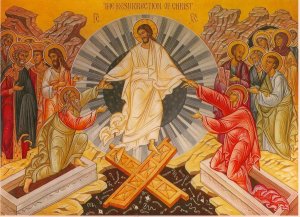
Matthew 17:1–9 1 After six days Jesus took Peter, James, and John his brother, and led them up a high mountain by themselves. 2 And he was transfigured before them; his face shone like the sun and his clothes became white as light. 3 And behold, Moses and Elijah appeared to them, conversing with him. 4 Then Peter said to Jesus in reply, “Lord, it is good that we are here. If you wish, I will make three tents here, one for you, one for Moses, and one for Elijah.” 5 While he was still speaking, behold, a bright cloud cast a shadow over them, then from the cloud came a voice that said, “This is my beloved Son, with whom I am well pleased; listen to him.” 6 When the disciples heard this, they fell prostrate and were very much afraid. 7 But Jesus came and touched them, saying, “Rise, and do not be afraid.” 8 And when the disciples raised their eyes, they saw no one else but Jesus alone. 9 As they were coming down from the mountain, Jesus charged them, “Do not tell the vision to anyone until the Son of Man has been raised from the dead.” Continue reading
Keeping up
The kingdom of heaven is like…. There are lots of parables that begin with those words. Maybe we can do a thought experiment – a kind of fill-in-the-blank thing. Keep your answers silent within your own thoughts. And since no one is listening, you can be completely honest with your answer. For you…. the kingdom of heaven is like……. What? (No hurry, I’ll wait….) Continue reading
Summer Isn’t Over

Day 1: Choose to act mercifully.
Day 2: Share what you have with those in need.
Day 3: Seek out someone you can help.
Day 4: Choose loving words and actions.
Day 5: Let no one in your day feel ignored.
Day 6: Visit, call, or send a card to someone sick.
Day 7: Pick a bad habit and let it go.
Day 8: Pray for those who have died.
Day 9: Tell someone today’s Gospel message.
Day 10: Say something to someone feeling hopeless.
Day 11: Go to confession; ask forgiveness of your sins.
Day 12: Pick an “enemy” and pray for them.
Day 13: Say to someone, “I forgive you” and mean it.
Day 14: Say thank you to God and be joyful.
Day 15: Pray for one particular person.
Day 16: Do something extra nice for Mom.
Day 17: Speak out against injustice.
Day 18: Donate clothing to a shelter.
Day 19: Donate food to a food pantry.
Day 20: Extend a loving touch to heal a hurt.
Day 21: Do something unexpected and nice for Dad.
Day 22: Offer an act of kindness to someone suffering or
afraid.
Day 23: Teach the Gospel by example.
Day 24: Be an instrument of peace .
Day 25: Be an instrument of pardon.
Day 26: Volunteer.
Day 27: Ask for forgiveness from someone.
Day 28: Find someone who needs a kind word.
Day 29: Share something with a friend.
Day 30: Write a thank you note.
Day 31: Say a prayer of gratitude to God for the last 30 days
The Net Cast Widely
The Net Cast Widely. The net pictured here is a large dragnet, usually about six feet deep and up to several hundred feet wide, positioned in the lake by boats and requiring several men to operate (hence the plurals of v. 48). The picture is realistic, portraying an ordinary event with no surprising twists: The net brings in “every kind” of both good and bad fish, which are then sorted, the good being kept and the bad thrown out. Whatever the original meaning of the parable, Matthew’s own ecclesiastical application already appears in the telling of the parable itself. The bad fish are called “rotten” (sapra), inappropriate to fish that have just been caught, but used four times previously in Matthew’s description of bad “fruit” (works) presented by Christians, where it is appropriate (7:17-18; 12:33 twice). The fishers “sit” for the sorting, as will the Son of Man at the end (19:28; 25:31). Continue reading
Treasure and Pearls: two parables
Two Parables. Matthew apparently intends the parable of the treasure to be interpreted together with the parable of the pearl, which immediately follows. The two parables do have common features: (I) In each case only a brief vignette of a crucial situation is given, without enough details to evaluate them as realistic stories. The interpreter should, therefore, be wary of filling in the gaps from pious imagination, but concentrate on what the parable does, in fact, portray. (2) The primary common feature is surely central to the meaning of each: The protagonist goes and sells everything for the sake of the one thing. This is the action of both the plowman and the merchant. This movement of the story as a whole is to be compared with the kingdom of God, for the kingdom is “like” neither the “treasure” of v. 44 nor the “merchant” of v. 45, but in each case somehow like the story as a whole. In each case, the protagonist acts with the single-minded response of the “pure in heart.” From the story in Mark 10:17-31, Matthew and his community had long known of the kingdom’s demand of “all,” and of one who had failed (cf. esp. Mark 10:21, where selling everything and giving it to the poor is connected with true “treasure”). Continue reading
Treasure and Pearls
44 “The kingdom of heaven is like a treasure buried in a field, which a person finds and hides again, and out of joy goes and sells all that he has and buys that field. 45 Again, the kingdom of heaven is like a merchant searching for fine pearls. 46 When he finds a pearl of great price, he goes and sells all that he has and buys it.
Hidden Treasure. Buried treasure is the stuff of popular stories in every age and while out “pirates” no longer sail the Seven Seas we seem content with stories of lottery winners. Given Israel’s location at the crossroads of major powers to the north and east and to the south (Egypt) there is a long history of wars and rumors of war playing out upon the promised land. “Buried treasure” was a realistic possibility. Continue reading