
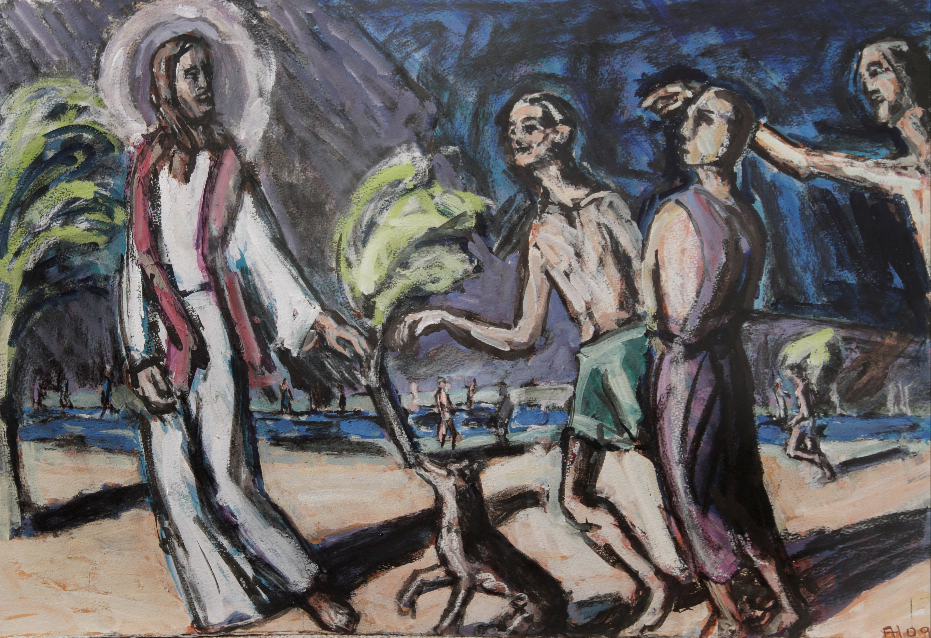
Ecce Agnus Dei – Francis Hoyland
Andrew. Three times Andrew is doing something in John – ‘and each time he is bringing someone to Jesus. First, his brother, Simon (v.40). Then, a boy with five barley loaves and two fish (6:8); and finally, “some Greeks” (12:20-22), which signals the hour for the Son of Man to be glorified. Andrew is never mentioned just by himself. Twice he is called Simon Peter’s brother (1:40; 6:8). We are told that Philip came from the city of Andrew and Simon (1:44). Andrew and Philip go and tell Jesus about the Greeks (12:22). It may be that being named as the first follower of Jesus (in the Fourth Gospel) was the first time that he had ever been first in anything. It seems likely to me that he was always living under the shadow of his more flamboyant brother. It also seems to me that our parishes are full of more behind-the-scenes “Andrews” than flamboyant “Peters” who seem to get all the credit. (“Peter” occurs in 32 verses in John – ‘8 times as many as Andrew.) One doesn’t have to be a “Peter” to be an effective follower and witness to Jesus (Stoffregen) Continue reading
 Today we celebrate the visit of the magi to the child Jesus. It is often referred to and celebrated as “Three Kings Day” especially in Latino and Mediterranean cultures. Its official name is Epiphany, from the Greek epiphania, meaning that which is revealed, unveiled. The meaning in Greek is reflected in our English language definition: (1): a usually sudden manifestation of the essential nature or meaning of something (2): an intuitive grasp of reality through something usually simple and striking (3): an illuminating discovery, realization, or disclosure. There is a certain excitement and energy that accompanies the moment of epiphany.
  Unless you happen to be like my muse, Calvin, in the comic strip, I suspect you are about to make some New Year’s resolutions. How did you do on last year’s resolutions? About the same as the rest of us? One ad hominem wisdom saying defines “insanity” this way: to keep doing the same thing and expect a different result. Perhaps 2018 is a time to consider changing the way resolutions are considered, made, and hopefully, kept.
 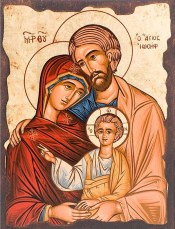 In today gospel account, it is now forty days after Jesus’ birth. Mary and Joseph are performing their duty as pious Jewish parents by coming to the Temple to fulfill the requirements of Exodus 13. It is a ritual that reminds the parents that this child is now a member of the family that God redeemed from the slavery in Egypt. And so, they come to offer a simple sacrifice as they dedicate their first-born child to the Lord and to the larger, holy covenant family of God.
  King David – living the dream! I mean who could have imagined? The Lord God had sent his prophet Samuel out to anoint the one who would be king – and the young shepherd David was selected among all of Jesse’s sons – the one to be king of Israel and all of God’s chosen people. And the Lord had been with David on the battlefield as he stood before the giant warrior Goliath. The Lord had stayed with David when he was a wanted man on the run from the murderous hand of King Saul. The Lord had guided David as be took on the mantle of leadership and had united the 12 tribes of Jacob into one nation. And now David was king.
  friarmusings