Trinity Sunday: context

TrinityHoly Trinity Sunday is celebrated on the first Sunday following Pentecost in most of the liturgical churches in Western Christianity. It is a solemn celebration of the belief in the revelation of one God, yet three divine persons. It was not uniquely celebrated in the early church, but as with many things the advent of new, sometime heretical, thinking often gives the Church a moment in which to explain and celebrate its own traditions; things it already believes and holds dear. In the early 4th century when the Arian heresy was spreading, the early church, recognizing the inherent Christological and Trinitarian implications, prepared an Office of Prayer with canticles, responses, a preface, and hymns, to be recited on Sundays to proclaim the Holy Trinity. Pope John XXII (14th century) instituted the celebration for the entire Church as a feast; the celebration became a solemnity after the liturgical reforms of Vatican II. Continue reading →

Not always what we want

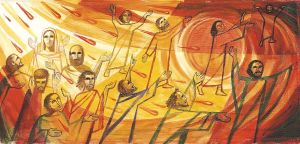
Pentecost Sunday is a day on which we are reminded that the Holy Spirit was promised and has been given. We celebrate the fulfillment of a promise by Jesus that the Advocate, the Paraclete, the one sent by Jesus would come to remind us of all that Jesus taught, to be with us, and to bring to us the power of God. We celebrate this day with three readings – each one of which is filled with mention of the Spirit. The first reading is the account from Acts 2 so familiar to every Christian, 50 days after the Resurrection. We imagine it as a very public event in which the power of the Spirit came with the roar of a great wind, as though tongues of fire, and suddenly the disciples can speak in a way that people from everywhere can understand them. It is as though what happened at the Tower of Babel is undone and finally the world can be united. The Spirit-filled disciples are to be the agents that restore unity to the world. Continue reading →
The Friars Gather

They things slow down as a parish approaches summer. That has not been my experience. I am writing this column before things even more busy. There are lots of meetings about one thing or another. Some are meetings that are looking at the “year in review” – some are planning for September 2017 and beyond. Some are planning summer events for the parish. And some are part of life as a Franciscan Friar. Continue reading →
Receiving the Spirit: forgiveness

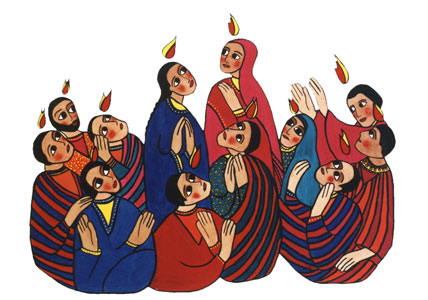
Pentecost3“Whose sins you forgive are forgiven them, and whose sins you retain are retained.” Many scholars see a parallel between v.23 and Matthew 18:18: “Amen, I say to you, whatever you bind on earth shall be bound in heaven, and whatever you loose on earth shall be loosed in heaven.” The parallel becomes clearer when we know that the words “forgive” in John 20:23 are the Greek words aphiēmi and krateō which mean “send away” and “hold” respectively [EDNT 2:314]. But even with the parallels aside, the meaning, extent and exercise of the Matthean and Johannine powers has been a source of division with the post-Reformation Christian community. Continue reading →

What to wear? – meeting the Pope!

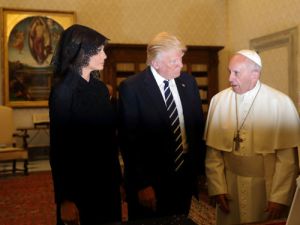
When President Donald Trump recently visited Pope Francis, part of the world’s attention was on Melania and Ivanka Trump as they wore black dresses and veils while meeting the Holy Father. The Holy See does not impose a compulsory dress code, but does suggest a protocol for state visits and hearings with the Pope, both for men and women. In the case of the latter, the protocol requires a long black dress with a high neckline, long sleeves, and a black veil. For historical reasons, however, some Catholic queens or consorts of kings have traditionally been exempted from using black. This is the so-called “privilège du blanc” (privilege of white), a special prerogative granted under the Pope’s criteria. Continue reading →

Receiving the spirit: sent

Pentecost3“As the Father has sent me, so I send you” The Fourth Gospel speaks often of Jesus being sent into the world by the Father: to do his will (6:38–39; 8:29), to speak his words (3:34; 8:28; 12:49; 14:24; 17:8), to perform his works (4:34; 5:36; 9:4) and win salvation for all who believe (3:16–17). That the disciples were sent to continue the words and works of Jesus is foreshadowed at various places in the Gospel: Jesus urged them to lift up their eyes and see fields ripe for harvest, and told them he had sent them to reap where others had labored (4:35–38), he said those who believed in him would do the works he had done and greater works than these because he was returning to the Father (14:12); he told them, “I … chose you and appointed you to go and bear fruit that will remain, so that whatever you ask the Father in my name he may give you” (15:16), saying that when the Paraclete comes “he will testify to me. And you also testify, because you have been with me from the beginning” (15:26–27), and when he prayed for his disciples he said to the Father, “As you sent me into the world, so I sent them into the world” (17:18). This last text, which parallels 20:21, confirms that the sending of the disciples was ‘into the world’, i.e. with a mission to the world. The other texts reveal the essential content of their mission was to ‘harvest’ men and women for the kingdom by their witness to Jesus by word and deed, alongside the ongoing witness of the Spirit. Continue reading →

Receiving the Spirit: peace

Pentecost3The Johannine account of the first post-resurrection appearance to the gathered disciples is linked to the events of the Resurrection by the simple expression “that first day.” As the startling and disturbing events of the last three days had unfolded the community’s overriding response was fear. They had gathered, but had locked themselves away out of fear of what persecutions the religious authorities might bring against them. It is into this complex of uncertainty, perhaps doubt and hesitation, that Jesus appears. Continue reading →

Receiving the Spirit: context

Pentecost319 On the evening of that first day of the week, when the doors were locked, where the disciples were, for fear of the Jews, Jesus came and stood in their midst and said to them, “Peace be with you.” 20 When he had said this, he showed them his hands and his side. The disciples rejoiced when they saw the Lord. 21 (Jesus) said to them again, “Peace be with you. As the Father has sent me, so I send you.” 22 And when he had said this, he breathed on them and said to them, “Receive the holy Spirit. 23 Whose sins you forgive are forgiven them, and whose sins you retain are retained.” Continue reading →

Doubts and all

When they saw him, they worshiped, but they doubted… (Mt 20:17)
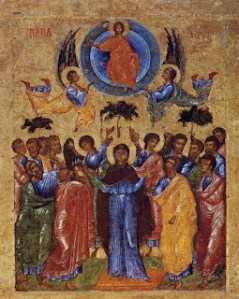
We are a little uncomfortable with that doublet:  worshiped, doubted.  I mean these are the apostles – they have been with Jesus for three years and have seen incredible signs and wonders, the lame have walked, the deaf hear and mute speak.  Surely these apostles would be people of great faith. Continue reading →

Reason to celebrate

The Ascension of the Lord is a great celebration of the Church. It commemorates the bodily ascension of Jesus into heaven. According to St. Luke it occurred 40 days after the Resurrection (Acts 1:3). It is a feast of great antiquity with liturgies and art of the 4th century already addressing it as a norm of the Church. In the Eastern Church this feast is known in Greek as Analepsis, the “taking up,” and also as the Episozomene, the “salvation from on high,” indicating that by ascending into his glory Christ completed the work of our redemption. Continue reading →