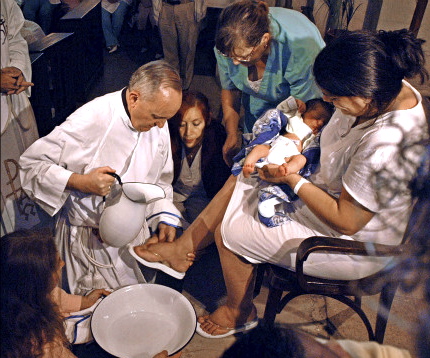
Did you know you are a priest? It is part of Catholic teaching that because of your baptism you share in a universal priesthood. Although having a different implication of such a priesthood, the German protestant Martin Luther described it this way: “The fact that we are all priests… means that each of us Christians may go before God and intercede for the other, If I notice that you have no faith or a weak faith, I can ask God to give you a strong faith.” Cardinal George, speaking about service, says a similar thing when he wrote: “Every Christian is someone else’s priest, and we are all priests to one another.” It seems to me that these notions of service as part of the universal priesthood very well fit the very readings on Holy Thursday, when we celebrate the sacramental priesthood, as Jesus takes off his cloak, puts on an apron and serves the disciples in the most menial of tasks: washing feet. The sacramental priesthood rests upon the more intrinsic foundation of the universal priesthood in which we all have the call to service because we are impelled by the love of God. Continue reading
What do you believe in there?
There are many different scenes and settings in which this basic scenario can play out. Barbara Taylor Brown tells of a woman in her congregation who left church, her mind and attention already turned to many things. She did not notice a lost-looking man on the sidewalk staring up at the cross on the steeple. She excused herself and started to walk on her way when the man called to her, and, pointing to the doors of the church, asked, “What is it that you believe in there?” She started to answer and then was unsure of what to say, or how to say it, or if she should say it. After a long uncomfortable silence, the man said, “Sorry to have bothered you” and walked away. Continue reading
How wide the embrace?
What kind of person…what kind of community. As we noted at the beginning, a large part of the Matthean narrative is devoted questions: (a) who is Jesus, (b) what does it mean to be his disciples in the light of his identity, and (c) what choices will you make because of his call. Those are questions that could be asked of the community as well as the individual. Fr. Ronald Rolheiser makes that point well in his reflection “The Width of Our Ecclesial Embrace” Continue reading
Upon the rock
Jesus’ Response: an emerging church. What history has made clear is that Jesus’ response had been a source of controversy in so far as how it is understood and thus what kind of church was expected to emerge from Jesus’ earthly ministry. Clearly whatever emerges is under the blessing of Christ. Continue reading
Calculus of the Kingdom
When I was a youth I read a book, “Cheaper By the Dozen” that tells the story of time and motion study and efficiency experts Frank Bunker Gilbreth and Lillian Moller Gilbreth, and their twelve children. I always thought they were on to something, at least in the sense that their must be a “calculus of child rearing.” So years later armed with an undergraduate degree in Mathematics, an MBA, and zero child rearing experience, I thought I would offer a multivariate model of child rearing that could be of aid to parents everywhere. Continue reading
Confession of Faith
Commentary. This pericope is located in a section of Matthean narrative that portrays the formation of the church (13:53-17:27) in the midst of the continuing conflict with all levels of Jewish society that is leading towards a growing rejection of Jesus as Messiah. This story forms the hinge of the section because after this Jesus will heighten his attention to the preparation of the disciples for their mission as a community once Jesus has died and resurrected from the dead. It will be a community who perceives and professes his true identity. Continue reading
The Confession: a context
Matthew 16:13-2013 When Jesus went into the region of Caesarea Philippi he asked his disciples, “Who do people say that the Son of Man is?”14 They replied, “Some say John the Baptist, others Elijah, still others Jeremiah or one of the prophets.”15 He said to them, “But who do you say that I am?”16 Simon Peter said in reply, “You are the Messiah, the Son of the living God.”17 Jesus said to him in reply, “Blessed are you, Simon son of Jonah. For flesh and blood has not revealed this to you, but my heavenly Father.18 And so I say to you, you are Peter, and upon this rock I will build my church, and the gates of the netherworld shall not prevail against it.19 I will give you the keys to the kingdom of heaven. Whatever you bind on earth shall be bound in heaven; and whatever you loose on earth shall be loosed in heaven.”20 Then he strictly ordered his disciples to tell no one that he was the Messiah. Continue reading
Resolutions – it’s never too late
A number of us were sitting around last week talking about this and that, and any number of things. In the course of the conversation someone mentioned New Year’s Resolutions – what has worked and what has… shall we say… resides somewhere between “oh yeah, I forgot about that” and “yeah… that didn’t work out so well.” What was interesting to us all is that many times the resolutions that did not work out shared something with “what not to do” advice in a column that appeared in this space just before New Year’s Day 2014. People thought it would be good to be reminded; hence the “reprint.” How did you do with your resolutions? Labor Day marks a “new year” of sorts. It is never too late. Continue reading
The Canaanite Woman: the reply
How are we to Understand Jesus’ Response? The disciples’ request, Send her away for she keeps calling out after us need not be understood as disapproval of her request, but simply a desire for peace and quiet (cf. 19:13?). In fact, if Jesus would just grant the petition, they all can rest. Many scholars hold this content makes Jesus’ emphatic objection (v.24) more cogent. But rather than take the path of least resistance, there is a principle to be highlighted. The principle is the same as that of 10:5–6, of a mission restricted to Israel (during Jesus’ earthly ministry): “I was sent only to the lost sheep of the house of Israel. The statement here is Jesus’ explanation to the disciples of his unexpectedly unwelcoming response to a woman in need; she herself need not have heard it, as it is only in v.25 that she approaches Jesus closely. Continue reading
The Canaanite Woman: crossing over
A Framework to Understand the Response. It is believed that the etymology of “Hebrew” comes from the Semitic root ‘apiru, which refers to those who cross over. It is an apt description when one considers the journeys of Abraham and Sarah, the travels of Jacob/Israel and his 12 sons, and the Exodus of the Jews to Israel – a narrative history of people who were “other” and yet willing to “cross over” because of the call of God. And paradoxically, the disciples are not willing to “cross over” to console this woman who is “other.” Continue reading