Know Jesus: grace and glory

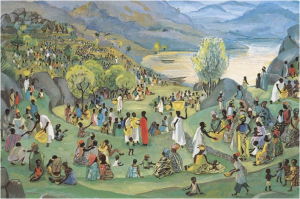
John 6+crowd+feedingThis chapter begins the second major ministry section in John (6:1-10:42). There are similarities to the beginning of the first major ministry section (2:1-5:47). O’Day [591] suggests: “It is probably no accident that the two inaugural miracles involve wine and bread, the sacramental symbols of God’s grace in Jesus.” Both sections start with miracles in Galilee that show God’s abundant grace and Jesus’ divine glory: Continue reading

Know Jesus: context

John 6+crowd+feeding1After this, Jesus went across the Sea of Galilee (of Tiberias). 2 A large crowd followed him, because they saw the signs he was performing on the sick. 3 Jesus went up on the mountain, and there he sat down with his disciples. 4 The Jewish feast of Passover was near. 5 When Jesus raised his eyes and saw that a large crowd was coming to him, he said to Philip, “Where can we buy enough food for them to eat?” 6 He said this to test him, because he himself knew what he was going to do. 7 Philip answered him, “Two hundred days’ wages worth of food would not be enough for each of them to have a little (bit).” 8 One of his disciples, Andrew, the brother of Simon Peter, said to him, 9 “There is a boy here who has five barley loaves and two fish; but what good are these for so many?” 10 Jesus said, “Have the people recline.” Now there was a great deal of grass in that place. So the men reclined, about five thousand in number. 11 Then Jesus took the loaves, gave thanks, and distributed them to those who were reclining, and also as much of the fish as they wanted. 12 When they had had their fill, he said to his disciples, “Gather the fragments left over, so that nothing will be wasted.” 13 So they collected them, and filled twelve wicker baskets with fragments from the five barley loaves that had been more than they could eat. 14 When the people saw the sign he had done, they said, “This is truly the Prophet, the one who is to come into the world.” 15 Since Jesus knew that they were going to come and carry him off to make him king, he withdrew again to the mountain alone. Continue reading

Hard to accept: final thought

TrinityNow that we reached the end of “The Bread of Life Discourse,” I thought it appropriate to have a “final thought.” I would offer this reflection from Bishop Craig Satterlee, a Lutheran bishop from Michigan [workingpreacher.org]

“Jesus promises rather than instructs or explains. Jesus promises that whoever eats the flesh and drinks the blood of Jesus, the Son of Humanity, has eternal life now and will be raised up on the last day. Jesus promises to provide food for the life of the world, his flesh and blood. Jesus promises to nourish the world with the gift of himself. For the “flesh” and “blood” of Jesus, his incarnate life and very real death on the cross, is life-giving food for us and for the world. In, with, and under the bread and wine of Holy Communion, which is nothing other than Christ’s body and blood, Jesus nourishes faith, forgives sin, and empowers us to be witnesses to the Gospel. What would it mean for preachers to proclaim Jesus’ promises rather than explain the sacrament?” Continue reading

Hard to accept: grace and will

Trinity64 But there are some of you who do not believe.” Jesus knew from the beginning the ones who would not believe and the one who would betray him. 65 And he said, “For this reason I have told you that no one can come to me unless it is granted him by my Father.” 66 As a result of this, many (of) his disciples returned to their former way of life and no longer accompanied him.

Some believe and some don’t. This is a theme woven throughout John 6 – the tension between divine initiative and human choice. Verse 65 echoes vv. 37,39, and 55 – we are drawn to Jesus via the initiating action of God. Continue reading

Hard to accept: Spirit, Flesh, and Life

Trinity63 It is the spirit that gives life, while the flesh is of no avail. The words I have spoken to you are spirit and life

John 6:63 is often a verse that one arguing against any Eucharistic interpretation of the whole of John 6 brings forward. The logic goes like this: “Jesus is saying things that are confusing. His disciples think he’s being literal. Jesus clears it up by saying “No not at all. I’m not saying that you should eat my flesh. My flesh profits nothing! I’m speaking with Spirit and life, which is metaphorical in nature.” That is more of a “hand waving” argument, but the scholarly argument proceeds along similar lines. Scholars who don’t hold the Bread of Life discourse as Eucharistic present but secondary at best also use the words of v. 63 to buttress their position. How, they argue, could Jesus advocate giving and eating his flesh in vv. 51–58 and reject the value of flesh here? Verses 51–58 thus cannot belong to the core of Jesus’ teaching in chap. 6, and the disciples in vv.60–71 can only be understood as protesting Jesus’ words in 6:35–50, not those in 6:51–58. (In case you miss the subtle of this train of thought, these scholars are arguing vv.51-58 are not part of the original Discourse but were added in later.) Continue reading

Hard to accept: grumbling

TrinityChallenging the grumbling. 60 Then many of his disciples who were listening said, “This saying is hard; who can accept it?” 61 Since Jesus knew that his disciples were murmuring about this, he said to them, “Does this shock you? 62 What if you were to see the Son of Man ascending to where he was before?

Before v.60 the dialogue was with the people in the crowds was marked by grumbling, incredulity, and quarrelling. The same range of reactions will be found among those closest to Jesus, the disciples: murmuring (v. 61), disbelief (v. 64), rejection (v. 66), confession of faith (vv. 68–69), and betrayal (vv. 64, 71). Jesus offers his very self – and yet even among the closest there are those who turn away to a former life, forsaking the very author of life. Continue reading

Hard to accept: word and sacrament

TrinityIt is Jesus’ words in the discourse that are also gift to the crowds along with the bread. The words are the gateway for the ones who ate the bread to see and believe (6:40) and thus to have life and live forever (6:51, 58). At the same time, one must eat the bread in order to live (6:53, 58). These are part of the seamless union of flesh, spirit, humanity, and divinity that are part of the integrity of the whole of Chapter 6.

It seems to me that too many commentators separate the miraculous feeding (vv.1-25) from the Christological and theological content of what follows. Their comparison point is no longer the Johannine miraculous feeding but rather the synoptic Eucharistic institution, norms of the primitive church and later patristic periods, and developing theology of later ages up and through the 17th century. Continue reading

Hard to accept: context

Trinity60 Then many of his disciples who were listening said, “This saying is hard; who can accept it?” 61 Since Jesus knew that his disciples were murmuring about this, he said to them, “Does this shock you? 62 What if you were to see the Son of Man ascending to where he was before? 63 It is the spirit that gives life, while the flesh is of no avail. The words I have spoken to you are spirit and life. 64 But there are some of you who do not believe.” Jesus knew from the beginning the ones who would not believe and the one who would betray him. 65 And he said, “For this reason I have told you that no one can come to me unless it is granted him by my Father.” 66 As a result of this, many (of) his disciples returned to their former way of life and no longer accompanied him. 67 Jesus then said to the Twelve, “Do you also want to leave?” 68 Simon Peter answered him, “Master, to whom shall we go? You have the words of eternal life. 69 We have come to believe and are convinced that you are the Holy One of God.” (John 6:60–69) Continue reading

Living Bread: death or life

living-breadMorris [335] offers this: “There is, moreover, a reference to the death of Christ, as we saw on verse 51. Flesh and blood in separation point to death. The words, then, are a cryptic allusion to the atoning death that Jesus would die, together with a challenge to enter the closest and most intimate relation with him.134 They are to be interpreted in the light of verse 47.” While most would accept the intuition of Jesus’ atoning death are implied, there are few who argue that is a major theme. Yet Morris strains against established biblical meaning. In Hebrew, the double formula “flesh and blood” emphasizes the reality and corporeality of human existence. Continue reading

Living bread: flesh and blood

living-bread53 Jesus said to them, “Amen, amen, I say to you, unless you eat the flesh of the Son of Man and drink his blood, you do not have life within you. 54 Whoever eats my flesh and drinks my blood has eternal life, and I will raise him on the last day.

The language is graphic and direct, including images and actions that would have been abhorrent to faithful Jews: eating flesh and drinking blood (Gen 9:4). But is the language meant to be realistic or one of metaphor. Morris’ approach [335] to this question seems fairly standard among those who do not hold to the sacramental, Eucharistic understanding of this text. “Both ‘eat’ and ‘drink’ are aorists, denoting once-for-all action, not a repeated eating and drinking, such as would be appropriate to the sacrament. And this eating and drinking are absolutely necessary for eternal life. Those who do not eat and drink in the way Jesus says have no life. Eating and drinking Christ’s flesh and blood thus appears to be a very graphic way of saying that people must take Christ into their innermost being.” I would suggest that it is hard to make this argument and at the same time demand also other biblical sources inform the understanding. Continue reading
