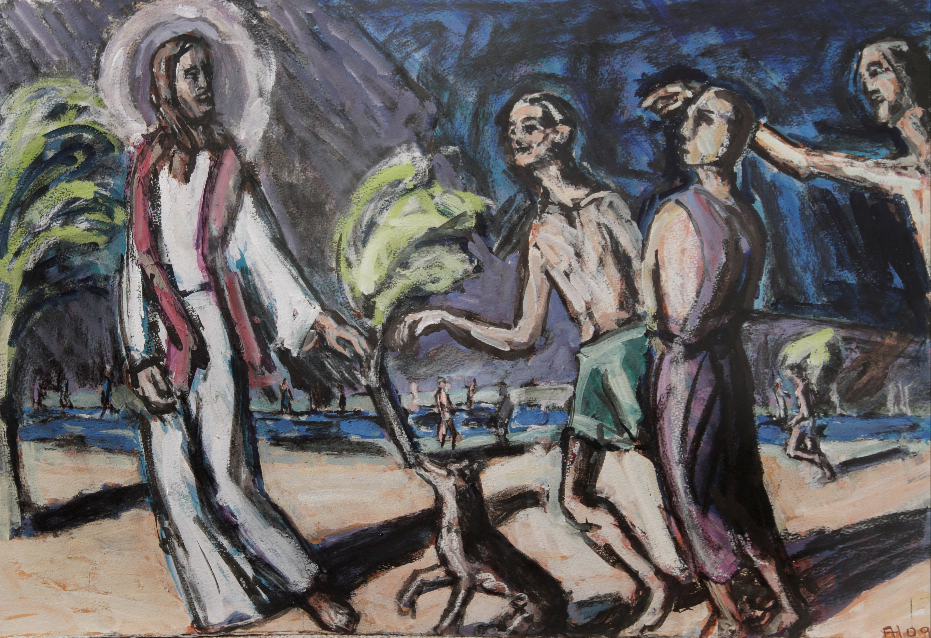
This coming Sunday is the 3rd Sunday in Ordinary Time. 16 As he passed by the Sea of Galilee, he saw Simon and his brother Andrew casting their nets into the sea; they were fishermen. As the first act of the Galilean mission Mark reports the calling of Simon and Andrew to be fishers of men. Jesus found these brothers working as fishermen on the shores of the Sea of Galilee, elsewhere designated the Lake of Gennesaret or the Sea of Tiberias. The inland sea, which was twelve miles in length and six miles across at its widest point, provided a point of access between Galilee and Perea. There were many towns and fishing villages especially on the western and northern shores. The waters teemed with life, and when Jesus summoned the brothers they were casting their nets into the sea. Continue reading
Tag Archives: calling disciples
Certitude or Trust
This coming Sunday is the 3rd Sunday in Ordinary Time. Douglas John Hall (Bound and Free: A Theologian’s Journey) writes about the necessity of “our becoming and being a thinking faith.” I think it relates to these two commands to repent and believe.
There is a problem today that is found not only in Christianity but in most of the religions, as well as in many nonreligious ideologies. I will call this the problem of certitude. Its corrective is the importance of Christianity’s being a thinking faith – and, more specifically, the importance of doubt in the life of faith. Continue reading
Repent and Believe
This coming Sunday is the 3rd Sunday in Ordinary Time. “Repent, and believe in the gospel.” (Mk 1:15) John Williamson, (Mark, p.43) offers this analogy which “may capture some (not all) dimensions of this summary of the preaching of Jesus.”
In a crowded airline terminal, hundreds of persons are scurrying in dozens of directions. Above the steady buzz of noise a voice booms through a loud-speaker, “Flight 362 is now arriving at gate we. Will passengers holding tickets for New York please check in at gate 23; you will be boarding soon.” Some people, of course, never hear the announcement and continue on their way. Others hear it but, having reservations on another flight, pay no attention. Some, however, who want to go to New York and who have been nervously awaiting such an announcement, look up expectantly, check their ticket for the flight number, gather their baggage, turn around and set out with some urgency for gate 23.
The Kingdom of God
This coming Sunday is the 3rd Sunday in Ordinary Time. The exact meaning of the expression “kingdom of God” is nowhere explicitly defined. In modern English we tend to think of “kingdom” as having geographical boundaries with associated royalty. The Greek word used is basileia which can mean kingdom in the same way, but as with its corresponding words in Hebrew and Aramaic, the more common meaning refers to “sovereign authority.” In the Old and New Testaments the Kingdom of God is often referred to in universal terms, but since this earth is the scene of universal rebellion against God, the Kingdom of God is the sphere in which, at any given time, His rule is acknowledged. Continue reading
The Time of Fulfillment
This coming Sunday is the 3rd Sunday in Ordinary Time. “This is the time of fulfillment. The kingdom of God is at hand.” (Mk 1:15) This phrase is only in Mark. The word for time is kairos; it is used in 11:13 and 12:2 to refer to the “time of harvest” – an image that usually refers to the time of judgment. It is also used in Mark 13 when the writer refers to the kairos of the great judgment: “The Son of Man coming in clouds with great power and glory.” Yet this is something “unfulfilling” about the moment. Continue reading
Transition
This coming Sunday is the 3rd Sunday in Ordinary Time in Lectionary Cycle B when our gospels are primarily drawn from the Gospel of Mark. The Gospel of Mark begins: “The beginning of the gospel of Jesus Christ the Son of God.” (Mark 1:1) And then in the following 13 verses, Mark introduces John the Baptist and his ministry in the wilderness “proclaiming a baptism of repentance for the forgiveness of sins.” (vv. 2-8), describes Jesus being baptized (vv.9-11), and then simply describes Jesus being driven by the Spirit into the wilderness (vv. 12-13). Continue reading
Following: context
Mark 1:14 After John had been arrested, Jesus came to Galilee proclaiming the gospel of God: 15 “This is the time of fulfillment. The kingdom of God is at hand. Repent, and believe in the gospel.” 16 As he passed by the Sea of Galilee, he saw Simon and his brother Andrew casting their nets into the sea; they were fishermen. 17 Jesus said to them, “Come after me, and I will make you fishers of men.” 18 Then they abandoned their nets and followed him. 19 He walked along a little farther and saw James, the son of Zebedee, and his brother John. They too were in a boat mending their nets. 20 Then he called them. So they left their father Zebedee in the boat along with the hired men and followed him.
The Bigger Picture. The first major section of Mark’s Gospel extends from 1:14 to 3:6, and describes the initial phase of the Galilean ministry. Within this section the evangelist records the calling of the first disciples (1:16–20; 2:14), Jesus’ ministry in and around Capernaum (1:21–34), and a series of controversies (2:1–3:6) which are climaxed by the decision to seek Jesus’ death (3:6). Continue reading
Come and See: calling disciples
Andrew. Three times Andrew is doing something in John – ‘and each time he is bringing someone to Jesus. First, his brother, Simon (v.40). Then, a boy with five barley loaves and two fish (6:8); and finally, “some Greeks” (12:20-22), which signals the hour for the Son of Man to be glorified. Andrew is never mentioned just by himself. Twice he is called Simon Peter’s brother (1:40; 6:8). We are told that Philip came from the city of Andrew and Simon (1:44). Andrew and Philip go and tell Jesus about the Greeks (12:22). It may be that being named as the first follower of Jesus (in the Fourth Gospel) was the first time that he had ever been first in anything. It seems likely to me that he was always living under the shadow of his more flamboyant brother. It also seems to me that our parishes are full of more behind-the-scenes “Andrews” than flamboyant “Peters” who seem to get all the credit. (“Peter” occurs in 32 verses in John – ‘8 times as many as Andrew.) One doesn’t have to be a “Peter” to be an effective follower and witness to Jesus (Stoffregen) Continue reading
Called to the Light
Currently, I am reading “The History of Florida” by Michael Gannon, a professor emeritus at the University of Florida. The book is a monographic sweep through Florida history from the pre-Columbian landscape, the settling by native peoples, the arrival of the first European explorers, the history of ethnicity and immigration, and to the changing landscape of life and people who form the great state we live in. So far I have also learned an amazing amount by the early Franciscan missionaries in Florida and Georgia in the 16th and 17th centuries. It put me in a “historical mindset” this week. Continue reading
Following: context
12 When he heard that John had been arrested, he withdrew to Galilee. 13 He left Nazareth and went to live in Capernaum by the sea, in the region of Zebulun and Naphtali, 14 that what had been said through Isaiah the prophet might be fulfilled: 15 “Land of Zebulun and land of Naphtali, the way to the sea, beyond the Jordan, Galilee of the Gentiles, 16 the people who sit in darkness have seen a great light, on those dwelling in a land overshadowed by death light has arisen.” 17 From that time on, Jesus began to preach and say, “Repent, for the kingdom of heaven is at hand.” 18 As he was walking by the Sea of Galilee, he saw two brothers, Simon who is called Peter, and his brother Andrew, casting a net into the sea; they were fishermen. 19 He said to them, “Come after me, and I will make you fishers of men.” 20 At once they left their nets and followed him. 21 He walked along from there and saw two other brothers, James, the son of Zebedee, and his brother John. They were in a boat, with their father Zebedee, mending their nets. He called them, 22 and immediately they left their boat and their father and followed him. 23 He went around all of Galilee, teaching in their synagogues, proclaiming the gospel of the kingdom, and curing every disease and illness among the people. Continue reading