
The word that reflects the deepest identity of Jesus is “Christ.” It is not a name, but a title. The Greek word Christos translates the Hebrew word moshiach or messiah. All those words mean “the Anointed One.” When we call upon Jesus Christ, we invoke the fact that Our Lord is anointed.
Throughout the Bible, anointing means the application of oil to someone’s body. Sometimes, it refers to simple grooming (Luke 7:46). But most of the time it means a special consecration.
- Kings were anointed (1 Samuel 9:16).
- Prophets were anointed (1 Kings 19:16).
- Priests were anointed (Exodus 40:15).
People who were anointed were set apart for a sacred task. They were fundamentally changed and divinely equipped for their mission. Through the action of anointing, God gave them a share of the holiness that is divine by nature.
Jesus’ anointing was more radical. He was anointed not with oil, but with the Holy Spirit (Luke 3:22, 4:18-21).
And that is the anointing he has shared with all Christians through the sacraments.
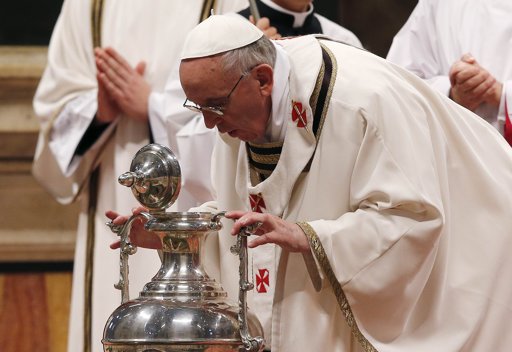
This week bishops in all diocese will celebrate the Chrism Mass. This liturgy takes place every year during Holy Week, and it is an important moment in the life of the local Church. During the Chrism Mass, Catholic priests renew the promises they made at the time of their ordination. They promise to respect and obey their bishop, and to live the chaste life that is proper to the clergy.
But the Chrism Mass gets its name from another action that occurs only on this day. During a special rite, the bishop will bless three different oils to be used in sacraments. He’ll bless holy chrism, the oil of catechumens, and the oil of the sick. The first is used in the sacraments of confirmation and holy orders. The second is used in baptism. The third is used for anointing people who are ill or infirm.
After the Chrism Mass, these oils will be distributed to every parish in the archdiocese. As the bishop sends out the oils, he symbolically renews his connection with every parish under his care. Through those oils he will take part in thousands of sacramental moments throughout the year. He will be there with the priest who visits a parishioner’s hospital bed. He will be there with the deacon who baptizes a baby. He will be there to welcome adult converts who are confirmed on Easter Vigil. In all these sacraments, the clergy apply the oils — they anoint. And so they make Christians, and they strengthen Christian identity, in a way that is true to the root meaning of the word anointing. They make every Christian into another Anointed One, another christ.
The Chrism Mass is a beautiful moment when the unity of the Church — clergy and laity — is most visible. We have many anointings, but “there is one body and one Spirit … one Lord, one faith, one baptism” (Ephesians 4:4-5).
“You have been anointed by the Holy One, and … the anointing which you received from him abides in you” (1 John 2:20, 27).
Adapted from Archdiocese of Los Angeles
 Folks who read blogs don’t always know too much about the person whose writings they have taken the time to read. You can always find out a little something on an “About” page. Here is
  friarmusings