Buona Festa!!

Today is the Feast of St. Francis of Assisi. Many blessings to all Franciscans and all those of a Franciscan heart.

The Lord bless you and keep you.
May He show His face to you and have mercy.
May He turn His countenance to you and give you peace.
The Lord bless you!

Happy Feast Day!

Being Family

The gospel today is one that was a central part of St. Francis of Assisi’s way of following Christ. Those who would follow this way of following Christ needed to understand that there was a clear demarcation between the former way of sin and that of “leaving the world.” In his writing known as the Earlier Exhortation, Francis divides the world of people into two categories: “Those Who Do Penance” and “Those Who Do Not Do Penance.” In medieval writing “penance” does not refer primarily to sacramental confession, but to a life directed to conversion to Christ. Continue reading

Buona Festa!!

Today is the Feast of St. Francis of Assisi. Many blessings to all Franciscans and all those of a Franciscan heart.

The Lord bless you and keep you.
May He show His face to you and have mercy.
May He turn His countenance to you and give you peace.
The Lord bless you!

Happy Feast Day!

A next step

You have to feel for the disciples. In recent gospels Jesus has been asking some fairly extraordinary things of them – to give away their possessions, to forgive countless times, to take up his cross, and the list goes on. No wonder then, they ask for more faith. They don’t feel up to what is being asked of them, are anxious about the challenges ahead, and just can’t imagine accomplishing what is being asked of them. Continue reading

Celano’s First Life of St. Francis

The earliest written account of Francis and the Leper occurs in Thomas of Celano’s The First Life (1C) written c.1229. The work was commissioned by Pope Gregory IX who asked Celano to write a vita of the newly canonized saint. Francis died in 1226, was declared a saint in rapid order and by April 1228, Gregory called for a burial church to be built for Francis. The commission to Celano was complementary to the architectural celebration. The vita was written in short order and declared official by Gregory in February 1229. Continue reading

Francis and the Leper: Fraternity and Factions

…and we continue with some historical context and background for our consideration of the accounts of St. Francis and the Leper.

While Francis was present with them in the years before 1219, the newness and charismatic dynamism of Francis was enough to keep the small group of brothers open to the unfolding vision that God was giving Francis.  They took on no special tasks or roles, rather they committed to a certain way of living the Gospel of Jesus Christ.  But as seen in the vocational questions above, the world and the Church had true needs, and the Pope especially saw in Francis and his brothers a ready reserve of workers for the vineyards of the Lord. Continue reading

Francis and the Leper: Growing Pains

…and we continue with some historical context and background for our consideration of the accounts of St. Francis and the Leper.

By the spring of 1213, four years after the founding of the “order,” Francis’ reputation had risen to the attention of the Italian aristocracy – not just in Assisi but throughout central Italy.  The order was beginning to attract men from the higher social classes. Sons of merchants like Francis, sons of the landed wealthy, sons of ruling households, men with established careers in law, music and the arts, and also ordained priests. They joined the already formed group of men from middle and lower backgrounds and joined in on the muddling through what it meant to follow Christ in the manner of Francis. G.K. Chesterton’s later definition of the Catholic Church – “here comes everybody.” Broadly speaking, apart from their spiritual gifts, these were “company men.” How many friars joined the fraternity in those years?  It is impossible to say, but we do know this: in 1217 the annual meeting (called a “chapter”) made the decision to send out missions across the Alps into northern Europe, the Baltic states, and to the Crusader States in the eastern Mediterranean. Within Italy, six provinces were established; outside of Italy, five provinces were established: Spain, northern and southern France, Germany, and Syria. Some scholars have written that the number of brothers exceeded 700 men. Continue reading

Francis and the Leper: the growth of the Fraternity

When Franciscans recount the story of Francis and the leper, one might presume that they are telling a story from a common core, perhaps even an official recounting of the story as approved by a Minister General of the Order of Friars Minor. And even if some friars are telling the story from a source different from the “official” record, the different medieval sources used make little difference, yes? Yea… not so much. Every medieval source has its own goal, tone, genre and point of view. And that is especially true in the period beginning some 20 years after Francis’ death (d.1226). Continue reading

Francis of Assisi and almsgiving

prayer fasting almsgiving2There are many ideas that people hold about what it means to be Franciscan.  I was once asked, “Where do you friars keep the animals?”  I was living in the Soundview area of the Bronx at the time.  The person assumed that our way of life would always be surrounded by furry friends.  Later, another person wondered why we were not living out our vow of poverty by spending our day begging for alms? Continue reading

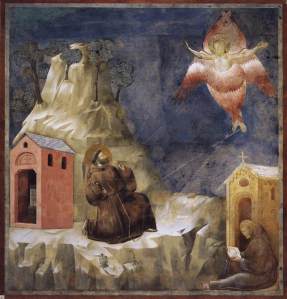
The Stigmata

stigmata-st-francis-giottoAfter Francis’ withdrawal from active ministerial leadership of the friars, he witnessed an inevitable evolution of the religious order, which had grown to over 5,000 brothers in 1223 from the humble beginnings in 1209 of Francis and four companions. The evolution of the Order, necessary on a number of levels, also began to change the life of the fraternity. Francis worried that the Spirit of prayer was being compromised and that the necessities of ministry were leading the brothers to increasing ties to material possessions. He lived and suffered in a “Time of Doubt,” as described in the previous article. Continue reading