Writing earlier about St. Francis Xavier, I was reminded about a Franciscan missioner, John of Montecorvino, whose feast was November 29. Mention John of Montecorvino and most people – even most Franciscans – will say “who?” John was the first Catholic missionary to China, centuries before the efforts of other Catholic religious orders. It is a compelling story. If you would like to read an interesting and accessible account of the travel within the context of an art historian comparing 13th century Italian and Chinese art, read Lauren Arnold’s: Princely Gifts & Papal Treasures: The Franciscan Mission to China & Its Influence on the Art of the West, 1250-1350 – fascinating book.
Continue readingTag Archives: franciscan
Blessed John Duns Scotus
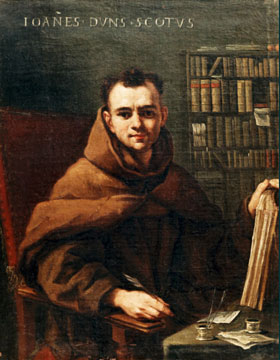
November 8th is the feast day of Blessed John Duns Scotus, a Franciscan friar from Scotland noted for his theological and philosophical work in the high-middle ages (late 13th and early 14th centuries). Scotus’ work was in the generation that followed Thomas of Aquinas and Bonaventure. His work was complex and nuanced, and he is generally considered to be one of the three most important philosopher-theologians of his time. He was given the medieval accolade Doctor Subtilis (Subtle Doctor) for his penetrating and subtle manner of thought.
Continue readingThe Assumption of Mary in Art
Much of our religious consciousness is affected by art; we have inherited specific images that are more artistic than biblical. For example, we always imagine St. Paul being knocked from a horse on the Damascus Road. There is no mention of the horse in scripture. Is that a bid deal? Perhaps not. But when Caravaggio placed Paul on the horse, a sign of privilege or royalty, he removed Paul from the midst of Corinth, the hard-scrabbled sea port town, from among the drunks, slackards, ner-do-wells, and people who sorely needed salvation. Continue reading
Talking about missionaries….
Writing earlier about St. Francis Xavier, I was reminded about a Franciscan missioner, John of Montecorvino, whose feast was November 29. Mention John of Montecorvino and most people – even most Franciscans – will say “who?” John was the first Catholic missionary to China, centuries before the efforts of other Catholic religious orders. It is a compelling story. If you would like to read an interesting and accessible account of the travel within the context of an art historian comparing 13th century Italian and Chinese art, read Lauren Arnold’s: Princely Gifts & Papal Treasures: The Franciscan Mission to China & Its Influence on the Art of the West, 1250-1350 – fascinating book.
The Subtle Doctor
November 8th is the feast day of Blessed John Duns Scotus, a Franciscan friar from Scotland noted for his theological and philosophical work in the high-middle ages (late 13th and early 14th centuries). Scotus’ work was in the generation that followed Thomas of Aquinas and Bonaventure. His work was complex and nuanced, and he is generally considered to be one of the three most important philosopher-theologians of his time. He was given the medieval accolade Doctor Subtilis (Subtle Doctor) for his penetrating and subtle manner of thought. Continue reading
John of Montecovino: Franciscans in China
Servant of God – John of Montecorvino
Franciscan and first Bishop of Beijing
Writing earlier about St. Francis Xavier, I was reminded about a Franciscan missioner, John of Montecorvino, whose feast was November 29. Mention John of Montecorvino and most people – even most Franciscans – will say “who?” John was the first Catholic missionary to China, centuries before the efforts of other Catholic religious orders. It is a compelling story. If you would like to read an interesting and accessible account of the travel within the context of an art historian comparing 13th century Italian and Chinese art, read Lauren Arnold’s: Princely Gifts & Papal Treasures: The Franciscan Mission to China & Its Influence on the Art of the West, 1250-1350 – fascinating book.
The Subtle Doctor
November 8th is the feast day of Blessed John Duns Scotus, a Franciscan friar from Scotland noted for his theological and philosophical work in the high-middle ages (late 13th and early 14th centuries). Scotus’ work was in the generation that followed Thomas of Aquinas and Bonaventure. His work was complex and nuanced, and he is generally considered to be one of the three most important philosopher-theologians of his time. He was given the medieval accolade Doctor Subtilis (Subtle Doctor) for his penetrating and subtle manner of thought. Continue reading
The Franciscan Scotus
November 8th is the feast day of Blessed John Duns Scotus, a Franciscan friar from Scotland noted for his theological and philosophical work in the high-middle ages (late 13th and early 14th centuries). Scotus’ work was in the generation that followed Thomas of Aquinas and Bonaventure. His work was complex and nuanced, and he is generally considered to be one of the three most important philosopher-theologians of his time. He was given the medieval accolade Doctor Subtilis (Subtle Doctor) for his penetrating and subtle manner of thought. Continue reading
Francis and the Church
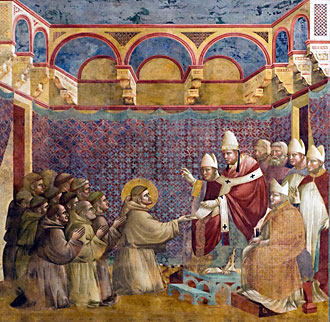
Francis finished his military adventures and time as a prisoner of war in early 1205. It was during the latter part of 1205 into 1206 that Francis chose to “leave the world.” In subsequent years , Francis’ model of following Christ began to attract other men to join him in the emerging way of life – even as the “way of life” was being discovered by Francis himself. Francis modeled the life, prayed with the brothers, exhorted them from time to time, and slowly the life began to take shape.
The basic shape of the movement was not all that unique in Francis’ day. There were many other penitential and mendicant movements in the beginning of the 13th century in western Europe. – some scholars tallying 130 others. Interestingly, only one of them exists today: the Franciscan. Why? Most scholars hold that it was because of Francis’ insistence on being “Catholic” and formally part of the Catholic Church. There are several theories as to the reason for that insistence. Like most things it is a complex reason, but likely primary among the reasons is Francis’ love of the Eucharist. But whatever the reasons, it is no surprise that in 1209 Francis and some of his brothers journeyed to Rome to seek an audience in a consistory with Pope Innocent III in order to receive formal recognition of his proposed way of life. Continue reading
A reluctant leader
One aspect of Francis’ changing life that has attracted recent attention is the movement of Francis from solitary figure, living a quasi-hermetical life for four to five years, now beginning to live in a growing community of brothers – all of whom are looking to Francis for spiritual and communal leadership. There was something attractive about Francis, his way of following the gospel, and perhaps the recent “commissioning” by Pope Innocent III gave a certain cache of legitimacy to this way of being Christian in the world. Eventually many people came to join the Franciscan movement, which soon enough became a religio and eventually an ordo, but those demarcations are eight to ten years in the future ahead of the Spring of 1209.
Virtually all scholars agree that Francis, at this point, did not envision his group to be more than a small group of men living an evangelical life in common. But there are also no indications that Francis thought too far ahead in any matter at this point in his life. Things just seemed to unfold, signs appeared along the way, and Francis followed the path in faith. And people followed Francis. Whether he liked it or not, Francis was their leader. Continue reading