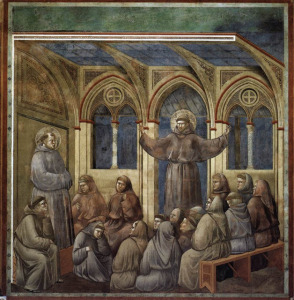
It is later in the autumn of 1206 that with his decision to “leave the world” Francis began to be aware of the powerful Divine Presence in his life through, his work among the lepers near Assisi, and his habit of taking refuge in churches for prayer and rebuilding the structures. At San Damiano he encountered the consoling presence of the Savior who had suffered and died for him. It was a presence he soon came to recognize in other churches: “And the Lord granted me such faith in churches that I would pray simply and say: We adore you, Lord Jesus Christ, in all your churches throughout the world, and we bless you, because by your Holy Cross, you have redeemed the world.” (Testament 4-7). Francis was at the beginnings of an inner peace. Continue reading
Tag Archives: franciscan
Finding peace
There are three events that seem to highlight the “period of crisis” in Francis life during the period from late 1205 until the summer of 1206:
- Francis’ experiences at the abandoned San Damiano chapel – especially his prayers before the cross
- Francis’ “leaving the world” as he turns away from his family towards the Church and an unknown path with God.
- Francis and the leper (or lepers)
There is no consensus on the order of the events – and there is some question about later embellishments of the event – and even questions about whether some accounts indicating a single event is actually a compilation of a series of experiences. But then the 13th century writers were not trying to capture “history” they were trying to tell their understanding of the “meaning” of the life of St. Francis of Assisi. Continue reading
Franciscans in China
Servant of God – John of Montecorvino
Franciscan and first Bishop of Beijing
Writing earlier about St. Francis Xavier, I was reminded about a Franciscan missioner, John of Montecorvino, whose feast was November 29. Mention John of Montecorvino and most people – even most Franciscans – will say “who?” John was the first Catholic missionary to China, centuries before the efforts of other Catholic religious orders. It is a compelling story. If you would like to read an interesting and accessible account of the travel within the context of an art historian comparing 13th century Italian and Chinese art, read Lauren Arnold’s: Princely Gifts & Papal Treasures: The Franciscan Mission to China & Its Influence on the Art of the West, 1250-1350 – fascinating book.
Franciscans in China
Servant of God – John of Montecorvino
Franciscan and first Bishop of Beijing
Today is a day in which we Franciscans remember John of Montecorvino. To which most people – even most Franciscans – will say “who?” Brother John was the first Catholic missionary to China, centuries before the efforts of other Catholic religious orders. It is a compelling story. If you would like to read an interesting and accessible account of the travel within the context of an art historian comparing 13th century Italian and Chinese art, read Lauren Arnold’s: Princely Gifts & Papal Treasures: The Franciscan Mission to China & Its Influence on the Art of the West, 1250-1350 – fascinating book.
Beginning with the pontificate of Innocent IV (1243–1254), the popes and Mongol khans began to communicate and exchange gifts in a diplomatic effort to see if there was a basis upon which to effectively bind and subdue their common enemy, the Muslim Empire. The two most famous envoys were the Franciscans John of Plano Carpini and William of Rubruck. Their journeys, remarkable and daring, were not specifically missionary but were more as political emissaries. Carpini traveled in the years 1245–1247 while Rubruck’s mission was 1253–1255. Although Rubruck was sent by Louis XI of France to enlist the aid of the khan against Islam, Rubruck also attempted to convert the Mongols (also known as Tartars) by converting the Great Khan. William’s Itinera is a masterful travel account that also includes observations about the Saracens and Nestorian Christians found in the Mongol territories. On Pentecost 1255 William met with the Great Khan who received William but nothing more came of the meeting. Continue reading
A little-known saint
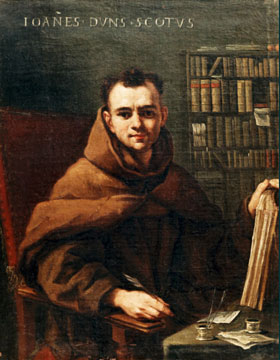
November 8th is the feast day of Blessed John Duns Scotus, a Franciscan friar from Scotland noted for his theological and philosophical work in the high-middle ages (late 13th and early 14th centuries). Scotus’ work was in the generation that followed Thomas of Aquinas and Bonaventure. His work was complex and nuanced, and he is generally considered to be one of the three most important philosopher-theologians of his time. He was given the medieval accolade Doctor Subtilis (Subtle Doctor) for his penetrating and subtle manner of thought. Continue reading
See you next week…

Taking a break…. see you next week.
The Franciscan Scotus
November 8th is the feast day of Blessed John Duns Scotus, a Franciscan friar from Scotland noted for his theological and philosophical work in the high-middle ages (late 13th and early 14th centuries). Scotus’ work was in the generation that followed Thomas of Aquinas and Bonaventure. His work was complex and nuanced, and he is generally considered to be one of the three most important philosopher-theologians of his time. He was given the medieval accolade Doctor Subtilis (Subtle Doctor) for his penetrating and subtle manner of thought. Continue reading
The Assumption of Mary
Much of our religious consciousness is affected by art; we have inherited specific images that are more artistic than biblical. For example, we always imagine St. Paul being knocked from a horse on the Damascus Road. There is no mention of the horse in scripture. Is that a bid deal? Perhaps not. But when Caravaggio placed Paul on the horse, a sign of privilege or royalty, he removed Paul from the midst of Corinth, the hard-scrabbled sea port town, from among the drunks, slackards, ner-do-wells, and people who sorely needed salvation. Continue reading
St. Anthony of Padua – part 2
Before He Was Anthony of Padua. Anthony of Padua was born Fernando Martins de Bulhões on August 15, 1195 in Lisbon, Portugal. His was in a very rich family of the nobility who wanted him to become educated, and they arranged for him to be instructed at the local cathedral school. Against the wishes of his family, however, at the age of 15 he entered the community of Canons Regular at the Abbey of St. Vincent on the outskirts of Lisbon. Monastery life was hardly peaceful for young Fernando, nor conducive to prayer and study, as his old friends came to visit frequently and engaged in vehement political discussions. Continue reading
St. Bonaventure of Bagnoregio
Today, July 15th is the Feast Day of St. Bonaventure of Bagnoregio. He was a Franciscan theologian and philosopher, held a Master’s Chair at the University of Paris, was elected Minister General of the Franciscan Order in one of its most contentious times, wrote many spiritual texts, compiled a biography (legenda) of St. Francis at the request of the friars, and many more things. His work Itinerarium mentis in Deum (Journey of the Soul to God) is considered a masterpiece of medieval spiritual practice. You can read more about the saint here. Happy Feast Day to all Franciscans.