Life with an Open Heart

One of the most subtle spiritual dangers is not outright rejection of God, but the slow closing of the heart, intentionally or not, in what amounts to some form of self-protection.

In his letter to Timothy, Paul writes with urgency and tenderness. He knows how easily fear can cause a believer to retreat from the fullness of gospel living. Perhaps we pull back on ministry or sharing our faith in parts of our lives where we might be judged or dismissed. That is why he reminds Timothy that God did not give us a spirit of fear, but of power, love, and self-control. We know the experience of being in love, how it opens our hearts. We know the experience of fear when we close in and begin to shield or protect some part of ourselves. Perhaps it is to protect our reputation, our safety, our comfort, or our standing in the community. Faith quietly loses its courage.

The Gospel shows what happens when self-protection hardens into resistance. The scribes are confronted with undeniable evidence of God’s power at work in Jesus. Rather than allowing the truth to challenge them, they reinterpret it in a way that preserves their authority. They choose explanation over conversion. In doing so, they close themselves off from the very grace meant to heal them.

Jesus’ warning about blaspheming the Holy Spirit is not about a single careless word. Let me suggest it is about a settled refusal to recognize God’s work when it stands plainly before us. A closed heart no longer seeks truth; it seeks justification. Once that happens, repentance becomes impossible not because God withholds mercy, but because the heart will no longer receive it. Paul tells us “and hope does not disappoint, because the love of God has been poured out into our hearts through the holy Spirit that has been given to us.” (Romans 5:5) We have closed off our hearts and refused entry to the Holy Spirit.

Paul offers a different path. From prison, stripped of security and status, he refuses self-protection. He entrusts himself to God and encourages Timothy to do the same. His confidence does not come from being safe, but from being faithful. The truth of the Gospel is worth the cost, even when it leads to suffering.

You might think, “I don’t think I have a closed heart.” A closed heart often begins as a cautious heart, a heart that wants to avoid risk. Where are we cautious? Where might we be choosing comfort over truth, silence over witness, control over trust?

The Gospel does not grow in protected spaces.  It grows where people are willing to be changed.

Today we are invited to pray for hearts that remain open; open enough to be challenged, open enough to repent, open enough to trust that God’s Spirit is at work even when it unsettles us. Because truth received brings life, but truth resisted for the sake of self-protection slowly shuts the door to grace.

May the Lord keep our hearts open, courageous, and free. May our hearts not be governed by fear, but shaped by the Spirit who leads us into all truth. The Spirit that is poured into our hearts.


Image credit: Canva, St. Francis Parish, CC-0
Conditions of the Heart

In a way this is a follow-on from yesterday’s reflection. The first reading again concerns itself with King Solomon. It is part of the dedication of the first Jerusalem Temple (a longer version of which you can read in 2 Chron 6) and, in a way, marks the high point of King Solomon’s reign. While the famous request for Wisdom soon follows this passage, not too long after, the long slide into disrepute begins when Solomon will abandon the rules of the King (Dt 17) collecting wives, armies and gold – things upon which he will depend rather than the covenant loyal love from the Lord. The passion of his heart moved onto other things. Continue reading

The heart of men

What lies in the heart of men? If we would rely on the introduction from the popular radio series the Shadow, our answer would be – “Who knows what evil lurks in the hearts of men? The Shadow knows!”  Given that we were created in the image and likeness of God, washed clean in the waters of Baptism, we began so hopeful, so innocent. What’s going on in the human heart? “More tortuous than anything is the human heart, Beyond remedy; who can understand it?” (Jer 17:9) In the language of the Bible “heart” means the core of the self, the deepest center of who we are, that place from which our thoughts and actions arise. Today’s gospel is none too hopeful about what lies in the heart of men:

From within the man, from his heart, come evil thoughts, unchastity, theft, murder, adultery, greed, malice, deceit, licentiousness, envy, blasphemy, arrogance, folly. All these evils come from within and they defile.” (Mark 7:20-22)

This is not a lone passage from Scripture which echoes such sentiment. St. Paul notes the same problem and locates it a failure to believe in and honor God. There are consequences: “God handed them over to their undiscerning mind.” (Romans 1:28) He goes onto describe the result of people looking to themselves for a moral compass:

They are filled with every form of wickedness, evil, greed, and malice; full of envy, murder, rivalry, treachery, and spite. They are gossips and scandalmongers and they hate God. They are insolent, haughty, boastful, ingenious in their wickedness, and rebellious toward their parents. They are senseless, faithless, heartless, ruthless.” (Romans 1:29-31)

If we are honest, each one of us can see something of ourselves in the list even if it is limited to envy and gossiping. What are we to do? St. Paul saw the root of the problem – the solution lies there, in your heart. Awake each day look into your heart to rediscover your love for God and give Him glory in prayer. Start each day in prayer. Each evening, examine your day and with hope pray:

Have mercy on me, God, in accord with your merciful love; in your abundant compassion blot out my transgressions. Thoroughly wash away my guilt; and from my sin cleanse me…wash me, and I will be whiter than snow. (Ps 51:3-4,9)

Let these be your treasure: “For where your treasure is, there also will your heart be” (Mt 6:21). And in the morn, begin again.

With a Father’s Heart

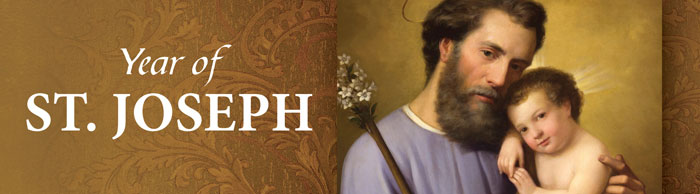
Pope Francis has declared his year to be the “Year of St. Joseph.” It is a celebration of the 150th Anniversary of the proclamation of St. Joseph a Patron of the Universal Church. Today is the Solemnity of St. Joseph. Pope Francis, in honor of this year, has provided the Apostolic Letter Patris Corde – With a Father’s Heart. It is a wonderful reflection of the attributes and characteristics of fatherhood – and also understands that St. Joseph serves as a model, not just for fathers, but for all who care for others. The Pope makes a special connection to all the front line, critical care, and essential workers who labor far from the limelight, especially so in this year of pandemic.

From Pope Francis’ Apostolic Letter, Patris Code: WITH A FATHER’S HEART: that is how Joseph loved Jesus, whom all four Gospels refer to as “the son of Joseph”. Continue reading

Our Hearts

This weekend we celebrate the patronal feast of our parish – The Sacred Heart of Jesus. There is an earlier post on the history of the feast day in which St. Bonaventure in his writing, “With You is the Source of Life” (which is the reading for the Divine Office on the Solemnity of the Sacred Heart) described the heart as the fountain from which God’s love poured into our lives.

But what about our heart? In Scripture, the heart symbolizes the center or “core” of our being, from which prayer and moral actions originate. The heart is mentioned frequently by Jesus explain spiritual truths. Continue reading

Habits of a Loving Heart

Back in the day when I was working in the world and spending way too much time on airplanes accumulating way too many frequent-flyer miles, it seemed to me business travelers did three things on longer flights: sleep, work, or read Stephen’ Covey’s “The 7 Habits of Highly Effective People.” The book argues that one should align universal and timeless principles with one’s values. Covey sees principles as external natural laws, while values remain internal and subjective. Covey asserts that values govern people’s behavior, but principles ultimately determine the consequences. If sales volume is measure of the usefulness of this self-help book, then 25 million copies sold says something. Maybe there are some possibilities for a parallel book about the best practices and habits for Catholics. Might be a Lenten best seller! Continue reading