
Standing in Hope

Over the last several weeks as we near the end of the liturgical year, the Church has chosen readings that are quite apocalyptic. The readings from the Book of Daniel and the gospels – are they meant to scare us into fearful compliance with the demands of God? The imagery easily serves as a source of all manner of end times predictions of death, doom and despair. Yet, that is not the reason why the Church selected these readings. What is common to all the apocalyptic texts is the final triumph of God. We are called to turn our eyes toward the final triumph of God and to recall where our hope truly lies.

Daniel lived in chaotic times. We live in chaotic times. Think of the past year: wars in Ukraine, Gaza and Israel, Syria, Myanmar, Sudan, Yemeni, Haiti, Ethiopia, Rwanda, and Congo – and those are state actors. There are all kinds of conflicts among non-state actors. Sabre rattling, trade wars, the war on drugs, gun violence, political acrimony reaching ever new levels of accusation and calumny.

There’s a word you don’t hear much. Calumny: the act of maliciously misrepresenting someone’s conduct to harm that person’s reputation. There are days when I think the majority of political party statements are calumnious in their nature.  

In Daniel’s vision the chaos arose from the sea, the usual source of such Old Testament beasts. In Scripture, the sea represents chaos, evil, and the forces that oppose God. The beasts symbolize earthly political and military empires – violent, unstable, rising and falling with history. And yet, after all the terrifying beasts, Daniel suddenly says: “As the visions during the night continued, I was watching and saw one like a Son of Man coming… He received dominion, glory, and kingship” (Dan 7:13–14).

This is the heart of the reading: human kingdoms rise and fall, but God’s kingdom, given to the Son of Man, endures forever. Daniel and all the prophets remind us that the last word is not chaos, but Christ and the Kingdom.

It is easy to be mesmerized by the chaos. It is like watching a tornado; we just can’t seem to look away. In the Gospel Jesus uses the fig tree to remind us to learn to see God at work: “When you see it put forth leaves, you know that summer is near. In the same way, when you see these things happening, know that the kingdom of God is near” (Lk 21:30-31). Jesus is telling us to read the signs, to learn how God works in our lives.

The fig tree does not leaf out suddenly. It happens quietly, gradually, almost unnoticed. The same way God’s grace unfolds in our lives. It is there amidst the chaos in a world full of noise, fear, and “beasts” of every kind such as division, conflict, sin, moral and confusion. Mixed right in with signs of His presence: acts of charity, the persistence of faith, forgiveness offered, hope renewed and much more.

Tornadoes demand our attention. Signs of the kingdom demand no such thing but patiently wait to be noticed.

Like the first reading, the gospel is a call to hopeful watchfulness. Daniel says: “Do not be afraid of the beasts; God remains King.” Jesus says: “Watch with faith; the Kingdom is already blossoming.”

Each reading proclaims: no matter how dark the world seems, God’s Kingdom is closer than we think. It is already growing, becoming, patiently waiting for us to spread its borders. “Heaven and earth will pass away, but my words will not pass away” (Lk 21:33).

Empires pass. Cultures pass. Trends pass. Even our worries pass. But Christ’s word, His promise, His presence – these do not pass away.

We can name the beast, the chaos and our fears. But where might we also see the first small leaves of the Kingdom God is quietly unfolding? We need not deny the reality of struggle. But we are not defined by it.

We are defined by the Son of Man who already reigns and who already draws near.


Image credit: Flevit super illam (He wept over it) | Enrique Simonet (1892) | Museo del Prado, Madrid | Wikimedia Creative Commons | PD-US
Hope does not disappoint

Part of the blessing being a parish priest is that you are invited into some of the most intimate moments of a family’s life. There is perhaps none more intimate and intense than the moments when illness passes through uncertain diagnosis, to one which blurs into the final days of a life. It is part of a life of ministry to be into a family whose loved one’s days are numbered. It is a privilege to journey with the family as they prepare for the loss that surely and steadily this way comes. In those times, Hope can seem more tentative, more distant; perhaps hovering on the edge of disappointment.

It seems to me the families that best journey this path are the ones who tell stories, not waiting for the wake and funeral service, but begin the telling at home, in the hospital, or in hospice. Those stories are the ones that are snapshots of life, wonder, and bring an easy laughter to the soul even as they bring a moment of joy to the dying person. For just a moment, a good life is recalled and one is transported away to another time and place. It is a comfort and a reminder of a life filled with love, family, and friends. A good life.

Continue reading

Hope for Us All

“A man had two sons …” (Luke 15:11) – such is the beginning of the beloved and well-known Parable of the Prodigal Son. But you know Scripture doesn’t come with titles for such things. That’s just what the parable has always been called. But we could call it something else. The Parable of the Waiting Father? Or perhaps the Parable of the Petulant Older Brother? I guess it all depends on what draws your interest and attention. What about you? Where are your thoughts drawn: to the younger son’s selfish greed, the older son’s arrogant fury, or perhaps the patient father’s extravagant love?

The younger son is a distant figure for me. I hope I have little in common with him – in the beginning he is impulsive, cavalier, inappropriately demanding, disrespectful and more. At first blush, I have nothing in common. At least I hope not. I have never run away, squandered gifts given to me, or led a life “a life of dissipation” as it says in scripture. Looking for some synonyms for “dissipation?” You can try, “debauchery, overindulgence, degeneracy, intemperance” at worst, but at best, we are still left with “reckless” and “unthinking.” But neither have I felt the ardent, tear-soaked embrace of a loving father welcoming me home – but then I never left. And so, I have never encountered the wild, unfettered love of reconciliation.

Continue reading

Genealogy of Hope

The gospel for today is St. Matthew’s genealogy of Jesus. It is Matthew’s way of showing how Jesus fulfills the Old Testament storyline and takes up the first 17 verses of the gospel – and since Matthew’s gospel is almost always the first book of the New Testament, one could say it is the first 17 verses of the entire New Testament! … and I am sure most people skip it and move on to the Nativity and Infancy narratives.

Genealogies in the Old Testament are always working to communicate multiple layers of information to readers. Genealogies obviously trace family trees, but they also help us follow priestly and royal lines through Israel’s story. You can see each of these types of genealogies in the first nine chapters of Chronicles. In fact, there’s little doubt that the author of Matthew had the book of Chronicles and its genealogies in mind when he wrote his own Gospel account and began it with a genealogy.

Okay… But why does this genealogy matter?

Continue reading

Such is Our God

“Comfort, give comfort to my people, says your God. Speak tenderly to Jerusalem, and proclaim to her that her service is at an end, her guilt is expiated…” (Isaiah 40:1-2)

The Prophet Isaiah is speaking to the Jewish people exiled to Babylon. His message is one of profound hope and consolation, reminding them – and us – of God’s infinite mercy. After a period of suffering and exile, God assures His people that their trials are not without purpose. He is both just and compassionate, bringing an end to their hardship and preparing a way for restoration.

Continue reading

Hope

Because today’s gospel reading is the same as the gospel for the Solemnity of the Annunciation, I suspect that is part of the reason that people somehow think we are celebrating the conception of Jesus in Mary’s womb. But that is not it at all. We are celebrating the conception of Mary, the daughter of Joachim and Anna, the one who will become the mother of Jesus. What is it that is “immaculate” about this conception? That because of the pure gift of God, and not on the merits of any human being, Mary was conceived without original sin. It is in the teaching of our Church that God provided such a gift so that the mother of His only begotten Son would be the holy and pure Ark of the New Covenant. It is a particular gift to Mary but also a gift to us. Let’s place that in a larger context.

Continue reading

Being Complete

There was a just-ordained priest was asked to celebrate a wedding for the first time.  He was nervous. So he decided to seek help from the Pastor, who told him, “Don’t worry about it.  Just recite any appropriate Bible verse and everything will be all right. They’re not going to remember what you say anyway.” The day of the wedding came, and the priest was even more nervous. As he looked at the couple standing before him, he forgot everything he was going to say.  Remembering what the Pastor said, he quoted the first Scripture that came to mind, “Father, forgive them for they know not what they do.” Continue reading

Being Hopeful

There are no Scripture passages that describe Holy Saturday. There are no accounts of disciples huddled in the Upper Room wondering how the life of Jesus came to an end on Calvary. There are no stories of what the disciples were thinking… or not thinking. Their world had been torn asunder. But were they hopeful? Were they well grounded in the meaning of the word “hope“? Are we?

Image credit: Pexels

Fasting and Hope

The second reading for today comes from the Prophet Isaiah – a book of complex content and 66 chapters long – yet there is a narrative, meta-narrative if you like, that threads and unifies the whole of the prophetic book. But, today we are privy to only 9 verses, all from Chapter 58.

I think the reason is straightforward why this reading was selected and paired with the gospel reading from Matthew 9. Both address fasting, one of the pillars of Lenten practices and piety. Just two days ago on Ash Wednesday we were reminded: “When you fast, do not look gloomy like the hypocrites” (Mt 6:16). Today our two readings take on the practice of fasting and ask us to examine our own intentions about following this Lenten practice. Continue reading

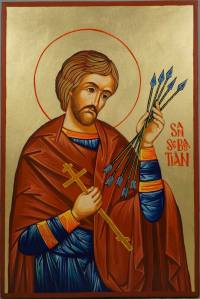
St. Sebastian

Today’s liturgical possibilities include an optional memorial for St. Sebastian who is the patron saint of athletes. Relatively little is known about St. Sebastian, a Christian martyr of the 3rd century. It is believed that he was an officer in the imperial bodyguard and Christian, but not openly so. When his faith was discovered the Diocletian, the Roman emperor, sentenced him to death. Sebastian was tied to a tree, executed by archers and left for dead. However, he had not died. He was found alive and nursed back to health. When at last he was able, he publicly announced his faith, denounced Diocletian for his persecution of Christians, and for this was martyred as he was beaten to death by the emperor’s guard. It is his virtues and gifts of strength, stamina, perseverance, courage and justice in the face of adversity and a superior opponent – and yet he gave his all.

The readings from today’s Mass include optional readings in celebration of the saint. The first reading is from the first letter of St. Peter and includes the following admonition:

Always be ready to give an explanation
to anyone who asks you for a reason for your hope,
but do it with gentleness and reverence
(1 Pt 3:15)

Are you ready?