We can probably spend the next hour telling humorous and outrageous stories about seating. From seats at school, seats on airplanes, and stories of being seated at wedding receptions with folks that are, …what can I say? “Unique” seems like a good word. We even have stories about seats at church.
Did you know that until the early/mid twentieth century, it was common practice in Anglican, Catholic, and Presbyterian churches to rent pews in churches to families or individuals as a means of raising income? This was especially common in the United States where, unlike Europe, churches lacked governmental financial support. So, churches rented pews to families, which of course enforced a sort of social status in church seating within a parish. It led to all kinds of problems. Should the pew rents simply be renegotiated, should they occasionally be subject to auction, can they be included in the will, bequeathed to the next generation?
Be you host or guest, Alan Culpepper [287-88] offers these final thoughts on the gospel for the upcoming Sunday.
These are liberating words [the gospel] that can free us from the necessity of succeeding in our culture’s contests of power and esteem. They free us from over-under relationships and the attitudes and barriers they create, so that we may be free to create human community and enjoy the security of God’s grace.
This commentary on ancient meal practices and social stratification makes two points. First, one should cultivate and practice humility, if only because it is a prudent means of avoiding embarrassment. The eschatological application at the end of each of the two sections drives home a deeper meaning. Although the practice of humility is proper and prudent for disciples, the kingdom of God will bring about an even more revolutionary reversal. The very standards and practices of discrimination will be overthrown. The outcasts will be accepted as equals. Those who live by kingdom standards and values now will not only bear witness to the kingdom but also will be rewarded in “the resurrection of the righteous” (v. 14). Righteousness, not social position or the esteem of others, should be our goal. God does not look on the glitter of our guest list. Instead, God looks to see that we have practiced the generosity and inclusiveness of the kingdom in our daily social relationships. One standard offers the reward of social position, the other the reward of God’s favor.
The distinctiveness of Jesus’ vision of the kingdom was nowhere clearer than in his protest against discriminatory meal practices. Jesus and the Pharisees ate differently. For Jesus, meals were times of celebration and an inclusive fellowship that foreshadowed the inclusiveness of God’s kingdom. The last supper, therefore, not only pointed ahead to the eschatological banquet, but also it reflected on Jesus’ meals with the disciples, Pharisees, crowds, and outcasts in Galilee. The greatest crisis the early church faced, moreover, was not the delay of the parousia but the burning issue of whom one ate with (see Acts 10:9–16, 28; 15:19–20; Gal 2:11–14). Perhaps it is time we learned new table manners.
Image credit: Jesus at Supper | Caravaggio (1606) | National Gallery London | PD-US
The gospel for the upcoming Sunday is taken from the Gospel of Luke describing an encounter with the Pharisees at a banquet. Just as Jesus’ fellow guests had occupied themselves in normal, honor-seeking pursuits upon arrival at the meal, so Jesus’ host had followed ordinary conventions in putting together his invitation list. Invitations served as “currency in the marketplace of prestige and power” [Green, 552] for those whose framework was the world as we know it. Seen through the framework of the Kingdom of God, a different currency is the “gold standard.”
Jesus expands the picture of humility by exhorting his audience to invite to their dinner table the needy and those who cannot repay such kindness. Hospitality should be open to all. This kind of reversal of expectations and status is thematic in Luke (e.g., 1:52; 6:20-26; 18:14). In fact, in the very next passage, our meal story continues with Jesus reemphasizing the notion of inviting the poor, the crippled, the lame, and the blind (14:21), this time in a parable representing the eschatological banquet of God, which will include just such marginalized ones, with the “invited guest list” being left out (14:24).
The gospel for the upcoming Sunday is taken from the Gospel of Luke describing an encounter with the Pharisees at a banquet. In a wedding banquet setting it was expected that power and prestige would be placed closest to the head of the table (see Note on 14:7 below). This was probably more formal than most meals, but the words apply to any banquet. Jesus points out the danger in pursuing seats of honor. He tells the story of a wedding where someone quickly grabs a high seat of honor. But then a person more distinguished walks in, and the host insists that the interloper vacate his position. At that point he may find all the other places occupied, so that the only course open to him is to take the lowest place, with all the shame and loss of face implied (cf. Prov. 25:7). So humiliated, the presumptuous one must head to the last seat. The description of the move down the social ladder is drawn out in Greek to underline the person’s shame (you begin with shame… to head for the last seat) It is as if every step hurts.
However, if one chooses the lowest place, the only way one can go is up. Rabbi Simeon b. Azzai is reported to have advised guests to take a place two or three seats lower than that to which they were entitled: ‘Better that people say to you “come up, come up,” and not say to you, “go down, go down”’ (Leviticus Rabbah I.5).
The gospel for the upcoming Sunday is taken from the Gospel of Luke describing an encounter with the Pharisees at a banquet. In yesterday’s post we discussed “humility”. Today we consider “honor.” The meal setting is common in many of the gospels as a metaphor for the celebration of the Kingdom’s come. But it is also often a setting of controversy. Consider that 14:1-6 centered on the debate at table regarding the lawfulness of curing on the Sabbath – reminiscent of earlier discussions about appropriate behavior on the Sabbath (e.g., 6:2, 9; 13:14–16). When Jesus asks if it would be lawful to cure the man with dropsy, those at the table are silent. When Jesus next asks if their son or oxen fell into a cistern would they pull them out, again, they are silent. The easiest take on their reaction is that Jesus has them timid and stumped. But there was a long standing tradition for debate about the understanding of the Law. I would suggest that given Jesus’ challenging questions, one would need time to think about the reasoning – and in the face of such challenging wisdom, perhaps there is a struggle for the host to figure out exactly where this wandering preacher from Nazareth should be sitting.
That dynamic then opens the way for Jesus’ larger questions about honor at meals. Notice that vv.7-11, addressed to guests, is parallel to vv. 12-14, addressed to hosts, both showing a common pattern in which humility plays out.
The gospel for the upcoming Sunday is taken from the Gospel of Luke describing an encounter with the Pharisees at a banquet. A key theme from this text is “humility.” This word comes into our language from the Middle English, via Anglo-French, from Latin humilis low, humble, from “humus” the word for earth. Webster’s offers this as a definition
not proud or haughty: not arrogant or assertive
reflecting, expressing, or offered in a spirit of deference or submission
ranking low in a hierarchy or scale: insignificant, unpretentious –or : not costly or luxurious
Does this capture the biblical sense of “humility?” Humility comes from the Greek tapeinoō (make low, humble; EDNT 3:334). In its verbal and noun forms, the word occurs 18 times in the NT and describes appropriate human conduct before God. And yet the use of the word often has a passive aspect to it. For example, John the Baptist challenges his listeners to ready themselves for God’s salvation by preparing the way of the Lord and making his paths straight. The decisive feature, however, must be performed by God himself, for every valley will be filled (by him) and every mountain made low (by him), i.e., leveled. The salvific action begins with God’s own actions. In this we are to humbly await actions from the Lord.
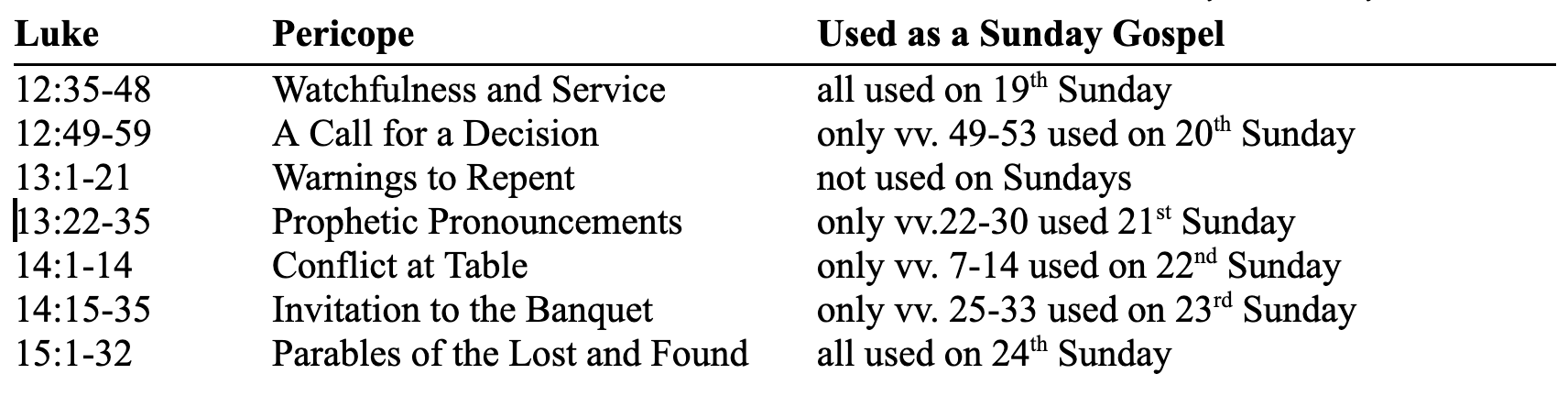
The gospel for the upcoming 22nd Sunday (Year C) is taken from the Gospel of Luke. On the journey to Jerusalem one of the principal themes has been that of discipleship. Much of Luke 12 attends to that theme especially in terms of preparedness and service. As Luke’s gospel narrative moves ahead, Jesus continues to teach about the nature of discipleship (see, judge, and act), the urgency of the decision to become a faithful and prudent disciple, and that our decisions and actions have consequences in terms of the kingdom of heaven. To that end, here is the recent progression of Sunday gospels. You’ll notice there are gaps and skips.
Among the portions missing from the Sunday gospels are
Jesus’ call to read the signs of the times as well as one reads the weather in order that one may judge rightly (12:54-59)
The parable of the fig tree that is permitted to remain in the vineyard for another season even though it has not yet produced fruit (13:1-9)
A healing of a woman, afflicted for 18 years, who was healed on the Sabbath that Jesus might again teach the meaning of the kingdom of God (13:10-17)
The parable of the mustard seed (13:18-21)
The lament of Jerusalem’s unfaithfulness (13:31-35)
A healing on the Sabbath at table (14:2-6)
The parable of the great feast (14:15-24)
The cost of discipleship and the necessity of preparations (14:25-35)
Some of the verses missing from Sunday gospels are well covered in the gospels of daily Mass, but there are some great images (reading the signs of time, the fig tree, and others) that would be great to have for Sunday homilies.
That being said, one does well to remember and understand that these verses come after Jesus exhortation to strive to enter that place where are gathered “Abraham, Isaac, and Jacob and all the prophets in the kingdom of God” (13:28) (from last Sunday’s gospel) and before the parable of the great feast (14:15-24) which speaks to the OT image of the kingdom of God as likened to a great banquet. The placement points out that the attitudes of discipleship in this life are reflected in the banquet of the kingdom of God.
This week’s gospel is at table. As Johnson [Luke, 223] notes: “If Jesus eats a meal with a Pharisee on the Sabbath, there surely will be conflict! During the meal Jesus addresses a fundamental attitude that is a constituent portion of discipleship: humility. This is not a new topic addressed to his disciples. Consider Luke 9:
46 An argument arose among the disciples about which of them was the greatest. 47 Jesus realized the intention of their hearts and took a child and placed it by his side 48 and said to them, “Whoever receives this child in my name receives me, and whoever receives me receives the one who sent me. For the one who is least among all of you is the one who is the greatest.”
Image credit: Jesus at Supper | Caravaggio (1606) | National Gallery London | PD-US
The enemies are on the horizon. Judah is in a time of darkness or uncertainty, waiting for a light to show there is a better future coming. Today’s first reading is from Isaiah 29:17-24. Beginning with the first verse the reading lets us know that something new and transforming is afoot.
To the north, Lebanon is known for its extensive forests and cedar trees – even today the nation’s flag shows forth the mighty cedar. So, what is with the mention of forest lands becoming orchards? In order to have orchards promised, the forest has to be cut down. Isaiah has used the imagery of such clearing before as a symbol of humiliation (2:13; 10:34; 37:24). This is the way of Isaiah telling Judah of the coming reversal in the positions of the noble/privileges and the common person.
“For everyone who exalts himself will be humbled, but the one who humbles himself will be exalted;” a familiar verse from St. Luke, one echoed in our readings for this day. Today’s first reading follows well from yesterday’s, giving “the” example of humility in Jesus who “did not regard equality with God something to be grasped. Rather he emptied himself taking the form of a slave.” That is not an option for us, but does raise the question of the meaning of true humility. Merriam Webster defines humility as freedom from pride or arrogance. That’s a start; it tells us what humility is not and by implication tells us what not to do in life. St. Bonaventure offered that humility is the guardian and gateway to all the other virtues. So, humility is important for being in this life and getting to the next. Continue reading →
From time to time, my dad would remind me that “every person you meet is your better in that you can learn something from them.” Good and sage advice. I wonder if he knew he was echoing Ralph Waldo Emerson who wrote: “In my walks, every man I meet is my superior in some way, and in that I learn from him.” Of course one can then ask if the quote is original to Mr. Emerson. Continue reading →

 friarmusings