
This pope began life as Giovanni Battista Cibo of a well-to-do Genoese family. He was perhaps the poster boy for misspent youth. His escapades were notorious and he fathered a son and a daughter outside marriage. Were it that young Giovanni experienced a conversion of heart, but with few prospects but tremendous family connections, the priesthood and a ecclesial career seemed to be his best career option. In Rome he became a priest in the retinue of Cardinal Calandrini, half-brother to Pope Nicholas V (1447–55). The influence of his friends procured for him, from Pope Paul II (1464–71), the bishopric of Savona, and in 1473, with the support of Giuliano Della Rovere, later Pope Julius II, he was made cardinal by Pope Sixtus IV, who appreciated his malleable nature. Continue reading
Innocent VIII: a malleable pope
Reply
 One aspect of Francis’ changing life that has attracted recent attention is the movement of Francis from solitary figure, living a quasi-hermetical life for four to five years, now beginning to live in a growing community of brothers – all of whom are looking to Francis for spiritual and communal leadership. There was something attractive about Francis, his way of following the gospel, and perhaps the recent “commissioning” by Pope Innocent III gave a certain cache of legitimacy to this way of being Christian in the world. Eventually many people came to join the Franciscan movement, which soon enough became a religio and eventually an ordo, but those demarcations are eight to ten years in the future ahead of the Spring of 1209.
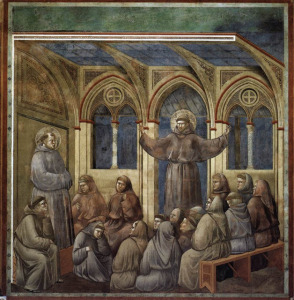 It is later in the autumn of 1206 that with his decision to “leave the world” Francis began to be aware of the powerful Divine Presence in his life through, his work among the lepers near Assisi, and his habit of taking refuge in churches for prayer and rebuilding the structures. At San Damiano he encountered the consoling presence of the Savior who had suffered and died for him. It was a presence he soon came to recognize in other churches: “And the Lord granted me such faith in churches that I would pray simply and say: We adore you, Lord Jesus Christ, in all your churches throughout the world, and we bless you, because by your Holy Cross, you have redeemed the world.” (Testament 4-7). Francis was at the beginnings of an inner peace.
  It is later in the autumn of 1206 that with his decision to “leave the world” Francis began to be aware of the powerful Divine Presence in his life through, his work among the lepers near Assisi, and his habit of taking refuge in churches for prayer and rebuilding the structures. At San Damiano he encountered the consoling presence of the Savior who had suffered and died for him. It was a presence he soon came to recognize in other church: “And the Lord granted me such faith in churches that I would pray simply and say: We adore you, Lord Jesus Christ, in all you churches throughout the world, and we bless you, because by your Holy Cross, you have redeemed the world.” (Testament 4-7). Francis was at the beginnings of an inner peace.
  friarmusings