The answer… or at least an answer

This coming Sunday is the 26th Sunday in Ordinary Time. This parable is about doing the will of God (v. 31). The question, “What is God’s will for my life?” is one that Christians often ask. However, answering that question with an unreflective “obeying God and working in the fields” too easily leads to an idea that one is able to work/earn one’s salvation. But then again, relying on faith alone can reduce action to a meaningless afterthought to one’s words. Continue reading

The Parable Of The Two Sons

This coming Sunday is the 26th Sunday in Ordinary Time28 “What is your opinion? A man had two sons. He came to the first and said, ‘Son, go out and work in the vineyard today.’ 29 He said in reply, ‘I will not,’ but afterwards he changed his mind and went. 30 The man came to the other son and gave the same order. He said in reply, ‘Yes, sir,’ but did not go. 31 Which of the two did his father’s will?”  Continue reading

Jesus’ authority challenged

This coming Sunday is the 26th Sunday in Ordinary Time. The texts leading up to and out of our gospel are replete with questions of authority. These events all occur in what we know as Holy Week and even though Jesus had triumphantly entered the City of David, Jesus had left Jerusalem for a brief stay in Bethany. He has now returned to the Temple area where, when he left the day before, the chief priests and scribes were angry with him (cleansing of the Temple, vv.12-17.) Given the deeds of the previous day, it seems only natural that the chief priests and the elders would ask about his credentials and question his authority. Continue reading

Conflict in Jerusalem

This coming Sunday is the 26th Sunday in Ordinary Time, Lectionary Cycle A. Jesus has already entered Jerusalem (Matthew 21:1 ff) and been received by the people, proclaimed as Messiah, overturned the moneychanger’s tables (21:12-17), and had his authority questioned by the chief priests and elders. Jesus is performing signs and speaking in a way that the people are interpreting as Messianic – and there is a history there. Jesus is not the first messianic figure to come to Jerusalem and the chief priests and elders want to protect the people – although they have already concluded that Jesus is another false claimant. They have been amassing charges and accusations against Jesus and are simply waiting for the opportunity to bring him to trial and be done with him. Continue reading

Everyone is looking: context

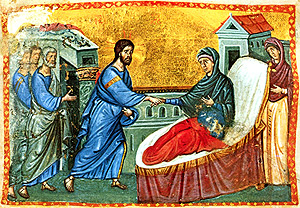
Jesus_healing_Peter_inlaw29 On leaving the synagogue he entered the house of Simon and Andrew with James and John. 30 Simon’s mother-in-law lay sick with a fever. They immediately told him about her. 31 He approached, grasped her hand, and helped her up. Then the fever left her and she waited on them. 32 When it was evening, after sunset, they brought to him all who were ill or possessed by demons. 33 The whole town was gathered at the door. 34 He cured many who were sick with various diseases, and he drove out many demons, not permitting them to speak because they knew him. 35 Rising very early before dawn, he left and went off to a deserted place, where he prayed. 36 Simon and those who were with him pursued him 37 and on finding him said, “Everyone is looking for you.” 38 He told them, “Let us go on to the nearby villages that I may preach there also. For this purpose have I come.” 39 So he went into their synagogues, preaching and driving out demons throughout the whole of Galilee.

The narrative move quite quickly in the Gospel according to Mark. The narrative’s pace and immediacy is one of the most notable attributes of the writing. Lest one think that Mark is simply concatenating stories without a larger vision in mind, it is always good to “step back” and see the larger framework in which the Gospel account exists. Continue reading

Healing many: context

Jesus_healing_Peter_inlaw29 On leaving the synagogue he entered the house of Simon and Andrew with James and John. 30 Simon’s mother-in-law lay sick with a fever. They immediately told him about her. 31 He approached, grasped her hand, and helped her up. Then the fever left her and she waited on them. 32 When it was evening, after sunset, they brought to him all who were ill or possessed by demons. 33 The whole town was gathered at the door. 34 He cured many who were sick with various diseases, and he drove out many demons, not permitting them to speak because they knew him. 35 Rising very early before dawn, he left and went off to a deserted place, where he prayed. 36 Simon and those who were with him pursued him 37 and on finding him said, “Everyone is looking for you.” 38 He told them, “Let us go on to the nearby villages that I may preach there also. For this purpose have I come.” 39 So he went into their synagogues, preaching and driving out demons throughout the whole of Galilee.

The narrative move quite quickly in the Gospel according to Mark. The narrative’s pace and immediacy is one of the most notable attributes of the writing. Lest one think that Mark is simply concatenating stories without a larger vision in mind, it is always good to “step back” and see the larger framework in which the Gospel account exists. Continue reading
