
A Parable of Right Relationships

This coming Sunday the gospel is the parable of the Pharisee and the Tax Collector. 

The Pharisee’s prayer is filled with himself. He speaks of his virtues, compares himself to others, and essentially reminds God how good he is. He asks for nothing, because he believes he needs nothing. His prayer is not really prayer—it is self-congratulation before heaven.

The tax collector, on the other hand, has no illusions. He stands at a distance, cannot lift his eyes, and prays only, “God, be merciful to me, a sinner.” He knows the truth about himself, and he places his whole hope in God’s mercy. And Jesus tells us it is this man, not the Pharisee, who goes home justified.

This tells us something about true prayer:

Continue reading
A Parable of Reversal?

This coming Sunday the gospel is the parable of the Pharisee and the Tax Collector. The parable reaches a conclusion as we are told: “I tell you, the latter [tax collector] went home justified.” The verb tense makes it clear that it is God who has justified this person. What does justified (dikaioo) mean? Lowe & Nida give the following for dikaioo:

  1. to cause someone to be in a proper or right relation with someone else
  2. to demonstrate that something is morally right
  3. the act of clearing someone of transgression
  4. to cause to be released from the control of some state or situation involving moral issues

It seems that 1 and 3 best fit the context. The tax collector goes home in a right relationship with God, because God made the relationship right. It was not something the tax collected did for himself (self-justification). The word also implies that he went home having been freed (by God) of his sin or guilt. He came to the temple “a sinner” and went home forgiven.

Continue reading

The Tax Collector

This coming Sunday the gospel is the parable of the Pharisee and the Tax Collector. As with Jesus’ parables, especially in Luke, they often echo earlier passages. For example:

“I have not come to call the righteous to repentance but sinners.” (Luke 5:32)

…there will be more joy in heaven over one sinner who repents than over ninety-nine righteous people who have no need of repentance.” (Luke 15:7)

Those echoes ring clearly in the word of the tax collector’s prayer: ‘O God, be merciful to me a sinner.” (Luke 18:13)  

Four aspects of the tax-collectors humility are briefly indicated by Luke: (1) he stood far off, (2) he kept his eyes lowered, (3) he beat his beast as a sign of repentance, an (4) he cries out for mercy. Unlike the Pharisee, the tax collector gives at least some evidence of humility and contrition: “…would not even raise his eyes to heaven” The tax collector’s reticence echoes Ezra’s prayer upon hearing of the numerous mixed marriages in Jerusalem: “O my God, I am too ashamed and embarrassed to lift my face to you, my God, for our iniquities have risen higher than our heads, and our guilt has mounted up to the heavens” (Ezra 9:6). Both of the situational comments in 18:13a—the downward gaze and the breast-beating—speak of a deep sense of unworthiness and embarrassment. 

Continue reading

The Righteous Who Despise

This coming Sunday the gospel is the parable of the Pharisee and the Tax Collector. In the previous post we considered the meaning of “righteous” as a prelude to the parable’s beginning: He then addressed this parable to those who were convinced of their own righteousness and despised everyone else. The Greek pepothoitas normally means “to convince” or “to persuade;” however, it can also mean “to seduce,” “to corrupt.” It would have been interesting had the translators chosen “those who seduced themselves that they were in right relationship to God.”

Continue reading

What is right

This coming Sunday the gospel is the parable of the Pharisee and the Tax Collector. We hear this parable differently than the first century listener.  We know how the parable ends and we also know how Luke has been describing the Pharisees, thus even at the words one was a Pharisee we know how this will end. Won’t it be that the Pharisee will represent the one who trusts himself and his own righteousness rather than God and the one who judges others and holds them in contempt? But let’s consider how the first century listener might have heard this narrative.

Continue reading

Persistence, Presumption, and Promise

This coming Sunday the gospel is the parable of the Pharisee and the Tax Collector. This gospel follows the parable of the persistent widow and the unjust judge (18:1-8).  While the common thread is certainly prayer, there are other aspects which bind together these two narratives. One of Luke’s ongoing themes is the inclusivity of the Gospel. In these two parables, prayers are answered by God for a (saintly and probably poor) widow and the sinful (and probably rich) male tax collector. Luke continues to demonstrate that the Reign of God is open to all – a message of keen importance to his Gentile audience.

The two parables are well placed. Alan Culpepper (Luke, 340) notes that “By reading these two parables together, the reader is instructed to pray with the determination of the widow and the humility of the tax collector. Peter Rhea Jones has characterized the complementary themes of the two parables as ‘The promise of persistent prayer’ (18:1-8) and ‘The peril of presumptuous prayer’ (vv. 9-14).”  Each parable is instructive for the disciples of all ages about the nature of Christian prayer.

Continue reading

Not like them

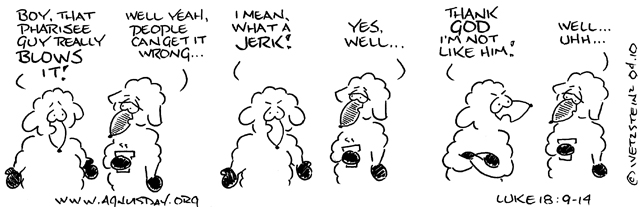
The Gospel for this Sunday is from Luke 18:9-14 in which Jesus tells a parable about those who depend upon their own compliance with religious regulation for righteousness: “The Pharisee took up his position and spoke this prayer to himself, ‘O God, I thank you that I am not like the rest of humanity—greedy, dishonest, adulterous—or even like this tax collector. I fast twice a week, and I pay tithes on my whole income.

comic

A Final Word from Jesus

This Sunday is the 29th Sunday in Ordinary Time, Lectionary Cycle C. Today is the final post on the parable of the unjust judge and the persistent widow. Today we hear Jesus: 7 Will not God then secure the rights of his chosen ones who call out to him day and night? Will he be slow to answer them? 8 I tell you, he will see to it that justice is done for them speedily. But when the Son of Man comes, will he find faith on earth?” Continue reading

The Widow

This Sunday is the 29th Sunday in Ordinary Time, Lectionary Cycle C. In yesterday’s post we looked in detail at the judge. Today we turn our attention to the persistent widow. The entire parable rings with the echo of Sir 35:14-24 (note: depending on translation you find verse numbering slightly different – also, this is part of the OT reading for the 30th Sunday in Year C) Continue reading

The Judge

This Sunday is the 29th Sunday in Ordinary Time, Lectionary Cycle C. Today we consider the Judge:

2 “There was a judge in a certain town who neither feared God nor respected any human being. 3 And a widow in that town used to come to him and say, ‘Render a just decision for me against my adversary.’ 4 For a long time the judge was unwilling, but eventually he thought, ‘While it is true that I neither fear God nor respect any human being, 5 because this widow keeps bothering me I shall deliver a just decision for her lest she finally come and strike me.’” 

Continue reading