
This coming Sunday is the start of a new liturgical year (Year C) and the first Sunday in Advent. In the previous post we were considering the Lukan usage of the word “sign” – 25 “There will be signs in the sun, the moon, and the stars, and on earth nations will be in dismay, perplexed by the roaring of the sea and the waves.
Luke’s use of signs only echoes the prophet Isaiah (13:9-10), Ezekiel (32:7-8), and Joel (2:30-31). Thus, these heavenly signs do not just point forward to the coming, but also backwards as fulfillment of the prophets’ word. Promise and fulfillment is one of the major themes throughout Luke. Just as Luke began with shepherds seeing the sign of a baby in a manger in fulfillment of the angels’ message, so this future coming is certain to occur in fulfillment of the prophets’ messages.
At that fulfillment Luke writes that people will be (a) in dismay, perplexed or (b) die of fright (could also be translated “faint”). These words are unique to Luke. But what is more significant is that there are two groups of listeners: “the people/they” in vv.26,27 and “you” in v.28. The responses to what happens are quite different. The people faint (or die) from fear and foreboding, but you (the disciples implied) are to “stand erect and raise your heads because your redemption is at hand.” (v. 28) For “you” the terrible signs symbolize the redemption that has come near. What does it symbolize for the “people”?
“Redemption” — this word (apolytrosis) occurs only here in all of the gospels. Although it occurs 7 times in Paul’s letters and twice in Hebrews. A form of this word (lytroomai) occurs in Luke 24:21a: “But we had hoped that he was the one to redeem Israel.” Another related word (lytrosis) is found occurs twice in Luke: “Blessed be the Lord God of Israel, for he has looked favorably on his people and redeemed them” (1:68). “At that moment she came and began to praise God and to speak about the child to all who were looking for the redemption of Jerusalem” (2:38). Continue reading
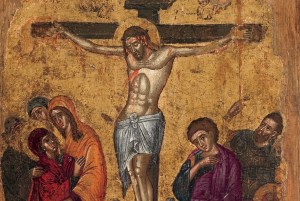 It is a sometimes very difficult pastoral situation, when a person has been truly wronged by the events that have unfolded with in a marriage, and I know that ultimately – in one form or another – I will let the person know that there are no innocent parties. Indeed some are infinitely more innocent, but in the end there is rarely complete innocence.
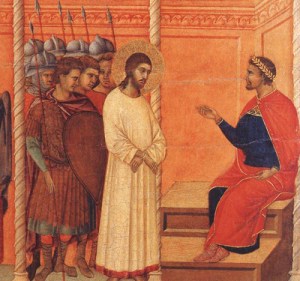 Up to this point in the narrative the chief priests, scribes, and leaders have been the ones who have been active throughout the arrest, hearing and trials of Jesus. While in the privacy of the Sanhedrin gathering, the charges brought against Jesus by this group were religious. Once the assembly moved to the public forum involving Pilate, the charges became secular – “misleading our people; he opposes the payment of taxes to Caesar and maintains that he is the Messiah, a king.” (23:2) In the start of this section, “the people” are now present. Previously the people have supported Jesus (cf. 19:47-48, 20:1, 20:6, 20:19, 21:38) – what will they do now?
 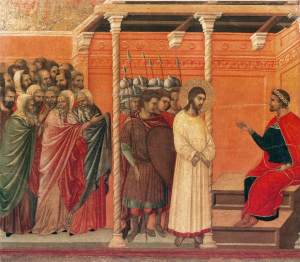 Alan Culpepper commented that reading the arrest and trials of Jesus is, for him, like watching film footage of John Kennedy’s motorcade winding through Dallas in 1963 or the 1986 launch of the Challenger space shuttle. We know what is coming, we know we have no power to undo them, but are compelled to watch because we honor the loss of great people doing what was theirs to do.
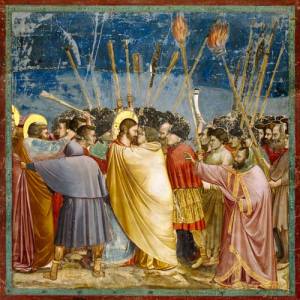 Of course we all know that after the meal with his disciples that Jesus went to the Garden of Gethsemane. Actually, no gospel says that. Matthew and Mark wrote that he went to a garden. John says he went to Gethsemane. Fuse them all together and you get the “Garden of Gethsemane.” What does Luke say? Luke only calls it “the place.” There is no garden specifically mentioned nor is Gethsemane. Is it important? Well, it is a reminder to be attentive to the text before you and not meld the familiar stories and scenes from other sacred writers. Each sacred writer has something distinctive that can be missed if one fuses all the details from other accounts.
  It is a sometimes very difficult pastoral situation, when a person has been truly wronged by the events that have unfolded with in a marriage, and I know that ultimately – in one form or another – I will let the person know that there are no innocent parties. Indeed some are infinitely more innocent, but in the end there is rarely complete innocence.
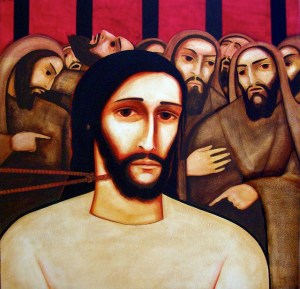 Up to this point in the narrative the chief priests, scribes, and leaders have been the ones who have been active throughout the arrest, hearing and trials of Jesus. While in the privacy of the Sanhedrin gathering, the charges brought against Jesus by this group were religious. Once the assembly moved to the public forum involving Pilate, the charges became secular – “misleading our people; he opposes the payment of taxes to Caesar and maintains that he is the Messiah, a king.” (23:2) In the start of this section, “the people” are now present. Previously the people have supported Jesus (cf. 19:47-48, 20:1, 20:6, 20:19, 21:38) – what will they do now?
  friarmusings