On November 26, Hull presented what became known as the Hull Note, demanding full Japanese withdrawal from China and Indochina and adherence to multilateral principles. Within Japan, the note was discussed in emergency meetings and ultimately rejected as unacceptable. Hull delivered what was seen within Japan as an ultimatum. It required Japan to:
withdraw all military forces from China and Indochina.
end support for any puppet regimes (i.e., dissolve Manchukuo).
recognize the Nationalist government (Chiang Kai-shek) as legitimate in China.
abandon the Tripartite Pact commitments.
agree to non-aggression pacts and equal commercial opportunity in the Pacific.
and in return, the U.S. would resume normal trade, including oil.
For leaders who had already committed themselves to war preparation, it confirmed that diplomacy could not secure Japan’s objectives.
Japan’s leaders viewed this ultimatum as humiliating and as requiring them to give up everything they had fought for since 1931. Yet, Japan’s oil reserves were running out. The Navy warned that by late 1942 or early 1943, Japan would be unable to support its armed forces anywhere in the Pacific.
Historians have asked if Hull’s note was a rogue act and the historical record is clear that it was not. Negotiations were dragging on and MAGIC intelligence (diplomatic not military) pointed to Japanese troop movements toward Southeast Asia along with repositioning of naval assets in that general direction. Roosevelt and his Cabinet were increasingly suspicious of Japanese intentions, seeing the protracted delays in responses as “stalling” to complete their war footing.
Going to War
The Second Imperial Conference was held November 5, 1941 after weeks of Army–Navy–Cabinet debates. It was decided that Japan would give negotiations until early December. If no settlement was reached, Japan would launch war against the U.S., Britain, and the Netherlands. The military finalized operational plans — the Navy would strike Pearl Harbor while also moving into Malaya and the Dutch East Indies.
There was a final Imperial Conference on December 1, 1941. The cabinet reported to Hirohito that negotiations had failed. The Army and Navy both argued that war was now unavoidable. Hirohito approved the resolution that war with the United States, Britain, and the Netherlands would begin in early December. Diaries record Hirohito as somber, but he gave no objection. His silence ratified the decision. Hirohito performed the ritual reading of the imperial rescript that authorized hostilities. The debate was closed.
In his post-war memoirs, Lord Privy Seal Kido wrote that Hirohito considered the Hull Note a “humiliation” Japan could not accept. There are layers of reasons why, but from Japan’s perspective the U.S. was treating Japan like a defeated power before a shot was fired. Kido recorded that Hirohito was deeply offended that the U.S. would presume to dictate terms so sweeping without acknowledging Japan’s own status as a great power. Prime Minister and Foreign Minister Tōgō wrote that it was “tantamount to a demand for unconditional surrender” for a war that had not begun.
Japan had spent a decade building the “New Order in East Asia” and the Greater East Asia Co-Prosperity Sphere. The Hull Note demanded Japan dismantle these achievements entirely — which would have been politically impossible for the Army, and a blow to Hirohito’s prestige as the figurehead of expansion.
In Japanese political culture, especially at that time, “losing face” before domestic and international audiences was nearly as bad as military defeat. If Hirohito had accepted the Hull Note, he would have been remembered as the Emperor who surrendered Japan’s destiny without a fight. Even though he disliked war, he considered acceptance dishonorable and humiliating — worse than risking war with the U.S.
On the same day the Hull Note was received, November 26th, the Japanese First Air Fleet (Kido Butai) — the carrier strike force that attacked Pearl Harbor — sailed. It consisted of 6 aircraft carriers, 2 battleships, 3 cruisers, 9 destroyers, 8 oilers. At dawn on December 7 it launched its first wave of aircraft.
The Asia-Pacific War in the Pacific expanded to include the United States, Great Britain, the Netherlands, Australia, New Zealand, and in time a host of other nations.
A small fire at the Marco Polo Bridge in 1937 spread to Manchuria, northern China, key Chinese ports, and French Indochina. On December 7, 1941 by attacking the U.S. Pacific Fleet at Pearl Harbor, the growing fire became the full firestorm of the Asia-Pacific War that lasted until September, 1945 at the cost of more than 30 million Asian lives.
It was a battle that the leaders of Japan knew they could not win. A war the Japanese government’s Total War Research Institute reported there was no chance of winning. Their actions were not rational; made no sense to the Western mind. Even the best minds in Japan argued against the possibility of success. But as Prime Minister Tōjō once remarked: “Occasionally, one must conjure up enough courage, close one’s eyes and leap off the veranda of the Kiyomizu Temple.”
Such was the path to the Asia Pacific War.
Image credit: various photographs from Naval Aviation Museum, National World War II Museum, and US Navy Archive.
The Hull note, in its essence, was the same four principles that Secretary Hull had presented to the Japanese since 1937. The note, in part, reads as follows:
The Government of the United States and the Government of Japan both being solicitous for the peace of the Pacific affirm that their national policies are directed toward lasting and extensive peace throughout the Pacific area, that they have no territorial designs in that area, that they have no intention of threatening other countries or of using military force aggressively against any neighboring nation, and that, accordingly, in their national policies they will actively support and give practical application to the following fundamental principles upon which their relations with each other and with all other governments are based:
The principle of inviolability of territorial integrity and sovereignty of each and all nations.
The principle on non-interference in the internal affairs of other countries.
The principle of equality, including equality of commercial opportunity and treatment.
The principle of reliance upon international cooperation and conciliation for the prevention and pacific settlement of controversies and for improvement of international conditions by peaceful methods and processes.
Historians do not agree on a single meaning or intention behind the Hull Note of November 26, 1941. As noted in other parts of this series, depending on when the historical research was conducted, what sources were available, one reaches a different conclusion.
Early postwar and revisionist historians portrayed the Hull Note as a de facto ultimatum that made war inevitable. The core argument is that the demand for complete Japanese withdrawal from China and Indochina amounted to strategic capitulation. Given Japan’s internal politics, acceptance was politically impossible. In this view, the U.S. leadership, especially President Roosevelt, either knew this or was willing to accept war as the price of principle. Most historians now see this view as overly deterministic and insufficiently attentive to the reality of Japanese internal politics, decision-making, and control by the military.
The dominant 20th century view holds that the Hull Note was not an ultimatum, but a reiteration of long-standing U.S. policy principles. The note did not introduce new demands; it restated positions held since 1937–1938 and it left room for negotiation if Japan chose to engage. The conclusion is that the U.S. did not intend it as a war trigger, but as a repetition of the clear baseline based on principles accepted by modern nations. Secretary of State Cordell Hull himself insisted the note was a “statement of principles”, not a take-it-or-leave-it demand. Perhaps naively, some U.S. officials continued to believe Japan might choose restraint given the note avoided explicit threats or deadlines. One critique of this view is that it does not pay enough attention to how Japanese leaders perceived the note.
Most contemporary historians adopt a synthetic view: the Hull Note neither caused nor prevented war, but clarified that war was already likely. The argument goes as follows:
By late November, Japan had already committed internally to war, pending a final diplomatic check.
The Hull Note exposed the incompatibility of U.S. and Japanese strategic visions.
It removed ambiguity, making continued diplomatic hedging impossible.
In this view, the note functioned less as a trigger than as a diagnostic moment. It must be remembered that Japan’s Imperial Conference of September 6, 1941 had already set war preparation in motion, the Japanese cabinet debated war before receiving the Hull Note, and the note was used in Tokyo primarily to justify a decision already made, not to cause it.
A crucial modern insight is the asymmetry of interpretation:
Americans saw the note as a firm but reasonable statement.
Japanese leaders saw it as a demand for humiliation and abandonment of empire.
This gap, rather than bad faith alone, helps explain why the same document could be viewed as both principled and provocative.
Most historians today conclude that the Hull Note was not designed to force war, was not a sudden escalation, did not meaningfully alter Japanese military timelines but it did clarify that no negotiated middle ground remained. In short, the Hull Note was less the cause of war than the moment when diplomacy finally caught up with strategic reality.
From Dialogue to War
On November 26, Hull presented what became known as the Hull Note, demanding full Japanese withdrawal from China and Indochina and adherence to multilateral principles. Within Japan, the note was discussed in emergency meetings and ultimately rejected as unacceptable. Hull delivered what was seen within Japan as an ultimatum. It required Japan to:
withdraw all military forces from China and Indochina.
end support for any puppet regimes (i.e., dissolve Manchukuo).
recognize the Nationalist government (Chiang Kai-shek) as legitimate in China.
abandon the Tripartite Pact commitments.
agree to non-aggression pacts and equal commercial opportunity in the Pacific.
and in return, the U.S. would resume normal trade, including oil.
For leaders who had already committed themselves to war preparation, it confirmed that diplomacy could not secure Japan’s objectives.
Japan’s leaders viewed this ultimatum as humiliating and as requiring them to give up everything they had fought for since 1931. Yet, Japan’s oil reserves were running out. The Navy warned that by late 1942 or early 1943, Japan would be unable to support its armed forces anywhere in the Pacific.
Historians have asked if Hull’s note was a rogue act and the historical record is clear that it was not. Negotiations were dragging on and MAGIC intelligence (diplomatic not military) pointed to Japanese troop movements toward Southeast Asia along with repositioning of naval assets in that general direction. Roosevelt and his Cabinet were increasingly suspicious of Japanese intentions, seeing the protracted delays in responses as “stalling” to complete their war footing.
Going to War
The Second Imperial Conference was held November 5, 1941 after weeks of Army–Navy–Cabinet debates. It was decided that Japan would give negotiations until early December. If no settlement was reached, Japan would launch war against the U.S., Britain, and the Netherlands. The military finalized operational plans — the Navy would strike Pearl Harbor while also moving into Malaya and the Dutch East Indies.
There was a final Imperial Conference on December 1, 1941. The cabinet reported to Hirohito that negotiations had failed. The Army and Navy both argued that war was now unavoidable. Hirohito approved the resolution that war with the United States, Britain, and the Netherlands would begin in early December. Diaries record Hirohito as somber, but he gave no objection. His silence ratified the decision. Hirohito performed the ritual reading of the imperial rescript that authorized hostilities. The debate was closed.
In his post-war memoirs, Lord Privy Seal Kido wrote that Hirohito considered the Hull Note a “humiliation” Japan could not accept. There are layers of reasons why, but from Japan’s perspective the U.S. was treating Japan like a defeated power before a shot was fired. Kido recorded that Hirohito was deeply offended that the U.S. would presume to dictate terms so sweeping without acknowledging Japan’s own status as a great power. Prime Minister and Foreign Minister Tōgō wrote that it was “tantamount to a demand for unconditional surrender” for a war that had not begun.
Japan had spent a decade building the “New Order in East Asia” and the Greater East Asia Co-Prosperity Sphere. The Hull Note demanded Japan dismantle these achievements entirely — which would have been politically impossible for the Army, and a blow to Hirohito’s prestige as the figurehead of expansion.
In Japanese political culture, especially at that time, “losing face” before domestic and international audiences was nearly as bad as military defeat. If Hirohito had accepted the Hull Note, he would have been remembered as the Emperor who surrendered Japan’s destiny without a fight. Even though he disliked war, he considered acceptance dishonorable and humiliating — worse than risking war with the U.S.
On the same day the Hull Note was received, November 26th, the Japanese First Air Fleet (Kido Butai) — the carrier strike force that attacked Pearl Harbor — sailed. It consisted of 6 aircraft carriers, 2 battleships, 3 cruisers, 9 destroyers, 8 oilers. At dawn on December 7 it launched its first wave of aircraft.
The Asia-Pacific War in the Pacific expanded to include the United States, Great Britain, the Netherlands, Australia, New Zealand, and in time a host of other nations.
A small fire at the Marco Polo Bridge in 1937 that spread to Manchuria, northern China, key Chinese ports, and French Indochina. On December 7th, by attacking the U.S. Pacific Fleet at Pearl Harbor, the growing fire became the full firestorm of the Asia-Pacific War that lasted until September, 1945 at the cost of more than 30 million Asian lives.
It was a battle that the leaders of Japan knew they could not win. A war the Japanese government’s Total War Research Institute reported there was no chance of winning. Their actions were not rational; made no sense to the Western mind. Even the best minds in Japan argued against the possibility of success. But as Prime Minister Tōjō once remarked: “Occasionally, one must conjure up enough courage, close one’s eyes and leap off the veranda of the Kiyomizu Temple.”
Such was the path to the Asia Pacific War.
Image credit: various photographs from Naval Aviation Museum, National World War II Museum, and US Navy Archive.
In late September into early October, 1941Prime Minister Konoe floated the idea of a summit meeting with President Roosevelt. Konoe was increasingly convinced that Japan could not win a prolonged war with the United States, diplomacy through normal Foreign Ministry channels had stalled, and only a direct leader-to-leader meeting might override military rigidity on both sides.
Konoe-Roosevelt Summit?
Roosevelt was intrigued but cautious. One of the great “what ifs” of the run-up to war was what if Roosevelt and Konoe had met. One of the problems for Konoe/Japan was the U.S. has already broken the Japanese diplomatic code (MAGIC). It was clear that Konoe did not have support of the Army, we understood that there needed to be unanimity among Japanese leaders directly advising the Emperor, and so it was clear that Konoe could not come to any meeting with the ability to commit the Japanese to anything agreed upon in any meeting. The fatal flaw was there was no real way to bypass the hardliners and militarists in Japan.
Roosevelt had his own hardliners: the American First movement that did not believe that we should in any way be embroiled in foreign wars. They had already claimed Roosevelt was dragging the U.S. into war. So, if the President met Konoe without preconditions, opponents would accuse him of “appeasement” — the same word used against Britain at Munich in 1938. And hence Roosevelt insisted he needed “substantial evidence of sincerity” from Japan before he could even consider a summit.
Word was relayed via Ambassador Nomura that he might meet Konoe, but only if Japan showed good faith first. The US was the first to “put its cards on the table.” The US asked that:
Japan must halt further aggression: no more moves into Southeast Asia or the Pacific.
Respect the territorial integrity of China: withdraw from newly occupied zones and stop expansion.
Renounce Axis obligations: the U.S. wanted assurances Japan would not support Germany if America entered the war in Europe.
The U.S. would ease some trade restrictions.
Japan’s counter proposal was
U.S. to accept Manchukuo (Japanese puppet state of Manchuria) as legitimate.
U.S. recognition of its “special position” in China, with acknowledgement of a new economic order in East Asia that included China
Stop aid to Chiang Kai-shek’s Nationalist China
Stop reinforcing the Philippines and other U.S. Pacific outposts.
Pledge to not interfere with Japan’s “Co-Prosperity Sphere.”
Its alliance with Germany and Italy must be respected
At this point the positions were “oceans apart.” The Konoe–FDR summit was seriously “bandied about” in some channels, lingered tenuously into early October, and then disappeared entirely with Konoe’s resignation on Oct 18th.
The Final Phase of Diplomacy
General Tōjō Hideki was appointed Prime Minister and immediately formed a new cabinet whose majority were military officers who supported the military move into Southeast Asia and war against the U.S. should diplomacy fail. The new cabinet directed the Foreign Ministry to draft a comprehensive proposal that might avert war while preserving Japan’s core positions in China. The draft took shape in late October and early November, under tight military oversight and with an explicit awareness of Japan’s dwindling oil reserves. It would eventually construct two negotiating proposals: Plan A and Plan B.
“Plan A” was formally approved at an Imperial Conference on November 5, 1941. At the same conference, Japan also authorized continued military preparations and set a diplomatic deadline, making clear that negotiations would not be open-ended. The proposal was Japan’s first comprehensive peace proposal of the final negotiation phase. It was presented in Washington on November 7, 1941, by Ambassador Nomura (soon joined by Envoy Kurusu). Key details of the Japanese proposal included:
The proposal contained the following core elements:
China: Japan would withdraw troops from most of China after the establishment of peace with Chiang Kai-shek. Manchuria (Manchukuo) was explicitly excluded from any withdrawal. Also, Japan insisted on a bilateral Japan–China settlement, not one imposed by the United States.
Indochina: Japan promised no further military advance from Indochina into Southeast Asia. Japanese troops would be withdrawn from Indochina after peace was restored in East Asia, not immediately.
Tripartite Pact: Japan reaffirmed adherence to the Tripartite Pact, while asserting it was defensive and did not threaten the U.S.
Economic Relations: Restoration of normal trade relations, including access to oil. Mutual lifting of asset freezes. Economic cooperation between Japan and the United States.
General Principles: Mutual non-aggression in the Pacific. Respect for territorial integrity as interpreted by Japan.
American officials concluded that the proposal did not require immediate withdrawal from China or Indochina and that what withdrawal was offered was at best contingent and vague while asking the U.S. to first restore trade and supply oil. The implication was that the U.S. would accept Japan’s continental gains. As a result, Proposal A was judged insufficient and evasive, though Washington did not immediately reject it outright. In fact, while Japan formally delivered its plan via diplomatic note, the U.S. never formally replied. Between Nov 12 and 15, Secretary Hull conveyed the U.S. position orally to Nomura (and later Kurusu) that Proposal A was insufficient:
Conditional and delayed withdrawals from China were unacceptable
Restoration of oil and trade could not precede concrete military withdrawal
The U.S. could not recognize Japan’s “special position” in China
This was a clear negative signal, but not a formal diplomatic note. Japan understood the message.
After U.S. officials made clear that Plan A would not be accepted, Prime Minister Tōjō directed the Foreign Ministry to prepare a minimal, provisional proposal designed primarily to secure short-term oil supplies while Japan completed military preparations. The draft took shape around November 15–18, with the Army and Navy insisting it be strictly temporary and not include withdrawal from China. The plan was approved at a Nov 19th Imperial Conference. The same conference reaffirmed Japan’s resolve to proceed with war preparations if negotiations failed, making clear that Plan B was a stopgap, not a compromise of peace. The proposal was presented in Washington on November 20, 1941, by Ambassador Nomura and Special Envoy Kurusu. It offered a temporary freeze on further military advances, limited Japanese withdrawals from southern Indochina, and non-aggression assurances, in exchange for partial unfreezing of assets and renewed oil shipments.
When the United States responded on November 26 with the Hull Note, Japanese leaders concluded that diplomacy had reached a dead end.
Image credit: various photographs from Naval Aviation Museum, National World War II Museum, and US Navy Archive.
Throughout October, most Japanese military leaders at cabinet level, at one point or another, left ample evidence of their doubt of success – but these doubts were not expressed at council meetings. In an October joint staff conference, Admiral Fukudome noted that if a war with the U.S. extended into a third year, at-sea losses and limited shipbuilding capacity meant that Japan’s merchant shipping capacity would be nil. At the same conference Admiral Ngano, Chief of Navy staff, reported that Fleet Commander Admiral Yamamoto, the architect of the Pearl Harbor attack, had informed hom that there was little chance war with the U.S. could be successful and should not be fought.
The Total War Research Institute Report was formally presented to senior officials, including members of the cabinet and military leadership. Its reception revealed the core dysfunction of Japanese decision-making in 1941. Leadership regarded the report as accurate and there was no serious challenge to the analysis and yet it did not seem to change the direction or momentum of Japan’s movement to widen the Asia-Pacific War. Military leaders argued that Japan had no alternative, given the oil embargo, because together with political leaders, they feared that abandoning already approved Imperial Conference objectives would cause domestic collapse or military revolt.
Ironically, the Institute report did not prevent war; it only clarified its risks. Its work reinforced the mindset that Japan was facing a closing window: if war was inevitable, it must be fought sooner rather than later, before oil reserves ran out. While the Institute stood as one of the clearest voices warning against war and was evidence that Japan went to war knowing it was likely to lose, but believing the political and strategic costs of restraint were even greater.
When all this was discussed at an October 4th liaison conference, Army Minister Hideki Tojo offered several revealing comments: the Institute report does not account for unpredictability, nor the fighting spirit of the Japanese army, and it dishonors the 200,000 IJA lives already lost in the struggle. While the report noted that war against the U.S. would be strategically irrational unless Japan fundamentally altered its political objectives it did not account for the impact of honor in the mindset of Japanese leaders.
In 1932, Lt. Joseph Rochefort, USN, was studying Japanese while living in Tokyo. Rochefort was later the officer-in-charge of Station HYPO, the Pacific Fleet communications intelligence unit that “broke the code” leading to the June 1942 success at the Battle of Midway. At a social gathering in 1932, Rochefort struck up a conversation with a senior executive of the Mitsui Corporation. Rochefort asked the man about Japan’s involvement in Manchuria and as far as Shanghai, noting that Japan could not possibly defeat the Chinese. The executive responded, “That’s right. But you are forgetting one thing. Our honor has become involved in this, and when honor becomes involved you should forget all the realistics…Caucasians and Americans don’t understand this at all… when honor is involved, we don’t care about anything else.” (Joe Rochefort’s War, p.56).
What the U.S. would see as strategic irrationality, the Japanese saw as a matter of honor.
That placed each cabinet leader “between the rock and the hard place.” There was the Imperial Conference directive from September and the issue of national honor. A good example was Navy Minister Oikawa. Privately he would tell Prime Minister Konoe that if he accepted U.S. demands, the Navy would back him. Navy Chief of Staff Ngano agreed to support Konoe. Yet at the Oct 4th Liaison Conference, Ngano and Oikawa called for setting a timetable. Two days later at a naval leadership conclave, the admirals talked about how to convince the Army to avoid a war with the U.S. But when given the chance to confront Tōjō and the IJA, the moment passed.
Following this, as Konoe realized the momentum to war was increasing even though the best minds in Japan argued against the possibility of success, he asked Army Minister Tōjō, the minister replied: “Occasionally, one must conjure up enough courage, close one’s eyes and leap off the veranda of the Kiyomizu Temple.” He was alluding to a well-known Japanese proverb and historical image associated with Kiyomizu-dera in Kyoto, whose main hall stands on a high wooden veranda supported by pillars over a steep drop. In Japanese usage it means to take a desperate, all-or-nothing gamble; to act with resolve in the face of fear; and to commit fully when hesitation seems worse than risk
Tōjō was pressing the argument that continued hesitation/endless negotiation was more dangerous than decisive action: Japan must choose war and embrace the risk even if the outcome was uncertain. His use of the metaphor was pointed and framed the choice of war and its uncertainty was the choice of courage, moral superiority and honor. Tōjō’s remark was a classic Japanese proverb, instantly recognizable, emotionally charged, and intentionally used to reframe war as an act of noble resolve rather than strategic necessity. It was rhetoric designed not just to persuade, but to shame hesitation.
To Konoe it implied that further diplomacy was dishonorable, a true leader must be willing to risk catastrophe, and moral resolve mattered more than material calculation. In this sense, the phrase neatly captures the psychological and cultural climate of late 1941 Japan, where symbolic courage increasingly outweighed strategic realism.
Konoe resigned Oct 16th, Tōjō became Prime Minister, who was widely perceived in Washington as a hardliner. In Tokyo, however, Tojo initially continued negotiations—though now within a framework that treated war as an acceptable outcome rather than a catastrophe to be avoided. With the fall of the Konoe cabinet, Prime Minister Tōjō appointed new cabinet members. Realists such as Navy Minister Oikawa were replaced by those more supportive of war.
October in Washington DC
By October 1941, U.S. policy toward Japan was shaped by three hard realities. Japan remained at war in China and showed no intention of full withdrawal. The economic pressures of the embargo had not seemed to modify Japanese behavior or intent. And, U.S. leaders increasingly believed Japan might strike south (or against the U.S.) if diplomacy failed. Despite this, the Roosevelt administration still hoped to avoid immediate war while holding firm to core principles. October diplomacy was therefore about testing whether Japan would make decisive concessions, not about crafting a new grand bargain.
Throughout October, negotiations formally continued between Secretary of State Cordell Hull and Ambassador Nomura – but there was little new as Hull remained firm on his Four Principles. Hull believed that anything less would reward aggression and undermine the international order the U.S. hoped to restore after the war in Europe. While the tone remained diplomatic, Hull, already skeptical of Japan’s honesty and sincerity regarding diplomacy, became increasingly skeptical. He doubted Nomura had authority to negotiate real concessions and so U.S. officials drew the conclusion that Japan was using talks to buy time while preparing for war.
By October 1941, U.S. leaders had access to extensive intelligence from MAGIC intercepts of Japanese diplomatic traffic. These intercepts revealed that Tokyo had set a deadline on negotiations and was pursuing parallel diplomatic and military planning. While MAGIC did not reveal operational attack plans, it confirmed U.S. suspicions that diplomacy was being conducted under severe Japanese internal constraints. This intelligence reinforced Hull’s conviction that the U.S. should not offer interim concessions and any agreement must be substantive and final, not temporary.
In late October, Japan decided to send Kurusu Saburō to Washington as a special envoy. His arrival was viewedcautiously. Some saw it as a last attempt at compromise. Others viewed it as a tactical move to extract limited economic relief. Hull and Roosevelt agreed that no change in U.S. principles should occur simply because Japan added another negotiator. Kurusu’s arrival did not materially alter U.S. policy in October—but it did set the stage for the November proposals.
Kurusu was a senior, well-connected diplomat who had negotiated the Tripartite Pact in Berlin, pPersonal familiarity with Western diplomats, and had a reputation for directness and political realism. Tokyo chose him precisely because he was not a routine Foreign Ministry channel.
By October 1941, Japan sensed that Washington had concluded Ambassador Nomura lacked authority. Sending Kurusu was meant to signal that Japan was serious about reaching an agreement, even though Tokyo was unwilling to alter its basic positions on China or the alliance with Germany. Kurusu’s presence was intended to restore credibility to Japanese diplomacy without changing policy.
Japanese leaders hoped Kurusu’s personal rapport might ease American suspicions, encourage flexibility from Cordell Hull, and possibly reopen the idea of a modus vivendi (temporary agreement). This reflected a persistent Japanese belief that the impasse was partly due to misunderstanding or tone, rather than incompatible objectives.
By this time, Japan’s oil reserves were dwindling rapidly. Kurusu’s mission was also tactical in that it was hoped they could gain time for Japan’s military preparations as, in parallel, explore whether limited economic relief, especially oil, could be secured without major withdrawals.
Kurusu arrived too late and with too little authority. He was unable to offer full withdrawal from China, or renounce the Tripartite Pact. While Kurusu improved the tone, he could not bridge the substantive gap. Japan sent Kurusu because it wanted peace without surrender, time without retreat, and flexibility from the U.S. without changing its own strategic commitments. Kurusu’s mission revealed not diplomatic innovation but revealed the final limits of what Japan was willing to concede.
October 1941 was not a month of dramatic diplomatic initiatives. It was a month when each side consolidated and repeated their positions. By the end of October Roosevelt and Hull believed Japan faced a choice, not a misunderstanding. Japan’s leadership had concluded that diplomacy was unlikely to secure oil without unacceptable concessions Thus, October became the bridge between a season of extended negotiation (summer 1941) and and the final crisis diplomacy during November 1941.
October at Sea
In October 1941, the Imperial Japanese Navy (IJN) moved from contingency planning to quiet but definitive operational preparation for a possible December conflict with the U.S. The shifts were deliberate and carefully constructed to appear as normal fleet readiness operations. The key inflection point had been the Imperial Conference of September 6th, past which detailed operations orders began to be issued, and special projects brought from field testing to weapons preparation. IJN Commander-in-Chief of the Combined Fleet, Admiral Yamamoto, had already insisted that if war came, it must begin with a decisive opening blow to the Pacific Fleet at Pearl Harbor.
In early October, the Combined Fleet was placed on heightened readiness as war plans moved from theoretical exercises to rehearsed operations, especially among the aircraft carrier divisions. There was intensified training on coordinating multiple carriers with multiple strike groups, all acting as one attack force. In the history of naval aviation this had never been done before. Carrier divisions began systematic coordination, air groups practiced mass takeoff, long-distance navigation, and coordinated attack profiles. There was an emphasis on torpedo and dive-bombing accuracy. Torpedoes were specially modified to compensate for the relatively shallow waters of Pearl Harbor. By the end of the month the First Air Fleet became a functionally unified striking force, even as they remained geographically dispersed.
October also saw less visible but critical moves: fuel stockpiling at forward bases, coordination of fleet fuel oil tanker movements and underway refueling, logistics support, and scheduling of maintenance so that key vessels would be available by late November.
Meanwhile, in October 1941, the U.S. Pacific Fleet was active in routine, but enhanced training. Aircraft carriers were active and ferrying planes to bases in Hawaii. Cruisers, destroyers, and battleships were active training for nighttime engagements. And other activities, but not so much as to move to a wartime footing.
Both Army Air Corp (B-17s) and the Navy (PBY Catalinas) had limited planes available for patrol and reconnaissance. Admiral Kimmel requested an additional 100 PBYs to provide the minimum air space monitoring. There weren’t 100 and what was available were being assigned to the Atlantic Fleet as part of anti-submarine patrols and convoy escorts. Kimmel received 8 additional planes.
Neither the Army or Navy had access to the MAGIC intelligence gathered by Washington at Fleet Main. They were sent what headquarters believed they needed. What they did receive emphasized the possibility of Japanese action in Southeast Asia, risks to the Philippines and British possessions, but there was no specific intelligence indicating Hawaii as a target. As a result local command in Hawaii might be threatened at some point, but only after a Japanese strike elsewhere.
Preparedness can be described as training routinely, not urgently while being defensively oriented, and unaware that Japan was already transitioning to an operational attack posture
Image credit: various photographs from Naval Aviation Museum, National World War II Museum, and US Navy Archives.
In Washington August 1941, Ambassador Nomura continued discussions with Secretary of State Cordell Hull. Nomura emphasized Japan’s desire for peace and mutual understanding, but he lacked clear negotiating authority and often received delayed or contradictory instructions from Tokyo. Hull, meanwhile, insisted on his four principles: withdrawal from China, respect for sovereignty, non-aggression and interference in another country’s internal affairs, and equality of commercial opportunity in the Asia-Pacific region. While the tone remained civil, the substance hardened. Hull increasingly doubted Japan’s sincerity, particularly as intelligence suggested that military timetables were advancing regardless of diplomacy.
The Imperial Conference
The Imperial Conference of September 6, 1941, marked the formal fusion of diplomacy and war planning. In the presence of Emperor Hirohito, Japan adopted a policy resolution stating that negotiations with the United States would continue through early October. If no agreement was reached, Japan would prepare for war against the United States, Britain, and the Netherlands. This decision was momentous. It established a deadline for diplomacy and subordinated negotiations to military necessity. It fundamentally shaped Japanese behavior for the remainder of 1941.
War planning, already in development, was accelerated now that a timeline was in place. The Army planned its move into the Philippines and Malay, while the Navy planned the attack on Pearl Harbor. Meanwhile, Konoe, increasingly isolated, still hoped for compromise. But the military interpreted the decision as authorization to proceed unless the U.S. accepted Japanese terms.
The Conference was not a simple presentation with Emperor Hirohito endorsing the decision. The questioning and conversation was extensive. Under questioning by the Emperor, Navy Chief of Staff Nagano acknowledged that Japan could not militarily defeat the U.S. He likened the decision for war to a doctor offering a dying patient a radical medical procedure with a 30% chance of success. Nagano advised the Emperor that the U.S. would pursue a protracted war, but that the current moment favored Japan if they attacked the U.S. by the end of 1941. He further commented that if Japan waited until the end of 1942, there was zero chance for success. His recommendation was to strike south for resources, not attack the U.S. and establish a defensive perimeter to deny U.S. access to the western Pacific. Part of his reasoning was that Germany would defeat the Soviets by the end of 1941 and that Britain would be invaded in the summer of 1942 putting pressure on the U.S. to support the European conflict.
Army Minister Sugiyama offered few details, but along with Ngano, under Imperial questioning, recognized that the Emperor placed a priority on diplomacy that led to peace in the region. When the Emperor asked if they agreed with that priority, both Sugiyama and Ngano agreed.
That all being said, nothing changed in the “Outline of National Priorities in View of the Changing Situation.” The Imperial Conference did not lock Japan into war with the U.S., but ramped up the momentum towards war, narrowed the room for diplomacy, as well as setting a deadline for diplomacy’s success.
Konoe, increasingly isolated, still hoped for compromise. But the military interpreted the Imperial decision as authorization to fully prepare and proceed to a war footing unless the U.S. accepted Japanese terms. Throughout September 1941 Prime Minister Konoe pressed for a meeting with President Roosevelt but was constrained to use the language of the “Outline.” Via back channels, Konoe tried to communicate to U.S. Ambassador Grew that in 1-on-1 talks, Konoe would abandon the hard points of the “Outline.” Konoe was also clear that without the meeting, the Konoe Cabinet would fall leading to a virtual military dictatorship.
The Institute Report
In late August 1941 the Total War Research Institute concluded that Japan would lose any war with the United States – these were similar to the estimates from the War Ministry and IJA General Staff Intelligence reports. The Total War Research Institute (Sōryokusen Kenkyūjo) was established in 1940 under the Prime Minister’s office. It brought together elite civilian bureaucrats, military officers, economists, industrial planners, and academics. Its mission was not propaganda or operational planning, but cold strategic analysis: manpower, industry, resources, morale, finance, logistics, and the sustainability of total war sustainability against the United States, Britain, and their allies.
The report was presented to leadership throughout September. Its conclusions were stark and were prescient in the way the war played out:
Japan could expect early tactical successes, especially at sea.
Long-term victory was impossible against the industrial and economic power of the United States.
Japan would face severe oil and raw material shortages
Japan was unable to match U.S. industrial replacement capacity
Likely blockage and limited merchant shipping would lead to gradual economic exhaustion
The report noted that even a favorable early war would likely end in defeat within several years unless the U.S. chose to negotiate early which the Institute judged unlikely. The Institute’s famous bottom line was that war against the U.S. would be strategically irrational unless Japan fundamentally altered its political objectives.
Image credit: various photographs from Naval Aviation Museum, National World War II Museum, and US Navy Archives.
The previous posts attempted to lead the reader through the labyrinth of thoughts and attitudes that formed the currents of Japanese-U.S. relationship from the beginning of 1941 until June 1941. Within the U.S. government, the key figures were already in place and would remain so for the remainder of 1941 as would their views and recommendations. Within the Japanese government the same could not be said. There were changes in the Foreign Ministry, Navy Ministry, and in the office of the Prime Minister. These changes are a reflection of the changing and narrowing of Japanese options.
In May of 1941, after months of private negotiations, Ambassador Nomura delivered Hull’s 4 principles to Tokyo. They were sent without context. Nomura never indicated that these were at the core of Secretary Hull’s agenda. Foreign Minister Matsuoka rejected them in substance and issued a counter-position that sharply redefined the terms of any agreement. Hull’s Four Principles (sovereignty and territorial integrity; non-interference; equality of commercial opportunity; peaceful change) were, in Matsuoka’s view, abstract and one-sided. His counter proposal stressed five key elements:
Any settlement had to recognize Japan’s leadership role and security needs on the Asian mainland. This meant the U.S. had to recognize Japan’s “special position” in East Asia, especially in China, which the Four Principles implicitly denied.
Non-abrogation of the Tripartite Pact: Japan would not renounce or dilute its alliance with Germany and Italy as a precondition for talks.
Reciprocal non-interference, meaning the U.S. should cease material and moral support for China, notably aid to Chiang Kai-shek, if Japan were to consider moderation of its China policy.
Stability through spheres of responsibility, not universal rules. Japan argued that regional order required acknowledging existing facts created by force.
Economic normalization first, particularly restoration of trade (notably oil), before political or military concessions.
In effect, Matsuoka transformed Hull’s universal principles into a regional, power-based framework that preserved Japan’s gains in China and its axis-powers alliance commitments. This response hardened American skepticism about Japan’s sincerity and widened the gap that later negotiators, after Matsuoka’s removal in July 1941, would struggle unsuccessfully to bridge.
At this point, Japanese–American relations were already severely strained. Four years of war in China, Japan’s alignment with Germany and Italy, and growing American economic pressure had narrowed the space for compromise. Yet neither side regarded war as inevitable in June 1941. Diplomacy continued, but increasingly as a race against time, shaped by internal political constraints and strategic calculations.
In Tokyo, the central question was whether Japan could secure its objectives, especially access to vital resources, without provoking war with the United States. The Japanese made efforts to secure long term oil delivery contracts through the Dutch East Indies. However it was not purely a commercial proposal, the request while offering preferred trading status to the Dutch East Indies also required recognition of Japan’s territorial gains and regional leadership. The Dutch rejected any agreement that implied political concessions or recognition of Japanese expansion in China or Southeast Asia. They coordinated closely with the United States and Britain, aligning Dutch policy with the broader Allied strategy of economic pressure. After Japan’s move into southern Indochina, the Dutch joined the asset freezes and export controls, effectively ending meaningful oil sales to Japan.
For Japanese leaders, the Dutch refusal was decisive. It confirmed that no major Western power would break ranks to supply oil. It reinforced the military argument that Japan must seize the oil fields rather than negotiate for access. By late summer 1941, Japanese planning explicitly assumed that oil would be taken by force if diplomacy failed.
In Washington, the question was whether Japan could be deterred from further expansion without concessions that would undermine U.S. commitments to its alliance partners: China, Britain, and the Netherlands.
Outline of National Priorities
The decisive turning point on the Japanese side came at the Liaison Conference of June 27–30, 1941, attended by civilian leaders, Army and Navy chiefs, and senior bureaucrats. This body coordinated policy between the government and the military and effectively set the framework for subsequent diplomacy. The conference produced the document titled “Outline of National Priorities in View of the Changing Situation.” When is this in time? It is before the Japanese move into Southern Indochina and the subsequent financial freeze and de facto oil embargo.
The significance of the document lay not in operational details but in its strategic logic. The core assumption of the “Outline of National Priorities” were:
The European war favored Japan in the short term, as Britain was stretched and Germany appeared dominant.
The United States was the primary long-term threat, due to its industrial capacity and naval power.
Japan must secure the resources of Southeast Asia, especially oil, to sustain both the China war and national defense.
Diplomacy should be pursued—but without sacrificing core objectives, especially Japan’s position in China.
The document endorsed a dual-track policy: (1) continue negotiations with the United States and (2) preparations for military expansion southward if diplomacy failed. Importantly, the conference concluded that waiting passively risked strangulation through economic pressure. This logic framed all subsequent diplomatic negotiations.
The “Outline” was handled as a confidential document that was never transmitted via diplomatic cables and so the U.S. was unable to intercept and decode. While the U.S. decision makers never saw the “Outline”, through other MAGIC intercepts of Tokyo–Washington diplomatic instructions, U.S. officials inferred Japan’s strategic direction, deadlines, and bargaining posture. Messages revealed that Japan was operating under time pressure, that negotiations had implicit deadlines, and that military preparations were proceeding in parallel with diplomacy. These intercepts conveyed the effects of the Outline: rigidity on China, insistence on economic relief, willingness to risk war. but not its formal articulation or internal debates.
June was also an important month in that Germany invaded the Soviet Union on June 22, 1941 requiring Japanese leaders to reassess their strategic options. With the Soviet threat temporarily reduced as they turned to the West to face the German advance, Japanese attention shifted decisively south. In early July, another Liaison Conference approved the occupation of southern French Indochina, a move that went far beyond earlier deployments in northern Indochina.
The decision of the Liaison Conference to advance into southern French Indochina was formally presented to, and approved by, the Emperor at an Imperial Conference on July 2, 1941. At that Imperial Conference, the government and military placed before Emperor Hirohito the policy resolution that authorized the southern advance into Indochina, continued diplomacy with the United States and Britain, and simultaneous preparation for possible war should diplomacy fail. The Emperor gave his assent, making the move into southern Indochina official state policy. Although well after the fact and Japan’s move into Southern Indochina, on August 8th MAGIC intercepted a message detailing the decision of the July 2nd Imperial Conference.
Although presented diplomatically as a stabilizing measure, it was widely understood by Tokyo and Washington alike as a direct threat to British Malaya and the Dutch East Indies. The American response was swift and severe: Japanese assets in the U.S. were frozen and oil exports effectively ceased. For Japanese leaders, this was a shock. While economic pressure had been anticipated, the scale and immediacy of the oil cutoff transformed diplomacy from a matter of advantage into one of national survival. The oil cutoff intensified internal divisions:
The Army argued that Japan had little choice but to prepare for war. Prolonged negotiation would only weaken Japan’s position.
The Navy warned that war with the United States was unwinnable in the long term but concluded that if war was unavoidable, it should be fought sooner rather than later.
Prime Minister Konoe Fumimaro sought a diplomatic breakthrough, including a personal summit with President Roosevelt, but lacked the authority to compel military compromise.
Throughout July and August, Liaison Conferences repeatedly reaffirmed the need to continue negotiations while accelerating military preparations, an inherently unstable posture.
Image credit: various photographs from Naval Aviation Museum, National World War II Museum, and US Navy Archive.
The previous posts focused on the internal dialogue within the United States government during the period January into June, 1941. The focus was limited to the Departments of State, Treasury, Army (War) and Navy; the office of the President of the United States; and even included independent non-governmental agents helping/confusing depending on one’s perspective. The positions and approaches on how to best engage the Japanese government were varied, sometimes inconsistent, and largely reactive to Japanese actions. The State Department under the leadership of Cordell Hull consistently advanced Hull’s “Four Principles” which were end-states of diplomacy without interim checkpoints and thus lacking in measured concrete progress. Within the Far East Division of State there were proponents of assertive action and response as well as those who wanted to always engage Japan diplomatically. The Treasury Department was largely “let’s use the financial tools available” and bring Japan’s aggression to heal. But, from that same department, the White Proposal took an approach which addressed material and non-materials concerns of Japan in measured and concrete ways. And then there was the President, Franklin D. Roosevelt, who preferred one-on-one meetings between leaders to make decisions.
That was a high-level view of the milieu in the U.S. What about in Japan?
Japan’s Internal Debates on the United States
In the first half of 1941 the idea of war between Japan and the U.S. was not considered inevitable or even desirable. It was a period of strategic uncertainty, factional rivalry, economic anxiety, and diplomatic improvisation within Tokyo. Although Japan had already been at war in China for nearly four years, its leadership remained divided on how to consider the United States. Should they should be deterred, negotiated with, or ultimately confronted. Between January and June 1941, the Japanese government under Prime Minister Fumimaro Konoe wrestled with three interlocking questions:
Could the China War be ended on terms acceptable to Japan?
Should Japan align more deeply with Germany?
Could conflict with the United States be avoided without abandoning imperial gains on mainland Asia? During the first half of 1941 this meant Manchuria, parts of Northern China, every major sea port in China, Taiwan (Formosa), Korea, and Northern French Indochina (North Vietnam)
The answers varied depending on whether one looked at political leaders, diplomats, or the armed services.
Political Circles: Konoe and the Problem of Survival
Prime Minister Konoe presided over a fragile civilian government increasingly overshadowed by military influence. In part by Meiji Constitution and in part by practice, the military occupied a minimum of four cabinet positions (Army, Navy, Army Minister, Navy Minister). If any one of them objected to a government policy or proposal, they simply resigned. This meant the Prime Minister had to form a new government and, as often was the case, the military refused to assign a new cabinet member until it received assurances that decisions would be in their favor. The Prime Minister had to navigate these waters.
Politically, three broad positions existed within the political arena: the pragmatists, the hardliners, and the diplomats. Prime Minister Konoe, cabinet members outside the military, leaders of key industries and others formed the “Pragmatists” view. They recognized Japan’s strategic weakness relative to the United States, especially in industrial capacity and oil supply. They favored:
Continued negotiations with Washington
A possible summit between Konoe and Roosevelt
Limited concessions (e.g., partial withdrawal from China under conditions)
Avoiding a two-front confrontation while Germany was at war with Britain
This group did not advocate abandoning imperial gains, but rather modulating expansion to avoid provoking U.S. intervention. However, Konoe’s weakness was structural. The military retained constitutional autonomy, and he lacked the authority to compel strategic compromise on their part, and sometimes to even control the military.
Right-wing politicians and ideological nationalists formed the group of “Hardliners” and by-in-large had the support of key elements within the military. The hardliners framed U.S. pressure and especially its support for China, as hostile interference in Japan’s rightful sphere. While not yet uniformly calling for immediate war, they increasingly depicted confrontation as inevitable. They argued that:
The United States’ goal was to strategically control Japan economically, tightening or loosing controls as needed until Japan complied with U.S. demands.
The Sino-Japanese War must be seen through to a political reordering of East Asia in which Japan established its own version of the Monroe Document. As the U.S. did in Central America and the Caribbean to eliminate despots and bandits, so too was China doing in China where war lords and the Chinese communists were disrupting peace and Japanese interests.
Any retreat from already achieved mainland Asia gains would undermine imperial prestige and internal cohesion and ultimately lead to losing it all.
The Diplomatic Circles were mostly associated with the Japanese Foreign Ministry. Unlike the U.S. where Cordell Hull had been in charge of the nation’s diplomacy, from 1930 until the end of 1941 Japan had ten different Foreign Ministers serving in 13 different cabinets. The high turnover reflected the instability of Japanese politics, the growing influence of the military, and the intensifying internal divisions over diplomacy toward China, the Tripartite Pact, and negotiations with the United States. Within the Foreign Ministry, debate was intense and more nuanced than often assumed and was not always clear to U.S. leaders who depended on Ambassador Joseph Grew whose connections were with the moderate wing of the government and was not always able to discern the shifting alliances and currents within the Japanese government.
Within Tokyo some diplomats favored a modus vivendi, a temporary freeze on expansion into other Asian countries in exchange for economic relief. Others believed U.S. policy was fundamentally hostile and would not accept Japan’s position in China under any conditions other than full withdrawal. An intrinsic problem was always China because Japan’s government was always reacting to independent decisions being made in China by the Imperial Japanese Army (IJA). Japan never had a policy or “end game” for China. As a result, diplomats lacking concrete instructions were often negotiating without authority or substance regarding the central issue: China.
When Admiral Nomura was sent to Washington DC, he was sent without instructions regarding any aspect of U.S.-Japanese relations and trouble spots – and yet was expected to steer the relationship away from confrontation with the U.S. Nomura, who had spent extensive time in the U.S. believed that war with the U.S. would be catastrophic. As a result his default position was incremental compromise to stabilize relationships and renormalize trade. This likely created the environment where Nomura was drawn into the Maryknoll/John Doe dialogue and then later private negotiations with Secretary Hull. The effect was 6 months passed and U.S.-Japanese relations were as they had been since the beginning of 1941.
Debate within the Imperial Army and Navy
The most consequential debates occurred within the armed forces, particularly between the Imperial Japanese Army (IJA) and the Imperial Japanese Navy (IJN). The Army remained focused primarily on securing victory in China and guarding against Soviet Union incursion into Manchuria (the northern strategy). However, after Germany invaded the Soviet Union in June 1941, Army factions renewed the debate about striking north into Siberia while the Soviets were occupied on the eastern front.
Even before June, many Army leaders believed economic strangulation by the U.S. would force Japan’s hands to launch offensive military action to the resource-rich Southwest Pacific. That said, in early 1941 the Army had not yet finalized a decision for war with the United States but knew that the southern expansion would increase the likelihood of war with the Americans.
The Navy’s position was paradoxical and was increasingly the more important voice from military circles. Senior naval leaders recognized U.S. industrial superiority., understood a long war would likely end in Japanese defeat, and yet believed that if war came, it must begin with a decisive blow to take the U.S. out of the conflict for a period while Japan consolidated gains in the south and created a defensive zone to the east against the U.S. fleet. In early 1941, many in the Navy preferred avoiding war if possible but in any case to have more time for adequate preparation.
But there was a contingent of naval officers that understood the U.S. was in the midst of building a two-ocean navy with the 1940 signing of the Naval Expansion Act. The act authorized the U.S. Navy to build 18 aircraft carriers, 7 battleships, 33 cruisers, 115 destroyers, 43 submarines, 15,000 aircraft, and 100,000 tons of auxiliaries. It was thought that a surprise attack was necessary, but the policy was not settled.
Economic Realities and Strategic Anxiety
Among all the groups, a central driver of debate was oil. Japan imported roughly 80% of its oil from the United States. By early 1941 U.S. export controls were tightening, Japanese reserves were finite and economic planners warned of severe vulnerability as the military operations continued to draw down oil reserves. The strategic dilemma became increasingly stark:
Concede in China to preserve economic survival?
Or seize resource-rich Southeast Asia (Dutch East Indies) and risk U.S. war?
This tension simmered throughout the first half of 1941 but did not fully crystallize until after July.
By June 1941, Japan had not yet decided on war with the United States. Japan’s internal debate was characterized by:
Political fragility within Konoe’s government
Diplomatic efforts lacking decisive authority
Military contingency planning without full consensus
Growing anxiety over economic vulnerability
The period was one of conditional escalation rather than inevitability. War became likely only when the internal debates (oil, China, and southern expansion) collapsed into a consensus after the summer crisis of 1941: the invasion of Southern French Indochina and the subsequent U.S. economic freeze and oil embargo. Any settlement that required major withdrawal was politically impossible at home in Japan.
Image credit: various photographs from Naval Aviation Museum, National World War II Museum, and US Navy Archive. |
I wonder how many readers know the name “Harry Dexter White.” Not a lot I suspect. I know that I didn’t before researching and writing this series. White is best known as the high-ranking U.S. Treasury official and influential economist who served as a primary architect of the postwar international financial system. As a key aide to Treasury Secretary Henry Morgenthau Jr., White was the creative mind that led to the creation of the International Monetary Fund (IMF) and the World Bank agreed to at the 1944 Bretton Woods Conference. He served as the first U.S. executive director of the IMF in 1946. He was accused in 1948 of spying for the Soviet Union, which he adamantly denied. Although he was never a Communist party member, his status as a Soviet informant was confirmed by declassified FBI documents related to the interception and decoding of Soviet communications, known as the Venona Project. Shortly after defending himself against these charges before Congress, White died of a heart attack in August 1948.
…and what does this have to do with the Asia Pacific War? White served as the director of the Division of Monetary Research and later as Assistant Secretary of the Treasury, shaping U.S. financial policy during World War II. In May 1941 he began a draft of a bold proposal to change the direction and tone of U.S. negotiations with Japan. The draft proposal was submitted to Treasury Secretary Morgenthal on June 6, 1941. As part of the submission, the background briefing described White’s view of the pattern of diplomacy that had been the craft of the Secretary of State Hull:
“19th century patterns of petty bargaining with its dependence upon subtle half promises, irritating pin prinks, excursions into double dealing, and copious pronouncements of good will alternating with vague threats – and all of it veiled in an atmosphere of high secrecy designed or at least serving chiefly to hide the essential bareness of achievement…Where modern diplomacy calls for swift and bold action, we engage in long drawn out cautious negotiations; where we should talk in terms of billions of dollars, we think in terms of millions; where we should measure success by the generosity of the government that can best afford it, we measure it by the sharpness of the bargain driven; where we should be dealing with all embracing economic, political and social problems, we discuss minor trade objectives or small national advantages; instead of squarely facing realities, we persist in enjoying costly prejudices; where we should speak openly and clearly, we engage in protocol, in secret schemes and subtleties.”
To put it mildly, he was not a fan of Hull’s modus operandi. From his position at Treasury he had watched 4 years of ineffective diplomacy as the nation moved closer to war. White believed it was time for boldness and one that addressed Japan’s interests more broadly than “stop aggression.”
The White Plan
Drafted before the de facto oil embargo and before Japan’s move into southern Indochina, Washington still hoped to avoid war through phased de-escalation. Perhaps the key feature of the June draft of the White Plan was that there was no demand for immediate and total Japanese withdrawal from China. The draft indicated that a gradual, staged withdrawal, tied to restoration of peace in China and stabilization of East Asia was acceptable. Implicitly, if not explicitly, the draft offered continued recognition of Japan’s existing position in Manchuria. The tone and emphasis was on non-aggression, respect for national sovereignty, and equal commercial opportunity in the region. To that end, the draft proposed that Japan would halt further expansion and that the U.S. would resume trade, including oil, under controlled conditions. The plan anticipated a multilateral framework involving China and other powers, but without forcing immediate regime change or humiliation of the current aggressive Japanese governing system. This version assumed that China policy could evolve over time and that Japan might be persuaded to disengage without losing face.
The June draft’s resumption of trade envisioned a restoration of the U.S.–Japanese trade, including strategic materials; unfreezing of Japanese assets under controlled conditions; renewed Japanese access to dollar earnings through exports so as to reduce pressure on the yen and improved Japan’s balance-of-payments position which was becoming an increasingly unmanageable problem. White’s draft reflected the belief that some economic relief could reinforce moderation in Japanese policy and give any moderate element in the Japanese government some leverage during internal debates. From a trade perspective the language of the June draft reveals White’s view that U.S. policy was treating Japan as a second tier power rather than a negotiating partner – which was a Japanese complaint for all of the 20th century up to 1941. White’s thinking was incremental: first stabilize behavior, then normalize trade and only then consider deeper financial engagement. Hull’s policy had been complete agreement on the end game without incremental stages along the way.
One of the elements in a May 1941 draft that was dropped after discussions with Morgenthal was a substantial line of credit. Morgenthal and other Treasury officials were cautious because a line of credit before stabilized behavior could be seen as subsidizing Japanese aggression. Also, in general Congress and public opinion were hostile to aiding Japan. And so the idea of loans or a line-of-credit was deliberately removed to preserve the possibility of future financial assistance after some evidence that Japanese behavior in the region was stabilized and some level of trade was restored with existing Japanese assets. The Treasury leadership wanted maximum leverage with minimal commitment. But it is also an indication of the thinking that was not constrained by Secretary Hull’s less-than-flexible process of diplomacy.
Another element of the May draft that was removed: modification of the 1924 Immigration Act: specifically, removal of the provision that excluded all Japanese from immigrating to the U.S and then setting quotas for Japanese as had been set with other nations. This was a major issue of honor for Japan, but by the summer of 1941 was a non-starter for the American public and Congress.
When the June draft was forwarded from the Treasury Department to the Far East Division with the State Department, who quickly endorsed it and adapted it into diplomatic language. It was then circulated through the War and Navy Departments for review and comment.
This was the first wave of reviews, strike outs, revisions, and rewording by various groups, departments, and leaders. Long story told short: in the end the intent of the original author had disappeared and the document morphed into another version of Cordell Hull’s “four principles.” Perhaps its weakness was its radical departure from previous and current U.S. diplomatic engagements and the associated uncertainty of how it would be received. Not in content, but in motivation. Would it appear that the U.S. was trying to appease Japan because it feared combat in the Pacific? If the U.S. would offer this, would Japan assume that if pressed, there might be more that the U.S. was prepared to offer?
Would the original White Proposal have made a difference? Hard to say.
Image credit: various photographs from Naval Aviation Museum, National World War II Museum, and US Navy Archive. | Source credit: Going to War with Japan: 1937-1941, Jonathan Utley
This is intentionally a post for a Saturday morning. It is longer than average and traces the “history” of how historians have treated the year 1941 as regards U.S.-Japanese relationships. As with most things, even when historians can agree on the events and sequence of events, the role of historian is more than a news reporter. A historian’s role is to research, analyze, interpret, and write about the past. They gather and critically evaluate primary sources (letters, records, artifacts, photos) and secondary sources (other historians’ work). They then determine the authenticity, significance, and context of historical information to form a coherent understanding of events. The historian then constructs and writes detailed accounts, reports, articles, and books that tell the story of the past. In essence, historians are detectives of time, piecing together human history to make sense of the what, when, where of things in order to understand the “why.”
When considering a single event in history, such as the oil embargo, one quickly discovers it is not a single event. The event has people who are animating history with choices and decisions. The event has precursor events (which might need their own “histories”). The event is part of a chain of larger events, later events, and a complex web of factors large and small. All of this leads to different “schools of thought” among historians.
In the case of the 1941 oil embargo by the United States against Japan, there are the following schools of thought – interpretive camps, if you will:
The Original Camp,
The Provocateur Camp,
The Coercion and Constraint Camp
The Turning Point Camp
The Contemporary Camp
These names are my own and (hopefully) offer a reasonably accurate 30,000 ft view of the positions. Over simplification and errors are mine, and so apologies in advance to the historians referenced if I have misunderstood or misinterpreted their work.
The Original Camp were the first wave of historians such as Herbert Feis and Samuel Eliot Morison who wrote in the later 1940s and early 1950s. As they were first to publish their work formed an initial orthodoxy regarding the oil embargo. Their conclusions were that Japan was solely responsible for the U.S. entry into the war. They judged U.S. policy to be defensive and reactive to Japan’s provocation with the ultimate treachery being the surprise attack on Pearl Harbor and the island of Oahu, Hawaii.
The work did not address prior U.S. economic sanctions and actions, internal policy debates within the U.S. State department and regulatory agencies, external policy debates with Britain over support and prosecution of the already on-going war in Europe, North Africa, and in the steppes of Russia.
The work did not have the available resources, and as such insufficient attention was paid to the internal dynamics of Japanese governance which was divided among the militarism and the moderates – with Emperor Hirohito seemingly passively on the sidelines. The treatment of the internal Japanese governance is as though it were monolithic when it was anything but. As a result there was limited consideration of internal Japanese deliberations which caused Japanese diplomatic responses and actions to appear opaque, intentionally vague, and even deceptive. In parallel, these authors were not insightful or critical of U.S. diplomacy which seemed blunt and imperious to the Japanese. There is very little recognition of U.S. errors in policy or decisions.
Lastly, given the period in which they worked, they relied almost entirely on U.S. sources.
The Provocateur Camp argues that U.S. policy made war so likely as to make war unavoidable regardless of who fired the first shot. In historiography circles, they are known as the “Revisionists.” I am not a fan of that title in this particular case as “revisionists” often just refers to the next generation with access to additional source materials. In this case, “Provocateur” seems the better moniker. Historians that I would place in the category include Charles Beard and Charles Tansill who published in the period 1950-1956. While they had some new materials, like all historians of their age they lacked access to all the classified war information that was only made available to researchers in 1995. While different in content, these writers contend that President Roosevelt deliberately maneuvered Japan to the brink of war knowing sanctions and embargoes were provocative.
While neither entertain the “Roosevelt knew Pearl Harbor would be attacked and did nothing” theory. They both hold Roosevelt and his cabinet as the provocateurs of the war. They conclude that Roosevelt knew the U.S. entry into the war with Germany was inevitable, and so used Japan as the “back door” to enter into the global conflict. Roosevelt’s concern was fascism’s (Germany. Italy, and Japan) deconstruction of liberal governmental and economic policies resulting in a new “dark ages” for the world order. The oil embargo was a virtual declaration of war as U.S. leadership understood Japan could not accept the embargo without collapsing as a power in the Asia-Pacific region where the U.S. had traditional trade and business interests. The weakness of this historical view is that it glosses over Japan’s “power” and, in effect, downplays the raw military aggression Japan had waged throughout the 1930s into the 1940s.
The Coercion and Constraint Camp are less conspiratorial but argue that U.S. actions left Japan with no acceptable alternatives. Writers such as William Williams and Gabriel Kolko might be considered part of this school of thought, writing in the period 1959-1968 – again researching in an age before the declassification of WW II records. A later work by Sidney Pash (2014) revisits some of the same archival information, but unlike Williams (an economic determinist), Pash emphasizes more traditional diplomatic concepts such as the balance of power and containment.
The principle argument is that the U.S. spoke of an open door policy of trade and commerce in the Asia Pacific region, but the real goal was a type of benign imperialism under the guise of open markets and free trade. It is argued that the U.S. insistence of principles such as respect for national boundaries, respecting the sovereignty of other nations, not interfering in other nations internal politics, and openness to trade and commerce failed to acknowledge the Japanese strategic realities of a lack of natural resources, burgeoning population, and a view of themselves as the rightful leader of the Asia-Pacific region.
In general this camp does not excuse Japanese aggression, but sees the U.S. as implementing systematic coercion and constraints to control events in the region. One view is that the U.S. did not realize the effects of systematic coercion and constraints they were attempting to put into play – nor the Japanese reactions to them. Unlike the “Provacteur Camp” there is no conspiracy to start conflict. It is more of a clumsiness and bias in operating the available levers of power. But like their historiographical elders, they too gloss over the manner in which Japan projected power, paying little attention to the rise of militarism and nationalism that were the drivers behind their naked invasion of other countries, and just seem to ignore that no Asia-Pacific nation wanted their leadership. Some work focuses only on diplomatic encounters of the moment while paying scant attention to other internal elements. A good example is the treatment of the 1922 Washington Conferences and naval limitation treaty. The conclusion reached is that the U.S. and Britain (two-ocean navies) were trying to control Japan’s shipbuilding projects (one-ocean navy) without ever mentioning that other than the military, the rest of Japan’s governance welcomed the limitation because they wanted to avoid an arms race they couldn’t afford while in the midst of their own financial crises.
The Turning Point Camp largely wrote in the late 1980s. Some consider this as an extension of the Revisionists Camp. Writers include Jonathan Utley, Waldo Heinrichs, and Akira Iriye. These historians focus on July-August 1941 as the turning point of the pre-Pearl Harbor period after which war between Japan and the United States was a given. Their focus is largely upon diplomacy and the currents of power/views within Washington DC and Tokyo. This group of writers had the advantage of access to non-military documents, war time diaries, translated Japanese documents, memoirs of key actors, and correspondence in the arena of governance and diplomacy. These were resources not available to previous historians.
A compilation of the central tenet of this camp might be captured in the problem of disinstantiated communication. In other words, “that’s not what I meant!” vs. “but that’s what I understood.” This was fueled by preconceptions, misconceptions, and presumptions of “national character.” And in some cases, the barrier of language and cultural norms. As a result, the actions and understandings were miscalculations rather than conspiracy. The “Hull Note” in late November 1941 is an example of such. Although it should be noted that Kido Butai, the Japanese fleet that attacked Peart Harbor, had already set sail, battle plans in hand, and under strict radio silence.
While acknowledging these shared problems, this camp finds fault with U.S. policymakers who:
underestimated Japanese willingness to fight,
overestimated the impact of embargoes and trade sanction on Japanese military and economic collapse
insisted on principles Japan could not accept without abandoning its empire, making war likely,
Did not realize that there was a “manifest destiny” operative in the politicized Shinto myth of the “eight corners of the world”
did not recognize that their (U.S.) actions were escalatory in effect,
were unwilling to compromise, and
assumed Japan would eventually back down.
Instead, the Japanese attacked Pearl Harbor and across the Southwest Asia region as a response to constraints applied by the U.S. These historians acknowledge that Japanese military aggression in the region over the decade was a war already begun. Their view is that the U.S. did not force Japan to attack Pearl Harbor, but it pursued policies attempting to control Japanese aggression that increased the probability that the U.S. would be drawn into armed conflict with Japan.
The Contemporary Camp is the current era of historians (e.g., Sadao Asada, Richard Frank) share a view with the “Original Camp” that holds Japan fully and wholly culpable for the Asia-Pacific War, but also recognize elements and nuance of the “Turning Point Camp.” What is different is the trove of new materials that have been made available, especially Japanese language sources, diaries, letters, previously unknown documents. They are more attentive to the chaotic rise and fall of Japanese cabinets, the veto power of the military, the popular support for the Japanese military, and the increasing alignment with fascist ambitions in the region.
These later historians are much more balanced in understanding the role of Nazi Germany in Roosevelt’s thinking. FDR understood that the U.S. was in no way prepared to enter war with Germany (which was the priority) much less war with Germany and Japan. What industrial capacity was available was geared to keep Britain “in the fight” as well as the Soviet Union (which Germany attacked in later June 1941).
While recognizing the impact of the “oil embargo”, these historians are more likely to call the timing of and the attack on Pearl Harbor the turning point in the broader was for these reasons:
On December 5tn, the Soviets began a massive counter-attack on German forces at Moscow and attacks across a broad front in other regions. The strength and impact of this would not be known to Hitler for several weeks.
Japan “declared war” on by the attack on Pearl Harbor on December 7, 1941
Germany formally declared war on the United States on December 11 in accord with the Tripartite Pact
By Dec 16th, Hitler was aware of the seriousness of the Soviet’s advances.
If Pearl Harbor had been planned for January 1942, realizing the problems on the German eastern front, would Germany have declared war on the United States? An interesting counter-factural, but the point is the broader view held by these historians.
Image credit: various photographs from Naval Aviation Museum, National World War II Museum, and US Navy Archives.
The previous post ended by comparing the current and flows of the events of 1941 as an “external and internal dynamics [that make] the path to diplomatic resolution akin to walking a moonless night in the wilderness with but only a lighted candle to show the way. There is light but its glow only reveals so much of the dark night. And as we will see in the next post, there are lots of things that “go bump in the night.” In the final months before Pearl Harbor we find one of those “bumps.”
In 1941 U.S.–Japanese diplomacy operated on two parallel planes. One was the formal, authorized negotiation between Japan’s Foreign Ministry and the U.S. State Department. The other was a private, unauthorized, and deeply fragile backchannel, involving two Maryknoll priests who sought out of moral urgency, without any official mandate, to open a path toward dialogue and de-escalation. The existence of this unofficial channel illuminates not only the desperation of late 1941, but also the fragmentation of authority, trust, and purpose within both governments. Examining the ebb and flow of this effort alongside the official negotiations reveals how diplomacy failed not for lack of contact, but because no shared political or moral common ground would be found. It either simply did not exist or was completely obfuscated by the many voices and channels working at cross purposes.
One way to describe the official diplomatic track is a system of increasing formalism and decreasing flexibility and imagination. By early 1941, official U.S.–Japanese diplomacy was already strained by mutual suspicion. Negotiations between Ambassador Kichisaburō Nomura (Ambassador to the U.S. and an acquaintance of President Roosevelt) and Secretary of State Cordell Hull were formal, cautious, and increasingly rigid. Nomura was not a diplomat; he was a retired admiral who had served as naval attache in Washington when Roosevelt was Assistant Secretary of the Navy in the 1920s. Hull was a career diplomat and a graduate of Yale and Havard Law who was connected in U.S. and international circles. While Japanese ambassadors came and went, Hull remained and consistently insisted on a principles-based approach—non-aggression, respect for sovereignty, and equality of trade—while Japanese negotiators often changed, were given differing instructions but often sought pragmatic accommodations that would preserve their position in China and Southeast Asia while asking immediate actions from the U.S. with delayed or vague actions on their part. Nomura arrives in Washington at the start of 1941 with no instructions at all.
As Japan moved into southern French Indochina in July 1941, the atmosphere hardened decisively. The U.S. freezing of Japanese assets and effective oil embargo transformed negotiations into a race against time, particularly for Tokyo. Within the U.S. government, confidence grew that Japan was negotiating in bad faith, using diplomacy to buy time for military preparations. Within Japan, civilian leaders feared economic collapse, while the military saw compromise as tantamount to surrender. This context is essential. By autumn 1941, official diplomacy would become procedural rather than exploratory. Notes were exchanged, positions clarified but over time imagination, trust, and risk-taking disappeared.
Maryknoll and John Doe
Against this bleak backdrop, two Maryknoll priests, Bishop James Walsh and Father James Drought became involved in a private initiative to foster dialogue. Maryknoll, as an American Catholic missionary order with deep experience in East Asia, occupied a unique moral and cultural position. Its members were neither diplomats nor intelligence officers, yet they were trusted by some Japanese interlocutors and respected within certain American circles, especially Irish Catholic Americans. The priests’ motivation was fundamentally pastoral and moral. They had already seen the devastation of combat in the Sino-Japanese war since 1937 in terms of 7 million Chinese deaths, devastation of major cities, and millions of millions of Chinese as refugees within their own country. They feared an expansion of the war if the U.S. were drawn into the war. They believed they could still find accommodation. Their effort was unauthorized, informal, and explicitly separate from official diplomatic channels, yet it unfolded in parallel with them, sometimes intersecting with individuals close to power.
As the Maryknoll effort developed in mid-winter and into the summer of 1941, it drew in a widening circle of intermediaries: Japanese civilians and former diplomats sympathetic to peace, American Catholic figures and lay intermediaries, and individuals connected indirectly to political leaders, including those who later were aware of Konoe’s last attempts to avoid war. All of these people shared a belief, already fading within governments, that personal trust and moral appeal might succeed where formal diplomacy had failed.
The Maryknoll contingent first proposed an outline of proposals to leaders in the Japanese government via Todao Ikawa, a senior banker and financier, thought to have a friendship with Prime Minister Konoe. In addition, the proposal was presented to Col. Hideo Iwakura, Chief of Military Affairs in the Ministry of the Army (War) said to be an important leader of the young officers and confidant of Army Minister Tojo. When the Maryknoll contingent left Japan in January 1941 they brought a concept of a Konoe-FDR summit, a clear message of Japan’s regional “Monroe Doctrine” aspirations, and a plan…that was not the same as they had presented in Japan (for reasons why, not clear).
Arriving in Washington DC, they bypassed the State Department and were able to secure a private meeting with FDR that lasted several hours. They assured the President that they had access to the moderates, the young conservative Army officers, and the Prime Minister. Soon after FDR pulled Ambassador Nomura into the conversation – but not Hull and the State Department.
Nomura found his naval attache, Capt. Yokoyoma, shared his perspective that a way to peace was necessary as Japan would ultimately lose in a war with the U.S. Nomura, Yokoyoma and two other staffers in the Washington DC embassy (unnamed and called “John Doe”) were then drawn into this parallel diplomacy effort.
The Maryknoll father’s Tokyo connections were in fact not that well connected, and did not represent either the moderates or the conservatives. But by March 1941, FDR had drawn Hull into the dialog. Long story short, in the end the stream of off-the-books diplomacy went nowhere. However it had three deleterious effects.
Nomura and Hull negotiated secretly. When the modified-Maryknoll proposal was presented to Tokyo and the Foreign Ministry, Nomura presented it as an American proposal without revealing the Maryknoll connection, sending inconsistent signals to Tokyo leading them to assume America’s resolve was weakening and that more concessions could be extracted.
In the end, Hull slowly morphed the draft to be the same as his four fundamental principles which asked for a permanent solution tied to concepts and lacking specificity. But it was understood that the U.S. wanted Japan to immediately withdraw from China – which was a not-starter for China.
It absorbed Secretary Hull’s time and energy from March to June when he realized this path was leading nowhere. In June he started an extended vacation and time away from Washington DC. Thus, he was not present in DC when Japan moved into Southern French Indochina (South Vietnam), the financial freeze was set, Dean Acheson slow-rolled the license approval in the FFCC, and the “oil embargo” began.
As we move into the summer of 1941 there are many dialogues and many distractions.
Image credit: various photographs from Naval Aviation Museum, National World War II Museum, and US Navy Archives. | Original timeline by G. Corrigan

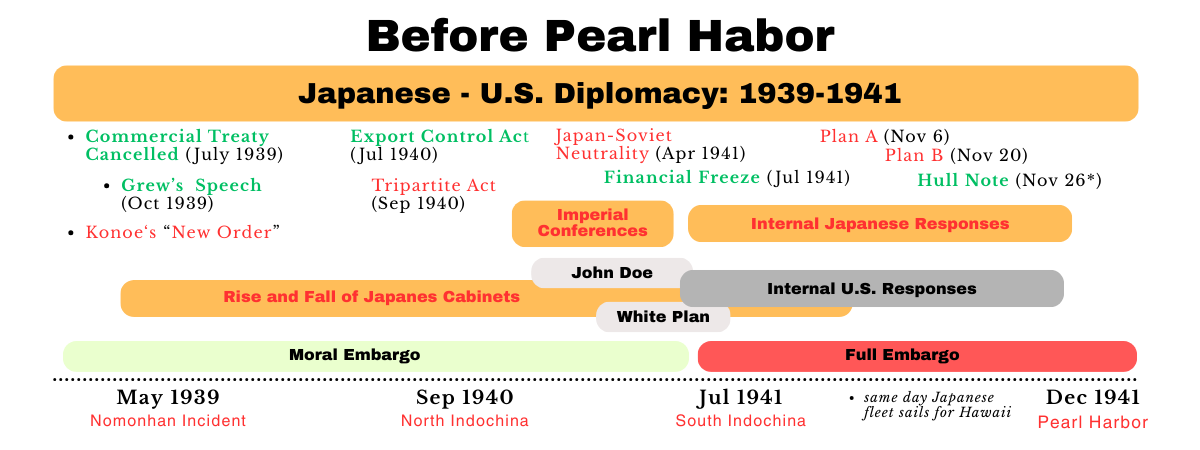
 friarmusings