
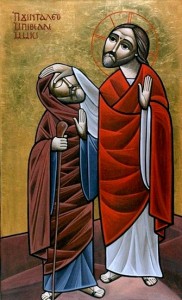
 Quotidian. Fancy word. It means belonging to the everyday, the ordinary, the normal, the commonplace, the regular, or the familiar. It includes everyday tasks such as laundry. Laundry does not require much thought. I often “sleepwalk” through it. Swimming is like that for me. I have done it for so much of my life, I don’t have to pay too much attention. Sometimes our attention ebbs and flows in other areas to which we should be paying attention. The usual conversation with a friend during which you suddenly realize you’re not listening. The moment you realize that the TV is watching you instead of the other way around. A liturgy in which you are momentarily lost. A homily that sounds like all the rest.
There is a moment of “blink” when we snap to and suddenly realize we are front and center. The whole room is looking at you, awaiting an answer. It is the stuff that haunts dreams.
In those moments when the quotidian becomes anything but, there is no pause, rewind, and going back to catch-all the nuance, texture, and tone of the events as they unfold. When we rejoin the world from our reverie, maybe the world has changed. In a moment, an instant, we are thrust center stage, and the world waits for us to speak. We are either prepared, frozen, or are able to see so clearly that path lays open before us. I think it is that way for the cast of the play, “The Man Born Blind.”
The play is afoot. The curtain draws and center stage, at the city gates, begging, is a man blind from birth. People pass by, some greet him by name. Some drop a coin into his begging tin. Same today as it was yesterday. Same as it will be tomorrow.
Entrance stage right. Jesus and disciples are approaching, but are their footsteps any different from the hundreds that pass by everyday? I wonder if the man even tuned in on their voices. “Rabbi, who sinned, this man or his parents, that he was born blind?” I doubt it was the first time he had heard the question asked. He had certainly asked it of himself. Maybe he heard his parents, relatives and neighbors ask the same question. Perhaps he no longer even cared what the answer was. He was blind and that was that. Same as it ever was.
Had the man born blind even heard the stories about Jesus, the Galilean wonder-worker. Had he heard the stories of the many healings? The Gospel doesn’t say one way or the other. He is not like Bartemaeus, another blind man who cries aloud and begs Jesus for healing. The man born blind is there, in his place, near the city gates where there is the most foot traffic. He sits waiting for the end of the day, his thoughts his own. His silent reverie occasionally interrupted if only briefly.
This day is different. The man born blind begins to pick up on the conversation between the disciples and Jesus: “…the works of God might be made visible through him…While I am in the world, I am the light of the world.” Well you don’t hear that everyday. I wonder who these people are.
Perhaps the man born blind is used to invisible hands helping him, touching, guiding, and supporting. But now he senses there is a man directly in front of him. He can hear the rustle of the clothing, senses him bending, no longer blocking the light. He hears the man spitting, hears something as the man seems to be kneading the dirt.
Suddenly something is being smeared on his eyes and he is told to go wash in the pool of Siloam. Disturbing, perhaps, but now he needs to wash up. So, why not? Maybe he is too shocked to do anything else? At least it is something different from the routine. Now he is alert. In any case, someone leads him to the pool, he splashes cool water on his face, washes, and then ordinary is no more. He can see. The ripples of what has just happened quickly spread.
It was just an ordinary day for the man, his parents, the neighbors, the Pharisees. And now everyone is snapped out the reverie. There is no ordinary now, it is all ripped asunder. Every person in this play is thrown front and center. Nothing is the same as it ever was. Prepared? Frozen? Blind? Able to see the path before them? And the world awaits their words. It is a moment of witness.
The neighbors fumble for something to say. The Pharisees can’t believe everything has gone off script. Closer to home, there is no unrestrained down-on-your-knees-thanks-be-to-God-our-son-can-see joy, party, and celebration.
The parents are not prepared; they clearly just want to be out of the firing line of the religious authorities, out of the spot light, off-stage. Sure, they’ll admit he is their son and he was indeed born blind, but…. ahhh, ask him…yeah, that’s the thing….ask him. He is of age. This is their witness. Fade to black. Exit stage left.
The play is ever afoot. There really is no ordinary. The man-once-blind stands center stage as this all swirls around him. When interrogated he answers. When everyone around him is running for the shadows, asking the wrong questions, he stands firm, center-stage, the path becoming clear. Pay attention, it is right here before us. Are you paying attention! I was blind, now I can see!
Even tossed from the Temple, he remains center stage. The world awaits his words.
His whispered words echo to our time, “Lord, I believe” (John 9:38).
As simple as that.
There is no ordinary. Nothing is the same as it ever was.
Ordinary is just the part of our life when we are not always paying attention. But be sure of this , there are coming moments when we will be thrust center stage. Spotlight. Cue. Do you have your words prepared? Will you freeze?
Always be ready to give an answer for the Hope you have within you.
Are you ready?
It is really the only line we truly have in the whole play: “Lord, I believe”
Discover more from friarmusings
Subscribe to get the latest posts sent to your email.
 friarmusings
Will I ever be ready? Will he world would be ever ready? God comes in a “blink” and leaves an indelible mark in my soul.
What a beautiful post today . . . As I have heard many of your homilies, you always end them with something that is thought-provoking, that engages us to ponder what you’ve shared with us about the Gospel, which usually prompts a response from us. Today is not different:
“It is really the only line we truly have in the whole play: “Lord, I believe”.
Three little words. Very simple, but powerful and life-changing.
And mine, a simple “thank you”.