We are a people who profess a faith in a God that has revealed God’s self as a Trinitarian God. In the history of the Church there were many who looked at the same Scriptures and denied that God was one, yet three divine persons. Back in the 4th century, a very large movement called the Arians said Jesus and the Holy Spirit were divine, but kind of a second- and third-tier God, divine but not as divine as the Father. The Sabellians held a belief that the Father, Son, and Holy Spirit are three characterizations or modes of being one God, rather than three distinct “persons” in one God. They were also a pretty large group. A very small and short-lived group were the Pneumatomachians (“Spirit fighters”) – while accepting the divinity of Jesus Christ they denied that of the Holy Spirit which they saw as a creation of the Son, and a servant of the Father and the Son. These were all people who held the New Testament to be the Word of God. Continue reading
Monthly Archives: June 2014
It all turns out well….
The first movie I saw after my years in mission in Kenya was “Shakespeare in Love.” There is a scene between Philip Henslowe, the theatre owner and producer, and Hugh Fennyman, the investor, which I have always remembered.
Henslowe: Mr. Fennyman, allow me to explain about the theatre business. The natural condition is one of insurmountable obstacles on the road to imminent disaster. Fennyman: So what do we do? Henslowe: Nothing. Strangely enough, it all turns out well. Fennyman: How? Henslowe: I don’t know. It’s a mystery. Continue reading
Trinity Sunday: God so loved the world
God so loved the world… For God so loved the world that he gave his only Son, so that everyone who believes in him might not perish but might have eternal life. Verse 16 provides the link between the two parts of the discourse. It sums up vv. 14-15 by reiterating the salvific dimensions of Jesus’ death, but moves the argument forward with its reference to God’s love. God gave Jesus to the world because God loves the world. Continue reading
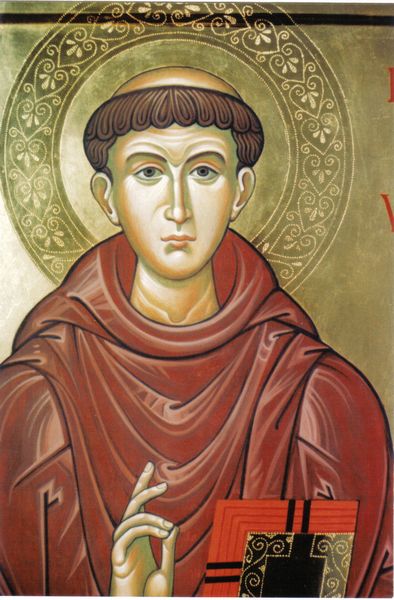
St. Anthony of Padua
When we Franciscans arrived at Sacred Heart in 2005, we were quite surprised to find that one of the clerestory windows (the ones up high in the nave vault) was Saint Anthony of Padua, a Franciscan contemporary of St. Francis of Assisi. In fact, we Franciscans still have a brief letter, in Francis’ own hand, written to Anthony. Most people know St. Anthony of Padua as the patron saint of lost and stolen articles, but have you ever wondered why he is that particular patron saint? Continue reading
Trinity Sunday: the offer of new life
The Monologue. At v. 11, the text shifts from a dialogue to a monologue. The dialogue between Jesus and Nicodemus alternated between Jesus’ offer of new birth (vv. 3, 5-8) and Nicodemus’s resistance (vv. 4, 9). The shift to the monologue allows Jesus’ voice to silence the voice of resistance. Jesus’ discourse runs through v. 21 and divides into two parts. Verses 11-15 interpret Jesus’ offer of new birth through his death, resurrection, and ascension, and vv. 16-21 focus on the theme of judgment.
We know. Jesus begins the discourse by speaking in the first-person plural. English translations of v. 11 mask the Greek word order. The translation “we speak of what we know ” flows in English, but the sentence literally reads, “what we know we say” (oidamen laloumen). This word order is important because it means that the beginning of Jesus’ discourse and Nicodemus’s opening words to Jesus (v. 3) are the same: “we know…. “ It is possible to read Jesus’ words as a continuation of the irony of v. 10; Jesus parodies Nicodemus’s assertion of his knowledge. Continue reading
Trinity Sunday: water and spirit
The Dialogue Continues… Nicodemus is oblivious to the two levels of meaning. He focuses on one meaning of “born anōthen” (“again”) and protests that what Jesus calls for is physiologically impossible (3:4). As in v. 2, Nicodemus’s categories of what is possible intrude into the conversation. On the level that Nicodemus understands Jesus’ words, Nicodemus’s protest is correct. It is impossible for a grown man to reenter his mother’s womb and be born a second time. Nicodemus’s protest is ironic, however, because his words are correct and incontestable on one level, but that level stands in conflict and tension with what Jesus intends by the expression “to be born anōthen.” Jesus’ words speak of a radical new birth, generated from above, but Nicodemus’s language and imagination do not stretch enough to include that offer. Continue reading
Trinity Sunday: being born
Born anōthen. Jesus response to Nicodemus’ opening greeting is bold, challenging and begins with the solemn “Amen, Amen…”
3 Jesus answered and said to him, “Amen, amen, I say to you, no one can see the kingdom of God without being born gennēthē anōthen .”
The expression gennēthē anōthen can be translated as “born again” or “born from above.” Some bibles opt for the “again” (TLW), some opt for “again” with a footnote to explain there is an alternative (RSV, NIV, TEV, NASB, ESV, KJV). Other opt for “from above” without explanation (NAB, NJB) or with explanation as to the alternative (NSRV, CEV). Continue reading
Trinity Sunday: prelude to belief
Commentary. In John 3:1-21, the focus shifts from the interaction of the many with Jesus to Jesus’ interaction with a single individual, Nicodemus. What follows seems to naturally divide into two parts: vv. 1-10, the dialogue between Jesus and Nicodemus; and vv. 11-21, a discourse by Jesus. This text is the first instance of a common Johannine pattern of a central event, in this case a dialogue, followed by a discourse that draws general theological themes out of the particular event. Continue reading
Trinity Sunday: context
Holy Trinity Sunday is celebrated on the first Sunday following Pentecost in most of the liturgical churches in Western Christianity. It is a solemn celebration of the belief in the revelation of one God, yet three divine persons. It was not uniquely celebrated in the early church, but as with many things the advent of new, sometime heretical, thinking often gives the Church a moment in which to explain and celebrate its own traditions; things it already believes and holds dear. In the early 4th century when the Arian heresy was spreading, the early church, recognizing the inherent Christological and Trinitarian implications, prepared an Office of Prayer with canticles, responses, a preface, and hymns, to be recited on Sundays to proclaim the Holy Trinity. Pope John XXII (14th century) instituted the celebration for the entire Church as a feast; the celebration became a solemnity after the liturgical reforms of Vatican II. Continue reading
Sent flying…
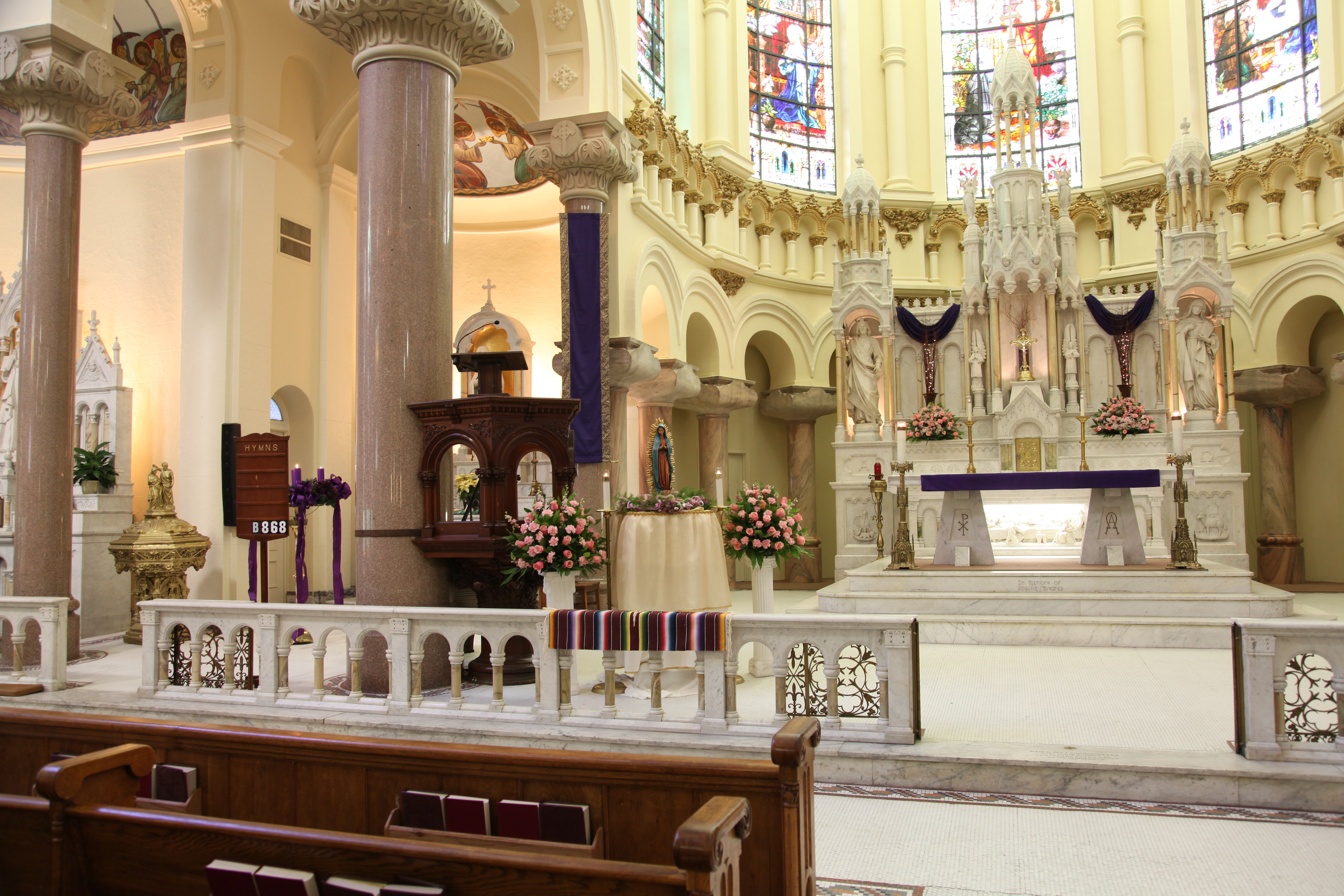
Church architecture is always a tough project – there are so many different ideas about what makes for a beautiful worship space. A couple of time in the last two weeks people have asked me if I agree with them that isn’t it a shame that churches have become so “modern” – or some other description – all the while complementing our church and wishing that all Catholic churches could be similar. Continue reading