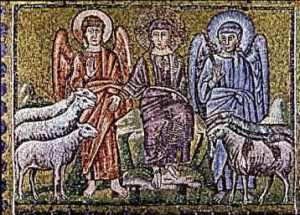
The Blessed. 34 Then the king will say to those on his right, ‘Come, you who are blessed by my Father. Inherit the kingdom prepared for you from the foundation of the world. As noted above, the “Son of Man” is now depicted as “king.” It the king himself who points out “my Father.” The Christological implications are clear – and even though it comes from the Gospel of John, one is hard pressed not to be reminded (John 5:27) where Jesus tells his disciples that all authority has been given to the Son to implement judgment. Continue reading
Monthly Archives: November 2014
Last Things – commentary
Fulfillment. 31 “When the Son of Man comes in his glory, and all the angels with him, he will sit upon his glorious throne, 32 and all the nations will be assembled before him.” Matthew, writing to a largely Jewish Christian audience, has, from the beginning, relied heavily on OT imagery and scenes. This opening verse does no less. The most evident echo is from Daniel 7:13-14 and the wider setting found there. “The Son of Man,” “comes,” “glory” all directly echo those verses, as does the idea of enthronement. Matthew also echoes Daniel 7:9-10 from which we have the specific mention of “throne,” the gathering of angels, and the idea of judgment. There is one important difference. In Daniel’s scene it is God himself seated on the throne of judgment. In Matthew it is now the Son of Man, fulfilling what was depicted in Dan 7:14. Continue reading
Last things – background
Background and Context- This passage from Matthew is particularly dense with OT references, uses language that has already appeared in earlier Matthean verses (thus already having an contextual meaning), and because of its eschatological setting, invites comparison with other sacred writers, especially, St. Paul. Hence a bit more “context” is needed, or better said, background. Continue reading
Last things – context
Matthew 25:31-46 – 31 “When the Son of Man comes in his glory, and all the angels with him, he will sit upon his glorious throne, 32 and all the nations will be assembled before him. And he will separate them one from another, as a shepherd separates the sheep from the goats. 33 He will place the sheep on his right and the goats on his left. 34 Then the king will say to those on his right, ‘Come, you who are blessed by my Father. Inherit the kingdom prepared for you from the foundation of the world. 35 For I was hungry and you gave me food, I was thirsty and you gave me drink, a stranger and you welcomed me, 36 naked and you clothed me, ill and you cared for me, in prison and you visited me.’ 37 Then the righteous will answer him and say, ‘Lord, when did we see you hungry and feed you, or thirsty and give you drink? 38 When did we see you a stranger and welcome you, or naked and clothe you? 39 When did we see you ill or in prison, and visit you?’ 40 And the king will say to them in reply, ‘Amen, I say to you, whatever you did for one of these least brothers of mine, you did for me.’ 41 Then he will say to those on his left, ‘Depart from me, you accursed, into the eternal fire prepared for the devil and his angels. 42 For I was hungry and you gave me no food, I was thirsty and you gave me no drink, 43 a stranger and you gave me no welcome, naked and you gave me no clothing, ill and in prison, and you did not care for me.’ 44 Then they will answer and say, ‘Lord, when did we see you hungry or thirsty or a stranger or naked or ill or in prison, and not minister to your needs?’ 45 He will answer them, ‘Amen, I say to you, what you did not do for one of these least ones, you did not do for me.’ 46 And these will go off to eternal punishment, but the righteous to eternal life.” Continue reading
What’s yours is yours…
“To one he gave five talents; to another, two; to a third, one – each according to his abilities.”
Let me paraphrase the opening of our gospel to make a point or two. “A man going on a journey call in his servants and handed over to them his possessions. To one he gave five pounds of $1,000 bills. To another, two pounds of $1,000 bills, and to a third, one pound of $1,000 bills – to each according to their gifts, talents and abilities – he did not give one them more than he or she could handle.” Continue reading
Parable of the Talents: a distrubing story
The Third Servant. 24 Then the one who had received the one talent came forward and said, ‘Master, I knew you were a demanding person, harvesting where you did not plant and gathering where you did not scatter; 25 so out of fear I went off and buried your talent in the ground. Here it is back.’ 26 His master said to him in reply, ‘You wicked, lazy servant! So you knew that I harvest where I did not plant and gather where I did not scatter? 27 Should you not then have put my money in the bank so that I could have got it back with interest on my return? Continue reading
Come, share your master’s joy
A Curious Start. 14 “It will be as when a man who was going on a journey called in his servants and entrusted his possessions to them. 15 To one he gave five talents; to another, two; to a third, one—to each according to his ability. Then he went away.” If Matthew had used a copy editor, I am sure they would be discussing the use of “it.” What will be as…? Curiously, most Matthean parables are explicit when it comes to the kingdom of heaven. The previous parable (Wise and Foolish Maidens) begins, “the kingdom of heaven will be like.” (25:1). Here Matthew begins hōsper gar, literally “for just as”, indicates that the same subject is under discussion. Continue reading
Ready and doing…what?
In what does readiness consist? Keep in mind that in our parable, the servants are not surprised at their master’s coming, so “readiness” is more attuned to whether the servants will be dependable in the use of the resources. We should note that the master entrusted his resources to the servants according to their individual abilities (25:15). The third one received only one talent, likely indicating that the master understands that he has less ability than the others. The master does not overburden the third servant who nonetheless fails – not in any loss of money, but in returning it without increase. It was not that he did something wrong—he simply did nothing. This is, then, apparently, a parable about maximizing opportunities, not wasting them. To be “ready” for the master’s return means to use the intervening time to “maximum gain”; it is again about continuing life and work rather than about calculating the date and being alert for his actual arrival. Continue reading
Readiness
Commentary – The preceding parables have been about readiness, and this one is particularly about faithful stewardship which readiness produces. The third in the series of parables about being ready returns to a setting similar to that of the first, a master dealing with his servants. But this time there is a more specific focus on their commercial responsibility in their master’s absence. Each is left with a very large sum of money, with no instructions on what to do with it, and the story turns on their different ways of exercising this responsibility. There is again a division between good and bad, between success and failure. Yet the “failure” of the last servant consists not in any loss of money, but in returning it without increase. It was not that he did something wrong—he simply did nothing. This is, then, apparently, a parable about maximizing opportunities, not wasting them. To be “ready” for the master’s return means to use the intervening time to maximum gain; it is again about continuing life and work rather than about calculating the date and being alert for his actual arrival. This third parable is thus essentially making the same point about readiness as the two preceding ones (Mt 24:45-51 and Mt 25:1-13). Continue reading
The Parable of the Talents
Matthew 25:14–30 14 “It will be as when a man who was going on a journey called in his servants and entrusted his possessions to them. 15 To one he gave five talents; to another, two; to a third, one—to each according to his ability. Then he went away. Immediately 16 the one who received five talents went and traded with them, and made another five. 17 Likewise, the one who received two made another two. 18 But the man who received one went off and dug a hole in the ground and buried his master’s money. 19 After a long time the master of those servants came back and settled accounts with them. 20 The one who had received five talents came forward bringing the additional five. He said, ‘Master, you gave me five talents. See, I have made five more.’ 21 His master said to him, ‘Well done, my good and faithful servant. Since you were faithful in small matters, I will give you great responsibilities. Come, share your master’s joy.’ 22 (Then) the one who had received two talents also came forward and said, ‘Master, you gave me two talents. See, I have made two more.’ 23 His master said to him, ‘Well done, my good and faithful servant. Since you were faithful in small matters, I will give you great responsibilities. Come, share your master’s joy.’ 24 Then the one who had received the one talent came forward and said, ‘Master, I knew you were a demanding person, harvesting where you did not plant and gathering where you did not scatter; 25 so out of fear I went off and buried your talent in the ground. Here it is back.’ 26 His master said to him in reply, ‘You wicked, lazy servant! So you knew that I harvest where I did not plant and gather where I did not scatter? 27 Should you not then have put my money in the bank so that I could have got it back with interest on my return? 28 Now then! Take the talent from him and give it to the one with ten. 29 For to everyone who has, more will be given and he will grow rich; but from the one who has not, even what he has will be taken away. 30 And throw this useless servant into the darkness outside, where there will be wailing and grinding of teeth.’ Continue reading