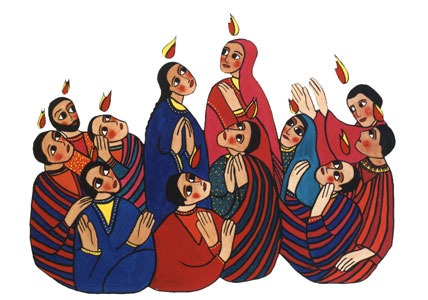
The Johannine account of the first post-resurrection appearance to the gathered disciples is linked to the events of the Resurrection by the simple expression “that first day.” As the startling and disturbing events of the last three days had unfolded the community’s overriding response was fear. They had gathered, but had locked themselves away out of fear of what persecutions the religious authorities might bring against them. It is into this complex of uncertainty, perhaps doubt and hesitation, that Jesus appears. Continue reading
Monthly Archives: May 2015
Pentecost: context
19 On the evening of that first day of the week, when the doors were locked, where the disciples were, for fear of the Jews, Jesus came and stood in their midst and said to them, “Peace be with you.” 20 When he had said this, he showed them his hands and his side. The disciples rejoiced when they saw the Lord. 21 (Jesus) said to them again, “Peace be with you. As the Father has sent me, so I send you.” 22 And when he had said this, he breathed on them and said to them, “Receive the holy Spirit. 23 Whose sins you forgive are forgiven them, and whose sins you retain are retained.” Continue reading
A sea change
We are firmly in the midst of high school and college graduation season. Every institution has their own traditions and ways to celebrate – including my alma mater, the United States Naval Academy. Every May, the seniors march on to the field at Navy-Marine Corps Stadium for graduation. The women and men are dressed in their “choker” whites (future Naval Officers) and blues (future Marine Corp officers). Theses graduating midshipmen take their places, listen to the speakers of the day, walk across the stage to receive their diploma, take the oath of office, and then it happens… Continue reading
Beautiful Feet
Salvador Dali’s painting “Ascension” is certainly one of the most provocative paintings depicting the Ascension of Our Lord Jesus. The symbolic elements are many, the speculations even more, and the agreement on meaning is still up for grabs. But I sometimes tend to focus on some of the more realistic elements cast among the surrealistic things. While the art experts discuss the finer points of Dali, his life, faith, and his work – I am fascinated by perspective, as well as the hands and feet. The former as though clutching at something; the latter soiled and showing the wear and tear of life on earth. Continue reading
Mother’s Day
“A word of advice to everyone: if you can’t remember whether or not you called your mother, you didn’t. But what about when your mom doesn’t remember if you called? And it has only been five minutes.” Those were my opening words a year ago on Mother’s Day when it became clear mom was beginning to experience increasingly severe memory issues. Continue reading
As the Father loves: commissioned
The Commission as Friends. The language of friendship is immediately contextualized by language of election in v.16: It was not you who chose me, but I who chose you and appointed you to go and bear fruit that will remain, so that whatever you ask the Father in my name he may give you.” As Fr. Raymond Brown points out [683], this language of election does not speak of the election of the Twelve because there is no indication anywhere in the Farewell Discourse of the number and composition of the circle that is present with Jesus on this last evening. Rather, Jesus reminds the disciples (including the readers) that their place with him is the result of his initiative, not theirs; relationship with Jesus is ultimately a result of God’s grace. Continue reading
As the Father loves: friends
The Greatest Love. In v.13 we come to the greatest love. Morris [598-9] comments succinctly and beautifully: “There is no love greater than that of one who lays down his life for others. Anything else must be less. This is the supreme test of love. In the context this must refer primarily to the love of Jesus shown on the cross. There he laid down his life on behalf of his friends. Some have raised the question whether the love that dies for enemies is not greater than that which is concerned for friends, but that is not before us here. In this passage Jesus is not comparing the love that sacrifices for enemies with that which sacrifices for friends. He is in the midst of friends and is speaking only of friends. With respect to them he is saying that one cannot have greater love than to die for them. When it is a question of enemies Jesus did in fact die for them (Rom. 5:10). And as Loyd says, ‘in truth love has sunk below its proper level if it begins to ask who is my friend and who my enemy. Love gives, and gives everything, for all men.’ That is the thought of this verse. Jesus gives everything, even life itself, for others. There is no greater proof of love. Continue reading
As the Father loves: commandments
Keep My Commandments.There is something very practical here: If you keep my commandments, you will remain in my love, just as I have kept my Father’s commandments and remain in his love. Many suggest that this is the practical answer of how one remains in Christ and in his Word, bears fruit, and remains in the love of Jesus. These things are not some mystical experience. It is simple obedience. It is when we keep Christ’s commandments that we abide in his love. Once again appeal is made to Christ’s own example. He kept the Father’s commandments and thus abides continually in the Father’s love. And it is not a blind following of the commands, it to “listen through” to the deeper love that resides within and throughout the commandments. Continue reading
As the Father loves: remain
As the Father loves me, so I also love you. Remain in my love. From the obligations placed upon his disciples (vv.1-8) Jesus turns to his love for them. He first tells them that his love for them is like the Father’s love for him. Then he commands them to continue in his love, suggesting that it is possible for people to live without being mindful of Christ’s love for them and so break the closeness of the fellowship. Jesus commands them not to do this.
The words agapao/ agapē (love), did not appear in vv. 1-8, but are found 9 times in vv.9-17. These words are prominent throughout the Farewell Discourse (John 13-17) with the verbal form occurring 24 times in those chapters (contrasted with 13 times in the rest of the book) and the noun form occurring 6 times in those chapters (and only once in the remainder of the book). Continue reading
As the Father loves: context
9 As the Father loves me, so I also love you. Remain in my love. 10 If you keep my commandments, you will remain in my love, just as I have kept my Father’s commandments and remain in his love. 11 “I have told you this so that my joy may be in you and your joy may be complete. 12 This is my commandment: love one another as I love you. 13 No one has greater love than this, to lay down one’s life for one’s friends. 14 You are my friends if you do what I command you. 15 I no longer call you slaves, because a slave does not know what his master is doing. I have called you friends, because I have told you everything I have heard from my Father. 16 It was not you who chose me, but I who chose you and appointed you to go and bear fruit that will remain, so that whatever you ask the Father in my name he may give you. 17 This I command you: love one another. Continue reading