
I will begin posting again…. well, when I get back, answer 2 gazillion emails, VMs, and talk to all manner of folk that have been waiting to chat. Could be a while.
God bless.

I will begin posting again…. well, when I get back, answer 2 gazillion emails, VMs, and talk to all manner of folk that have been waiting to chat. Could be a while.
God bless.
 When the English historian Christopher Dawson decided to become a Roman Catholic, his aristocratic mother was distraught, not because of Catholic teaching, but because now her son would, in her words, have to “worship with the help.” His background would no longer set him apart from others or above anyone. At church he would be just an equal among equals because the Eucharist would strip him of his higher social status. It was this very thing that first drew Dorothy Day to Christianity. During the Eucharist, she noticed the rich and the poor knelt side by side; all humbled before the great gift of Christ. Around the Eucharistic table what Mary prophesized in her Magnificat came to be, that, in Jesus, the mighty would be brought down and that lowly would be raised up. Continue reading
 Begotten, Not Created. The language of “begetting,” “created,” and the like has, historically, been the source of great controversies. Beginning at least as early as the apologist Justin Martyr (A.D. 125), Christians, almost without exception, identified Sophia/Wisdom in Proverbs 8 with Jesus Christ. This almost universal interpretation of the passage embroiled the church in controversy about the precise nature of the relationship between God and Christ. From the time of Origen (ca. A.D. 180) patristic exegesis interpreted Wisdom’s birth in Proverbs 8:25 as Christ’s continual coming into existence. Not all agreed with such understanding. Lead by the Alexandrian deacon Arius, a group called the Arians held that there was a time when the Son “was not” and thus the Son was created as God’s most exalted creature. They concluded this using Prov. 8:22, “the LORD begot/created me,” as their primary text. In contrast, orthodox Christians held that Christ was of the same substance as the Father, the true Son of God, and not a creature. Orthodoxy interpreted Prov. 8:22 by explaining that the ever-existing Son was “created” when he became incarnate. According to his second strategy, the “creation of Wisdom was actually the creation of Wisdom’s image in creatures as they were brought into being.” Continue reading
Place in Our Tradition. The Book of Proverbs can make an important contribution to Christians and Jews today.
Wisdom. In the ancient Near East (ANE), people assumed that wisdom belonged to the gods, who were wise by reason of their divinity; human beings needed to have wisdom granted them by the gods. Many of the “beginning of the world” accounts found in surrounding ANE cultures depict creation in two stages. In the first stage, human beings lived an animal-like existence, without clothes, writing, or kingship (seen as proper governance). Over time, the gods came to realize that such a low-grade of existence made the human race inadequate as their servants, so they endowed the race with “wisdom,” which consisted of culture (e.g., kingship) and crafts (e.g., knowledge of farming, ability to weave). Such wisdom elevated the race to a “human” level and made them effective servants of the gods. Furthermore, divine wisdom was mediated to human beings through earthly institutions—the king, scribes (who produced wise writings), and heads of families (fathers, sometimes mothers). These traditional mediators appear in Proverbs – in fact, the book is credited to King Solomon. Throughout the book kings are mentioned as pillars of society (e.g., 16:12–15); writings are a source of wisdom (1:1–7); the father instructing his son is the major paradigm of teaching. Proverbs differs, however, from other wisdom books in concentrating on wisdom itself, treating it as a virtually independent entity and personifying it as an attractive woman. Other books urge readers to perform wise acts, but Proverbs urges them to seek wisdom itself and portrays wisdom as a woman seeking human beings as disciples and companions. Continue reading
The Spirit in Creation
22 “The LORD begot me, the first-born of his ways,
the forerunner of his prodigies of long ago;
23 From of old I was poured forth,
at the first, before the earth.
24 When there were no depths I was brought forth,
when there were no fountains or springs of water;
25 Before the mountains were settled into place,
before the hills, I was brought forth;
26 While as yet the earth and the fields were not made,
nor the first clods of the world.
27 “When he established the heavens I was there,
when he marked out the vault over the face of the deep;
28 When he made firm the skies above,
when he fixed fast the foundations of the earth;
29 When he set for the sea its limit,
so that the waters should not transgress his command;
30 Then was I beside him as his craftsman,
and I was his delight day by day,
Playing before him all the while,
31 playing on the surface of his earth;
and I found delight in the sons of men. (Proverbs 8:22–31) Continue reading
 You know it is when it hasn’t rained in a long time and then it does. Not a gully washer of a rain, but just a regular rain. You know the roads can get a little slick when the accumulated road oil comes to the surface. Well that is what happened to this truck driver on a country road. Came around this corner and the tires started to slip a little bit, then a lot, and he skidded right to the ditch. Continue reading
Monday night I was called out to Tampa General for an emergency anointing for a patient preparing to pass into God’s bright glory. When I arrived at the room, a very familiar sight greeted me. Kumbe! There was a pair of religious sisters I recognized as Benedictine Sisters from Tanzania. I attended to the immediate family, greeting them and offering some words of comfort. When I came to the Sisters, it was their chance to be surprised when I greeted them in Kiswahili. Their eyes grew wide, surprised that another person in this small room shared some of the sounds and words of their home a half a world away. We all let the surprise pass and gave way to the woman for whom I had been called. Continue reading
John 20:19-31 :: 19 On the evening of that first day of the week, when the doors were locked, where the disciples were, for fear of the Jews, Jesus came and stood in their midst and said to them, “Peace be with you.” 20 When he had said this, he showed them his hands and his side. The disciples rejoiced when they saw the Lord. 21 (Jesus) said to them again, “Peace be with you. As the Father has sent me, so I send you.” 22 And when he had said this, he breathed on them and said to them, “Receive the holy Spirit. 23 Whose sins you forgive are forgiven them, and whose sins you retain are retained.”
If this Pentecost gospel reading “rings a bell”, it is because this was the gospel for the 2nd Sunday on Easter. That instance of the reading went on to include the misnamed account of “Doubting Thomas.” Rather than repeat those materials during the course of the week, I will simply provide links to what I had already posted:
As the week progresses, perhaps I might find other odds and ends to post regarding Pentecost.
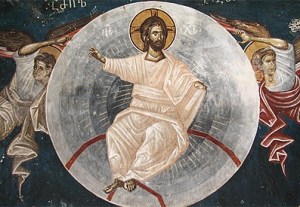 When I was in seminary, our homiletics professor had lots of advice and pointers for the Sunday homily – I am about to ignore one of the pieces of advice. The professor was pretty adamant about not explaining theology. And I mostly agree with his point – it can make a homily really dry and fill it with language that needs its own explanation. The professor’s final point was that you are likely to give an inaccurate or heretical version of the theology in any case. Continue reading
 friarmusings