Receiving the Spirit

In today’s readings both St. Paul and Jesus have something to say about receiving the Holy Spirit. I wondered what the Early Church Fathers might have to say about receiving the Spirit. Some use receiving the Spirit in context of a different point they are trying to make. But others have deep insight about  receiving the Spirit as a key divine event in the human person. They reflect on God entering, inhabiting, sanctifying, transforming, empowering and even beginning within us the life we will possess fully, not just now, but also in eternity.

In his Catechetical Lectures, St. Cyril of Jerusalem, is addressing adults preparing for Baptism. It is not a theological treatment on pneumatology but rather a preparation for people who expected sacramentally to receive the Holy Spirit at their initiation. Cyril strives to help the people realize that receiving the Spirit means receiving Someone. In Lectures 16 and 17, he notes that the Spirit isn’t merely an influence or divine power. Rather, the Spirit acts personally. The Spirit speaks, calls, sends, teaches and sanctifies. It is an interpersonal relation.

Cyril explicitly cites our Gospel: “How much more shall your heavenly Father give the Holy Spirit to them that ask him.”  But what interests Cyril is what happens when this gift is received. Speaking about Christ breathing the Spirit upon the Apostles in John 20 and then Pentecost, Cyril sees degrees of capacity for receiving God’s gift: the Apostles genuinely receive the Spirit, and yet Pentecost brings a still greater outpouring. He paints a picture as the human person like a vessel being enlarged to receive more. 

So often receiving the Spirit is depicted as something that happens once, but Cyril makes the point that receiving the Spirit is something we are continually becoming capable of receiving even more deeply. We received the Spirit sacramentally in Baptism and Confirmation. But that doesn’t mean God has exhausted what the Spirit can do within us. Cyril’s image allows the prayer of Luke 11:13 to remain meaningful for baptized Christians: “Father, give me your Holy Spirit.” Not because the Spirit is absent, but because we are not yet completely open to everything the Spirit desires to do in us.

St Irenaeus, his writings, echoes Cyril to a degree when he offers that the Spirit accustoms us to God. Irenaeus describes Christians as already receiving a portion of the Spirit with a pledge of more to come. He describes this wonderfully when he writes that: “little by little [we become] accustomed to receive and bear God.” Think about what that means: the Holy Spirit is teaching us to grow and ever be more capable of bearing a greater presence of God in our lives. For Irenaeus, salvation isn’t merely God changing our legal status. It is God gradually transforming human beings so that we become capable of sharing divine life. The Spirit dwelling within us is already the beginning of that future.

In the first reading St. Paul asks: “Did you receive the Spirit from works of the law, or from faith in what you heard?” (Gal 3:2) Often that is taken primarily as part of Paul’s argument about justification, and indeed it is. But Paul already knows they have received the Holy Spirit and so he appeals to their experience.

Then in v. 5: “Does, then, the one who supplies the Spirit to you and works mighty deeds among you do so from works of the law or from faith in what you heard?”  He is making the point that something has already happened to them. Their experience, their Christian existence itself was evidence of God’s action. That is what makes rumors of their return to circumcision and Torah observance so incomprehensible to Paul. God has given you his Spirit. You have already received the thing you are trying to earn. He is asking, why are they now behaving as though God’s life must be acquired through something they accomplish?

All of this together reinforces the idea that the Spirit is gift, not achievement or reward. The Spirit is something earned by sufficient religious performance.

This is the point St. Augustine makes in his homily on Luke 11.  Augustine emphasizes that Christ would not urge us so persistently to ask unless God truly desired to give: God is more willing to give than we are to receive. When you join Augustine’s thought to that from Irenaeus, it means the Spirit gradually makes us capable of receiving what God desires to give.

Consider how that might make us think differently about today’s Gospel. We hear: “And I tell you, ask and you will receive; seek and you will find; knock and the door will be opened to you. For everyone who asks, receives; and the one who seeks, finds; and to the one who knocks, the door will be opened. “Ask and you will receive; seek and you will find; knock and the door will be opened…” and immediately begin filling in the blank. Ask for what? And we ask about of current needs and future hopes, no doubt legitimate prayers.

But consider Jesus’ words: “How much more will the Father in heaven give the Holy Spirit to those who ask him?” Jesus isn’t promising that persistent prayer eventually persuades God to give us whatever particular outcome we’re requesting. He promises something much greater: God gives us God in the Holy Spirit.

Maybe that’s why the answer to prayer sometimes doesn’t look like what we asked for. We ask God to remove a difficult situation but the Spirit gives us courage to live through it. We ask God to change someone else and the Spirit begins changing us. We ask God to show us exactly what to do but the Spirit gives us patience to wait. We ask God to take away suffering and the Spirit somehow enables us to discover Christ within it.

The gift isn’t always a changed circumstance. Sometimes the gift is a changed person within the circumstance.

May the real question is how much of me have I allowed the Holy Spirit to receive so as to change me. What parts of my life do I insist on keeping control? My decisions, relationships, plans fears…? 

Maybe we over-complicate our prayer. Might it be as simple as teaching me to receive and bear God? And then “buckle up” as we let the Spirit change us.

The Holy Spirit

This coming Sunday is the 4th Sunday of Advent and the story of the Visitation when Mary went from Nazareth to the hill country near Jerusalem to visit Elizabeth and her husband Zechariah, who for many years, had prayed to conceive and have a child. During the Annunciation, the Angel Gabriel had informed Mary: “And behold, Elizabeth, your relative, has also conceived a son in her old age, and this is the sixth month for her who was called barren.” (Luke 1:36) And so Mary sets out in haste to visit. Continue reading →

Comes the Spirit

Today’s first reading is from one of my favorite books: The Book of Jonah. The book is only four chapters long and we are in Chapter 3. The whole Jonah and the “whale” has already happened, Jonah has traveled to Nineveh as a very reluctant prophet. Frankly Jonah hopes that God calls down a rain of fire, death, doom and destruction upon the king, the people, and all the animals. His entire call to conversion is five words in Hebrew. We get a few  more in English, but not many: “Forty days more and Nineveh shall be destroyed.” Jonah does not say who will destroy them or why or in any way amplify the bottom line.

“When God saw by their actions how they turned from their evil way, he repented of the evil that he had threatened to do to them; he did not carry it out.” (Jonah 3:10) Great! The Ninevites repented, God relented, and Jonah’s prophetic mission is complete. But poor Jonah, it’s not the result he wanted. Chapter 4 is a long description of Jonah pouting about this turn of events.

But such are the turn of events when the Holy Spirit comes in ways you’d never expect.

It happens all the time to every homilist if we are honest. Sometimes I sit and wonder from whence came the idea for a particular homily. But mostly I am surprised after the homily.

A person comes up to say, “Thank you, Father, your homily really touched me. It was just what I needed to hear.”  Often I will ask them what moved their hearts. The reply is often not the point of the homily, but there was one word, one phrase upon which the Holy Spirit descended and turned into a seed which will bear great fruit in the life of the listener.

But such are the turn of events when the Holy Spirit comes in ways you’d never expect.

Enthusiastic or reluctant, gifted or timid, … whatever… speak into the waiting world. The Spirit can take over from that point.

Figuring things out

It is Memorial Day 2020. My thoughts and prayers are with all those who have lost a loved one who died while actively serving their country. In the morning, before the sun was up, I celebrated a private Mass (lots of those these days!) for all those we honor on this day, for my Naval Academy classmates who have already gone on to God’s bright glory, and in thanksgiving for all our parishioners who have served and are serving their country. God’s blessings be upon all. Continue reading →
Not always what we want

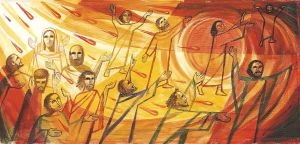
Pentecost Sunday is a day on which we are reminded that the Holy Spirit was promised and has been given. We celebrate the fulfillment of a promise by Jesus that the Advocate, the Paraclete, the one sent by Jesus would come to remind us of all that Jesus taught, to be with us, and to bring to us the power of God. We celebrate this day with three readings – each one of which is filled with mention of the Spirit. The first reading is the account from Acts 2 so familiar to every Christian, 50 days after the Resurrection. We imagine it as a very public event in which the power of the Spirit came with the roar of a great wind, as though tongues of fire, and suddenly the disciples can speak in a way that people from everywhere can understand them. It is as though what happened at the Tower of Babel is undone and finally the world can be united. The Spirit-filled disciples are to be the agents that restore unity to the world. Continue reading →

On Fire

Pentecost3Monday night I was called out to Tampa General for an emergency anointing for a patient preparing to pass into God’s bright glory. When I arrived at the room, a very familiar sight greeted me. Kumbe! There was a pair of religious sisters I recognized as Benedictine Sisters from Tanzania. I attended to the immediate family, greeting them and offering some words of comfort. When I came to the Sisters, it was their chance to be surprised when I greeted them in Kiswahili. Their eyes grew wide, surprised that another person in this small room shared some of the sounds and words of their home a half a world away. We all let the surprise pass and gave way to the woman for whom I had been called. Continue reading →

Not your status quo

pentecost-ruahA “…strong driving wind…tongues as of fire,” – this is what descends upon the apostles and disciples gathered together. Are we surprised that they are confused, astounded, amazed, skeptical, believing, and disbelieving – all at once? In a certain way, they were simply more confused, amazed, etc. because they were already together experiencing bewilderment over how to move forward with the mission given them by Jesus when the Holy Spirit flows among them and shakes things up even more. Continue reading →

It comes back to love

Holy-Face-of-Jesus-23I will not leave you…I will come to you. The second promise of continuing presence is Jesus’ promise of his own return (vv. 18-20). “Orphan” (orphanos) was a common metaphor to describe disciples left without their master but the use of the meta­phor here has a special poignancy in the light of the familial and domestic imagery that runs throughout Jesus’ words to his own (e.g., 13:33; 14:2-3, 10-14; 15:9-11; 16:21-24, 27). Jesus’ promise that he will not leave the disciples or­phaned recalls his use of the address “little chil­dren” in 13:33 and is an assurance that the intimacy of that familial relationship is not under­cut by Jesus’ departure. His promise to return (v. 18b) thus immediately counters any possible per­ception of Jesus’ death as his abandonment of his own. Continue reading →

Love and holding dear

gospel_of_john_logo3Keeping His Commandments. If we now have some hint at what we mean by “commandments,” what does it mean to “keep” (tereo) them? The basic meanings of this word [TDNT 1:21 ff] are:

  1. keep watch over, guard
  2. keep, hold, reserve, preserve someone or something
  3. keep = not lose
  4. keep = protect
  5. keep, observe, fulfill, pay attention to

NOTE: that “obey” is not one of the meanings (although perhaps implied by “observe”).

Brian Stoffregen’s paraphrase of tereo as “hold dear” or perhaps, “consider important” seems to capture the sense of the passage. This interpretation goes beyond mere obedience. One may detest the words that one is hearing and obeying. One may detest the one giving the orders, but to avoid punishment, one obeys them. In contrast to this, phrasing it, “Holding Jesus’ word dear,” implies having a positive attitude towards that Word and the Word-giver. That is, wanting to hear and obey it out of love for the speaker.

Loving Jesus and “holding dear” what Jesus said and did are inseparable. In chapters 14-15, twice “love” comes before “keep” (14:15; 23) and twice “keep” comes before “love” (14:21; 15:10). In addition, “keeping” is used with “commandments” (entole) (14:15, 21; 15:10) and with “word” (logos) (14:23, 24; 15:20). Loving Jesus and “holding dear” his word and commandments are inseparable.

The connection between love and keeping (i.e., holding dear) the commandments is illustrated by Jesus himself in v. 31. He is doing what the Father has commanded him, so that the world might know that he is loving the Father. The purpose of Jesus’ obedience is witnessing. The results of that witnessing are given in v.23:

  1. The Father will love that one
  2. The Father and Son will come to that one
  3. The Father and Son will make a dwelling with that one

The promise we have from Jesus is that he (and his Father) will be present to those who, out of their love for Jesus, keep (i.e., hold dear) his word. These are those to whom Jesus will reveal himself.

In contrast to these who love Jesus and keep his word, Jesus next talks about “Whoever does not love me does not keep (hold dear) my words” (v. 24). Presumably these non-lovers and non-keepers do not receive the Father’s love or the abiding presence of the Father and the Son. This is understandable if the love and presence comes through the Word that one “holds dear” or “considers valuable,” those who do not have this relationship with the Word will not have the presence of the divine in their lives.

The Advocate. This is the first occurrence of the noun parakletos in the Fourth Gos­pel. This word occurs five times in the NT. It is used in 1 John 2:1 to refer to Jesus; and four times in John’s Farewell Discourse (14:16, 26; 15:26; 16:7).

Perhaps it best not to translate the Greek word paraclete because there are too many possibilities. While the literal meaning of the related verb (parakaleo) means “to call to one’s side,” usually asking the other for help, the noun took on a legal meaning as “helper in court”. Thus we have translations like “counselor,” “advocate,” or “one who speaks for another” as well as the too general translation of “helper”.

If the Paraclete is a “helper in court,” whose helper is it? Clearly the Paraclete has a role as helper to the disciples (and, now, our helper); but there are also indications that it is Jesus’ helper. The Paraclete comes to speak to us for Jesus. In 14:26, it will teach us everything and remind us of all that Jesus has said to us. In 15:26, it will testify on Jesus’ behalf. The Paraclete comes to speak to us on behalf of Jesus. In our text, the Paraclete will teach us “everything” and remind us of “all” that Jesus has said to us. (In 16:8; its topics are more specific: the truth about sin, righteousness, and judgment.) It is not too much of a stretch to say that the Paraclete “helps” us to hear Jesus’ word, which, as noted above, brings the continuing presence of Jesus and his Father to us. The Paraclete reveals Jesus to us, but those without the help of the Paraclete will not properly hear or remember the word of Jesus’ presence.

What the Paraclete does is not new, but is a continuation of the work of Jesus. This can be seen clearly in the description of the Paraclete as the Spirit of truth in v. 17. To call the Paraclete the “Spirit of truth” is to identify the Paraclete as more than a true—i.e., truthful—Spirit. As the Spirit of truth, the Paraclete shares in the work of Jesus, because Jesus is the truth (14:6). The work of the Paraclete is thus to keep the truth of Jesus present to the world after Jesus’ departure (cf. 16:7-11). As with the unity of the Father and Jesus in their work, the relationship between Jesus and the Paraclete is also defined by the unity of their work.

The response of the world to the Paraclete’s presence echoes the response of the world to Jesus, a division between those who receive and those who do not (cf. 1:10-13). Yet the focus of vv. 16-17 is not ultimately on this division, but on the assurance that the presence of the Paraclete gives to Jesus’ “own.” Knowledge of the Paraclete is defined as the Paraclete’s abid­ing with the believing community (v. 17b). The Paraclete is repeatedly described in ways that emphasize its presence in and relationship with the faith community: “will be with you forever”; “abides with you”; and “will be in you.” The Paraclete ensures that the revelation of God in the incarnation does not end with Jesus’ death and return to God.

Notes

John 14:16 another Advocate: Jesus is the first advocate (paraclete); see 1 John 2:1, where Jesus is an advocate in the sense of intercessor in heaven. The Greek term derives from legal terminology for an advocate or defense attorney, and can mean spokesman, mediator, intercessor, comforter, consoler, although no one of these terms encompasses the meaning in John. The Paraclete in John is a teacher, a witness to Jesus, and a prosecutor of the world, who represents the continued presence on earth of the Jesus who has returned to the Father. another: There are two Greek words meaning “another”, allos and heteros. It is sometimes argued that the first means another of a similar kind, the second another of a different kind, and because allos is used in v.16 the other Advocate is of the same kind as Jesus himself. However, the way allos and heteros are used in the Fourth Gospel and the NT as a whole does not support this distinction.

John 14:17 the Spirit of truth: The Advocate is described as “the Spirit of truth” here and in two other places in this Gospel (15:26; 16:13). In this respect, the Advocate is like Jesus, who revealed the truth (8:31–36, 40, 45–46; 16:7; 18:37) and embodied the truth of God (1:14, 17; 14:6). This expression was also used at Qumran community (Jewish), where it is a moral force put into a person by God, as opposed to the spirit of perversity. The Spirit of truth is more personal in John; it will teach the realities of the new order (14:26), and testify to the truth (14:6). While it has been customary to use masculine personal pronouns in English for the Advocate, the Greek word for “spirit” is neuter, and the Greek text and manuscript variants fluctuate between masculine and neuter pronouns. it remains with you, and will be in you: the manuscripts are not consistent on the tenses of the two verbs in this verse, while remains is always present tense, is/will be varies from present to future tense (differing only by an accent mark) in otherwise consistent manuscripts. Without repeating the myriad of explanations, perhaps it is no more complicated that the “former” Paraclete (Jesus) is now with them while “another Advocate” (v.16) will be in them – always realizing that “another Advocate” takes place after and because of the departure of Jesus. In you:The expression en hymin is also validly translated as “among you” and is perhaps indicated given that “you” is plural. But it should also be noted that the promise will become individualized in vv.21-23.

The Peace of God revealed…

6th Sunday of Easter, Year C: John 14:23-29

23 Jesus answered and said to him, “Whoever loves me will keep my word, and my Father will love him, and we will come to him and make our dwelling with him. 24 Whoever does not love me does not keep my words; yet the word you hear is not mine but that of the Father who sent me. 25“I have told you this while I am with you. 26 The Advocate, the holy Spirit that the Father will send in my name—he will teach you everything and remind you of all that (I) told you. 27 Peace I leave with you; my peace I give to you. Not as the world gives do I give it to you. Do not let your hearts be troubled or afraid. 28 You heard me tell you, ‘I am going away and I will come back to you.’ If you loved me, you would rejoice that I am going to the Father; for the Father is greater than I. 29 And now I have told you this before it happens, so that when it happens you may believe.

Introduction

Our passage today is taken from the “Farewell Discourse” of Jesus contained in five chapters of John (13:1-17:56). In other words, we have but a few verses which are an integral part of a much larger passage. Accordingly, the Discourse can be outlined in a number of ways, though three main parts are fairly clear: Continue reading →