
 The illustration (vv.54-55) seems to point to the weather patterns in the Near East. The Mediterranean Sea was to the west and winds from that direction brought rain. The desert was to the south and winds from that direction brought heat. It is not clear whether these words were spoken on the same occasion as the preceding verses. There is no direct connection. Matthew gives a similar saying in response to a request for a sign. Still, it is interesting to note that here, while Jesus is encouraging, exhorting people to “see,” he again uses the accusatory “hypocrite.” Jesus has only used this expression once before in Luke’s gospel: “How can you say to your brother, ‘Brother, let me remove that splinter in your eye,’ when you do not even notice the wooden beam in your own eye? You hypocrite! Remove the wooden beam from your eye first; then you will see clearly to remove the splinter in your brother’s eye” (Luke 6:42).
By calling them hypocrites Luke suggests that they share in the blindness of the lawyers (scholars of the law) who have “taken away the key of knowledge. You yourselves did not enter and you stopped those trying to enter” (Luke 11:52). Jesus concludes by saying that the people must interpret (12:56) and judge for themselves what is right (v.57)
“Interpret” (v. 56 twice) is a bit of a stretch as a translation of the Greek word dokimazo. The basic meaning of this word group is “to test”. The definitions given by Lowe & Nida [2:66] are:
- to try to learn the genuineness of something by examination and testing, often through actual use
- to regard something as being worthwhile or appropriate
- to regard something as genuine or worthy on the basis of testing
The second meaning seems to best fit our verse. The people “regard the appearances of earth and sky as worthwhile or appropriate.” That is, I think, they will take the time to check the direction of the wind. They plan their planting or harvesting or picnics or travel accordingly. They take seriously the direction of the wind and let that determine their actions. Are we are observant regarding the signs of our times?
Part of Culpepper’s (Luke, New Interpreters Bible, p.269) reflections on these verses:
To what do we pay close attention, and to what do we turn a blind eye?…
Jesus’ sayings challenge us to examine the inconsistencies between attention and neglect in our own lives, but the underlying challenge is to consider whether these inconsistencies reveal a pattern of prioritizing the insignificant while jeopardizing the things of greatest value and importance. Have we given as much attention to the health of the church as we have to our golf score? Have we given as much attention to the maintenance of our spiritual disciplines as to the maintenance schedule for our car? Where in the scale of our attention to detail does our devotion to the teachings of our Lord rank?
The signs of the time are everywhere, and so was spiritual blindness. Not reading this weather correctly is dangerous. Having issued warnings of approaching division and the nature of the times, Jesus calls on the multitudes to make one more judgment. He actually calls for their reflection: ”Why don’t you judge for yourselves what is right?” The picture is a simple one. The judgment in view is a legal, civil dispute (given Jesus mentions settling accounts prior to reaching the “magistrate.”) Failing to settle accounts you will end up in the hands of a praktor, a kind of sheriff, tax collector and general financial official. In this context the praktor is a sort of bailiff in charge of the debtors’ prison. Jesus’ advice is simple: settle up accounts and avoid prison. In fact, his imagery is graphic, for those who fail to settle accounts and are found guilty will be “thrown” to prison.
In Luke this is a key moment on the journey to Jerusalem. The disciples and the people are the ones on the road (13:58) who must make their decision now, before it is too late. If they do not settle things with their adversary – in this case the prophet who calls them to conversion – then it will be harder for them when judgment comes.
Jesus closes by assuring them that negligent debtors will certainly have to pay the debt, down to the very last copper coin. The use of the Greek double negative ou me makes his statement emphatic – you will never get out without payment.
Notes
Luke 12:59 the last penny: Greek, lepton, lit. “a very small amount.” Matthew 5:26 has for “the last penny” but uses the Greek word kodrantes (Latin quadrans, “farthing”). Only Mark 12:42 offers the explanation of the two lepta cast into the treasury: “that is, a quadrans.” The two lepta of Mark 12:42 together had a value of one sixty-fourth of a denarius. [EDNT 2:349-350]
Sources
- Alan Culpepper, Luke in The New Interpreter’s Bible, Vol. IX (Nashville, TN: Abingdon Press, 1995)
- Joel Green, The Gospel of Luke, vol. 3 of The New International Commentary on the New Testament, ed. Gorden Fee (Grand Rapids, Mich.: W.B. Eerdmans, 1997)
- Luke Timothy Johnson, The Gospel of Luke, vol. 3 of Sacra Pagina, ed. Daniel J. Harrington (Collegeville, MN: Liturgical Press, 1991) pp. 207-10
- Jerome Kodell, “Luke” in The Collegeville Bible Commentary, eds. Diane Bergant and Robert J. Karris (Collegeville, Minn.: Liturgical Press, 1989) p.960
- Leon Morris,. Luke: An introduction and commentary. Tyndale New Testament Commentaries Vol. 3: (Downers Grove, IL: InterVarsity Press, 1988) pp. 237-8
- K. Beale and D. A. Carson, Commentary on the New Testament Use of the Old Testament (Grand Rapids, MI; Nottingham, UK: Baker Academic; Apollos, 2007) p. 332
- Brian Stoffregen, “Brian P. Stoffregen Exegetical Notes” at www.crossmarks.com
- Gerhard Kittel, Gerhard Friedrich and Geoffrey William Bromiley, Theological Dictionary of the New Testament (Grand Rapids, Mich.: W.B. Eerdmans, 1995) -Lang, pýr, VI:928-52 and Köster, “synéchō”,VII:877-87
- Horst Robert Balz and Gerhard Schneider, Exegetical Dictionary of the New Testament (Grand Rapids, Mich.: Eerdmans, 1990-c1993) — Bieder, “baptizō “ 1:192-96 andSchwank, “lepton” 2:349-350
Scripture – Scripture quotes from New American Bible by Confraternity of Christian Doctrine, Inc., Washington, DC. © 1991, 1986, 1970
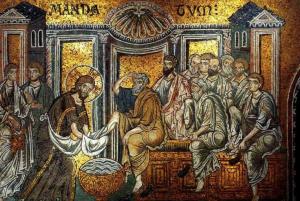 “By faith…” Abraham went out from a land not his own to a place he and Sarah were to inherit. And in that long journey they continued to move forward, against all odds and sense, but always in faith. That journey was not only of faith, but also of service. Three weeks ago our first reading was an example of how Abraham and Sarah welcomed three travelers with hospitality – and this but adds to the accounts of Abraham’s service – to his family and clan, to Lot and his family, to the King of Salem, and so many others. The story of Abraham’s life is a story told in the outlines of faith and in the outlines of service as discipleship.
  One of the interesting things about “blogging” is what happens off-line. WordPress has a feature for “comments” and it is a controllable feature. You can allow all comments and then remove inappropriate ones as you see fit. But then that means you have to monitor; sometimes manners and charity are not hallmarks of text and comments left behind. It takes time. Not willing to dedicate time to the supervising task? The blog administrator can not allow any comments at all. That takes no additional time to oversee. There is at least one “middle way.” You can allow comments but require that all comments be approved before they are posted on one’s blog. That takes some time, but you have the luxury of getting to such things when you have time.
 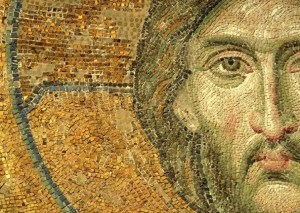 The disciples of Jesus are to be ready to open to the Master “immediately when he comes.” The answer to Peter’s question (v. 41) directs the discourse toward the Christian leaders especially. The overriding image of authority in this text is one of service. Something that Jesus applies in a special way to the Twelve as leaders of a restored Israel. Where the servants are to stand in readiness for the return of the master, the stewards are responsible for their own work as well as that of the community as a whole. The care of what has been entrusted foreshadows the parable of the sums of money (19:11–27). The sayings on the distribution of responsibilities or gifts in the concluding verse of the section are clearly pertinent for those in authority, but they have a wider application for all on whom spiritual and temporal gifts have been bestowed.
  friarmusings