
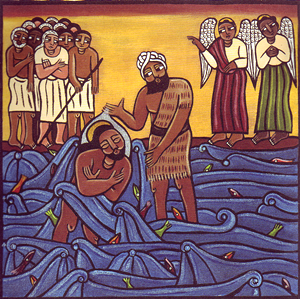
John the Baptist is a crucial figure in the history of revelation and redemption. In retrospect, his appearance in the wilderness was the most important event in the life of Israel for more than three hundred years. The absence of a prophet throughout this period had been interpreted to signify that the prophetic task was accomplished. Yet all clung to the hope that the “faithful prophet” would appear, the Prophet like Moses, whose coming would signal the events of the “last days” (Deut. 18:15–19; 1 Macc. 4:42–46; 14:44). The very fact of John’s appearance was an eschatological event of the first magnitude, and signified that the decisive turning point in the history of salvation was at hand. It was John, the preacher of radical repentance, who initiated the messianic crisis. To speak of the gospel of Jesus is to speak of the good news which began with John. Continue reading
Monthly Archives: December 2017
The One Coming: who?
2 As it is written in Isaiah the prophet: “Behold, I am sending my messenger ahead of you; he will prepare your way. 3 A voice of one crying out in the desert: ‘Prepare the way of the Lord, make straight his paths.’”
We often interpret vv. 2-3 in light of Matthew and Luke where they clearly refer to John the Baptist. John is presented before the OT quotes are given. However, in Mark, the only person who has been named prior to the quotes is Jesus. Note also, for those who have difficulty memorizing scripture, Mark’s quote is a hybrid: v. 2 seems to come from Ex 23:20 (LXX) and Mal 3:1 (MT) and v. 3 from Isaiah 40:3, but not quoted exactly. Continue reading
The One coming: more questions
Question 3: What was meant by “Christ”? Is it a title? Is it part of Jesus’ name?
- The Greek christos is used to translate “anointed” or “Messiah.” It might have made sense to a Greek audience. But it would be hampered by its first century usage to refer to wrestlers who had “greased up” before their match to make it more difficult for their opponents to gain a tactical hold on them during the match.
- The uses of “Messiah” or “anointed (one)” in the OT do not help much in understanding Jesus as Messiah.
- The word is used of “the anointed priests” (Leviticus 4:3, 5, 16, 6:22; 2 Maccabees 2:10)
- The word is used of the king. (Throughout 1 and 2 Samuel)
- The word is used of Cyrus, the Persian King (Is 45:1)
- The word is used of the prophets (Ps 105:15; 1 Chr 16:22)
The One Coming: questions
Mark begins his writing with a statement by the narrator: “The beginning of the gospel of Jesus Christ (the Son of God).” For the people in Mark’s narrative the realization of who Jesus is will come only in starts and stops. As readers of this gospel, right from the beginning, we are given the answer to the question, “Who is he?” We already know this is narrative is good news for us; news about what will happen to us and for us. Yet even as the opening answers big questions, we are left with other important questions, ones that will help us to plumb the depth of this good news. Continue reading
The One Coming: context
Mark 1:1-8 1The beginning of the gospel of Jesus Christ (the Son of God). 2 As it is written in Isaiah the prophet: “Behold, I am sending my messenger ahead of you; he will prepare your way. 3 A voice of one crying out in the desert: ‘Prepare the way of the Lord, make straight his paths.’” 4 John (the) Baptist appeared in the desert proclaiming a baptism of repentance for the forgiveness of sins. 5 People of the whole Judean countryside and all the inhabitants of Jerusalem were going out to him and were being baptized by him in the Jordan River as they acknowledged their sins. 6 John was clothed in camel’s hair, with a leather belt around his waist. He fed on locusts and wild honey. 7 And this is what he proclaimed: “One mightier than I is coming after me. I am not worthy to stoop and loosen the thongs of his sandals. 8 I have baptized you with water; he will baptize you with the Holy Spirit.” Continue reading