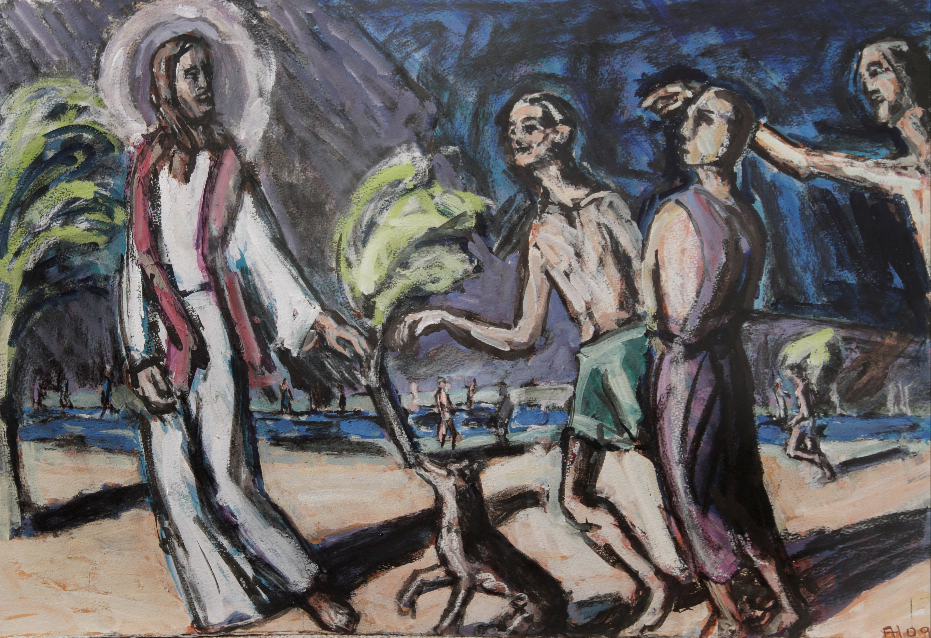
Fishers of Men. As the first act of the Galilean mission Mark reports the calling of Simon and Andrew to be fishers of men. Jesus found these brothers working as fishermen on the shores of the Sea of Galilee, elsewhere designated the Lake of Gennesaret or the Sea of Tiberias. The inland sea, which was twelve miles in length and six miles across at its widest point, provided a point of access between Galilee and Perea. There were many towns and fishing villages especially on the western and northern shores. The waters teemed with life, and when Jesus summoned the brothers they were casting their nets into the sea. Continue reading
Monthly Archives: January 2018
Following: trust
Repent and Believe. John Williamson, (Mark, p.43) offers this analogy which “may capture some (not all) dimensions of this summary of the preaching of Jesus.”
In a crowded airline terminal, hundreds of persons are scurrying in dozens of directions. Above the steady buzz of noise a voice booms through a loud-speaker, “Flight 362 is now arriving at gate we. Will passengers holding tickets for New York please check in at gate 23; you will be boarding soon.” Some people, of course, never hear the announcement and continue on their way. Others hear it but, having reservations on another flight, pay no attention. Some, however, who want to go to New York and who have been nervously awaiting such an announcement, look up expectantly, check their ticket for the flight number, gather their baggage, turn around and set out with some urgency for gate 23. Continue reading
Following: time of fulfillment
“The Time of Fulfillment” This phrase is only in Mark. The word for time is kairos; it is used in 11:13 and 12:2 to refer to the “time of harvest” – an image that usually refers to the time of judgment. It is also used in when “The Son of Man coming in clouds with great power and glory.” Yet this is something liminal about the moment. There is a part of us that wants an “epiphany” with the kingdom clearly present; there is a triumphalistic part of us that wants the kingdom to conquer all – here and now. Yet the world still seems very much intact. Instead of a kingdom epiphany, the second act opens with Jesus wandering by the sea, bidding some common laborers to accompany him on a mission. Still, here in Mark’s gospel we know when the time is. It is now – and yet we pray “Your kingdom come….” I appreciate Martin Luther’s explanation to the second petition of the Lord’s Prayer. “God’s kingdom comes on its own without our prayer, but we ask in this prayer that it may also come to us.” Continue reading
Following: context
Mark 1:14 After John had been arrested, Jesus came to Galilee proclaiming the gospel of God: 15 “This is the time of fulfillment. The kingdom of God is at hand. Repent, and believe in the gospel.” 16 As he passed by the Sea of Galilee, he saw Simon and his brother Andrew casting their nets into the sea; they were fishermen. 17 Jesus said to them, “Come after me, and I will make you fishers of men.” 18 Then they abandoned their nets and followed him. 19 He walked along a little farther and saw James, the son of Zebedee, and his brother John. They too were in a boat mending their nets. 20 Then he called them. So they left their father Zebedee in the boat along with the hired men and followed him.
The Bigger Picture. The first major section of Mark’s Gospel extends from 1:14 to 3:6, and describes the initial phase of the Galilean ministry. Within this section the evangelist records the calling of the first disciples (1:16–20; 2:14), Jesus’ ministry in and around Capernaum (1:21–34), and a series of controversies (2:1–3:6) which are climaxed by the decision to seek Jesus’ death (3:6). Continue reading
His First Words
I like trivia games. Not too esoteric or arcane, but still a bit challenging. A friend of mine knows music. Not my specialty. Because of life on a submarine, time in Kenya, and formation time as a friar and priest, I have large gaps in my musical knowledge and exposure. I do alright in history, swimming, and (likely no surprise here) the Bible. Continue reading
Come and See: calling disciples
Andrew. Three times Andrew is doing something in John – ‘and each time he is bringing someone to Jesus. First, his brother, Simon (v.40). Then, a boy with five barley loaves and two fish (6:8); and finally, “some Greeks” (12:20-22), which signals the hour for the Son of Man to be glorified. Andrew is never mentioned just by himself. Twice he is called Simon Peter’s brother (1:40; 6:8). We are told that Philip came from the city of Andrew and Simon (1:44). Andrew and Philip go and tell Jesus about the Greeks (12:22). It may be that being named as the first follower of Jesus (in the Fourth Gospel) was the first time that he had ever been first in anything. It seems likely to me that he was always living under the shadow of his more flamboyant brother. It also seems to me that our parishes are full of more behind-the-scenes “Andrews” than flamboyant “Peters” who seem to get all the credit. (“Peter” occurs in 32 verses in John – ‘8 times as many as Andrew.) One doesn’t have to be a “Peter” to be an effective follower and witness to Jesus (Stoffregen) Continue reading
Come and See: Lamb of God
In vv.19-34 we have seen John the Baptist bearing his witness (see commentary here). Now we find him sending some of his followers after the Lord. There are accounts of a “call” in the Synoptics (e.g., Mark 1:16–20), but they differ greatly from this. The Fourth Gospel tells of a call to be disciples; the Synoptics of a call to be apostles. John’s theme is not the calling of the apostles into office; it is their call to relationship with Christ. Strictly speaking, there is no “call” in this Gospel (except in the case of Philip, v. 43). Jesus does not call the disciples and John the Baptist does not send his disciples to Jesus; Jesus and his role as the Lamb of God is pointed out – or rather John’s witness. The English leaves a bit of room as to how to understand the disciples’ motivation. Are they curious, intrigued or do they perhaps recognize the Messiah and spontaneously follow. Continue reading
Come and See: context
This coming Sunday is the 2nd Sunday in Ordinary Time, Year B – the cycle of readings in which The Gospel according to Mark is the principal source of our Sunday gospels. That being said, our reading is from the Gospel According to John. In fact, regardless of which cycle of readings (A,B, or C), the “Second Sunday of Ordinary Time the Gospel continues to center on the manifestation of the Lord” with a gospel from John (General Introduction to the Lectionary, 105). It is done as a means of transitioning from the theme of “manifestation” highlighted in Epiphany to ordinary time readings – I suspect – because there are some years when the Baptism of the Lord is celebrated on the Monday following the Sunday celebration of Epiphany (when Epiphany Sundays falls on Jan 7th or 8th). The reading for the 2nd Sunday ensures the theme is continued in the simple verse: “We have Found the Messiah.” Continue reading
The Richness of Epiphany
Today we celebrate the visit of the magi to the child Jesus. It is often referred to and celebrated as “Three Kings Day” especially in Latino and Mediterranean cultures. Its official name is Epiphany, from the Greek epiphania, meaning that which is revealed, unveiled. The meaning in Greek is reflected in our English language definition: (1): a usually sudden manifestation of the essential nature or meaning of something (2): an intuitive grasp of reality through something usually simple and striking (3): an illuminating discovery, realization, or disclosure. There is a certain excitement and energy that accompanies the moment of epiphany. Continue reading
Epiphany: more than three Kings
January 6th is the day we typically call “Three Kings Day,” more formally known as The Epiphany. Epiphany is derived from a Greek word ἐπιφάνεια, epiphaneia, meaning “manifestation,” and refers, generally, to Jesus being manifested to the gentile visitors from the East. But in truth it is more complicated than that. What is striking is that there are a variety of liturgical celebrations and dates that are all part of our rich Catholic tradition surrounding “Epiphany.” Continue reading