Back in 1983 the division of the company I worked for bought an IBM personal computer and hard drive (they were an add-on, were only 10 MB and were about as expensive as the computer.) That was going to be our “competitive edge” or so said one of the senior executives. I inwardly rolled my eyes knowing that the rapid advance in the personal computer world / emerging technology would transform the business world as performance improved and prices dropped. I had already purchased a portable computer (ok…”luggable” would be a better description) that came with word processing software, a spreadsheet, and a database – and 20MB hard drive and for 50% of the costs of the new office computer. To put this in context, there was no Microsoft or MS-DOS. Unix or CPM were the operating systems de jour. OK … enough history. My point is that there is this underlying belief that technology would make our lives better – especially in the world of business. Continue reading
Monthly Archives: July 2021
A possible way ahead
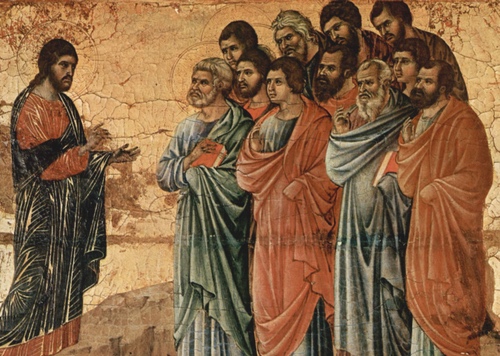
In today’s gospel, “As you enter a house, wish it peace. If the house is worthy, let your peace come upon it; if not, let your peace return to you. Whoever will not receive you or listen to your words— go outside that house or town and shake the dust from your feet.”
Shaking off the dust from the feet is an symbol of dissociation. Nehemiah 5:13 has a similar act as does Acts 13:51 (as Paul and Barnabus shake the dust of Antioch off their feet and move on to Iconium. In all its forms, one is calling it quits and they want nothing more to do with the place (Luke 10:11 spells it out more fully). Continue reading
Active Mission
This coming Sunday is the 15th Sunday of Ordinary Time in Year B. The gospel for the day comes from Mark 6 and narrates the beginning of mission for the disciples.
The Message. 12 So they went off and preached repentance. 13 They drove out many demons, and they anointed with oil many who were sick and cured them.
The New American Bible (NAB) offers a translation that seems minimally functional – merely reporting that they set out on mission and what they did when they got there. A more literal translation of the verse is: “And the went out and proclaimed so that all might repent.” The second part of the verse is a hina clause in Greek, normally indicating purpose, aim, or goal. The purpose in their proclaiming is that people might repent, that is, have a change in mind/heart. Such preaching will include the demands from God and our failure to live up to them. It also includes the grace of God that accepts the law-breakers. It includes the mandate to speak the truth in such a way that it leads people to repent, to have a change in mind about their own sinfulness and about God’s gracefulness. Continue reading
The Mission and Instructions
Knowing the Mission. I have two thoughts for you today. The first concerns “the twelve” while the second involves Jesus’ instructions: “Do not go into pagan territory or enter a Samaritan town. Go rather to the lost sheep of the house of Israel. As you go, make this proclamation: ‘The Kingdom of heaven is at hand.’” (Mt 10:5-6)

The Twelve. This is the first time in Matthew’s gospel that Jesus calls to himself a “select team” of disciples to whom he will assign a mission. Up to this point in time, the disciples were called one-by-one, witnessed Jesus’ proclamation of the Kingdom of heaven being at hand, and watched Him perform miracles. Now they are being sent out to proclaim the Kingdom. Continue reading
Mystery of human freedom
This coming Sunday is the 15th Sunday of Ordinary Time in Year B. The gospel for the day comes from Mark 6 and narrates the beginning of mission for the disciples.
Instructions for the Mission. 10 He said to them, “Wherever you enter a house, stay there until you leave from there. 11 Whatever place does not welcome you or listen to you, leave there and shake the dust off your feet in testimony against them.” Continue reading
Speaking of cows
Apart from milking them, herding them, and delivering salt to the cows, there were two other interesting stories from my time in the west of Kenya that pertains to cows.
One of the traditions of the Luo people of western Kenya (at least where I was residing) was the use of cows as part of a funeral procession. I was told that there were two mainstays of the Luo funeral procession – only one of which I was witness to – and those are cows and mourners, both of which can be hired for the occasion. In the west of Kenya, cows are a mainstay of assets, and the procession of cows is a way to honor the deceased. When it comes to death, it has been a long tradition that evil spirits can play a role in someone’s passing. Mourners may wail, sing, and dance to scare away the evil spirits. To be fair, I have not done justice to the Luo death and funeral rituals which are far more traditional and extensive than the other tribes in Kenya. Still, it was a sight to behold in the one funeral procession I observed. Continue reading
That would be amazing

In today’s gospel, “A demoniac who could not speak was brought to Jesus, and when the demon was driven out the mute man spoke.” In Jesus’ day, deafness and dumbness usually went together in persons, who are deaf from their birth. They could not hear, and so they could not learn to speak. But this man seems to be unable to speak, not by nature, but through the possession of a demon, who had taken away, or restrained the use of his speech, out of demonic malice. Continue reading
For the Journey
This coming Sunday is the 15th Sunday of Ordinary Time in Year B. The gospel for the day comes from Mark 6 and narrates the beginning of mission for the disciples.
Rejected by his own family and home crowd, Jesus preaches elsewhere and sends his twelve disciples out with special instructions and powers. It is good to remember that the apostles are not sent out as a reaction to the rejection. The mission of the apostles is part of a larger plan. First, Jesus had call them personally (1:16–20). Then he selected twelve special ones to accompany him (3:13–19). The Twelve, tutored by Jesus and present with him as he healed many from sickness and evil (chapters. 3–5), are now ready to become apostles, in Greek, literally the “ones sent out.” Continue reading
Notes from the In Between
There I was: on mission, in the west of Kenya near Lake Victoria, living at an all-boys high school, speaking neither Kiswahili nor Dhluo, and not quite sure what was next. It is interesting to look back through my journal which is filled with all manner of reflections, notes about an adventure for the day, but I have no distinct memory of having any enduring task that carried me from day to day. I did help out in teaching mathematics occasionally. The Form 3 and Form 4 (that means, 11th and 12th grade) math teacher had recently started a family and the first child had many health issues which took him away from the school on an recurring but irregular basis. You might ask how could I teach without common language skills? Mathematics has its own language of symbols and signs, many of the key words are in English, and with a little imagination and waving of hands, it was possible to get through a class. There was also a student available who could translate, but as I recall in the Form 3 class the translator was not the best of mathematicians. Not sure what was lost in translation. Continue reading
Belief and Rejection
This coming Sunday is the 15th Sunday of Ordinary Time in Year B. The gospel for the day comes from Mark 6 and narrates the beginning of mission for the disciples.
Some context for the gospel. The miracles of the preceding chapter in the Gospel according to Mark demonstrate his divine powers. Jesus overcomes the life-destroying powers of demonic possession, chronic illness, and death. The gospel two weeks prior contained the stories of Jairus/his daughter and the women with the hemorrhage. Each account tells of an imperfect faith, yet enough faith that God enters into their lives in a way that is healing and ultimately life-giving. For Jairus’ daughter, it is the restoration of life; for the woman with the hemorrhage it is being restored to the fullness of life as her illness will no longer keep her from living life to its fullness in this lifetime. The miracles, viewed together even as they as told together, are the vestige of Jesus’ fuller mission: that all might have life eternal, free from death, and have life completely. Jesus is forming new family bonds, no longer centered on blood relationships, but on faith and those willing to act on that faith. Continue reading