The Other Procession

Sunday as part of our Palm Sunday celebration we remembered and proclaimed Jesus’ entry into the city of Jerusalem, from the East. He came riding upon a donkey and was greeted by ordinary people of the city who shouted “Hosanna” – “save us” to the wandering prophet from Galilee, the one of whom was whispered that he might be the promised anointed one. Continue reading

Sent into the naked city

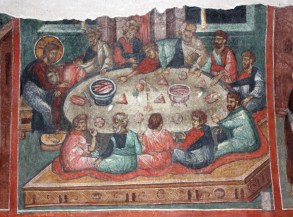
There is a lot going on in the readings of Holy Week. Today is “Spy Wednesday” with Judas busy about the his treachery and betrayal. As we move farther into the week, the story line seems to narrow from Jesus in the public square of Jerusalem to his gathering with his disciples for a last supper, a Passover meal.  And the story continues it narrows, leaving accounts of individuals all moving into isolation. Peter falls into the slumber of a long night while Jesus prays. Jesus is arrested and Peter waits, far removed, in a courtyard. When asked if he is with Jesus, he withdraws through his denial, and then he is alone. The sum of all these individual stories leaves Jesus alone. It is a brand of social distancing to another end, but social distancing nonetheless. Jesus is the contagion people wish to avoid. And so they separate themselves from being in contact with Him and, in the end, each other. The community of disciples is no longer together. Continue reading

Why Women?

Fittingly, the two women who sat by the tomb (27:61) on that fateful day before the Sabbath, return to visit the tomb. Why women? Throughout Matthew’s Passion, women have proven to be the model disciples. There is the unnamed woman who anoints Jesus for his burial (26:6-13). The men argue about the waste of the expensive ointment. Jesus commends her for her good work for him. Continue reading

Outside the Light

The gospel readings in Holy week always speak about Judas and his betrayal of Jesus. The Gospel of Mark, for example, gives no motivation for Judas’s sudden betrayal. Matthew, writing a decade or so later than Mark, attempts to clarify things in his account by introducing the motive of greed: “What are you willing to give me if I hand him over to you?” asks Judas to the Jewish high priests. Luke simply writes: “Then Satan entered into Judas, the one surnamed Iscariot, who was counted among the Twelve, and he went to the chief priests and temple guards to discuss a plan for handing him over to them.” The Gospel of John parallels the avarice theme depicting Judas as a greedy keeper of the common purse. “He said this not because he cared about the poor but because he was a thief and held the money bag and used to steal the contributions.” Continue reading

Resurrection and Restoration

As many scholars note, Matthew bases his account upon Mark 16:1-8 and a comparison of those verses with Mt 28:1-8 reveals the dependence – and there are differences. The two points that are common to the resurrection testimony of all the gospels are that the tomb of Jesus had been found empty and that the risen Jesus had appeared to certain persons, or, in the original form of Mark, that such an appearance was promised as soon to take place (see Mark 16:7). At one level it might appear as though Matthew is constructing a Christian apologetic for the faith. But the emphasis throughout (except in the story of the guard) is not on factual proof of the Resurrection for the non-Christian world, but on the impact of the incredible truth on Jesus’ bewildered and exhilarated followers, on their fear and joy, doubt and assurance. It is with the restoration of their broken relationship with him, with all that this implies for their continuing mission, that Matthew will conclude his book. Continue reading

Extravagence

Today’s gospel for the Monday of Holy Week is the well-known story of Mary of Bethany, anointing the feet of Jesus with “a liter of costly perfumed oil made from genuine aromatic nard.”  In Jesus’ time, the washing on someone’s feet carried with it meaning. While a host would offer water to a visitor for the visitor to wash their own feet, otherwise, only a servant or slave would wash someone’s feet. The same applied to anointing of the feet, considered a soothing treatment after a long day or journey. Because of these connotations, those who voluntarily washed someone else’s feet showed they were devoted enough to act as that person’s slave. The act of anointing Jesus’ feet, when taken in its literary and cultural context, displays Mary’s utter devotion to Jesus. Continue reading

The main thing

I think it is very possible to drift through life, or at least parts of your life. Looking back into my life, I certainly find that to be true. Over the years listening to people chatting with me on the sidewalks, in the office, in the confessional and more – it seems to be quite common. Maybe it is during a time when there are too many things that you are trying to juggle. Or during a time when one thing occupies a huge amount of your attention and energy. Or maybe it is just a part of your life that is in cruise control so to speak – maybe like Tesla’s autopilot. Your attention is just elsewhere.

My dad used to say that the main thing is making sure that the main thing remains the main thing. Continue reading