
Ever Missionary

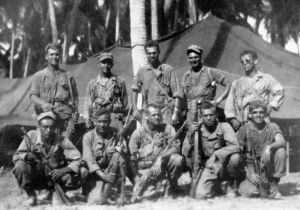
During WWII there was a platoon of Army Rangers deployed well behind enemy lines on a critical mission during the European campaign. A single sniper bullet had killed one of the platoon members. The mission had to continue, but they just could not leave their friend as a stranger in a strange land, buried in an unmarked grave that they might never again find. They remembered a small Catholic church in the area. So, under the cover of the moonless night, they approached the church and rectory, and knocked on the door. After a while a single light came on in the house. Eventually, the door cautiously opened, and the parish priest even more cautiously greeted them. Continue reading

A Final Thought

This coming Sunday is the 27th Sunday in Ordinary Time. The old tenants lost their place because they failed to produce the required fruit, and it is the distinguishing mark of the new “nation” that it will produce it. The point is not developed here, but this qualification potentially carries a warning also to the new “nation.” If it in turn fails to produce the fruit, it cannot presume on its privileged position. The next parable will contain a sobering final scene to just that effect (22:11–13). Continue reading

Give and Take

This coming Sunday is the 27th Sunday in Ordinary Time. The climax of the “Lord’s Vineyard” parable comes with the unexpected involvement of the landowner’s son following the servants. If the servants are the OT prophets, it is interesting to note that in Hebrews 1:1–2 “a son” as God’s last word follows prophets. Within the framework of the story the sending of the son is clearly a last resort, short of the owner returning himself (as he will eventually do in v. 40). When the son goes as his father’s messenger he goes with all his father’s authority, and so deserves “respect” and obedience. To reject the son’s demand is therefore the climax of rebellion. But to kill him is to add injury to insult. As a bid for independence and an attempt to gain possession for themselves it was hardly likely to succeed in a society under the rule of law, and it reads more as a spontaneous and ill-conceived impulse than as a calculated policy. But a parable does not have to fit into real life, and the points at which it becomes improbable are usually meant to draw attention. Continue reading

The Coming Change

This coming Sunday is the 27th Sunday in Ordinary Time. The traditional interpretation holds that the parable is a symbolic account of the history of Israel, whose leadership (tenants of v.34) has rejected God’s earlier prophetic messengers (cf. Jer 7:25–27 seen in servants of vv.34-35). In v.37 the parable leaves Israel’s past and intuits the events of the Passion and Crucifixion that lay in the days to come. Indeed, the leaders of Jerusalem will seize Jesus and crucify him outside Jerusalem (cf. v.39). Where the traditional interpretation begins to waver starts in v.43 taking on a different direction from its OT parallel in Is 5:1-7: Continue reading

A Reflection on St Francis and Humility

BarbaraA good friend and staff member at Sacred Heart in Tampa (where I served for many years) was asked by the friars to prepare a reflection on St. Francis in honor of his Feast Day. Barbara is the Director of Faith Formation at the parish and a wonderfully vibrant and faithful woman. The final line of her reflection describes her well: “May we strive to emulate the spirit of St. Francis by leading lives of humble service to one another and to love the Lord God above all.”

Continue reading

Bearing Fruit

This coming Sunday is the 27th Sunday in Ordinary Time. In today’s parable, four times the word karpos (“fruit”) appears in the text, although not always translated that way [v. 34 literally “time of the fruits” = NAB’s “vintage time;” 34 and 41 literally “fruits” = NAB’s “produce;” and in v.43 translated as “fruits”]. By comparison the word karpos occurs once in Mark’s version (12:2) of this parable. Matthew’s use of this theme/image is consistent across his gospel (see also: 3:8, 10; 7:16-20; 12:33; 13:8, 23). It is central to this parable. Continue reading

The Visions of Zechariah

The Book of Zechariah is set during this period of restoration and reconstruction following the Babylonian Exile. Zechariah, along with Haggai, another prophet, played a crucial role in encouraging the returning exiles to complete the rebuilding of the temple, which had been halted due to opposition and discouragement. The book provides insights into the challenges faced by the Jewish community as they sought to rebuild their city and reestablish their religious practices. As part of an introduction to the The Book of Zechariah, this post outlines the series of eight night visions that are presented in chapters 1 through 6. These visions are filled with symbolism and convey messages of God’s presence, protection, and judgment upon the nations that oppressed Israel.

Continue reading

Matthew’s Vineyard

This coming Sunday is the 27th Sunday in Ordinary Time. Much like Isaiah 5:1-2 (the reading from the OT accompanying our gospel), Matthew’s parable has a vineyard setting (also the preceding two parables: 20:1-16, the workers in the vineyard; 21:28-32, the two sons). What does the vineyard represent? In Isaiah it represents Israel and many have assumed that that is its meaning in the gospel parable, e.g., the vineyard = Israel; the tenants = religious leaders; landowner’s slaves = prophets whom they rejected. With this interpretation, we note that the vineyard is not destroyed, but turned over to new tenants. To use another biblical metaphor, the unfaithful, greedy shepherds are removed (Mt 9:36; Ezekiel 34) and new shepherds are installed to care for the sheep. Continue reading

Zechariah: An Overview

The historical background of the Book of Zechariah is closely tied to the post-exilic period of Israel’s history. After the Babylonian Empire conquered Judah and destroyed Jerusalem in 587 BC, many Israelites were taken into captivity in Babylon for a period of around seventy years. Following the fall of Babylon to the Persian Empire under King Cyrus the Great in 538 BC, Cyrus issued a decree allowing the Jewish exiles to return to their homeland and rebuild the temple in Jerusalem. This marked the beginning of the post-exilic period and the subsequent waves of Jewish returnees to Jerusalem. Continue reading

A Call for Change

This coming Sunday is the 27th Sunday in Ordinary Time, Lectionary Cycle A. In this section of the Gospel according to Matthew we encounter Jesus in Holy Week amidst an on-going dialogue with the chief priests and elders. These folk are not happy with Jesus as just the day before he had upset the tables of the moneychangers in the Temple area. When Jesus returned to the Temple the following day, the leaders of Judaism were there with questions about the authority with which Jesus takes such bold and prophetic actions (and interrupts the commerce of the Temple). Continue reading