Two of the legendary warships of the modern Navy were commissioned on this day, 17 years apart. In 1937 the USS Enterprise (CV-6) – the “Big E” was commissioned at Newport News, VA. Enterprise was the only aircraft carrier to start and finish WWII – with a lot of bumps along the way.
The Big E participated in the Battle of Midway, the Battle of the Eastern Solomons, the Battle of the Santa Cruz Islands, various other air-sea engagements during the Guadalcanal campaign, the Battle of the Philippine Sea, and the Battle of Leyte Gulf. Enterprise earned 20 battle stars, the most for any U.S. warship in World War II, and was the most decorated U.S. ship of World War II.
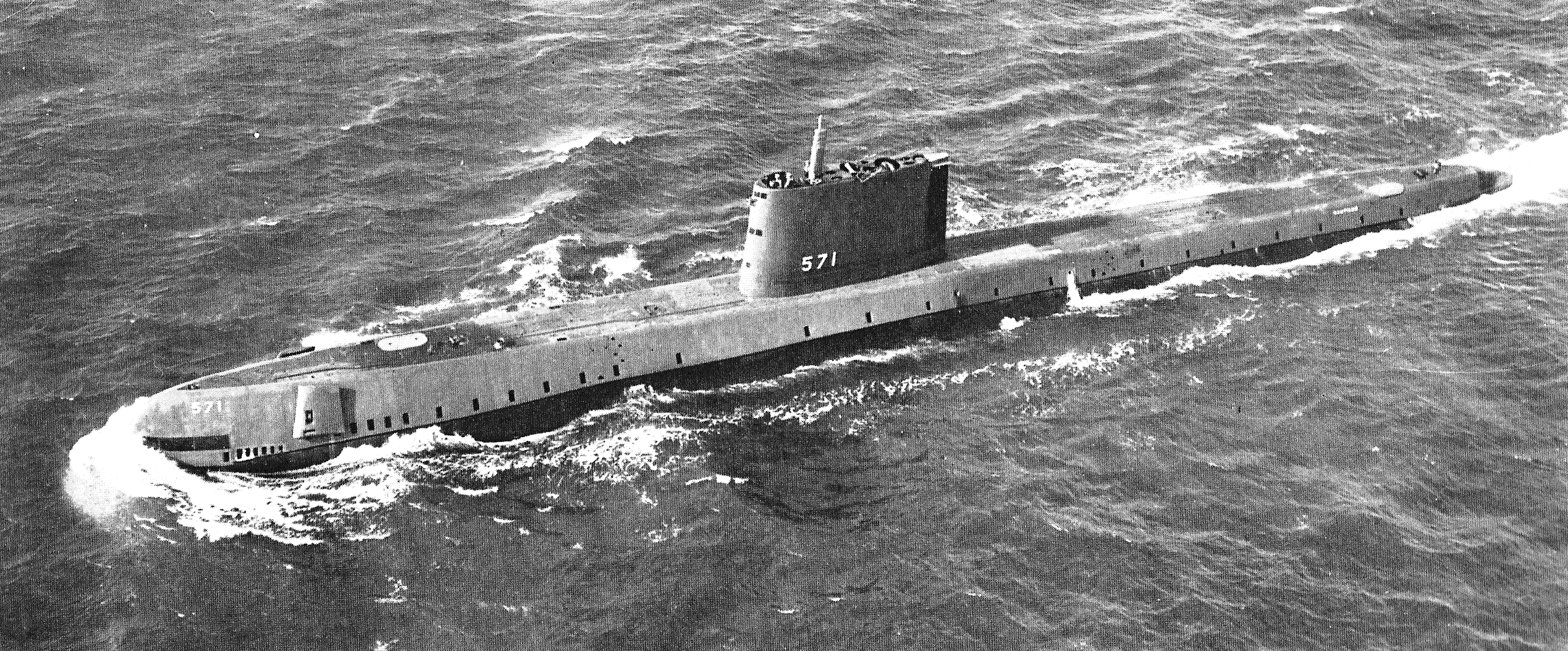
17 years later, the USS Nautilus (SSN-571) was commissioned as the first nuclear powered submarine. Constructed and commissioned at Electric Boat, Groton CN. Nautilus shares the name of the fictional submarine in Jules Verne’s classic 1870 science fiction novel “Twenty Thousand Leagues Under the Sea” and the USS Nautilus (SS-168) that served with distinction in World War II.
Nautilus was decommissioned in 1980 and designated a National Historic Landmark in 1982. She has been preserved as a museum ship at the Submarine Force Library and Museum in Groton, Connecticut, where she receives around 250,000 visitors per year. Sadly the “Big E” was sold for scrap metal.
When it became clear that the Mariana Islands (Saipan, Tinian and Guam) had been taken over by the Allies, the Imperial Japanese Army (IJA) Journal recorded: “We can no longer direct the war with any hope of success. The only course left is for Japan’s one hundred million people to sacrifice their lives by charging the enemy to make them lose the will to fight.” The Japanese military would implement that plan in the Special Attack Forces and would promote their sacrifice to the general population as a means of propaganda and to animate and reinforce the resolve of the Japanese people to be willing to sacrifice their lives for the Emperor.
The air battles at Philippine Sea in June 1944 decimated the Japanese Navy’s (IJN) aviation capability for aircraft carrier based operations. The IJN and IJA aviation units (planes and pilots) were further reduced by the air battles over Formosa (Taiwan) in October 1944. Between the two engagements, Japanese losses were approximately 800 planes and 900 airmen. The critical loss was skilled and experienced pilots. Japan’s aircraft production peaked at about 2,572 planes per month in September 1944, then began to decline from late 1944 into 1945 as strategic bombing increasingly disrupted output, though production hovered above 1,000 combat aircraft per month until mid‑1945. They could replace the planes more easily than the aviators.
At the start of WWII, Japan had 2,600 airplanes of all types. The average pilot had 500-700 flight hours. They reached a peak in January 1944 – approximately 5,600 planes and despite the 1944 losses, they began 1945 with some 4,100 planes. But by 1945 the average Army pilot had only 130 hours of flight time; a Japanese naval aviator had 275 hours on average. The net effect was an enfeebled air combat capability.
By late 1943 Japanese officers began to see the slow devolution of capability and began to advocate for organized suicide attacks. There was no consensus on the idea. On May 27, 1944 an Army pilot intentionally crashed into an allied ship (IJN Journal). Within a month, as Saipan was about to fall, Fleet Admiral Prince Hiroyasu (former chief of the Naval General Staff) openly spoke: “Both Army and Navy must think up some special weapons and conduct the war with them.” “Special weapons” was the Japanese euphemism for suicide weapons. Only a year before the idea had been rejected.
The first organized air kamikaze attack occurred on October 25, 1944 at the Battle of Leyte Gulf (Sommar) in the Philippines against Task Force Taffy 1 which consisted of escort carriers and destroyers. The Japanese force was led by Lt. Seki Yukio and Hiroshi Nishizawa, two of Japan’s premier naval aviators; each of the ace aviators. Eighteen kamikaze took off; six returned having failed to find a target – a common feature on such missions. The remaining dozen scored damaging hits on the escort carriers Santee and Kitkun Bay, killing 17, but sank the St. Lo leaving 114 dead.
Nishizawa’s role was observer. He returns to base and reports the great success of the mission. What was to that point an idea, now became a tactic. The experience at the Battle of Philippine Sea revealed two major advantages held by the US Fleet: aviation and anti-aircraft defense. By the summer of 1944, the US Navy had superior aircraft, better pilots, and superior numbers – all being controlled by the first Combat Information Center (CIC) that coordinated sorties, targets, and missions by integrating radar and message traffic. In 1942 “first detect” range was ~30 miles. By 1944 that range was extended to 100 miles making the first intercept miles away from the aircraft carriers. If they got past that gauntlet, the enemy pilots faced the next advantage.
By 1944 the carriers were protected by defense-in-depth from destroyers to light cruisers that were intentionally outfitted, not for ship-to-ship engagement, but for anti-aircraft (AA) defense. These ships were “armed to the teeth.” In addition, the VT fused shells (proximity weapons) increased the lethality 5-7 times. In 1942 the fleet was capable of firing 32,000 lb/minute in AA weapons fire. In 1944, with the advent of the VT-fused shells, the fleet was capable of effectively firing 575,000 lbs/min.
In a sad calculus of thinking, all the above made clear that a Japanese battle plan to mount a torpedo or dive bomb attack against the US Fleet was not likely to succeed and had an almost zero chance of the pilot returning. The conventional mission gave way to the reality of the one-way mission, now almost a given – and from this was born the battle plan of the divine wind, kamikaze.
What are we seeing?
For the survivors of Taffy 1’s ships they had to wonder what they had just seen. Were the pilots intentionally crashing into ships? Word spread rapidly through the 3rd Fleet. From Admiral to sailor all began to wonder how could these aviators were suddenly suicide bombers? What could possibly drive them? The answer to that question lay deep inside the military culture of Japan.
Kusunoki Masashige was a 14th-century samurai and retainer of Emperor Go-Daigo. He was known for his absolute loyalty to Emperor Go-Daigo during the struggle to overthrow the Kamakura shogunate. He was admired for his strategic brilliance, his defensive stand at Chihaya Castle, and—most famously—his willingness to obey the emperor’s command to fight a hopeless battle at Minatogawa (1336). Knowing he would die, Kusunoki went into battle anyway, sacrificing himself for imperial loyalty. He died in combat along with his brother and many of his men. Because of this, he came to be revered as the archetype of the loyal retainer who sacrifices himself for duty and country.
In the early 20th century, especially during the rise of State Shintō and Japanese militarism, Kusunoki was lionized as a national hero and portrayed as the embodiment of bushidō: selfless loyalty, obedience, and honor in death. A massive bronze statue of him, erected in 1900, stands in front of the Imperial Palace in Tokyo, symbolizing martial devotion to the emperor. By the 1930s and 40s, Kusunoki was the center piece and model of what it meant to be, not just in the Japanese military, but as a citizen of Japan. His story and his devotion to the Emperor was part of school textbooks and state propaganda. He was the personification of a Japanese person: a warrior who placed loyalty above life itself. His famous dying words lamenting “Would that I had seven lives to give for my country” (“Shichishō Hōkoku”). School children memorized his words and were repeatedly taught his story with his statue becoming a pilgrimage site.
Kusunoki gave a historical precedent that made the kamikaze sacrifice seem like part of a long Japanese tradition, not an aberration. By portraying suicide attacks as the modern version of Kusunoki’s doomed battle, leaders could frame the kamikaze not as desperate measures but as honorable continuity. “Seven lives for the emperor” became a rallying cry for the kamikaze pilots.
This was the ethos of the WW II Japanese military and citizenry. Now the aviators were urged to live and die in the same spirit. One need only search for internet images of kamikaze unit flyers. Most of them show young men in their aviator kits with samurai swords.
What the US sailors were seeing was the spirit of Kusunoki Masashige, not on horseback, but piloting lethal, ship-killing missiles.
Okinawa
On April 6, 1945, the first wave of ten coordinated kamikaze attacks began to hit the U.S. Navy’s Fifth Fleet off the coast of Okinawa. Ships in the Fifth Fleet had experienced suicide attacks before — but never on such a scale. The terrifying sight of Japanese pilots diving their planes into ships would become common over the next two and a half months. Aircraft carriers and battleships were supposed to be the main targets, but the ships that suffered the most damage were the destroyers and smaller vessels assigned to protect the fleet from incoming attacks. And as the war continued, troop ships, tankers, and supply ships were increasingly targeted.
From October 1944 until the end of the war, there were some 3,000 sorties flown. This resulted in the loss of 3,389 naval personnel. In total, by the end of July 1945 kamikaze attacks damaged 350 ships (including 30 aircraft carriers) and sank 47.
Invasion Planning and Threat of Kamikaze
According to the postwar Strategic Bombing Survey, Japanese airpower at the end of the was: 5,350 aircraft (combat, advanced trainers and primary trainers) assigned to Special Attack units with an additional 5,300 not yet assigned. In addition, there were another 7,200 aircraft in need of repair. Operationally there were as many as 10,000 available aircraft and some 18,000 pilots with at least 70 hours of flight experience. The survey also noted that there were 1 million barrels of aviation fuel on hand. The planned kamikaze missions were only expected to require 50,000 barrels.
Advanced planning for the coming allied invasion of Kyushu included suicide sorties in waves of 300 to 400 planes every hour with the primary targets being troop transports. This would be more kamikazes in three hours than sent against the Okinawa campaign in three months.
There would be a major difference between Okinawa and Kyushu. The Okinawa attacks required long flights over open water through rings of scouting places, radar picket ships, and combat air patrols. The waves of attacks were always seen in advance, weather/cloud cover permitting. The experience in the Philippines was different: shorter flights, ground clutter affecting radar, and other topographic factors lead to more stealth and thus surprise attacks. At Kyushu the troop transports would lay in conventional disposition close to the coast allowing the kamikaze to burst upon the scene with little warning.
That being said, ULTRA identified most of the kamikaze bases and these would be subject to advanced air attack. This was something that the Japanese realized and initiated new efforts of dispersal and concealment away from the base. They estimated that no more than 20% of aircraft would be destroyed on the ground prior to missions. In addition new production of suicide planes were wood construction: easy to move, shorter runways needed, not easily detected by radar, and far less vulnerable to the proximity fused antiaircraft shell.
Clearly, the airborne kamikaze attacks were a significant threat to lives and shipping. But these were not the only Special Attack units. Other units/means included:
Shinyo – Suicide Motorboats. Small, fast, one-man boats packed with 250–300 kg of explosives in the bow. Around 6,000 were built.
Kaiten – Manned Suicide Torpedoes. These were modified Type 93 “Long Lance” torpedoes with a cockpit for a pilot. The unit was launched from submarines with the pilot guiding the weapon to its target. They had limited success but were responsible for sinking the USS Mississinewa (AO-59) in November 1944.
Ohka (“Cherry Blossom”) – Rocket-Powered Manned Bomb. Small, rocket-propelled glide bomb carried under a bomber, piloted by a kamikaze. The Ohka was to be released near the target to glide/rocket into a ship at high speed.Used mainly in 1945, especially against US ships off Okinawa.
Fukuryu and Maru Dai – both were “frogmen” with either explosive packages or mines to attach to ships.
This all indicates the extent of the June 1944 decision to develop “special weapons.”
That is the mindset and future facing Kyushu invasion planners. What follows is the experience of those who survived kamikaze attacks.
Shipboard perspective (Source: PBS – American Experience: Victory in the Pacific, “Kamikaze”)
One such destroyer was the U.S.S. Newcomb. The Newcomb had seen combat before, at the Mariana Islands, Peleliu, Palau and in the Philippines. But it was at Okinawa that she would fight her fiercest battle. On board the destroyer was 21-year-old John Chapman, a First Class Boatswains Mate, and gun captain of a five-inch gun. Facing enemy pilots willing to give their lives to sink his ship struck him as almost incomprehensible.
“It didn’t make you feel good. I don’t know whether that’s ‘terrified’ or not, but it didn’t make you feel too well because of it, knowing that people would do a thing like that. You know, people we had always known weren’t like that. They were brave people and so forth, and they fight, but weren’t someone to just deliberately take their lives to take yours.”
Watching Kamikazes Attack. More than 300 kamikazes departed Southern Kyushu on April 6. Their target was the U.S. Fifth Fleet stationed in support of the battle being waged on Okinawa. As the Japanese pilots approached, they broke off into smaller attack groups. John Chapman was at his gun post at the stern of the U.S.S. Newcomb.
“There was probably 45 planes in the air. Well, it was a scary situation, because you knew that they were going to dive on you. You could be firing on the aircraft, and they’d come right on, just keep coming right on through that. And you’d see pieces flying over the planes and everything else, and they’d just keep right on a-coming.”
A Roaring Inferno. The Newcomb shot down four enemy planes. Five others hit the ship. Those on board who were not killed or injured fought desperately not only to put out the raging fires and repair damaged engines, but also to keep firing at an enemy dead set on sinking them. The scene aboard the Newcomb was repeated on many vessels of the fleet that day.
“It was hot. The fires were just raging totally out of control. Between the bridge and the afterdeck house, that’s a big percent of the ship. It was nothing but a roaring inferno. The flames were shooting. They said [it] was high as 1,000 feet in the air off the Newcomb.”
Overboard. Firefighters battling the raging fires forced John Chapman and an injured friend to jump overboard. There was no space left for them on the stern to remain. Chapman handed his life belt to the injured friend and, once in the water, towed him to the safety of a lifeboat. They were later rescued along with many others in the waters off Okinawa.
Aftermath. Ninety-one sailors were killed or wounded on the U.S.S. Newcomb. Many of those who were injured suffered devastating burns. But despite suffering at the hands of the five kamikazes, the crew of the Newcomb kept their vessel afloat and earned the Navy Unit Commendation and eight battle stars for World War II service. John Chapman would earn a bronze star for his service; years later, his view of his heroism is clear-eyed:
“People try to glorify wars and so forth. There’s people that do outstanding things, but there’s nothing really glorious about a war. You do wars to protect your country if you have to, and that’s the only time you should ever do it.”
Terrible Naval Losses. Nine more waves of kamikaze attacks hit the fleet off of Okinawa before the battle came to an end. Almost 2,000 Japanese pilots would willingly lose their lives in these attacks.
By late June 1945, close to 5,000 U.S. sailors had been killed and 5,000 more wounded by the Japanese suicide pilots. Thirty ships had been sunk and almost 400 others were damaged. The attack on the Fifth Fleet off Okinawa would mark the worst losses of World War II for the U.S. Navy.
1 He said to his disciples, “Things that cause sin will inevitably occur, but woe to the person through whom they occur. 2 It would be better for him if a millstone were put around his neck and he be thrown into the sea than for him to cause one of these little ones to sin. (Luke 17)
These two sayings are connected by the words skandala (v. 1) and skandalizo (v. 2). The original meaning of this word group skandal- was “trap;” or, more specifically a trap’s tripping mechanism. The word group is used to translate the Hebrew próskomma, meaningboth “trap”, “stumbling block” or, “cause of ruin.” In the latter sense, this transferred to the religious setting to mean “cause of sin.” But is “cause of sin” the best translation here? Paul says that “Christ crucified is a stumbling block (skándalon)to the Jews” (1 Cor 1:23) and also describes the cross as a stumbling block (skándalon) (Galatians 5:11). Consider three other modern gospel translations, all noted for faithful adherence to translation.
In May of 1942 the Japanese Empire covered 10 million square miles and extended from Manchuria, China and Korea eastward to the International Dateline and southward to the Philippines, Dutch East Indies, Java, Borneo, Sumatra and Malaya. The shape of the Empire was as though a lopsided, bottom heavy pear with Japan located at the top near the stem. As an island nation massively importing oil, rubber, iron, bauxite, aluminum, all manner of raw materials – and food – it was completely dependent on shipping to fuel the war machine, supply its armed forces, and feed the people on the home islands.
A blockade of Japan was, from the beginning of the war, a primary objective of the Allies. The island empire was surrounded by shallow, mineable water. Her crowded people depended on imports for 20 per cent of their food; nutritional standards were so low that a mere one-fifth reduction of imports meant privation for the population. Japan’s war effort and manufacturing potential depended on imports for 90 per cent of all oil, 88 per cent of all iron, 24 per cent of all coal. Over half of all domestic coal was waterborne between mine and factory. Even in-country domestic transport depended in large part on coastal craft transport because the geography of Japan made rail and road development problematic
On December 7, 1941 Chief of Naval Operations Admiral Harold R. Stark authorized unrestricted submarine operations against all Japanese ships – combatant or merchant. An earlier post on the topic described the slowly building strangulation of merchant shipping over the course of the war. By 1945, Japan no longer had access to 90–95% of the oil/fuel it had been importing. There were similar impacts of the other raw materials imported from the southern reaches of the Empire. By 1945 the open ocean sea lanes from Borneo, Java, Indonesia, French Indochina (Vietnam) and all points in Southeast Asia were heavily patrolled by American, British and Dutch submarines. As described in the Big Blue Fleet post, the fast carrier fleet and land based allied aircraft were beginning to take a serious toll on Japanese shipping. The cumulative effect was a slow tightening of the blockade.
The submarine blockade had virtually stopped water-borne traffic to and from the huge east coast ports of Tokyo, Yokohama, and Nagoya but a vast amount of shipping still passed into the smaller west coast ports facing the Inland Sea (Sea of Japan) after passing through Shimonoseki Strait and the Bungo Suido. These were the only “safe” sea lanes: the Sea of Japan, the Yellow Sea, and the straits and inter-island passages within Japan. And even that was about to change.
Submarines already had been laying mines in the Sea of Japan and near west coast Japanese ports with some effect. The Sea of Japan was a dangerous operating area for allied submarines due to shallow water and lack of accurate charts. The Japanese still provided air patrols and combat coverage for shipping in the Sea of Japan and the Combined Fleet dedicated destroyers to merchant escort duty. Submarines could carry 24-40 sea mines, but that meant the submarines did not have torpedoes. Each patrol had to balance the torpedo/mine loadout. In late 1944 Admiral Nimitz requested that his naval operations be augmented by extensive mining of Japan’s “safe sea lanes” by the US Army Air Force (AAF) operating out of Tinian and Saipan.
Now that the B-29s had the ‘reach’ to cover the same area, they only needed the mission to drop mines in designated areas. They were far more capable of delivering large numbers of anti-shipping mines in short amounts of time. It took time for the AAF to agree to the mission and then to modify the B-29s for the mine dropping mission. Nimitz had hoped the operation could have commenced in January, as the attrition of enemy merchant shipping might have considerably reduced Japanese resistance by the time of the Okinawa assault.
The mining campaign of the safe sea lanes and non-East coast ports was initiated by the Tinian-based B-29s on 27 March 1945: Operation Starvation. The title was meant to convey the goal: starving Japan’s war machine of needed raw materials and oil, as well as starving people on the home islands who depended on the net import of rice and raw fish. Marine merchant traffic between Japan and the Asiatic mainland grew scarce. Manchurian imports dropped. Major General William F. Sharp, an American POW in Siberia, watched lines of loaded freight cars grow longer, waiting for Japanese ships which never came. The goods were available; the transport ships were not.
Factories which had survived continued strategic bombing raids operated at reduced levels or not at all. “It was not only the bombing of factories that defeated us,” said Takashi Komatsu of the Nippon Steel Tube Company, after the war was over, “it was the blockade which deprived us of essential raw materials— aluminum and coal.” Hisanobu Terai, president of NYK, Japan’s biggest shipping line, blamed food and raw materials shortages for the defeat and claimed that in the last months “proportions of shipping sunk were one by sub, six by bombs, twelve by mines.” The proportions were not technically correct, but the statement was indicative of the sense of the growing frustration and fear of the industrial sector of Japan’s war economy.
In addition to the havoc brought to bear on Japanese shipping, U. S. mines kept Japanese mine sweeping forces busy. At least 20,000 men and 349 ships attempted to keep sea lanes and harbors open during the blockade. Three out of every four minesweepers were lost. Speaking for all Japanese mine experts, Captain Kyuzo Tamura, Imperial Japanese Navy, told postwar interrogators, “The result of B-29 mining was so effective against the shipping that it eventually starved the country. I think you probably could have shortened the war by beginning earlier.”
Shipping losses continued, and seagoing traffic dwindled to a mere trickle. Merchants not sunk were in need of repair, but only 3 of the 22 principal merchant marine shipyards were open because access was closed due to sea mining. Damaged merchant ships were as good as sunk; there was no way to repair them.
Shortages of coal, oil, salt, and food were coming close to eliminating what Japanese industry survived the bombing raids. Japan’s leading industrialists could see the end coming. By mid-July they warned military leaders that if the war went on another year, as many as 7 million Japanese might die of starvation.
Mines sank or damaged over 670 ships, accounting for more than 1.25 million tons of shipping. Shipping through major areas like Kobe declined by 85% from March to July 1945
As an island nation dependent on outside sources of oil, raw materials, and foodstuffs, Japan was uniquely vulnerable to sea mine warfare. The AAF launched 1,529 sorties and laid 12,135 mines in 26 fields on 46 separate missions. A total of 670 ships were sunk or damaged, accounting for more than 1.25 million shipping tons.
Eventually most of the major ports and straits of Japan were repeatedly mined, severely disrupting Japanese logistics and troop movements for the remainder of the war with 35 of 47 essential convoy routes having to be abandoned. This operation sank more ship tonnage in the last six months of the war than the efforts of all other sources combined during the same period.
Image credit: various photographs from Naval Aviation Museum, National World War II Museum, and US Navy Archives.
This coming Sunday is the 27th Sunday in Year C with the Gospel taken from Luke 17:5-10. Throughout the previous chapter (Luke 16), Jesus has addressed the Pharisees and scribes (scholars of the law) with beginning and ending parables: the dishonest steward and the rich man and Lazarus – each begins with a statement, “There was a rich man.” The clear target were the lovers of money, i.e., those whose love of riches prevented them from truly being lovers of God. Although the parables are aimed at the Pharisees the lesson continues a theme from 12:1 “Beware of the leaven–that is, the hypocrisy–of the Pharisees.” The disciples are reminded of the characteristics of true discipleship as well as the pitfalls along the way.
In addition, looking ahead to Luke 17:11: “As Jesus continued his journey to Jerusalem…” it is clear that Luke will return to a travel motif to continue telling the narrative. It is as though v.11 marks a new subsection within the longer travel narrative (9:51-19:48). Joel Green holds that 17:1-10 marks the end of a lengthy question that began in 13:10, namely, “who will participate in the kingdom of God?” (Green, Luke, 611). If this is true, then clearly the two characteristics emphasized are faith and service.
Every so often it is good to “check in” with the Patriarchs of the early Church to see their reflections on the parable of the Rich Man and Poor Lazarus. Here is a sample of their thought
St. John Chrysostom (late 4th century AD) – often used this parable to warn that failing to aid the poor is itself a form of robbery. “Not to share our own wealth with the poor is theft from the poor and deprivation of their means of life; we do not possess our own wealth, but theirs.” (Homily on Lazarus and the Rich Man, 1) Chrysostom He stresses that the rich man’s sin was not that he had wealth, but that wealth without mercy leads to condemnation
St. Augustine (late 4th and early 5th century AD) focused on the end of the parable: “They have Moses and the prophets. Let them listen to them.” (Luke 16:29). In his Sermon 115, Augustine warns that waiting for miraculous signs is foolish when the Word of God is already sufficient: “If they do not hear Moses and the prophets, neither will they believe if one rises from the dead.” (v. 31). For Augustine the matter that has always plagued humankind in our relationship to God is hardness of heart. The hardness of heart we display for those around has its own measure in the hardness of our hearts to follow the Word of God.
Across military histories of the War in the Pacific the phrase “strategic bombing” is used and refers to B-29 Superfortresses flying out of the Mariana Islands (Saipan, Tinian, and Guam) and bombing the Japanese home islands of Honshu and Kyushu. Strategic bombing was an idea that grew out of the experience of air power in the First World War. Military theorists such as airpower advocates like the Italian Giulio Douhet, Britain’s Hugh Trenchard, and General William “Billy” Mitchell became influential in shaping the concept during the 1920s and 1930s. Douhet’s The Command of the Air (1921) and Mitchell’s Winged Defense (1925) became the starting point of thought and planning about the future of air warfare, strategic bombing in particular.
In Winged Defense Mitchell predicted that Japan would one day be America’s principal Pacific rival and that Tokyo itself could be struck by long-range strategic bombers launched from Pacific islands. His ideas were considered to be influential in a general way in the development of War Plan Orange but he was not personally involved in such planning. Nonetheless, the idea of strategic bombing had been planted.
This coming Sunday we continue in the Gospel of Luke with Jesus’ parable of the Rich Man and Poor Lazarus. We are describing the parable as a drama told in three acts. We are in midst of Act 3.
The Second Exchange. 27 He said, ‘Then I beg you, father, send him to my father’s house, 28 for I have five brothers, so that he may warn them, lest they too come to this place of torment.’ 29 But Abraham replied, ‘They have Moses and the prophets. Let them listen to them.’”
Here the rich man asks that Lazarus (again as servant) be sent back to warn the rich man’s surviving brothers. Seemingly accepting his fate, he at least gives evidence of thinking of another person. “But Abraham replied, ‘They have Moses and the prophets. Let them listen to them’” (v.29). Indeed, let us listen to them:
“If one of your kinsmen in any community is in need in the land which the LORD, your God, is giving you, you shall not harden your heart nor close your hand to him in his need. Instead, you shall open your hand to him and freely lend him enough to meet his need” (Dt 15:7-8)
During the early 1945 the war in the Pacific was inexorably drawing closer to the Japanese home islands. There were two major campaigns that were initiated in the Winter and early Spring:
Iwo Jima (Feb 19 – Mar 26, 1945)
Okinawa (Apr – Jun 1945)
Each of these campaigns were within range of Japanese aviation forces based on Kyushu and Honshu. A critical element of the above campaigns was the suppression of those aviation forces. That work fell to the U.S. Navy.
The Navy, freed from most major fleet engagements after the Philippine Sea and Leyte Gulf, shifted to directly attacking the Japanese homeland with multiple purposes in mind: suppression of aviation support for Okinawa and Iwo Jima; damage to industrial facilities, disruption of coastal shipping; elimination of the remnants of Japan’s Combined Fleet; disruption of rail-ferry links between Hokkaido and Honshu; cutting a key source of food shipments; disruption of the rail supply system leading from the Tokyo industrial area southward toward Kyushu and; presenting to the Japanese people that the Allied Forces could strike at will.
In February 1945 the first major aircraft raids were conducted in the Tokyo area. The objective was to neutralize Japanese air power prior to the Iwo Jima landings. Carrier aircraft from Task Force 58 struck Tokyo, Yokosuka, and nearby airfields, shipyards, and factories. Over 500 Japanese aircraft were destroyed (majority on the ground), some naval units damaged, including the carrier Amagi.
In the months following, US carriers pre-emptively struck Japan in preparation for the Okinawa landings. From April through June the US carriers supported the ongoing Okinawa operations by striking airfields in nearby Japan when necessary. Finally, by July 1945 Okinawa was secure and the full attention of the US and British fleets (carriers, battleships, cruisers and destroyers) could turn their attention to shore bombardment of Japan from Kyushu in the south to Hokkaido in the north with Honshu in between. While their reach was limited their accuracy was deadly. In late July the industrial and electronics-producing city of Hitachi was subject to shore bombardment. A key factory that had avoided destruction by air assault was level with four hits from the 16-inch guns of a US battleship.
While the July 1945 naval bombardment received little coverage, there are several key elements revealed regarding the state of the war in the Pacific:
Naval ships (carriers, battleships, cruisers, etc.) could approach the coast with impunity. By way of analogy, Japan was a medieval castle under siege. Outside the “walls” the Allied forces were free to operate; inside there was nothing to do except endure
At the same time, the Naval aviators and US Army Air Force bombers also operated without restriction.
The Allied fleet was free to aggressively sweep Home Island waters searching for Japanese warships and merchantmen.
The primary focus of this undeterred bombardment from sea and air was focused on Operation Olympic, the invasion of Kyushu. Targets included:
Pre-invasion bombardment of potential Kyushu landing beaches and the inland areas immediately adjacent to the beaches to begin the “softening” on the in-depth defense and on-going construction of the same.
Japanese airfields and aircraft production sites in order to minimize the operational capacity and ability to mount kamikaze attacks during
Transportation lines and hubs that would be used to supply/re-supply Kyushu (Japan was particularly dependent on coast shipping and railways as they had little to no developed roadways)
Coastal shipping and merchants attempting to import supplies – including food – to Japan
At this point, by any effective measure, Japan was under an almost complete blockade. Only the Korea-Japan shipping channels were available and only under the cover of weather which limited the ability of the allies to find and track the merchants.
Image credit: various photographs from Naval Aviation Museum, National World War II Museum, and US Navy Archives.
This coming Sunday we continue in the Gospel of Luke with Jesus’ parable of the Rich Man and Poor Lazarus. We are describing the parable as a drama told in three acts. This is Act 3. To a first century hearer of the parable, the fates of the two would have been surprising for it went against the grain of the common wisdom: blessings in this life were a sign of God’s favor while illness, poverty, and hardship were a sign of God’s curses. Yet the one well “blessed” in his lifetime is now tormented in the netherworld (see the Note on 16:23 below) where he can see Lazarus and Abraham across the great chasm that divides them (v.26).
The First Exchange. 24 And he cried out, ‘Father Abraham, have pity on me. Send Lazarus to dip the tip of his finger in water and cool my tongue, for I am suffering torment in these flames.’ 25 Abraham replied, ‘My child, remember that you received what was good during your lifetime while Lazarus likewise received what was bad; but now he is comforted here, whereas you are tormented. 26 Moreover, between us and you a great chasm is established to prevent anyone from crossing who might wish to go from our side to yours or from your side to ours.’




 friarmusings