
Trust and Human Imperfection

“How could God listen to me after all that I have done?” Not an uncommon question asked of priests. The person asking is a sinner…and a saint…a complex person. Today’s first reading is from St. Paul’s Letter to the Romans, one of the most challenging and complex of all the New Testament books – and addresses an equally complex character in the person of Abraham. Known for his unwavering faith in God he is a person who is not always righteous and forthright; a person who sometimes acts in ways not in accord with the will of God. Consider some moments in the story of Abraham.

Early in his journey, Abraham doubted God’s promise of protection, which led him to lie about his wife Sarah being his sister to Pharaoh in Egypt, putting her in a compromising position. This act showed a lack of trust in God’s ability to protect them.  And this tale was repeated to King Abimelech making one wonder about his honesty and trust in God.

Both Abraham and Sarah laughed when God promised them a child in their old age. While this laughter can be seen as a natural reaction to an incredible promise, it also reflects a degree of doubt or disbelief, a lack of trust that led to actions reflecting that doubt.  At Sarah’s urging Abraham had a son via Sarah’s maidservant, Hagar. He essentially took on a concubine who bore Abraham’s son, Ishmael. The rivalry between Sarah and Hagar, and their descendants, the Israelites and the Ishmaelites, persisted for generations – even to this day.

Abraham’s negotiation with God over the fate of Sodom and Gomorrah could be considered his hesitation to accept God’s judgment without question.

That is one side of the ledger. Abraham’s choices for and with God are a far longer list and one might say, on balance, Abraham “did good” and it was credited to him as righteousness.

Except it isn’t a ledger. 

It is a story that serves as a testament to the idea that faith can coexist with human imperfection. Abraham’s journey, marked by both faith and human flaws, is a central narrative in the Book of Genesis. It is as St. Paul notes it is not about the works, even when called for by God. It is not about the failings – for St. Paul notes, quoting the Psalms: “Blessed are they whose iniquities are forgiven and whose sins are covered. Blessed is the man whose sin the Lord does not record.

It is a story to accept the grace to trust in the One who can justify even the ungodly. It is a story about accepting the grace to take action in the world. It is a story about accepting the grace of forgiveness. It is a story about trusting and continuing the journey.

That’s how God can listen to us after all we have done.


Image credit: Pexels + Canva, CC-BY-SA 3.0
While We Weren’t Paying Attention

One of the things that surprised me about publishing (news, magazine articles, books, etc.) is how little control the author has over the title. That is the domain of the publisher and editors. The title is meant to hook you, to raise your curiosity and interest in the created content by the author. Several years ago I ran across a book with the following title “An Economist Walks Into a Brothel.” The publisher accomplished their mission; I bought the book. It is a book about risk – the ways we assess it and manage it. The first chapter was very interesting … and then it becomes less so. I probably need a publisher’s touch for the title of this post. I wonder how many times I will have changed it before I finally post it.

There is a lot of good information, scholarly articles, theological reflections, and more on just war theory. Some of it focuses on historical development. Some attempts to reinterpret the theory to fit modern context. Since the end of WW II that nature of war has changed whether we were paying attention or not. While always a threat, the likelihood of a “world war” is not (hopefully) on the horizon.  Since the end of World War II the conflicts have been geographically limited – the interested parties might well be many – but the breadth of the conflict is limited to a region or even a single country. Theorists speak in terms of warfare as

  • Intranational
  • Cross border
  • Revolutionary overthrow energized by political systems
  • Etc.

The war in Vietnam in the 60s and 70s was intranational (North v. South Vietnam), was also cross border and revolutionary (Viet Cong), but was not international in scope. The same or similar can be said of other conflicts in the last 80 years. But in the first quarter of this century, conflicts are increasingly urban warfare where proportionality and necessity vs. military advantage are increasingly difficult despite a focus on “rules of engagement” (ROE) for combat missions. The recent experiences of Iraq and Afghanistan are replete with examples.

Consider how different the Asia Pacific War is compared to the conflicts in Korea, Vietnam, Serbia-Croatia, Kuwait, Iraq, Afghanistan, and Syria. These were just the wars involving the United States and don’t address the series of Pakistan-India wars (both of whom possess nuclear weapons) or the varied Israeli-Arab wars. The insurgencies are too many to list here.

In addition, armed combat increasingly involves people who do not have a view of Western just war theory. While some might point to the Geneva Convention as the international law equivalent thereof, such things can simply be ignored and withdrawn from.  Japan withdrew from the League of Nations and the Washington Naval Treaty when it suited their needs. Cross border and internal revolutionary forces are not signatories to any convention and have often demonstrated a pattern (e.g. people traditionally seen as non-combatants acting as suicide bombers, lookouts, scouts, being used as shields, etc.) whose immediate effect is to place the moral burden squarely on the shoulders of the warfighter.


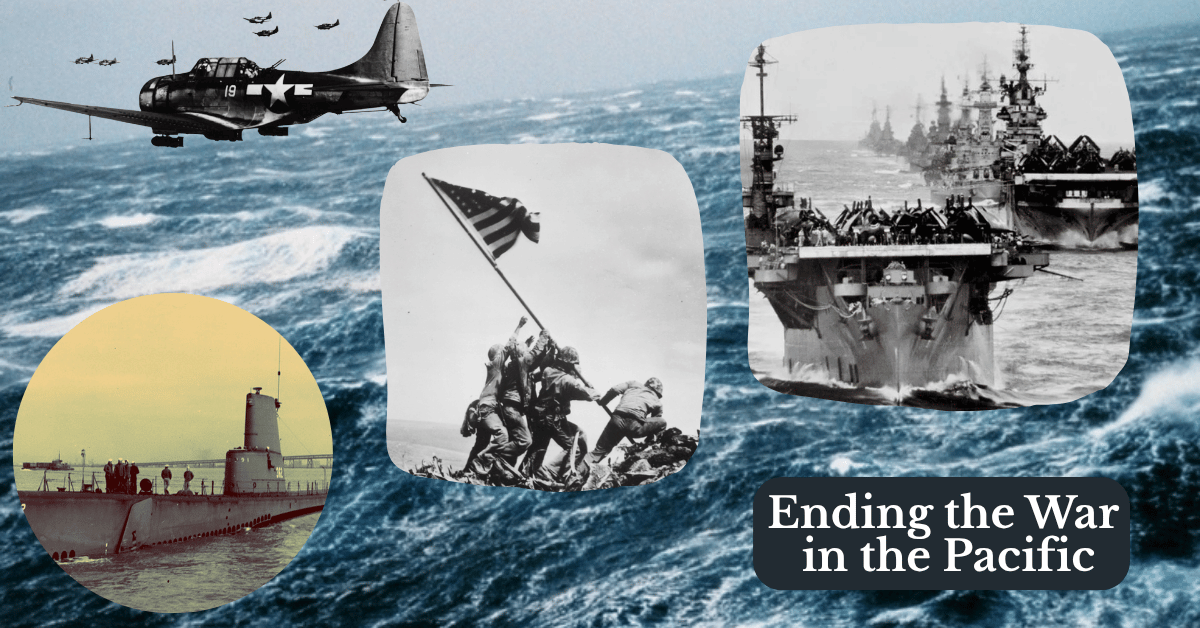
Image credit: various photographs from Naval Aviation Museum, National World War II Museum, and US Navy Archives.

Authorizing Operation Olympic

Truman’s questions and comments during the meeting reflected his own continuing unease over the level of US casualties. The President also expressed concern that an invasion of the homeland by Americans could carry a racial connotation in the minds of the Japanese that would unite them for a fight to the finish. Stimson said there was every indication that this would be the case. At the meeting’s end, Truman said he agreed that the plan presented by the Chiefs was the best choice under the circumstances, but he added that he “had hoped there was a possibility of preventing an Okinawa from one end of Japan to the other.”

Truman gave the go-ahead to continue preparations for the Kyushu operation; he said the decision on a follow-on invasion of Honshu could be made later. The minutes of the meeting indicate that an explicit rationale for this postponement was to enable the President and his advisers to take into account the impact of the Kyushu campaign and the anticipated Soviet entry into the war. 

Continue reading

Persistence, Presumption, and Promise

This coming Sunday the gospel is the parable of the Pharisee and the Tax Collector. This gospel follows the parable of the persistent widow and the unjust judge (18:1-8).  While the common thread is certainly prayer, there are other aspects which bind together these two narratives. One of Luke’s ongoing themes is the inclusivity of the Gospel. In these two parables, prayers are answered by God for a (saintly and probably poor) widow and the sinful (and probably rich) male tax collector. Luke continues to demonstrate that the Reign of God is open to all – a message of keen importance to his Gentile audience.

The two parables are well placed. Alan Culpepper (Luke, 340) notes that “By reading these two parables together, the reader is instructed to pray with the determination of the widow and the humility of the tax collector. Peter Rhea Jones has characterized the complementary themes of the two parables as ‘The promise of persistent prayer’ (18:1-8) and ‘The peril of presumptuous prayer’ (vv. 9-14).”  Each parable is instructive for the disciples of all ages about the nature of Christian prayer.

Continue reading