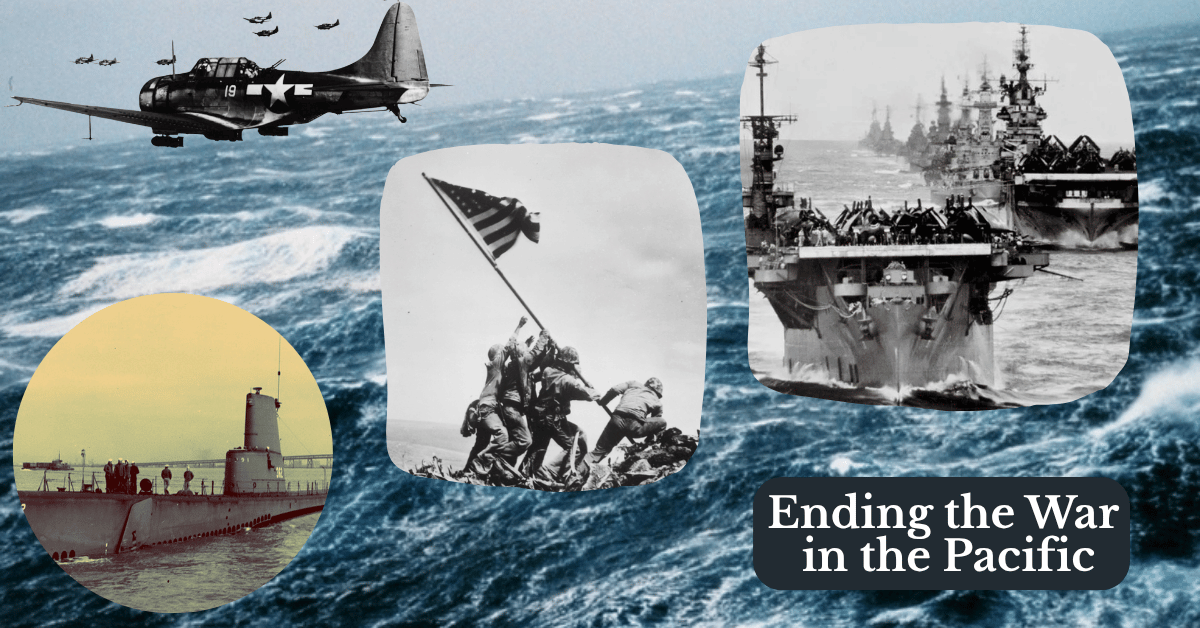
Japan prepares for Invasion

The sooner the Americans come, the better… One hundred million die proudly” 

Such was the Japanese wartime propaganda campaign in 1945 as part of the Ketsu-Go defense plan against the inevitable invasion of the home islands by Allied forces. The slogan urged a total commitment, even unto death, to protect Japan. If necessary, Japanese civilians were to fight to the death to defend the homeland.  Along with military operations, the goal was to inflict unacceptable casualties on the enemy and force a negotiated peace. 

Japan had a standing army of 4 million men, but more than half were spread out across the Asia Pacific region with a large part garrisoned in China and Manchuria but unable to cross the Sea of Japan to reach the home islands because of the naval blockade, submarine operations, and mining of the sea lanes by allied bombers operating from Saipan. Thus the call for the people to come to the aid of their homes and nation.

For more than 2,000 years, Japan had never been successfully invaded. The most serious threat had come from two attempted Mongol invasions in the 13th century, both of which were thwarted by typhoons that caused massive losses of ships, sailors and soldiers. Although the story of the “Divine Wind” (Kamikaze) “grabbed the headlines” in both invasions, the on-shore Japanese resistance was epic. It is estimated that the Mongol losses approached 100,000 with survivors becoming enslaved. The foundational story became the intervention of the divine and total commitment of the people.

Continue reading

A Parable of Reversal?

This coming Sunday the gospel is the parable of the Pharisee and the Tax Collector. The parable reaches a conclusion as we are told: “I tell you, the latter [tax collector] went home justified.” The verb tense makes it clear that it is God who has justified this person. What does justified (dikaioo) mean? Lowe & Nida give the following for dikaioo:

  1. to cause someone to be in a proper or right relation with someone else
  2. to demonstrate that something is morally right
  3. the act of clearing someone of transgression
  4. to cause to be released from the control of some state or situation involving moral issues

It seems that 1 and 3 best fit the context. The tax collector goes home in a right relationship with God, because God made the relationship right. It was not something the tax collected did for himself (self-justification). The word also implies that he went home having been freed (by God) of his sin or guilt. He came to the temple “a sinner” and went home forgiven.

Continue reading

The Collapse of Civil Order

As the summer progressed, the emperor and other key members of the inner leadership grew concerned and anxious that the civil order of Japan was threatened. In the breakdown of civil order, there was fear that the Japanese people would be ripe for a revolutionary moment. The root cause of growing dissatisfaction was the slow realization that the reports of Japanese victories were simply wrong. They had daily evidence that allied bombers controlled the skies and were unhindered in their devastating fire-bombing attacks on cities. The vaunted Japanese military could not protect them. 

Food Crisis and the “domestic situation”

At the same time it was clear that the food situation was becoming increasingly dire. For too long Japan had relied on food from Korea, Taiwan, Manchuria, and occupied territories. U.S. naval blockade had cut off imports, and domestic stockpiles were being depleted. Japan did not have a developed roadway system and so internal distribution of food and supplies were dependent upon rail and coastal transport. US bombers targeted train tunnels in the mountainous and hilly regions. At the same time, B-29 continued the mining of the coastal waterways, dramatically reducing the capacity of that transportation system.

Prior to 1941, 40% of Japan’s rice was imported, primarily from Korea and China. By the summer of 1945 those imports fell to virtually zero. The Japanese government instituted food stuffs to replace rice: soybean, sweet potatoes, wheat, barley, millet and a variety of greens. The problem was that these substitutes did not provide the caloric intake needed. But even more, rice was not just a staple but a cultural cornerstone. Its scarcity created a deep psychological blow as it “whisphered” wartime defeat. The food problems led to malnutrition, absenteeism from work, and other social problems. “The domestic situation” became the euphemism describing the building dynamic. They projected the real crisis would come in the fall, particularly when the rice crop was due. The 1945 rice harvest was expected to be only 50% of the normal harvest.

Continue reading

The Tax Collector

This coming Sunday the gospel is the parable of the Pharisee and the Tax Collector. As with Jesus’ parables, especially in Luke, they often echo earlier passages. For example:

“I have not come to call the righteous to repentance but sinners.” (Luke 5:32)

…there will be more joy in heaven over one sinner who repents than over ninety-nine righteous people who have no need of repentance.” (Luke 15:7)

Those echoes ring clearly in the word of the tax collector’s prayer: ‘O God, be merciful to me a sinner.” (Luke 18:13)  

Four aspects of the tax-collectors humility are briefly indicated by Luke: (1) he stood far off, (2) he kept his eyes lowered, (3) he beat his beast as a sign of repentance, an (4) he cries out for mercy. Unlike the Pharisee, the tax collector gives at least some evidence of humility and contrition: “…would not even raise his eyes to heaven” The tax collector’s reticence echoes Ezra’s prayer upon hearing of the numerous mixed marriages in Jerusalem: “O my God, I am too ashamed and embarrassed to lift my face to you, my God, for our iniquities have risen higher than our heads, and our guilt has mounted up to the heavens” (Ezra 9:6). Both of the situational comments in 18:13a—the downward gaze and the breast-beating—speak of a deep sense of unworthiness and embarrassment. 

Continue reading

Japanese-Soviet Diplomacy

Many commentaries, focused on the use of atomic weapons, suggest that use of such weapons of mass destruction was not necessary given that Japan was attempting to open peace negotiations via the Soviets as intermediaries. As noted in earlier posts, if one wishes to assert that peace negotiations via the Soviets was a viable pathway, one needs to account for the history of Japanese-Soviet relations which in general had always been contentious. Military actions include the 1903-1905 Japanese-Soviet war which concluded with a resounding Japanese victory at the naval battle of Tsushima, the 1939 Japanese invasion (unsuccessful) of Soviet-held Mongolia, and a long history of border conflict in northern Manchuria and Siberia.

The 1939 German–Soviet Non-Aggression Pact surprised Japan. Berlin, its nominal Axis partner, had essentially made peace with Moscow just as Japan had been fighting the Soviets. This left Tokyo diplomatically exposed. With tensions high, both Japan and the USSR had reasons to avoid a two-front war. The Soviets feared German aggression. By securing peace with Japan in the east, he could concentrate forces in the west. A neutrality pact would allow Japan to focus on expansion southward (toward Indochina, the Dutch East Indies, the Philippines) without worrying about Siberia. The pact was signed on April 13, 1941. Both sides pledged to respect each other’s territorial integrity and neutrality if either was attacked by a third power. On April 5, 1945 the Soviets informed Japan that they would not renew the pact in April 1946. But on the same day, the Soviets began deploying approximately 1 million soldiers to the Far East in fulfillment of a 1943 pledge to the Allies to enter the Asia-Pacific war within 3 months of the surrender of Germany. 

Continue reading

The Righteous Who Despise

This coming Sunday the gospel is the parable of the Pharisee and the Tax Collector. In the previous post we considered the meaning of “righteous” as a prelude to the parable’s beginning: He then addressed this parable to those who were convinced of their own righteousness and despised everyone else. The Greek pepothoitas normally means “to convince” or “to persuade;” however, it can also mean “to seduce,” “to corrupt.” It would have been interesting had the translators chosen “those who seduced themselves that they were in right relationship to God.”

Continue reading

Through One Man: Sin and Death

In today’s first reading our selection from The Letter to the Romans moves on from its prior focus on Abraham as a model of trust/belief/faith even when he has moments of doubts. Moving ahead to Chapter 5, St. Paul now takes on the matter of sin and death. Paul’s claim that “Through one man sin entered the world, and through sin, death” would have been nothing new to anyone familiar with Genesis chapters 2-3 and the Jewish understanding of those chapters. This “man” is, of course, Adam, whose very name means “man.”

Throughout Romans Chapter 5 and well into Chapter 8, Paul attributes to “sin” a very active role: 

it “reigns” (5:20; cf. 6:13, 14), can be “obeyed” (6:16–17), pays wages (6:23), seizes opportunity (7:8, 11), “deceives,” and “kills” (7:11, 13). In a word, he personifies sin, picturing it as a power that holds sway in the world outside Christ, bringing disaster and death on all humanity. Through this personification, Paul shows that individual acts of sin constitute a principle, or “network,” of sin that is so pervasive and dominant that the person’s destiny is determined by those actions. In the present instance, then, the “sin” that enters the world is more than an individual sin; it is the bridgehead that paves the way for “sinning” as a condition of humanity. The fact that Paul attributes to Adam this sin is significant since he certainly knows from Genesis that the woman, Eve, sinned first (cf. 2 Cor. 11:3; 1 Tim. 2:14). [Douglas J. Moo, The Epistle to the Romans, 1996; p.319]

The verse above is incomplete. The entire verse reads: “and through sin, death, and thus death came to all men, inasmuch (houtōs) as all sinned.” The word houtōs is one of those words that depending on how it is translated has lots of different implications. Remember it is all tied to the expression “through one man.” That being said, the majority of commentators think that “houtōs” draws a comparison between the manner in which death came into the world—through sin—and the manner in which death spread to everyone—also through sin. The implications are death is universal because sin is universal: “all sinned.”

But it is not the only possible rendering. Perhaps the most famous alternative is the translation “in whom,” adopted by Augustine and others. For, assuming that “the one man” is the antecedent of the pronoun, we have then an explicit statement of “original sin”: “in Adam all sinned.” St. Paul’s single verse has resulted in centuries of debate and caused deep divisions among Christians over the “transmission of original sin.”

However, St. Paul’s main interest is not to talk about sin or death, but rather to draw a contrasting picture of Adam and Christ, prominent figures of the beginning and the end time respectively. Adam is a “prototype” of the person to come, namely, Jesus, who would far surpass what Adam did. The world was changed by both of these individuals.

Adam unleashed an active hostile force into the world (sin), which had the power to cause definitive alienation (death) from God, the source of all life, inasmuch as or because all individuals have sinned through personal, actual deeds (v. 12). Thus death has two causes in human existence: Adam’s sin and personal ratification of that deed by individuals who sin. This was Adam’s effect on the world. In contrast, Christ’s effect is starkly different. Through the gracious gift, namely, the redemptive death of Jesus Christ uprightness and life superabound for all individuals who accept him. [Collegeville Bible Commentary, 1989, p.1086]

Debates aside, it is good to remember sin and death are real, but more real are grace and eternal life found in Christ as Lord and Savior.


Image credit: Pexels + Canva, CC-BY-SA 3.0

What is Necessary?

Much of the Just War Theory conversations (apart from what I have called narrow consequentialism) centers on the deaths of civilian populations. Broadly reading the available literature there seems to be a rating of moral importance in which the moral weight is given to civilians over drafted military over volunteer military. In part, it is the theorist’s way to nuance out the factors involved in thinking through jus bello decisions. For example, if the only way to save 100,000 of our civilians’ lives from terrorist attacks is by bombing another country’s cities and intentionally killing 10,000 of its citizens – would it be an action jus bello? Or, what if some enemy civilians place themselves as voluntary shields around a military target, hoping to deter attacks on it. Have they become combatants? What if they are not voluntary but are being forced into that role as happened in the Battle of Manila? What if citizens, dressed as citizens, are part of a military charge against defended positions such as happened on Saipan? What if citizens have workshops, critical to war production, adjacent to their house as was common in Tokyo and other major industrial cities of Japan? What if only 20% of the homes in a neighborhood have such workshops but the majority of other residents work in the larger factory where home workshop items are assembled into war materials and weapons? 

And if the larger goal is to end the Asia Pacific war to stop the mass deaths of non-Japanese citizens in Japanese-occupied territories, is it proportional and necessary to not intend, but to know that it is inevitable that Japanese civilians will die because of allied military actions that are scaled up to a national level? What if the action is not direct attack by armed forces and weapons, but simply the blockade of the aggressor nation that will result in increasing civilian deaths by starvation until the nations, already militarily defeated, finally politically surrenders?

Continue reading

Japanese “Diplomacy”

When one talks about Japan’s efforts to end the war, there are those who claim there were numerous attempts, all of which were ignored by the Allies. There were indeed several and they were, for the most part, simply “noted.” The Allies then waited to see what might become of the Japanese inquiry.

What one must keep in mind is that diplomats, intermediaries, and private citizens can all be in conversation with important, well-placed individuals of other governments. Those individuals might informally pass along information, but there will be no substantive conversations that have a hope of going anywhere unless the government knows the inquiry was authorized by the Japanese government – not just the Foreign Minister, but the Supreme Council and Emperor – and there is some kind of “term sheet” outlining “this is what we want to talk about” and here is “the opening position.” Otherwise, it is just talk.

Continue reading

What is right

This coming Sunday the gospel is the parable of the Pharisee and the Tax Collector. We hear this parable differently than the first century listener.  We know how the parable ends and we also know how Luke has been describing the Pharisees, thus even at the words one was a Pharisee we know how this will end. Won’t it be that the Pharisee will represent the one who trusts himself and his own righteousness rather than God and the one who judges others and holds them in contempt? But let’s consider how the first century listener might have heard this narrative.

Continue reading