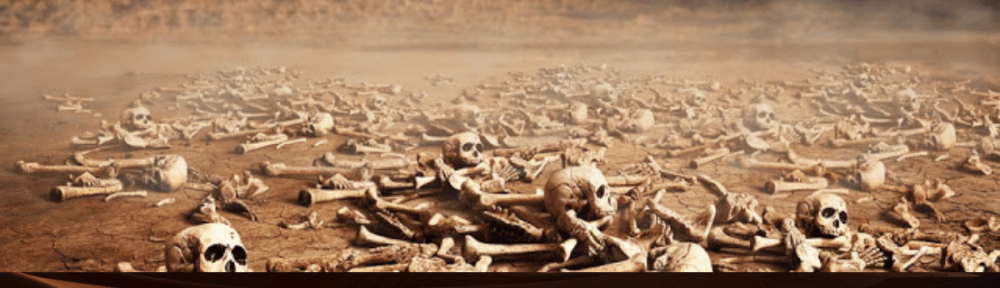
On this 5th Sunday of Lent, 2026, our gospel is the memorable story of the Raising of Lazarus from the Grave. It is an account that foreshadows not only Jesus’ resurrection but also our own. But this year, it is the first reading from Ezekiel that captured my thoughts. The reading is part of Ezekiel’s vision of the Valley of the Dry Bones.
“Dem bones, dem bones, dem dry bones” so goes the lyrics of the spiritual based on the prophet Ezekiel’s vision in Ezekiel chapter 37. In his vision, the prophet sees himself standing in a valley full of dry human bones. The vision comes at a sad moment in Israel’s history. Jerusalem has fallen, the people exiled to Babylon, and any realistic hope of national restoration seems gone. Ezekiel’s is filled with dry bones scattered across a barren landscape. It is a metaphor of the people who see themselves as not merely defeated, but finished: “Our bones are dried up, our hope is lost.” (Ezek 37:11) The vision captures both the historical devastation and the internal despair of a community that no longer believes in a future.
The vision given to Ezekiel is not subtle. It is stark. These are bones long dead and gone, no longer resembling the humanity that once surrounded them. There is nothing hopeful about the vision. Yet the Lord asks Ezekiel: “Son of man, can these bones live?” (v.3) That question was not just for Ezekiel in his time. It is for us in our times. Before we can hear the promise “I am going to open your graves; I will make you come up out of your graves” we must first recognize where the graves are.
In our own time, those graves are not always visible. They do not always look like death. Often, they look like ordinary life on the surface. But beneath, something essential has been buried. The graves have different names:
- Isolation where people are surrounded by others and yet profoundly alone, unknown, unseen. We see this in the breakdown of some family and community bonds, virtual abandonment of the elderly, and people who have a digital “connection” without real communion.
- Addiction where freedom is entombed in an ever smaller world. It is the world of substance abuse, pornography, gambling, and digital dependency – often accompanied by denial and more isolation.
- There is a grave of despair where hope itself has withered and the future feels closed off. People can be affiliated by a growing sense that life has no deeper purpose, suffering has no redemptive meaning, and the future does not seem to offer hope.
- People can be drawn into the void of a type of consumerism – not everyday commerce – but the type that has convinced us that “we are what we own” and that fulfillment can come from acquisition.
- These days who hasn’t seen the grand silence brought about by polarization. The place where dialogue is replaced by contempt and a clip more outrageous than the last. There, differences are now clear divisions where relationships, communities, even families, are fractured by suspicion and denigration.
- Shame where a person is burdened by unresolved guilt even if forgiven in the Sacrament of Reconciliation. It is the void where a person believes that their sins, their past, places them beyond mercy.
- Spiritual Apathy where the hunger for God fades, not through rejection, but through neglect: faith is reduced to routine; worship and prayer are ever more empty, more dry; and, you begin to think God is too distant to notice, to care. This is a quiet grave; the slow burial of the soul.
In these modern graves people suffer and some have quietly given up expecting resurrection. Like the bones in Ezekiel’s vision, they can feel dry, final, beyond restoration.
So the Lord’s question comes again: Can these bones live? Ezekiel’s answer is striking. He does not say yes. He does not say no. He says: “O Lord God, you know.” It is the answer of humility. It is the answer of one who trusts. The answer of someone who has seen too much to rely on human optimism. It is the answer of someone who still leaves room for God. And that is the turning point.
God does not ask Ezekiel to solve the problem. God does not say to fix yourself, try harder or I have opened the grave, now climb out…” God asks Ezekiel to speak the Word of God into “dem bones”, into those graves. “Prophesy over these bones” the Lord tells Ezekiel. And as the word is spoken, something impossible begins to happen: bones come together, sinews and flesh appear, and breath enters them. What was dead becomes alive—not gradually, not symbolically, but decisively. And then comes the promise that stands at the heart of this reading: “I am going to open your graves and I will make you come up out of your [them] I will put my spirit in you that you may come to life,.”
That is the hope of Lent. Lent is the time to let the fasting, prayer, and alms giving be the prophesy you speak into “dem bones.” Lent is the time we allow the power of the Word and the grace of the Sacraments enter the places we have accepted as closed, sealed, and beyond change. The places we avoid. The places we hide. The places we have quietly declared: “There is nothing more that can be done – it’s finished….It’s hopeless… It doesn’t matter.” Those are precisely the places where God speaks: “Look! I am going to open your graves.”
Earlier God promised the people: “I will sprinkle clean water over you to make you clean; from all your impurities and from all your idols I will cleanse you. I will give you a new heart, and a new spirit I will put within you. I will remove the heart of stone from your flesh and give you a heart of flesh.” (Ezek 36:25-26)
That promise has already been given us in our Baptisms. We were given hearts ready to share in the divine life. We were given the Spirit of God so that we could live in communion with God and one another. And together pass through the mountain highs and the dry valleys.
It seems to me the familiar expression “one foot in the grave,” can also describe the graves with different names that we experience in the course of life. The question for us is not simply: Where are the graves in the world? But more personally: what are my graves? And if you find “one foot” in one of those voids, remember the promise: “I will open your grave.” In Baptism we have already been given new hearts and new spirits. It is in the continued practice of this Faith, in the Word proclaimed, the Eucharist received – our hearts and spirits are reinvigorated. And if we can, even with hesitation, answer as Ezekiel did “O Lord God, you know.” In those simple words of trust, we make room for the small miracles that are always there. Perhaps less spectacular than raising Lazarus, but as life-giving. We make room for Hope in our lives.
The God who spoke over dry bones has not changed. His promise stands forever. He is still opening graves and called us into the light of Hope.
Image credit: CANVA AI, downloaded 3-21-2026
Discover more from friarmusings
Subscribe to get the latest posts sent to your email.
 friarmusings