The gospel for the 29th Sunday, the parable of the “Unjust Judge and the Persistent Widow,” concludes with: 7 Will not God then secure the rights of his chosen ones who call out to him day and night? Will he be slow to answer them? 8 I tell you, he will see to it that justice is done for them speedily. But when the Son of Man comes, will he find faith on earth?”
Jesus’ comments make clear the intended parallels: from an unjust judge to God; from the widow to God’s elect. The term “his chosen ones” (hoi eklektoi), used in Luke-Acts only here, echoes texts such as Isa. 42:1; 43:20; 65:9, 15, 22; Ps. 105:6, 43 (cf. Sir. 47:22), which use the term “chosen” in a context that emphasizes election to serve Yahweh (also refers to Deut. 4:37; 7:7; 1 Chron. 16:13; Ps. 77:31; 88:3).
A great deal of the discussion about Just War theory focuses on the state and national polities especially before the war and in the context of the decision to declare war: jus en bellum. The focus is the justice of the cause. What is often overlooked, or at least not often spoken of, is the moral and spiritual burden borne by the warfighter. Already in the Summa Theologiae (II–II, q.40), Aquinas notes that the individual soldier’s actions must be ordered toward right intention — not hatred, cruelty, or greed. That is not only to avoid sin, but also a recognition of the impact of war is very different on the foot soldier than on the monarch. St. Thomas does not offer more on the topic, but then it was not the focus of his writings.
In cinematic offerings before, during, and after WW II, combat was depicted as heroic: soldiers carrying out their righteous duty to protect their country, complete their mission, and sometimes, take the lives of their enemies. But the cinematic lens of that era rarely focused on what happens after the gunfire stops, after the explosions cease, and after a soldier takes another human’s life. The notable exception is “The Best Years of Our Lives.” The film, which won an Academy Award for Best Picture, follows three servicemen as they re-adjust to civilian life, dealing with issues like unemployment, physical disability, and the emotional toll of war. Movies of this century have more offering of the time after combat ends, leaving behind a harsh and devastating reality: the psychological toll of combat, specifically for those who have taken a life. Moral injuries have been part of the warrior culture throughout human history. There is a perilous journey into war and a perilous journey back. It is a journey that is volatile, uncertain, complex, and ambiguous.
This is an addendum to the “Olympic Decision” post. It continues the thread of thought that suggests President Truman left the June 18, 1945 without a firm answer to expected losses – not to say he wasn’t briefed later. But it also addresses the historians who offer that post-war Truman inflated the estimated US losses associated with an invasion to “more than a million.”
In the earlier article it was posited that based on Japanese troop strength on Kyushu by the end of July and a casualty rate similar to Okinawa, there would be an estimated 792,000 allied casualties. By and large those are ground force casualties and do not account for shipboard naval losses. In Admiral Nimitz’s early May estimate, his planning staff projected massive losses due to kamikaze attacks: 25 aircraft carriers, 10 battleships, and 40 cruisers and destroyers. Japanese documents and testimony of naval leadership indicated that the Kyushu kamikaze efforts would be primarily aimed at troop transports and supply ships. The troop ships (Attack Transport-AP) varied in size but this will give you an idea of the capacity.
This is an addendum to the “Olympic Decision” post. It continues the thread of thought that suggests President Truman left the June 18, 1945 without a firm answer to expected losses – not to say he wasn’t briefed later. But it also addresses the historians who offer that post-war Truman inflated the estimated US losses associated with an invasion to “more than a million.”
In the earlier article it was posited that based on Japanese troop strength on Kyushu by the end of July and a casualty rate similar to Okinawa, there would be an estimated 792,000 allied casualties. By and large those are ground force casualties and do not account for shipboard naval losses. In Admiral Nimitz’s early May estimate, his planning staff projected massive losses due to kamikaze attacks: 25 aircraft carriers, 10 battleships, and 40 cruisers and destroyers. Japanese documents and testimony of naval leadership indicated that the Kyushu kamikaze efforts would be primarily aimed at troop transports and supply ships. The troop ships (Attack Transport-AP) varied in size but this will give you an idea of the capacity.
The gospel for the 29th Sunday is the parable of the “Unjust Judge and the Persistent Widow.” Language and etymology can tell us a lot. The word chḗra, meaning “widow,” derives from a root meaning “forsaken.” Widows are associated with others who are disadvantaged, e.g., orphans, aliens, or day laborers. They suffer wrongs (Is. 10:2) or loss of rights (1:23). They are held in low esteem (54:4); cf. their special clothes (Gen. 38:14). Yet the OT enjoins all the righteous to be kind to widows. God is their refuge, and he helps them to their rights (Ps. 146:9; Dt. 10:18). He threatens judgment on those who wrong them and promises blessing to those who assist them (Ex. 22:21ff.; Jer. 7:6)
The previous post ended with this: “The question of interest is jus bello (in war), especially as it concerns the ways and means to end the Asia Pacific War. In the language of Just War Theory – were the ways and means “proportional” and was adequate care given to the question of non-combatant injury and death.? In preparing to write on this topic I am not sure how to best describe the reading and research. The following expressions come to mind: “down the rabbit hole,” “swamp,” and “forget the forest, I am still looking for trees.” Whereas the conditions for establishing jus ad bellum are consistent and have been clearly expressed, not so much for jus bello. It is an understatement to say there are “different schools of thought.” The debate centers on two concepts: proportionality and necessity – that are intertwined.
One of the schools of thought are the “consequentialists.” Although I did not see a delineation of “schools with a school,” the literature certainly seemed to indicate a wide division in views of writers that would be counted as consequentialists. For the sake of brevity, I would label them the “wide” and “narrow” schools of thought and would provide an example of each (with apologies to just war theorists and their work.)
After the May 1945 German surrender, arrangements were made for the Allies to meet in Potsdam, Germany. The topics were to settle the postwar arrangements for Europe and to reach agreement on coordinated Allied military operations against Japan. A month before the mid-July Potsdam Conference, President Truman met with his senior advisers to go over plans for ending the war with Japan and to prepare himself for Potsdam. In a 14 June memorandum to the service chiefs setting up this meeting, his Chief of Staff, Admiral Leahy, said the President wanted to:
“. . . discuss details of our campaign against Japan. He expects at this meeting to be thoroughly informed of our intentions and prospects in preparation for his discussions with Churchill and Stalin. He wants an estimate of the time required and an estimate of the losses in killed and wounded that will result from an invasion of Japan proper. He wants an estimate of the time and the losses that will result from an effort to defeat Japan by isolation, blockade, and bombardment by sea and air forces. It is his intention to make his decision on the campaign with the purpose of economizing to the maximum extent possible in the loss of American lives. Economy in the use of time and money cost is comparatively unimportant. I suggest that a memorandum discussion of the above noted points be prepared in advance for delivery to the President at the time of the meeting. . . .”
The gospel for the 29th Sunday is the parable of the “Unjust Judge and the Persistent Widow” which begins in v.2, “There was a judge in a certain town.” A more literal translation: There was a certain judge in a certain town, echoes a previous passages – a certain rich man who experienced an abundant harvest or a certain rich man (fool) who lived in purple garments and fine linens but never gave heed to poor Lazarus.
This judge is likely a local magistrate yet of notable status within the community. Despite his exterior bearing Jesus characterizes him as someone who neither feared God nor respected any human being (v.2). In the scriptural tradition The fear of the LORD is the beginning of knowledge (Prov 1:7) and the threshold of God’s grace: His mercy is from age to age to those who fear him (Luke 1:50). Fear (holy awe) is the manner in which he disciples and others respond to Jesus’ power (8:25, 35; 9:34, 45). Further, Jesus instructs the disciples not to fear their persecutors but to fear God (12:4-5). Luke portrays those who “fear God” in a positive manner (cf. Acts 10:2, 22, 35; 13:16, 26). It can be taken that a lack of such fear is a sign of one’s thorough wickedness. The statement that the judge does not fear God points to 2 Chron 19:7, where King Jehoshaphat appoints judges in Judah, charging them, “And now, let the fear of the LORD be upon you. Act carefully, for with the LORD, our God there is no injustice, no partiality, no bribe-taking.” Without such fear, can one expect justice or impartiality except with a bribe?
In the previous post we considered the basis of modern just war theory in the writings and reflections of St. Thomas Aquinas. His thoughts became the basis for reflection on wars prior to the 20th century. For example, in the 16th century the Dominican Francisco de Vitoria applied just war thinking to Spain’s wars of conquest in the Americas. While he rejected armed conflict against indigenous people for the cause of conversion, he argued that the Spanish explorers had freedom to be in the foreign lands and their defense was just. Thomas’ thoughts were applied to conflicts between Christian monarchs, regional disputes, and the such. It was not until the 17th century that Hugo Grotius, De Jure Belli ac Pacis, used the theory and applied just war reasoning to the Thirty Years’ War and European state conflicts. His work was foundational in international law and guided legal-political thinking for centuries. It also reflected the changing nature of war in the western European world.
In a very different setting, during the Crusades of the 11th–13th centuries, medieval theologians and canonists defended the Crusades as just wars under Aquinas’ principles. Their understanding was that the wars met the criteria: legitimate authority in the Pope; a just cause in defense of pilgrims and recovery of holy places; and the right intention, namely service to God. It was not until the late 16th century in the work of Francisco Suárez that “proportionality” was considered.
In May 1945, Germany surrendered unconditionally. Many commentators offer that this would have been the optimal time to organize discussions with the Allies about a negotiated peace, preempt Russian involvement in the Pacific War, and end the war on terms acceptable to Japan. No attempts were made – nor were they likely to have gotten “off the ground.” The mindset of the Council was devotion to the Ketsu-Go plan. Suzuki had zero possibility of reaching a unanimous Council position in order to present such an option to the Emperor.
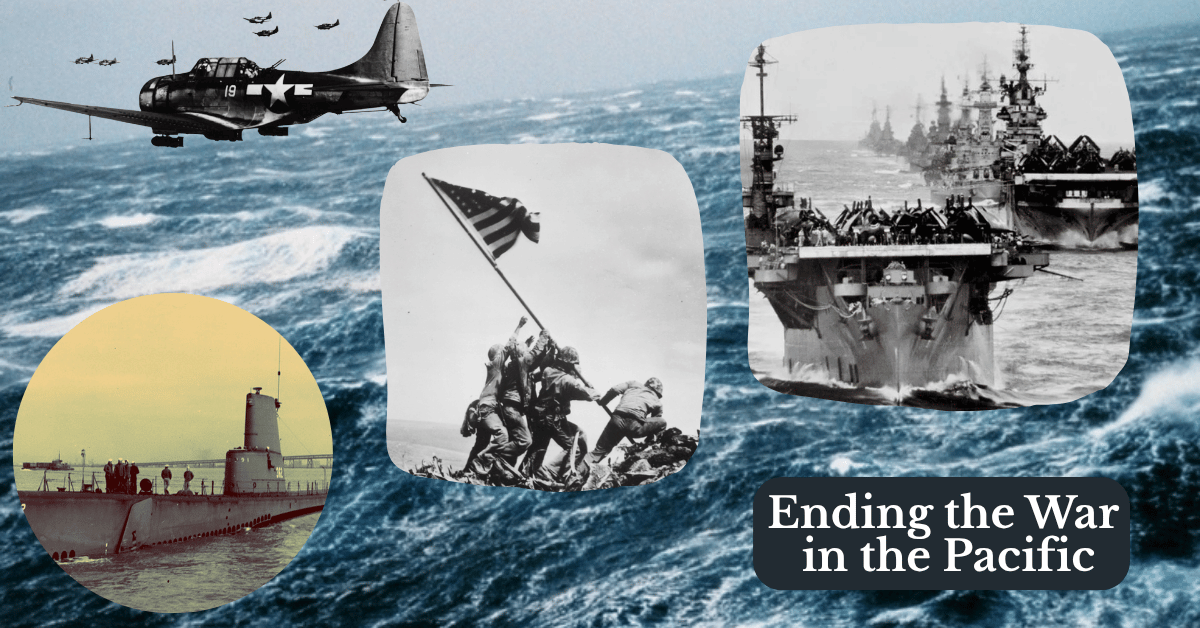
Meanwhile, during this time period, Leyte has fallen, Luzon is all-but-defeated, Iwo Jima has been taken, and Okinawa is in progress. Allied bombing and firebombing continues. The submarine blockade is tightening its hold. The last oil tanker reached Japan in March 1945. Japan had their oil, gas and aviation fuel reserves and no hope to replenish their stock – which was more than 1 million barrels. At the same time B-29 sealane mining is grinding coastal sea traffic to a halt, naval shore bombardment continues and there is no decisive battle left save Okinawa (doubtful) or Ketsu-Go, the defense of the home islands.
In this time period Emperor Hirohito had asked for two reports: (a) Estimate of the World Situation (prepared by the Army staff) and (b) Sōri Daijin Hōkoku – “Report to the Prime Minister” (prepared by Admiral Sakomizu). Sakomizu was asked to produce an objective, comprehensive assessment of Japan’s military, economic, and social condition to guide decisions about continuing or ending the war. The report painted a grim and realistic picture.


 friarmusings