This week the posts focus on the Passion Narrative from Matthew’s gospel which will be proclaimed this coming Sunday on Palm Sunday of the Lord’s Passion. As you well know it is a long reading. And so I have broken the commentary on the gospel into 18 posts spread from today until Saturday morning. And still some of the posts will be long, e.g. the arrest of Jesus and his crucifixion. Over the course of the week you can expect that there will be 3-4 posts per day. I hope this makes reading the commentary a little more manageable.
On this 5th Sunday of Lent, 2026, our gospel is the memorable story of the Raising of Lazarus from the Grave. It is an account that foreshadows not only Jesus’ resurrection but also our own. But this year, it is the first reading from Ezekiel that captured my thoughts. The reading is part of Ezekiel’s vision of the Valley of the Dry Bones.
“Dem bones, dem bones, dem dry bones” so goes the lyrics of the spiritual based on the prophet Ezekiel’s vision in Ezekiel chapter 37. In his vision, the prophet sees himself standing in a valley full of dry human bones. The vision comes at a sad moment in Israel’s history. Jerusalem has fallen, the people exiled to Babylon, and any realistic hope of national restoration seems gone. Ezekiel’s is filled with dry bones scattered across a barren landscape. It is a metaphor of the people who see themselves as not merely defeated, but finished: “Our bones are dried up, our hope is lost.” (Ezek 37:11) The vision captures both the historical devastation and the internal despair of a community that no longer believes in a future.
The vision given to Ezekiel is not subtle. It is stark. These are bones long dead and gone, no longer resembling the humanity that once surrounded them. There is nothing hopeful about the vision. Yet the Lord asks Ezekiel: “Son of man, can these bones live?” (v.3) That question was not just for Ezekiel in his time. It is for us in our times. Before we can hear the promise “I am going to open your graves; I will make you come up out of your graves” we must first recognize where the graves are.
In our own time, those graves are not always visible. They do not always look like death. Often, they look like ordinary life on the surface. But beneath, something essential has been buried. The graves have different names:
Isolation where people are surrounded by others and yet profoundly alone, unknown, unseen. We see this in the breakdown of some family and community bonds, virtual abandonment of the elderly, and people who have a digital “connection” without real communion.
Addiction where freedom is entombed in an ever smaller world. It is the world of substance abuse, pornography, gambling, and digital dependency – often accompanied by denial and more isolation.
There is a grave of despair where hope itself has withered and the future feels closed off. People can be affiliated by a growing sense that life has no deeper purpose, suffering has no redemptive meaning, and the future does not seem to offer hope.
People can be drawn into the void of a type of consumerism – not everyday commerce – but the type that has convinced us that “we are what we own” and that fulfillment can come from acquisition.
These days who hasn’t seen the grand silence brought about by polarization. The place where dialogue is replaced by contempt and a clip more outrageous than the last. There, differences are now clear divisions where relationships, communities, even families, are fractured by suspicion and denigration.
Shame where a person is burdened by unresolved guilt even if forgiven in the Sacrament of Reconciliation. It is the void where a person believes that their sins, their past, places them beyond mercy.
Spiritual Apathy where the hunger for God fades, not through rejection, but through neglect: faith is reduced to routine; worship and prayer are ever more empty, more dry; and, you begin to think God is too distant to notice, to care. This is a quiet grave; the slow burial of the soul.
In these modern graves people suffer and some have quietly given up expecting resurrection. Like the bones in Ezekiel’s vision, they can feel dry, final, beyond restoration.
So the Lord’s question comes again: Can these bones live? Ezekiel’s answer is striking. He does not say yes. He does not say no. He says: “O Lord God, you know.” It is the answer of humility. It is the answer of one who trusts. The answer of someone who has seen too much to rely on human optimism. It is the answer of someone who still leaves room for God. And that is the turning point.
God does not ask Ezekiel to solve the problem. God does not say to fix yourself, try harder or I have opened the grave, now climb out…” God asks Ezekiel to speak the Word of God into “dem bones”, into those graves. “Prophesy over these bones” the Lord tells Ezekiel. And as the word is spoken, something impossible begins to happen: bones come together, sinews and flesh appear, and breath enters them. What was dead becomes alive—not gradually, not symbolically, but decisively. And then comes the promise that stands at the heart of this reading: “I am going to open your graves and I will make you come up out of your [them] I will put my spirit in you that you may come to life,.”
That is the hope of Lent. Lent is the time to let the fasting, prayer, and alms giving be the prophesy you speak into “dem bones.” Lent is the time we allow the power of the Word and the grace of the Sacraments enter the places we have accepted as closed, sealed, and beyond change. The places we avoid. The places we hide. The places we have quietly declared: “There is nothing more that can be done – it’s finished….It’s hopeless… It doesn’t matter.” Those are precisely the places where God speaks: “Look! I am going to open your graves.”
Earlier God promised the people: “I will sprinkle clean water over you to make you clean; from all your impurities and from all your idols I will cleanse you. I will give you a new heart, and a new spirit I will put within you. I will remove the heart of stone from your flesh and give you a heart of flesh.” (Ezek 36:25-26)
That promise has already been given us in our Baptisms. We were given hearts ready to share in the divine life. We were given the Spirit of God so that we could live in communion with God and one another. And together pass through the mountain highs and the dry valleys.
It seems to me the familiar expression “one foot in the grave,” can also describe the graves with different names that we experience in the course of life. The question for us is not simply: Where are the graves in the world? But more personally: what are my graves? And if you find “one foot” in one of those voids, remember the promise: “I will open your grave.” In Baptism we have already been given new hearts and new spirits. It is in the continued practice of this Faith, in the Word proclaimed, the Eucharist received – our hearts and spirits are reinvigorated. And if we can, even with hesitation, answer as Ezekiel did “O Lord God, you know.” In those simple words of trust, we make room for the small miracles that are always there. Perhaps less spectacular than raising Lazarus, but as life-giving. We make room for Hope in our lives.
The God who spoke over dry bones has not changed. His promise stands forever. He is still opening graves and called us into the light of Hope.
The gospel reading for 5th Sunday in Lent is the account of the raising of Lazarus from the dead (John 11:1-45). In yesterday’s post we listened in on the conversation between Jesus and Mary, the sister of Martha. Today we consider the actions and event of the raising of Lazarus from the dead. Continue reading →
In today’s first reading we read from the Book of Wisdom which was written about fifty years before the coming of Christ, likely in Alexandria. That places the author in a deeply Hellenistic environment, where Jewish communities were immersed in Greek language, philosophy, and cultural pressures. It reflects a real tension between
The author’s name is not known to us. The primary purpose of the author was to give moral support to fellow Jews in a time when they were experiencing suffering and oppression from secular society and especially from Jews who had left the faith because of the lure of Hellenistic thought and privileges that came from being part of the ruling class. It was their own version of “culture wars.”
It reflects a real tension between Jewish covenantal faith (rooted in Torah, righteousness, and fidelity to God) and a Hellenistic worldview, which could include philosophical skepticism about divine justice, materialism or hedonism (in some popular forms), and other tenets of that worldview. In addition, the ruling, wealthy and business class were of the Hellenistic world and so Jews might well feel pressure to culturally assimilate. It almost seems to be their version of “a culture war.”
The passage taken from Wisdom 2 presents the reasoning of “the ungodly,” who say things like: life is short and meaningless, enjoy pleasure now, oppress the righteous person, test whether God will save him. It has all the hallmarks of popularized versions of Epicureanism or maybe recast in our times, a caricature of moral relativism. It can feel like a “culture war” text, though with nuance. The “culture war” here is not just intellectual, it is moral and existential. The core question is will one remain faithful when righteousness is mocked as foolishness? One voice claims our world is sunsetting. Our faith tells us we are at the sunrise of an every new age.
In its time, it was a question for faithful Jews in a hostile cultural setting. In Christian reading it foreshadows the passion of Christ. Both these motifs are seen when the wicked plot against “the righteous one.” “Culture war” is a helpful modern analogy, but the book is doing something deeper. It is defending righteousness against nihilism, affirming divine justice against apparent injustice, and proclaiming immortality against despair. It proclaims faith in a just, purposeful cosmos vs. the temptation to believe that life is accidental and morally empty.
It is the challenge that Christian faithful have faced in every age. It is not a call to close oneself off from the world, to proclaim that you are one of the “faithful remnant.” It is a call to find your own voice to be a Book of Wisdom to a world that does not share our view of how we are called to live.
Call it what you will, culture war or persecution, ridicule or derision, in every age we are still called to go to the ends of the earth with the Good News. This is the Way.
The hostilities of the Asia- Pacific war ended over 80 years ago. It was a war that by most estimates took more than 30 million Asian lives, the vast majority of whom were neither combatants nor Japanese. We have considered the currents of history that brought us to the doorsteps of war, over the threshold into war’s carnage, until its end which was possibly inevitable even from its beginning. Was it inevitable? Some historians answer, “yes,” but there are always choices. It is just that you might not like any of the choices available.
By the 1930s it was clear that Japan viewed its role as the leader of the Asia-Pacific region in every aspect by which a modern, great-power nation should be seen. The slow morphing of its self-understanding was traced in the post Japan Apart. It was not as simple as Japan understanding itself to be superior in terms of civilization, military strength, institutional stability, and a host of other measures – it was now a matter of destiny. Japan’s self-assigned role in the modern era was to be the leader, guardian and protector of Asian nations against the incursions of western colonialism that had left its mark through all reaches of the Asia-Pacific region. To their thinking, only they had risen above the grasp of western powers. They were possessed of the destiny to assume the role of leadership of a greater Asian prosperity sphere: an oriental Monroe Doctrine.
The previous several posts have added information and insights to draw closer to uncovering why Japan would draw the United States into the already ongoing conflict in the Asia-Pacific region. Was it inevitable? Some historians answer, “yes,” but there are always choices. It is just that you might not like any of the choices available. And how the choices are viewed and evaluated are “in the eyes of the beholder.”
By 1941 Japan was bogged down in China fighting a war it started and, despite early successes, had very little chance of winning but every chance of experiencing the endless quagmire that had always been China. The fighting was already draining Japanese national reserves, was being fueled (literally) by oil and gasoline from the U.S., and was beginning to drastically reduce the standard of living among the Japanese people on the home islands. And yet Japan started armed combat with the U.S., a battle that the leaders of Japan knew they could not win militarily. It was a war the Japanese government’s Total War Research Institute reported there was no chance of winning. Even the best minds in Japan argued against the possibility of success. But as Prime Minister Tōjō once remarked: “Occasionally, one must conjure up enough courage, close one’s eyes and leap off the veranda of the Kiyomizu Temple.” Their actions were not rational; made no sense to the Western mind.
The presumption of irrationality is natural when considering the latent military and industrial power of the U.S.. But “counting the costs” was not the criteria employed by Japan. Their decision for war has to be seen in the light of the alternatives available to them: economic suffocation or surrender of Tokyo’s empire and imperial ambitions/destiny on the Asian mainland. The choices made by the United States have to be seen in the light of the alternative available to them at the same crossroads of history.
Japanese aggression in East Asia was the root cause of the Asia-Pacific War. Given that perhaps war was inevitable, but the road to Pearl Harbor was paved with American as well as Japanese miscalculations.
Rationality
History does not lack accounts of the irrational. Consider Winston Churchill and Britain in 1941. The British army had been driven off the continent as the last soldier evacuated from Dunkirk. By mid-1940 there was no one who could challenge Hitler’s control of Europe.
Was Churchill’s decision to fight on after Dunkirk rational? In May-June 1940 Britain had no means of effectively challenging Hitler’s on the European continent. Britain was down to its last hope: American and Soviet entry into the war. The Soviets had a non-aggression pact with Germany and the situation in Europe was not enough to bring America “off the sidelines.” The people of the United States were not interested in again being drawn into “European affairs” as they were in 1917. Only profound mistakes by Germany and Japan would change Britain’s strategic fortunes to bring the United States into the war.
A rational Winston Churchill would have explored the possibility of accepting German rule on the continent in exchange for allowing Britain to withdraw from the war and save the remains of its empire. Perhaps this was the sun beginning to set on the British Empire. Was it rational to continue the good fight? It would have been epic, heroic but ultimately foolhardy and futile. The choices were the heroic last stand, negotiate peace, or hold on until the Axis powers take irrational actions.
In June 1941 Germany invaded the Soviet Union. In December 1941 Japan attacked Pearl Harbor. They were the seismic events that changed the tide of history.
American naval historian Samuel Eliot Morison called Tokyo’s decision for war against the United States “a strategic imbecility.” [Quoted in Gordon Prange’s Pearl Harbor: The Verdict of History] Apart from all the reasons already noted in previous posts, the United States lay beyond Japan’s military reach. Though Japan could fight a war in East Asia and the Western Pacific, it could not threaten the American homeland. In attacking Pearl Harbor, Japan elected to fight a geographically limited war against an enemy capable of eventually waging a total war against the Japanese home islands themselves.
Dean Acheson, who in 1941 was Assistant Secretary of State for Economic Affairs, declared before Pearl Harbor that “no rational Japanese could believe that an attack on us could result in anything but disaster for his country.”3 Secretary of War Henry L. Stimson believed the Japanese, “however wicked their intentions, would have the good sense not to get involved in a war with the United States.”4 Admiral Isoroku Yamamoto certainly had good sense. In October 1940 he warned that to “fight the United States is like fighting the whole world. Doubtless I shall die aboard the Nagato (his flagship). Meanwhile, Tokyo will be burnt to the ground three times.”
Perhaps the most savage indictment is that of historians Haruo Tohmatsu and H. P. Willmott: “[N]o state or nation has ever been granted immunity from its own stupidity. But Japan’s defeat in World War II was awesome. The coalition of powers that it raised against itself, the nature of its defeat across an entire ocean, and the manner in which the war ended represented an astonishing and remarkable, if unintended, achievement on the part of Japan.” (A Gathering Darkness: The Coming of War to the Far East and the Pacific, 1921-1942, p. 1) Wilmott, a top tier historian, is noted for his acute and searing analysis.
Thucydides famously explained the desire of ancient Athens to retain its empire by declaring that “fear, honor, and interest” were among three of the strongest motives. Japan’s decision for war has to be seen in the light of the alternatives available to them: war, economic suffocation or surrender of Tokyo’s empire and imperial ambitions/destiny on the Asian mainland. These seem to fall within Thucydides categories of the strongest of motives. Japan’s decision for war was made after months of agonizing internal debate by leaders who recognized America’s vast industrial superiority and who, in the more sober moments, suffered few illusions about Japan’s chances in a protracted war against America. Japan’s leaders did not want war with the United States, but by the fall of 1941 few saw any acceptable alternative to war and they resigned themselves to it.
The Blind Alley
All the above being true in perception, it would seem that the 20th century had seen a dynamic in which Japan was working its way deeper and deeper into labyrinth of international complexities with nations that were well familiar with the twists and turns of the morass. Japan has been isolated from the world for centuries, only emerging some 60 years prior. It entered the labyrinth with a certain presumption about its readiness for the adventure. By the end of the 1930s their undisguised military aggression had created a situation in which the survival of Japan as a great power, and of her conception of an Asian empire, did indeed hang in the balance. They had essentially walked themselves into a dead end with absolutely no allies in the region. It is like the driver who is lost, refuses to ask directions, won’t admit he can’t read a road map, and nonetheless pride moves him ahead deeper into an increasingly blind alley. Arguments of honor, humiliation and subjugation can be hoisted – and even agreed they don’t have to be rational – but it does not exonerate the choices made. Or the inability to see what Japan feared as economic subjugation was more likely the start of an economic partnership that would benefit Japan in ways it could not imagine. Consider the economic fortunes of Japan in the last 80 years.
But by the fall of 1941 the question had come to be not whether there was to be a war with the Western powers, but, given the regional and world situation, whether Japan’s leaders could imagine a more favorable time to solve Japan’s resource problems by military action. Japan’s relative naval strength would never be better than in 1941. In capital ships, Japan’s fleet was 70% of the size of the U.S. Pacific Fleet. It was more modern, more practiced, and already had established the ability to operate multiple aircraft carriers as a single, coordinated air fleet (something the U.S. did not figure out until late 1943 and early 1944). But during the course of the war, the United States built 8,812 naval vessels to Japan’s 589. In 1941 the United States produced 1,400 combat aircraft to Japan’s 3,200; 3 years later, the United States built 37,500 to Japan’s 8,300. Japanese leaders reasoned, better war now than later. While the odds were never in their favor, Japan’s chances of defeating the United States were better in 1941 than in any subsequent year.
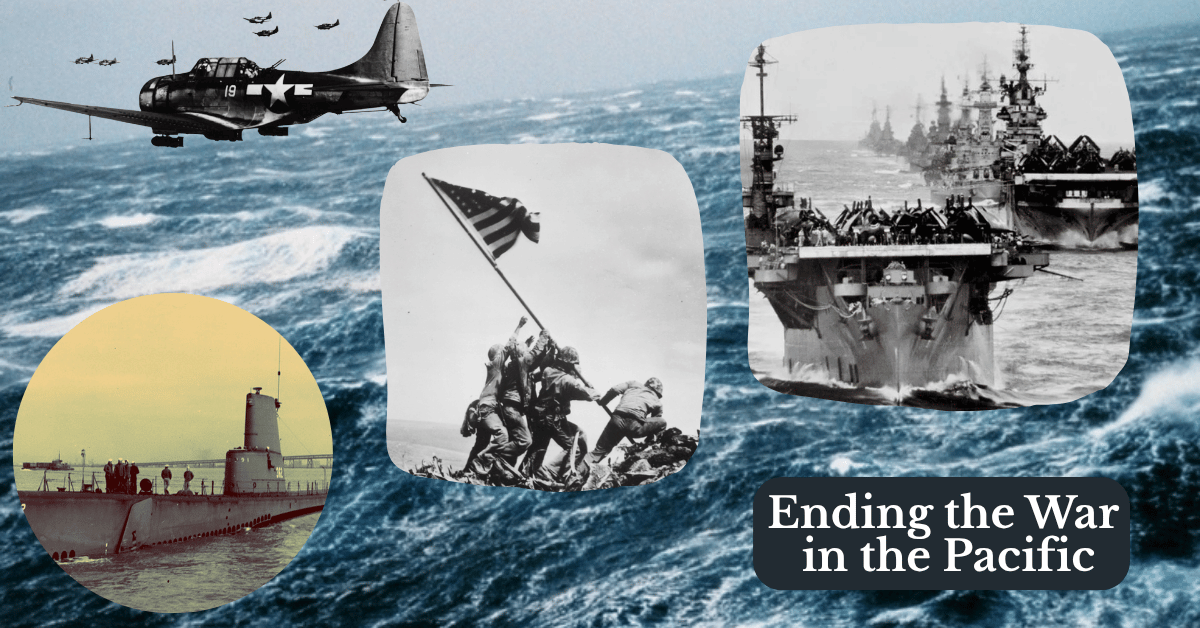
Image credit: various photographs from Naval Aviation Museum, National World War II Museum, and US Navy Archive | Source credit: Samuel Elliot Morse quote taken from Gordon Prange’s Pearl Harbor: The Verdict of History | Tohmatsu and Wilmott quote taken from A Gathering Darkness: The Coming of War to the Far East and the Pacific, 1921-1942 | Utley quote taken from Going to War with Japan 1937-1941 | Tojo quote taken from Nobutake Ike, ed. and trans., Japan’s Decision for War: Records of the 1941 Policy Conferences. |
The gospel reading for 5th Sunday in Lent is the account of the raising of Lazarus from the dead (John 11:1-45). In yesterday’s post we arrived in Bethany and considered Jesus’ dialogue with Martha, the sister of Lazarus. Today we listen in on the conversation between Jesus and Mary, the sister of Martha. Continue reading →
Today is the Solemnity of St. Joseph. Several years ago Pope Francis wrote the Apostolic Letter Patris Corde – With a Father’s Heart. It is a wonderful reflection of the attributes and characteristics of fatherhood – and also understands that St. Joseph serves as a model, not just for fathers, but for all who care for others. Click here to read the full text of Pope Francis’ Apostolic Letter.
The biblical record of St. Joseph is narrated by Matthew and Luke. Their accounts tell us very little, yet enough for us to appreciate what sort of father he was, and the mission entrusted to him by God’s providence. In so many of the scenes, Joseph is navigating his way through uncertainty, the unexpected, and events that seem to ask too much of him – and yet he is a just and righteous man seeking to do God’s will.
I think it notable that today’s celebration offers two gospel selections: (1) the account from Matthew wherein Joseph knows that Mary is already with child or (2) the child Jesus is lost in the Temple. In both accounts Joseph’s concern is for the other. In the first account, while he feels the need to end the betrothal to Mary he is concerned about Mary’s welfare, that she not be exposed to shame. In the second account, his is a natural concern for a missing child. I have often wondered what Joseph thought upon finding Jesus and the child says: “Why were you looking for me? Did you not know that I must be in my Father’s house?” The text tells us neither he or Mary understood. But I wonder if Jesus’ word cut Joseph “to the quick.” Did Joseph feel diminished or dismissed? Pope Francis comments on all this:
Often in life, things happen whose meaning we do not understand. Our first reaction is frequently one of disappointment and rebellion. Joseph set aside his own ideas in order to accept the course of events and, mysterious as they seemed, to embrace them, take responsibility for them and make them part of his own history. Unless we are reconciled with our own history, we will be unable to take a single step forward, for we will always remain hostage to our expectations and the disappointments that follow. The spiritual path that Joseph traces for us is not one that explains, but accepts. Only as a result of this acceptance, this reconciliation, can we begin to glimpse a broader history, a deeper meaning.”
In those moments in our life when disappointment arrives and we are asked to set aside our own ideas, with the help of St. Joseph, may we recognize the movement of the Spirit calling us into the mysterious unfolding of God’s plan.
Image credit: detail of St Joseph with the Infant Jesus | Guido Reni, 1620s | Hermitage Museum St Petersburg Russia | PD-US
In the previous posts we considered the strategic and tactical plans that began to take shape in 1940 into 1941 – the Imperial Japanese Navy (IJN) war planning and the Germany-first strategy by the United States. Underneath all that, both Japan and the United States approached the coming conflict with deeply rooted presumptions about culture, race, and military capability. These assumptions shaped strategy, diplomacy, and expectations about how the war would unfold. In many cases, they proved to be serious misjudgments on both sides.
Japanese leaders believed their society possessed a unique moral cohesion derived from loyalty to the emperor and a strong collective identity. The ethos of duty, sacrifice, and endurance often summarized in terms such as seishin (spiritual fighting spirit) was thought to provide a decisive advantage in war. This belief led many Japanese officers to assume that national willpower could compensate for material disadvantages. Military training emphasized discipline, courage, and willingness to die for the state, which were viewed as traits lacking in Western societies.
At the same time, Japanese observers also believed that American society was overly individualistic, comfort-oriented, and politically divided. Because Americans valued personal prosperity and safety, Japanese planners assumed the United States might lack the resolve to sustain a long and costly war far from home. These assumptions helped support the belief that a sudden shock, such as the attack on Pearl Harbor, might move the United States to negotiate rather than fight a prolonged war.
In Japan, modern nationalism incorporated ideas that the Japanese people were a uniquely pure and spiritually superior race. As Japan’s power expanded in Asia, this belief blended with the claim that Japan was the natural leader of the region. Many Japanese leaders saw Western colonial dominance in Asia as hypocritical and believed Japan had a mission to reshape the regional order.
American perceptions of Japan were shaped by a mixture of limited knowledge, racial stereotypes, and strategic complacency. Many Americans saw Japan as a small, resource-poor nation that could not match the industrial strength of the United States.
Culturally, Americans often viewed Japanese society as rigid, authoritarian, and overly obedient, assuming that soldiers trained in such a system would lack initiative or flexibility in combat. There was also a tendency to believe that Japan relied heavily on imitation of Western technology rather than genuine innovation. American planners expected Japanese forces to fight aggressively at the outset but believed that Japanese morale and capacity would eventually collapse under sustained pressure.
In the United States, racial attitudes toward Japan were shaped by decades of exclusion laws, immigration restrictions, and popular stereotypes. Japanese people were often portrayed as inscrutable, fanatical, or technologically inferior, while Western societies were assumed to possess inherent cultural and scientific advantages. These mutual racial assumptions deepened mistrust and contributed to a climate in which both sides underestimated the capabilities of the other.
While Japanese racism was evident in its views of their Asian neighbors, the United States, not without its own parochial and racial views of the Japanese, lacked understanding of Japan’s history and culture that was considered secondary to the assumption of a general superiority of peoples of European descent. Prior to December 1941, the assumed moral high ground was proven by the widespread accounts of Japanese atrocities in Nanking, Shanghai, and other events. Besides, according to some experts, the IJA had been bogged down in China for four years; the Soviets had made quick work of them at Nomonhan and the Japanese Navy had not been engaged in battle on the high seas since 1905. How accomplished could their military be? Even after the attack at Pearl Harbor, U.S. Secretary of War Stimson, asserted that Nazi Germany must have planned the attack, apparently thinking the blitzkrieg at Pearl Harbor was beyond Japan’s military planning capabilities. Stimson must have been unaware the “sneak attack” was actually a hallmark of the Japanese military as the Russians discovered in 1904. So embedded were such convictions, widespread within the Roosevelt administration, that key policymakers were blinded to the likely consequences of the decisions to impose what amounted to a complete trade embargo of Japan in the summer of 1941.
A Matter of Honor
By the beginning of 1941, Japan ruled over Korea and Manchuria, had conquered much of China north of the Great Wall and made inroads into central China, seized all of China’s major ports and islands in the South China Sea, and established a military presence in northern French Indochina. Japan was poised to invade resource-rich Southeast Asia, which Japanese propagandists had long and loudly proclaimed was rightfully within Japan’s sphere of influence, notwithstanding the fact that almost all of Southeast Asia lay under British, Dutch, French, and American colonial rule.
Japan had signed the Tripartite Act which the U.S. rightly understood as intended to deter the United States from going to war with Germany or Japan by raising the specter of a two-ocean war. Their signature transformed Japan from regional threat into a potential extension of Hitler’s agenda of aggression, especially with respect to the Soviet Union after the Nazi invasion of June 22, 1941. The hardliners in Washington DC correctly predicted that now Japan would turn towards Southeast Asia.
For the Japanese all things were a matter of honor and destiny. After the embargo it became a matter of necessity. Japan’s leaders were not certain that moving on Southeast Asia would cause a U.S. reaction but assumed that it would. The Roosevelt administration regarded a Japanese invasion of Southeast Asia, especially the oil-rich Dutch East Indies and tin and rubber-rich British Malaya, as strategically unacceptable. Control of Southeast Asia would weaken the British Empire and threaten India, Australia, and New Zealand allies in the war against Germany. Also, it would also afford Japan access to oil and other critical raw materials that would reduce its economic dependence on the United States, weakening the effect of other economic sanctions as controls on Japanese aggression.
While it might seem the U.S. reaction was simply an economic consideration. The more important consideration was keeping Britain in the war. It was a fundamental strategy of the United States and Britain that they could not afford to lose the raw material wealth and the sea lanes of Southeast Asia even if it meant war. Though the administration was never prepared to go to war over China, it regarded an extension of Japan’s empire into Southeast Asia as unacceptable. Thus Japan provoked a strong American response when Japanese forces occupied southern French Indochina in July 1941 as an obvious preliminary to further southward military moves. Operating out of southern French Indochina, the superior long-ranged Japanese naval bombers could provide air control of the seas around Singapore and support ground operations in Malay – both interim steps to the oil riches of Sumatra, Borneo and Java.
The United States was prepared to declare economic war on Japan as a means of deterring—or at least delaying—a Japanese advance into Southeast Asia, and that is exactly what the Roosevelt administration did in July 1941. The post The Financial Freeze details how those actions unfolded. In Going to War With Japan: 1937-1941, the author Jonathan Utley argues that the intent of the financial freeze was not to cut off all oil, but to ration it at a rate that let Japan know we control the spigot. Or as Roosevelt famously remarked it was to be like a noose around Japan’s neck which he would give it a jerk now and then to keep their attention. But by the end of August 1941, Roosevelt declined to reverse the decision. The reasons remain unclear. Perhaps he believed that a reversal would look like a retreat, or perhaps he had come to regard a Japanese advance into Southeast Asia as inevitable.
What was intended and what eventually happened is the nature of unintended consequences.
The consequence was that as a result of the de facto embargo and in conjunction with the seizure of Japanese assets by Great Britain and the Netherlands, there was a complete suspension of Japanese economic access to the United States and the destruction of between 50 and 75 percent of Japan’s foreign trade. No nation would meekly accept this situation – certainly the U.S. would not if such had been imposed on them. And neither did the Japanese.
Image credit: various photographs from Naval Aviation Museum, National World War II Museum, and US Navy Archive| Utley quote taken from Going to War with Japan 1937-1941
The gospel reading for 5th Sunday in Lent is the account of the raising of Lazarus from the dead (John 11:1-45). In yesterday’s post we considered the debate among Jesus and the disciples about returning to Galilee to attend to the illness of Lazarus. In today’s post we arrive in Bethany and Jesus’ dialogues with the sisters of Lazarus begin. Continue reading →
The connection between the first reading and the Gospel becomes much deeper when we notice how the Servant imagery in Isaiah quietly anticipates the way Jesus speaks about Himself in John’s Gospel. I think the two connections are especially striking. Isaiah 49 belongs to the Second Servant Song (Isaiah 49:1–13). In this passage God appoints His Servant to restore Israel and bring salvation to the nations. God says: “I will keep you and give you as a covenant to the people…to say to the prisoners: Come out! to those in darkness: Show yourselves!” This Servant is presented as the one through whom God’s saving work reaches the world. Now listen to the language Jesus uses in John 5: “Just as the Father raises the dead and gives life, so also the Son gives life to whom He wills… the dead will hear the voice of the Son of God, and those who hear will live.” I am struck by the parallels:
Isaiah 49 The Servant Who Restores Life
John 5 The Son Who Gives Life
God appoints a Servant to restore the people
The Father sends the Son
The Servant liberates prisoners
The Son calls the dead to life
The Servant brings people out of darkness
The Son’s voice awakens the spiritually dead
What Isaiah describes poetically as release from captivity, Jesus interprets at a deeper level as the gift of divine life. In other words, Jesus is presenting Himself as the fulfillment of the Servant’s mission.
When these connections are noticed, the readings create a unified message. Isaiah presents God’s promise that He has not forgotten His people and will send a Servant to restore them. John reveals the fulfillment that His Father is still at work and that the Son carries out that work by giving life and bringing judgment.
The tenderness of Isaiah—“Can a mother forget her child?”—finds its concrete expression in Christ’s mission. God does more than merely remember His people. He comes among us in the person of the Son to restore our life. What Isaiah promised in poetry, Jesus accomplishes in person.
Image credit: detail of Jesus Falls the Second Time by Giovanni Domenico Tiepolo, c. 1745-49 | Church of San Polo (Venice) | PD – Wikimedia Commons


 friarmusings