The Battle of Midway (June 4, 1942) was one of the key battles in World War II and in naval history. It marked the first major aircraft carrier v. aircraft carrier engagement in naval history and was the first defeat in the onslaught of what were otherwise victory after victory for the armed forces of the Empire of Japan.
On this day in history in 1867, Captain William Reynolds of the screw sloop Lackawanna raised the American flag over Brooks’ Islands (later renamed Midway Atoll). It was formally annexed on 28 December. by the United States as the Unincorporated Territory of Midway Island and was administered by the United States Navy.
There were attempts to settle the island but the first successful effort was by the Commercial Pacific Cable Company as part of the effort to lay a trans-Pacific telegraph cable. A small contingent of US Marines were stationed on the island. In 1935 Pan American Airlines operated out of the island as part of it trans-Pacific routes – and as a tourist destination.
Today is the Feast Day of St. Augustine of Hippo and perhaps it is good for a quick refresher of this person that so influenced Christianity. He was born in Thagaste, in Roman North Africa (present-day Algeria), growing up with his mother, Monica, was a devout Christian, while his father remained a pagan until late in life. His early life did not follow in his mother’s faith tradition, rather he pursued studies in rhetoric and philosophy, eventually teaching in Carthage, Rome, and Milan. His was the pursuit of truth which he sought in various philosophies and religious movements – none of which seemed to address his greater questions. In the interim, as was the tradition of the day, he was – shall we say – morally unsettled. Meanwhile his mother prayed for his conversion.
At the age of 31 he was moved by the preaching of St. Ambrose in Milan and by an experience of divine prompting while reading Scripture. It was in this period that he remarked: “Lord make me chaste, but not just yet” – a good indication of the on-going internal struggle. Soon enough Augustine was baptized and soon returned to North Africa founding a monastic community. He was later ordained a priest, becoming bishop of Hippo (North Africa) four years later, a position he held for 35 years.
Here are five pivotal moments in Augustine’s life and the impact of these moments that resonant even up to today:
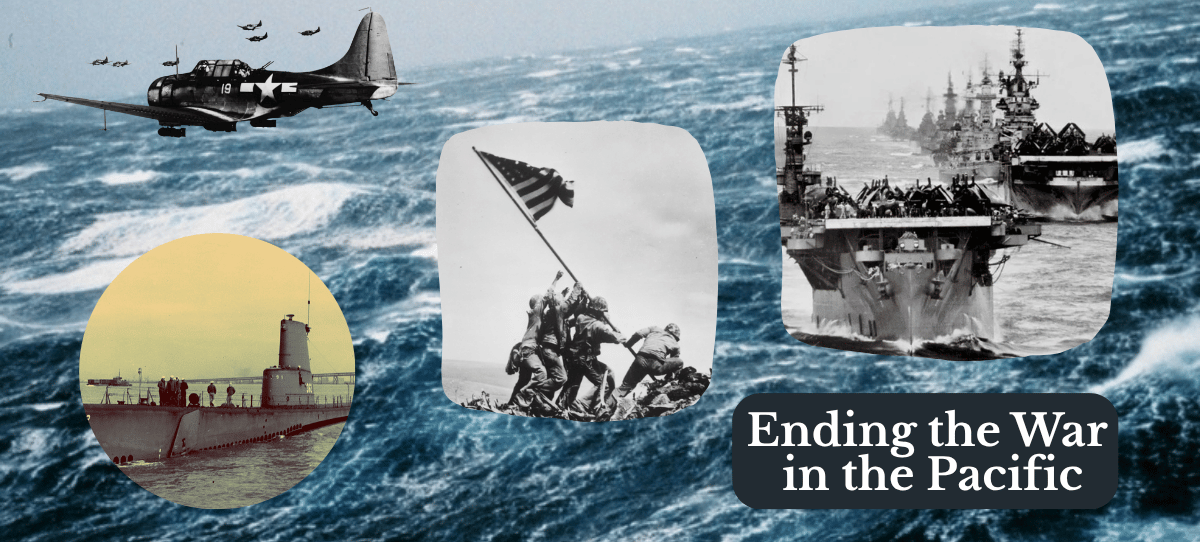
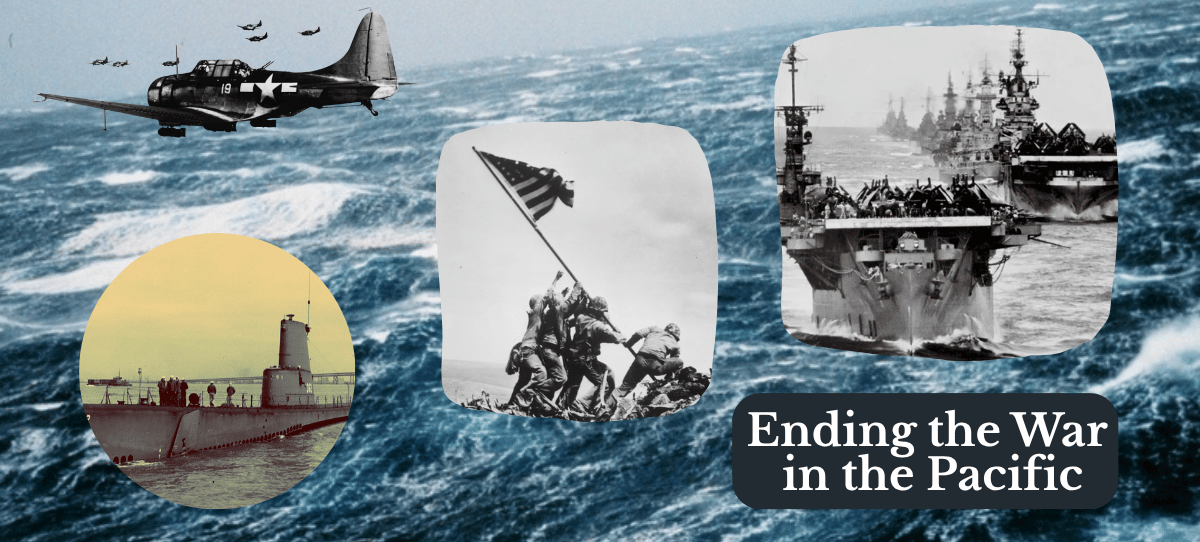
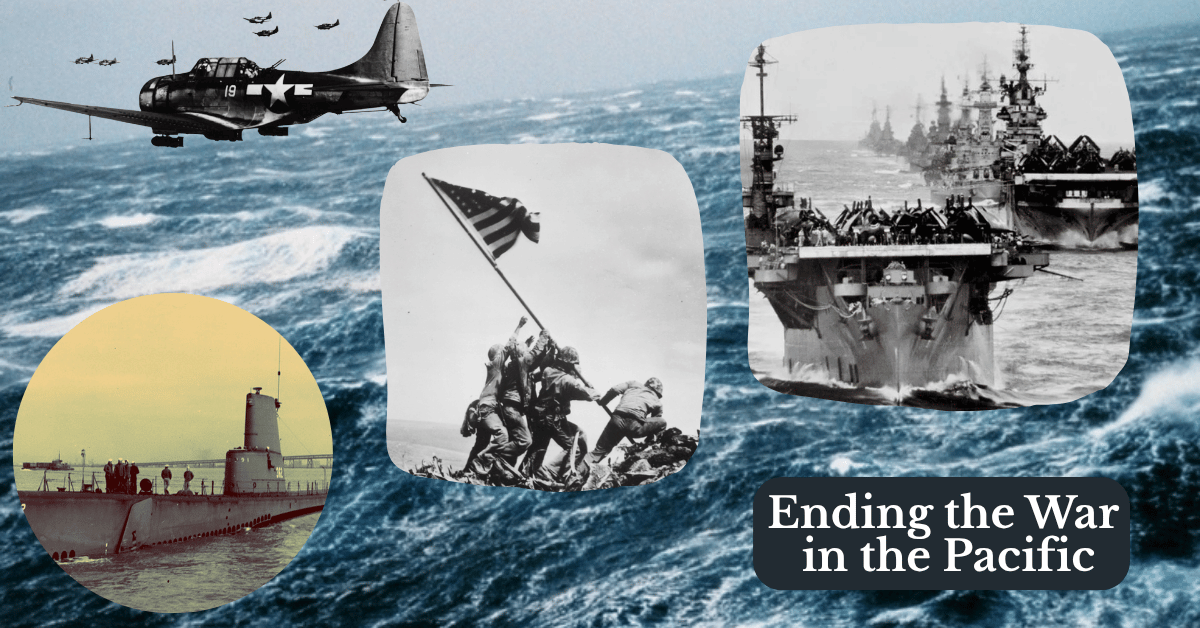
As the war in the Pacific moved into the summer of 1945 combatant casualties continued to mount as discussed in the previous post – so too did civilian deaths. On Saipan the Imperial Japanese Army (IJA) incorporated civilians into combat roles – it was the first but not the last time allied forces would encounter this blurring of military and civilian roles: Guam, Tinian, Iwo Jima, Okinawa and Manilla in the Philippines. By any measure, these were war crimes, but the effect was to implant in allied war planners the seeds of what they might expect if and when it came time to invade the main Japanese home islands of Kyushu and Honshu where the civilian populations were in the tens of millions
Historian Richard Frank (in Downfall: The End of the Imperial Japanese Empire) and John Dower (in War Without Mercy) detail this evolution. Both historians see evidence of a “total-war” mindset that developed as the war in the Pacific progressed when it was clear to Japanese military leadership that they were fighting a war of attrition. Twin allied advances in the Southwest and Central Pacific campaigns were inexorably driving towards the Japanese home islands leading into the brutal logic of late-war defense. By mid-1944, Japanese commanders had recognized that defeating U.S. forces in head-to-head combat was unrealistic. Their goal became to:
The gospel for the upcoming Sunday is taken from the Gospel of Luke describing an encounter with the Pharisees at a banquet. In a wedding banquet setting it was expected that power and prestige would be placed closest to the head of the table (see Note on 14:7 below). This was probably more formal than most meals, but the words apply to any banquet. Jesus points out the danger in pursuing seats of honor. He tells the story of a wedding where someone quickly grabs a high seat of honor. But then a person more distinguished walks in, and the host insists that the interloper vacate his position. At that point he may find all the other places occupied, so that the only course open to him is to take the lowest place, with all the shame and loss of face implied (cf. Prov. 25:7). So humiliated, the presumptuous one must head to the last seat. The description of the move down the social ladder is drawn out in Greek to underline the person’s shame (you begin with shame… to head for the last seat) It is as if every step hurts.
However, if one chooses the lowest place, the only way one can go is up. Rabbi Simeon b. Azzai is reported to have advised guests to take a place two or three seats lower than that to which they were entitled: ‘Better that people say to you “come up, come up,” and not say to you, “go down, go down”’ (Leviticus Rabbah I.5).
Kokutai is a uniquely Japanese concept often translated as ‘national polity’ or ‘national essence.’
It refers to the unique constitutional and spiritual essence of the Japanese nation and its people, centered historically on the Emperor as a symbol of continuity and unity. Kokutai is not just a political constitution but a broader idea of Japan’s national identity and political order. It embodies ideas about the Emperor’s divine descent (from Amaterasu, the sun goddess), Japan’s unique historical destiny, and the special relationship between the ruler and subjects.
In prewar and wartime Japan, Kokutai was used to legitimize the Emperor’s absolute sovereignty and Japan’s political system. It was often invoked to promote national unity, loyalty, and resistance to foreign political ideas like liberal democracy or socialism. Kokutai placed the Emperor at the center of sovereignty and moral authority. This made Kokutai both a political doctrine and a national ideology that justified Japan’s imperial system and mobilized the population.
The gospel for the upcoming Sunday is taken from the Gospel of Luke describing an encounter with the Pharisees at a banquet. In yesterday’s post we discussed “humility”. Today we consider “honor.” The meal setting is common in many of the gospels as a metaphor for the celebration of the Kingdom’s come. But it is also often a setting of controversy. Consider that 14:1-6 centered on the debate at table regarding the lawfulness of curing on the Sabbath – reminiscent of earlier discussions about appropriate behavior on the Sabbath (e.g., 6:2, 9; 13:14–16). When Jesus asks if it would be lawful to cure the man with dropsy, those at the table are silent. When Jesus next asks if their son or oxen fell into a cistern would they pull them out, again, they are silent. The easiest take on their reaction is that Jesus has them timid and stumped. But there was a long standing tradition for debate about the understanding of the Law. I would suggest that given Jesus’ challenging questions, one would need time to think about the reasoning – and in the face of such challenging wisdom, perhaps there is a struggle for the host to figure out exactly where this wandering preacher from Nazareth should be sitting.
That dynamic then opens the way for Jesus’ larger questions about honor at meals. Notice that vv.7-11, addressed to guests, is parallel to vv. 12-14, addressed to hosts, both showing a common pattern in which humility plays out.
In the previous post we reviewed the legacy of battle as 1944 came to a close and noted the lethal legacy of Japanese military choices and led to one loss after another. The once powerful Combined Fleet of the Imperial Navy was but a memory. They had once roamed the western Pacific at will; now they were limited to coastal water and home island ports. The Imperial Army fared no better losing garrison after garrison, sacrificing their most experienced battlefield leaders and soldiers to death. There was no surrender. Japan wanted a “decisive victory” conclusion to conflict. What they started was a war of attrition they had no hope of winning. All the while war draws closer to the home islands. At this point one has to ask about civil and military leadership at the start of 1945.
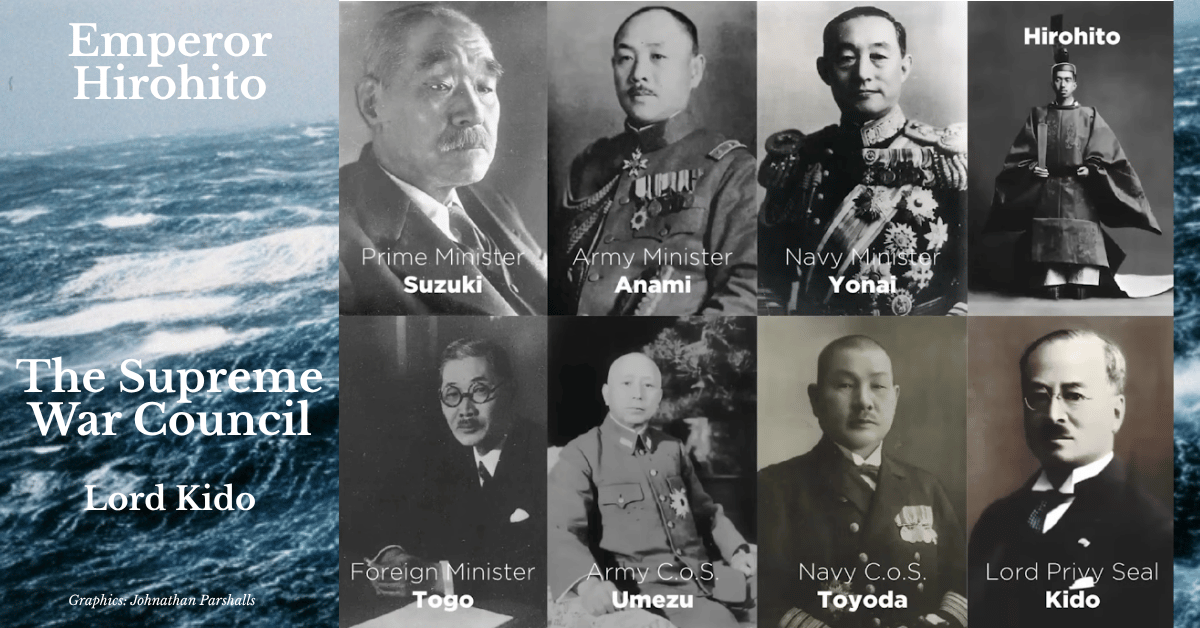
Here is an overview of leadership dynamics and structures in January 1945 (as it had been through out the war):
Real decision-making power rested with the military, particularly the Army, as it had since the 1930s
The civilian government had limited independence, often subordinate to military interests.
The Emperor held ultimate constitutional authority, but his actual role in daily governance and war policy remained ambiguous. Many war decisions were “approved” by his silence. That strikes us as strange, but that was the operative culture of governance.
The gospel for the upcoming Sunday is taken from the Gospel of Luke describing an encounter with the Pharisees at a banquet. A key theme from this text is “humility.” This word comes into our language from the Middle English, via Anglo-French, from Latin humilis low, humble, from “humus” the word for earth. Webster’s offers this as a definition
not proud or haughty: not arrogant or assertive
reflecting, expressing, or offered in a spirit of deference or submission
ranking low in a hierarchy or scale: insignificant, unpretentious –or : not costly or luxurious
Does this capture the biblical sense of “humility?” Humility comes from the Greek tapeinoō (make low, humble; EDNT 3:334). In its verbal and noun forms, the word occurs 18 times in the NT and describes appropriate human conduct before God. And yet the use of the word often has a passive aspect to it. For example, John the Baptist challenges his listeners to ready themselves for God’s salvation by preparing the way of the Lord and making his paths straight. The decisive feature, however, must be performed by God himself, for every valley will be filled (by him) and every mountain made low (by him), i.e., leveled. The salvific action begins with God’s own actions. In this we are to humbly await actions from the Lord.
As noted in the previous post, “War in the Pacific to this Point”, the series has focused on the strategic plans and tactical experience that has shaped the war on land and sea, and in the air. 1944 ended with the Philippine island of Leyte under Allied control. An invasion of Luzon was next with the hope that Japan would declare Manila an “open city” as MacAruthur had done in 1942.
After Luzon, the “road to Tokyo” was clear: Iwo Jima, Okinawa, and then (most likely) the southern Japanese home island of Kyushu.
This is a good point in the series to look at Japan and consider its governance, national identity, and their plans to defend the home islands. From the Allied perspective it is clear that the Imperial Japanese Army has effective control of future war plans and actions, but as allied intelligence operations reveal (via diplomatic code MAGIC) there are some misgivings about the military dominated governance. What remains a point of uncertainty is the role of Emperor Hirohito.
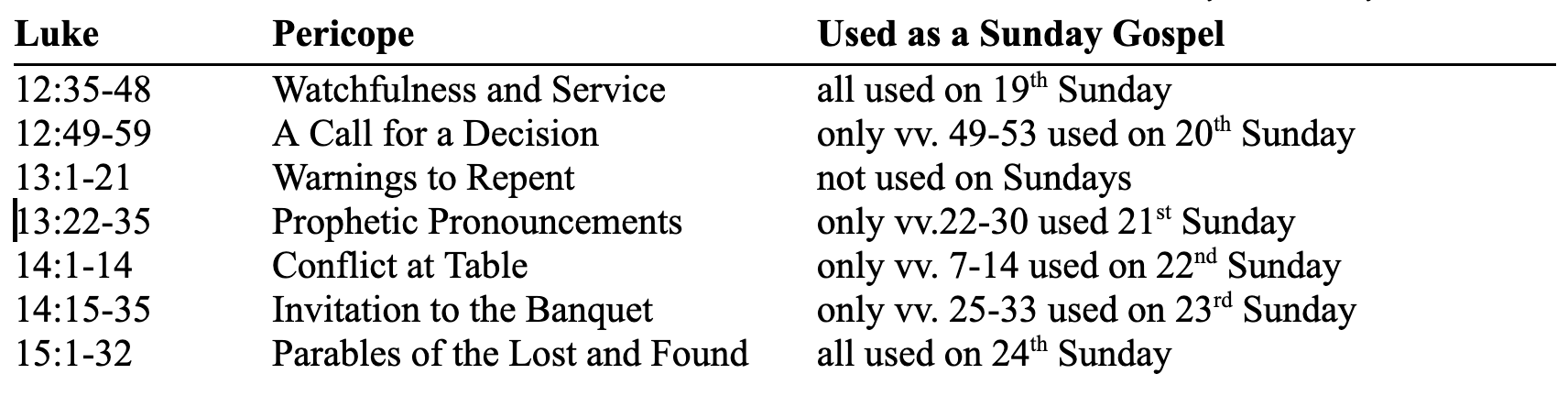
The gospel for the upcoming 22nd Sunday (Year C) is taken from the Gospel of Luke. On the journey to Jerusalem one of the principal themes has been that of discipleship. Much of Luke 12 attends to that theme especially in terms of preparedness and service. As Luke’s gospel narrative moves ahead, Jesus continues to teach about the nature of discipleship (see, judge, and act), the urgency of the decision to become a faithful and prudent disciple, and that our decisions and actions have consequences in terms of the kingdom of heaven. To that end, here is the recent progression of Sunday gospels. You’ll notice there are gaps and skips.
Among the portions missing from the Sunday gospels are
Jesus’ call to read the signs of the times as well as one reads the weather in order that one may judge rightly (12:54-59)
The parable of the fig tree that is permitted to remain in the vineyard for another season even though it has not yet produced fruit (13:1-9)
A healing of a woman, afflicted for 18 years, who was healed on the Sabbath that Jesus might again teach the meaning of the kingdom of God (13:10-17)
The parable of the mustard seed (13:18-21)
The lament of Jerusalem’s unfaithfulness (13:31-35)
A healing on the Sabbath at table (14:2-6)
The parable of the great feast (14:15-24)
The cost of discipleship and the necessity of preparations (14:25-35)
Some of the verses missing from Sunday gospels are well covered in the gospels of daily Mass, but there are some great images (reading the signs of time, the fig tree, and others) that would be great to have for Sunday homilies.
That being said, one does well to remember and understand that these verses come after Jesus exhortation to strive to enter that place where are gathered “Abraham, Isaac, and Jacob and all the prophets in the kingdom of God” (13:28) (from last Sunday’s gospel) and before the parable of the great feast (14:15-24) which speaks to the OT image of the kingdom of God as likened to a great banquet. The placement points out that the attitudes of discipleship in this life are reflected in the banquet of the kingdom of God.
This week’s gospel is at table. As Johnson [Luke, 223] notes: “If Jesus eats a meal with a Pharisee on the Sabbath, there surely will be conflict! During the meal Jesus addresses a fundamental attitude that is a constituent portion of discipleship: humility. This is not a new topic addressed to his disciples. Consider Luke 9:
46 An argument arose among the disciples about which of them was the greatest. 47 Jesus realized the intention of their hearts and took a child and placed it by his side 48 and said to them, “Whoever receives this child in my name receives me, and whoever receives me receives the one who sent me. For the one who is least among all of you is the one who is the greatest.”
Image credit: Jesus at Supper | Caravaggio (1606) | National Gallery London | PD-US



 friarmusings