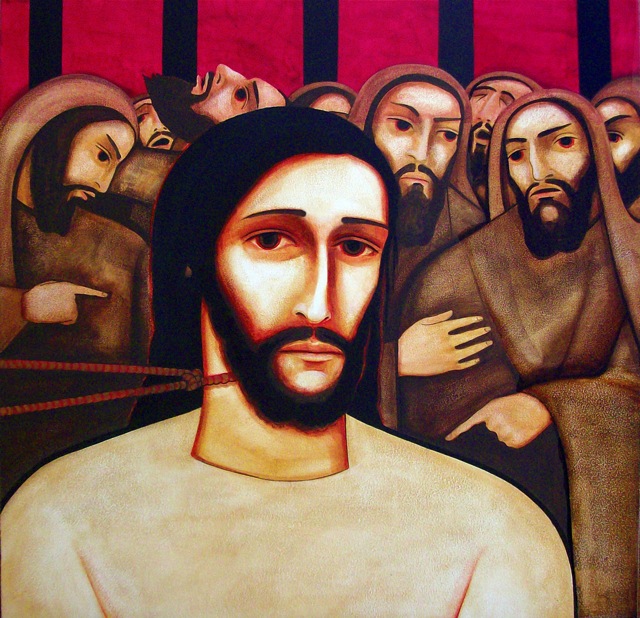
 Good Friday has passed and now it is morning on the second day. And we wait, even as we are busy about things. This morning last vestiges of the sparseness of Lent and Good Friday will give way to the many hands readying our church for the Light of Christ to enter the main doors. And yet we wait. The Elect and Candidates of RCIA, along with their sponsors are waiting. They too wait. All filled with Hope.
“The Spirit itself bears witness with our spirit that we are children of God, and if children, then heirs, heirs of God and joint heirs with Christ, if only we suffer with him so that we may also be glorified with him. I consider that the sufferings of this present time are as nothing compared with the glory to be revealed for us. For creation awaits with eager expectation the revelation of the children of God… For in hope we were saved. Now hope that sees for itself is not hope. For who hopes for what one sees? But if we hope for what we do not see, we wait with endurance.” (Romans 8:16-19, 24-25)
 We wait between the two earthquakes – the ones announcing the death of Jesus and his Resurrection
 We say that. We think that. About others and not often charitably. Even about ourselves as a reminder and call to be good. It is the mark of Christ that a person can live with the focus on others, making it all about them because the love of God compels us.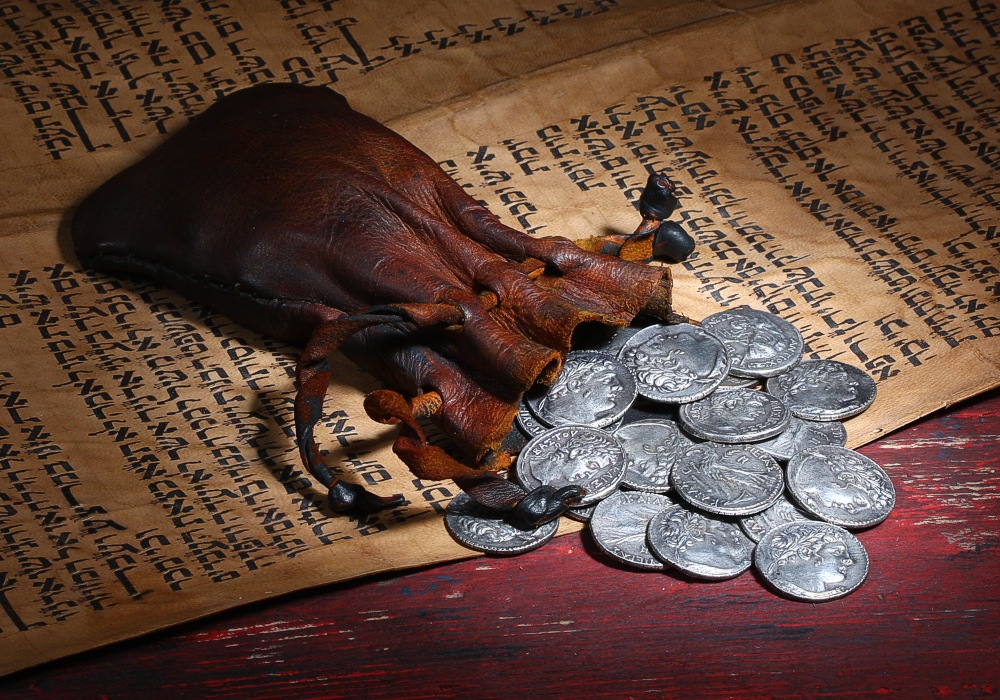
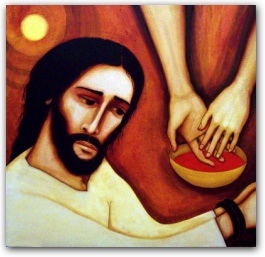
 1 Six days before Passover Jesus came to Bethany, where Lazarus was, whom Jesus had raised from the dead.2 They gave a dinner for him there, and Martha served, while Lazarus was one of those reclining at table with him. 3 Mary took a liter of costly perfumed oil made from genuine aromatic nard and anointed the feet of Jesus and dried them with her hair; the house was filled with the fragrance of the oil. 4 Then Judas the Iscariot, one (of) his disciples, and the one who would betray him, said, 5 “Why was this oil not sold for three hundred days’ wages and given to the poor?” 6 He said this not because he cared about the poor but because he was a thief and held the money bag and used to steal the contributions. 7 So Jesus said, “Leave her alone. Let her keep this for the day of my burial. 8 You always have the poor with you, but you do not always have me.” 9 (The) large crowd of the Jews found out that he was there and came, not only because of Jesus, but also to see Lazarus, whom he had raised from the dead. 10 And the chief priests plotted to kill Lazarus too, 11 because many of the Jews were turning away and believing in Jesus because of him.
  During the recent NCAA basketball tournament, it was interesting to see South Carolina makes its run all the way to the Final Four. The coach, Frank Martin, just seems to me to be a wonderful blend of “old school” and yet able to connect so closely with his players. I can only imagine what his halftime speeches were like. I also suspect they were straight forward – “you’re ready,” “you know what it yours to do.” I am sure there were X’s and O’s, but at the heart of it all, he pointed to the road that brought them to this point in time, he reminded them what they had achieved, that they were prepared, and to now it was time to answer the call. “You are ready!”
 I have been a Catholic all my life, and yet somehow Holy Week was not part of the landscape of my Catholicism growing up. Years later as an adult I was living in Northern Virginia and worshipping at a church out in a rural town northwest of Washington D.C. The town was in the rolling hills of the Catoctin – the first ridge of the Blue Ridge Mountains.