This coming weekend is the 3rd Sunday of Lent. In the previous post we refreshed our understanding of the encounter between Nicodemus and Jesus as a prelude to the encounter with the Samaritan Women.
In John 4:4-42, Jesus’ ministry enters a new stage. He leaves the confines of traditional Judaism and turns to those whom his Jewish contemporaries reckoned as outsiders and enemies: the Samaritans. The breach between Jews and Samaritans can be traced to 10 of the 12 tribes of Israel withdrawing from the throne of David in Jerusalem upon the death of King Solomon. They formed a competing confederation building a new capital city and a new temple (Mt. Gerizim), claiming that this was the true place of worship of God. To the people of the south (Judah) they were traitors and heretics.
When the Assyrian Empire conquered the north some 200 years after the division (721 BCE; see 2 Kings 17), there was likely little sympathy in the south. But it was 500 years later that the rivalry intensified when the armies of Judah marched north and destroyed the Temple at Gerizim. It did little but to deepen and inflame the divisions as witnessed in John 4:9: “For Jews use nothing in common with Samaritans.”
When Jesus meets the Samaritan woman at the well, he meets someone who stands in marked contrast to all that has come before in this gospel. When Jesus spoke with Nicodemus (3:1-21), he spoke with a named male of the Jewish religious establishment, a “teacher of Israel.” When Jesus speaks to the Samaritan woman, he speaks with an unnamed female of an enemy people.
This long passage of the encounter at the well consists of two main blocks of conversation (vv.7-26, Jesus and the Samaritan woman, and vv.31-38, Jesus and his disciples) surrounded by their narrative frames. The structure of the text can be outlined as follows:
4:4-6 Introduction: Jesus’ arrival at the well 4:7-26 Conversation between Jesus and the Samaritan woman 4:27-30 Transition: Arrival of the disciples and departure of the woman 4:31-38 Conversation between Jesus and his disciples 4:39-42 Conclusion: Jesus and the Samaritan townspeople
Christ and the Woman of Samaria | Pierre Mignard, 1681 | The North Carolina Museum of Art, Raleigh | PD
This coming weekend is the 3rd Sunday of Lent in lectionary cycle A. The gospel account is that of the Samaritan Woman at the well (John 4:4-52). It is a long passage and on several days there are two posts. In addition the Tuesday and Wednesday posts are fairly lengthy because St. John has just packed so much into the telling of the encounter. Today’s post is going to provide some context. I’d suggest that while the story stands on its own, it is best read with an eye toward the story that precedes it: Jesus’ encounter with Nicodemus. It then stands as bookends framing the whole of Jesus’ ministry even as it is positioned at the beginning of the Johannine telling of the story of Jesus. So, before moving ahead let us review the encounter with Nicodemus so that we understand the deep contrasts between these two protagonists.
Nicodemus was a Pharisee (3:1) and a “teacher of Israel” (3:10) a moniker from which we can infer a number of things: he was Jew by birth, married, and the head of rabbinic school. He was not “the man on the street.” He was someone who was particularly familiar with Scripture and the traditions of Judaism. While within the official ranks of Judaism there was likely already great concern about Jesus because of the incident of the cleansing of the Temple (John 2). Was he another would-be-claimant to the title Messiah whose campaign would only bring the harsh response of the Romans? One suspects their judgment was negative, but it seems Nicodemus was curious – but cautious, and so he approaches Jesus under the cover of darkness (3:2). In John’s gospel, a weak, wavering or incomplete faith emerges from the night or darkness. Nicodemus has been attracted by Jesus’ signs, an attraction not to be despised, yet he remains at a distance from true faith.
A dialogue ensues, animated by ambiguity and the potential for misunderstanding; a particular feature of Johannine stories. Jesus tells Nicodemus: ““Amen, amen, I say to you, no one can see the kingdom of God without being born ańothen.” (3:3). I deliberately left the Greek ańothen in place because the word has dual meanings: “again/anew” or “from above.” In American Christianity which so often opts for “from above,” they lose the nuance of the exchange and the inherent choice being offered to Nicodemus.
The expression “born again” has a context and meaning in Judaism of Nicodemus’ day. One is born again when one converts to Judaism, comes of age, is married, crowned a king, ordained a rabbi or becomes the head of a rabbinic school. Nicodemus has done all these things (that pertain to him) and hence the question: “How can a person once grown old be born again?” There is no achievement or milestone left for him and hence the follow-on: “Surely he cannot reenter his mother’s womb and be born again, can he?” (3:4). Nicodemus apparently does not consider that he is being offered the choice to be born from above. He cannot understand who it is before him and what he offers: two choices, earthly (again) or heavenly (from above), Nicodemus seems to only understand the earthly choice; he does not understand that “without being born of water and Spirit” he will not have eternal life in the kingdom. Nicodemus is being asked to let go of all he knows/believes to be true in order to be “reborn” but from above.
The expression “born again” is a slogan, a rallying cry, and a test – “Have you been born again.” It is a short-hand to reduce the contemporary Christian experience to a sound bite. While the phrase has its merits, it is also taken out of the context of a much more nuanced dialogue. It flattens the word ańothen to only be connected to an individual’s private moment of conversion. As Gail O’Day notes, it privileges anthropology over Christology. It is the mistake that Nicodemus makes in not grasping the decisive Christological meaning of ańothen – the source of the change: the cross. And in doing so lose the emphasis of the newness of life possible for which there are no precedents. To approach the text of the Nicodemus story already assured that one knows the meaning/translation, is to repeat the experience of Nicodemus.
To approach the text of the Samaritan women already assured that one knows the meaning is to miss an encounter with Jesus that leads her to the newness of life. But then she is a Samaritan. She is a woman. What could she possibly understand that would elude Nicodemus, the teacher of Israel? The answer lies in the telling of the story.
Christ and the Woman of Samaria | Pierre Mignard, 1681 | The North Carolina Museum of Art, Raleigh | PD
This is intentionally a post for a Saturday morning. It is longer than average and traces the “history” of how historians have treated the year 1941 as regards U.S.-Japanese relationships. As with most things, even when historians can agree on the events and sequence of events, the role of historian is more than a news reporter. A historian’s role is to research, analyze, interpret, and write about the past. They gather and critically evaluate primary sources (letters, records, artifacts, photos) and secondary sources (other historians’ work). They then determine the authenticity, significance, and context of historical information to form a coherent understanding of events. The historian then constructs and writes detailed accounts, reports, articles, and books that tell the story of the past. In essence, historians are detectives of time, piecing together human history to make sense of the what, when, where of things in order to understand the “why.”
When considering a single event in history, such as the oil embargo, one quickly discovers it is not a single event. The event has people who are animating history with choices and decisions. The event has precursor events (which might need their own “histories”). The event is part of a chain of larger events, later events, and a complex web of factors large and small. All of this leads to different “schools of thought” among historians.
In the case of the 1941 oil embargo by the United States against Japan, there are the following schools of thought – interpretive camps, if you will:
The Original Camp,
The Provocateur Camp,
The Coercion and Constraint Camp
The Turning Point Camp
The Contemporary Camp
These names are my own and (hopefully) offer a reasonably accurate 30,000 ft view of the positions. Over simplification and errors are mine, and so apologies in advance to the historians referenced if I have misunderstood or misinterpreted their work.
The Original Camp were the first wave of historians such as Herbert Feis and Samuel Eliot Morison who wrote in the later 1940s and early 1950s. As they were first to publish their work formed an initial orthodoxy regarding the oil embargo. Their conclusions were that Japan was solely responsible for the U.S. entry into the war. They judged U.S. policy to be defensive and reactive to Japan’s provocation with the ultimate treachery being the surprise attack on Pearl Harbor and the island of Oahu, Hawaii.
The work did not address prior U.S. economic sanctions and actions, internal policy debates within the U.S. State department and regulatory agencies, external policy debates with Britain over support and prosecution of the already on-going war in Europe, North Africa, and in the steppes of Russia.
The work did not have the available resources, and as such insufficient attention was paid to the internal dynamics of Japanese governance which was divided among the militarism and the moderates – with Emperor Hirohito seemingly passively on the sidelines. The treatment of the internal Japanese governance is as though it were monolithic when it was anything but. As a result there was limited consideration of internal Japanese deliberations which caused Japanese diplomatic responses and actions to appear opaque, intentionally vague, and even deceptive. In parallel, these authors were not insightful or critical of U.S. diplomacy which seemed blunt and imperious to the Japanese. There is very little recognition of U.S. errors in policy or decisions.
Lastly, given the period in which they worked, they relied almost entirely on U.S. sources.
The Provocateur Camp argues that U.S. policy made war so likely as to make war unavoidable regardless of who fired the first shot. In historiography circles, they are known as the “Revisionists.” I am not a fan of that title in this particular case as “revisionists” often just refers to the next generation with access to additional source materials. In this case, “Provocateur” seems the better moniker. Historians that I would place in the category include Charles Beard and Charles Tansill who published in the period 1950-1956. While they had some new materials, like all historians of their age they lacked access to all the classified war information that was only made available to researchers in 1995. While different in content, these writers contend that President Roosevelt deliberately maneuvered Japan to the brink of war knowing sanctions and embargoes were provocative.
While neither entertain the “Roosevelt knew Pearl Harbor would be attacked and did nothing” theory. They both hold Roosevelt and his cabinet as the provocateurs of the war. They conclude that Roosevelt knew the U.S. entry into the war with Germany was inevitable, and so used Japan as the “back door” to enter into the global conflict. Roosevelt’s concern was fascism’s (Germany. Italy, and Japan) deconstruction of liberal governmental and economic policies resulting in a new “dark ages” for the world order. The oil embargo was a virtual declaration of war as U.S. leadership understood Japan could not accept the embargo without collapsing as a power in the Asia-Pacific region where the U.S. had traditional trade and business interests. The weakness of this historical view is that it glosses over Japan’s “power” and, in effect, downplays the raw military aggression Japan had waged throughout the 1930s into the 1940s.
The Coercion and Constraint Camp are less conspiratorial but argue that U.S. actions left Japan with no acceptable alternatives. Writers such as William Williams and Gabriel Kolko might be considered part of this school of thought, writing in the period 1959-1968 – again researching in an age before the declassification of WW II records. A later work by Sidney Pash (2014) revisits some of the same archival information, but unlike Williams (an economic determinist), Pash emphasizes more traditional diplomatic concepts such as the balance of power and containment.
The principle argument is that the U.S. spoke of an open door policy of trade and commerce in the Asia Pacific region, but the real goal was a type of benign imperialism under the guise of open markets and free trade. It is argued that the U.S. insistence of principles such as respect for national boundaries, respecting the sovereignty of other nations, not interfering in other nations internal politics, and openness to trade and commerce failed to acknowledge the Japanese strategic realities of a lack of natural resources, burgeoning population, and a view of themselves as the rightful leader of the Asia-Pacific region.
In general this camp does not excuse Japanese aggression, but sees the U.S. as implementing systematic coercion and constraints to control events in the region. One view is that the U.S. did not realize the effects of systematic coercion and constraints they were attempting to put into play – nor the Japanese reactions to them. Unlike the “Provacteur Camp” there is no conspiracy to start conflict. It is more of a clumsiness and bias in operating the available levers of power. But like their historiographical elders, they too gloss over the manner in which Japan projected power, paying little attention to the rise of militarism and nationalism that were the drivers behind their naked invasion of other countries, and just seem to ignore that no Asia-Pacific nation wanted their leadership. Some work focuses only on diplomatic encounters of the moment while paying scant attention to other internal elements. A good example is the treatment of the 1922 Washington Conferences and naval limitation treaty. The conclusion reached is that the U.S. and Britain (two-ocean navies) were trying to control Japan’s shipbuilding projects (one-ocean navy) without ever mentioning that other than the military, the rest of Japan’s governance welcomed the limitation because they wanted to avoid an arms race they couldn’t afford while in the midst of their own financial crises.
The Turning Point Camp largely wrote in the late 1980s. Some consider this as an extension of the Revisionists Camp. Writers include Jonathan Utley, Waldo Heinrichs, and Akira Iriye. These historians focus on July-August 1941 as the turning point of the pre-Pearl Harbor period after which war between Japan and the United States was a given. Their focus is largely upon diplomacy and the currents of power/views within Washington DC and Tokyo. This group of writers had the advantage of access to non-military documents, war time diaries, translated Japanese documents, memoirs of key actors, and correspondence in the arena of governance and diplomacy. These were resources not available to previous historians.
A compilation of the central tenet of this camp might be captured in the problem of disinstantiated communication. In other words, “that’s not what I meant!” vs. “but that’s what I understood.” This was fueled by preconceptions, misconceptions, and presumptions of “national character.” And in some cases, the barrier of language and cultural norms. As a result, the actions and understandings were miscalculations rather than conspiracy. The “Hull Note” in late November 1941 is an example of such. Although it should be noted that Kido Butai, the Japanese fleet that attacked Peart Harbor, had already set sail, battle plans in hand, and under strict radio silence.
While acknowledging these shared problems, this camp finds fault with U.S. policymakers who:
underestimated Japanese willingness to fight,
overestimated the impact of embargoes and trade sanction on Japanese military and economic collapse
insisted on principles Japan could not accept without abandoning its empire, making war likely,
Did not realize that there was a “manifest destiny” operative in the politicized Shinto myth of the “eight corners of the world”
did not recognize that their (U.S.) actions were escalatory in effect,
were unwilling to compromise, and
assumed Japan would eventually back down.
Instead, the Japanese attacked Pearl Harbor and across the Southwest Asia region as a response to constraints applied by the U.S. These historians acknowledge that Japanese military aggression in the region over the decade was a war already begun. Their view is that the U.S. did not force Japan to attack Pearl Harbor, but it pursued policies attempting to control Japanese aggression that increased the probability that the U.S. would be drawn into armed conflict with Japan.
The Contemporary Camp is the current era of historians (e.g., Sadao Asada, Richard Frank) share a view with the “Original Camp” that holds Japan fully and wholly culpable for the Asia-Pacific War, but also recognize elements and nuance of the “Turning Point Camp.” What is different is the trove of new materials that have been made available, especially Japanese language sources, diaries, letters, previously unknown documents. They are more attentive to the chaotic rise and fall of Japanese cabinets, the veto power of the military, the popular support for the Japanese military, and the increasing alignment with fascist ambitions in the region.
These later historians are much more balanced in understanding the role of Nazi Germany in Roosevelt’s thinking. FDR understood that the U.S. was in no way prepared to enter war with Germany (which was the priority) much less war with Germany and Japan. What industrial capacity was available was geared to keep Britain “in the fight” as well as the Soviet Union (which Germany attacked in later June 1941).
While recognizing the impact of the “oil embargo”, these historians are more likely to call the timing of and the attack on Pearl Harbor the turning point in the broader was for these reasons:
On December 5tn, the Soviets began a massive counter-attack on German forces at Moscow and attacks across a broad front in other regions. The strength and impact of this would not be known to Hitler for several weeks.
Japan “declared war” on by the attack on Pearl Harbor on December 7, 1941
Germany formally declared war on the United States on December 11 in accord with the Tripartite Pact
By Dec 16th, Hitler was aware of the seriousness of the Soviet’s advances.
If Pearl Harbor had been planned for January 1942, realizing the problems on the German eastern front, would Germany have declared war on the United States? An interesting counter-factural, but the point is the broader view held by these historians.
Image credit: various photographs from Naval Aviation Museum, National World War II Museum, and US Navy Archives.
Annemarie Reiner (of Adelaide, Australia) posted this reflection on the Transfiguration on her blog “Who Do You Say That I Am.” It is a very nice reflection to consider in this Lenten Season.
When we look at our Gospel today we can understand why daily reflection is so important. These three disciples (and the rest of them) didn’t get who Jesus was until well after his death. They didn’t understand what had happened at the transfiguration. They didn’t understand what was happening as they witnessed Jesus’ life. They didn’t understand what was happening at the crucifixion. But they kept pondering their experiences over and over – if they didn’t we simply wouldn’t have the New Testament.
So what do we learn from this?
Every human life is filled with experiences from when we get up until we go to sleep and even in our sleep we experience our dreams. What do we do with these experiences?
Mostly we ignore them and then we forget them. Even the profound moments that come into our lives, we can shut the depth of their meaning out. We might have gone through a depression – do we take the time to ponder the meaning of this depression in my life or do I just think: thank God that is over and then fill our lives with all sorts of other distractions and then wonder why down the track I fall into another bout of depression?
I might have experienced walking with a loved one who has been sick and has died. Do I sit back and reflect upon the experience or is it too difficult to re enter this painful period, so we try and shut it out hoping it will go away.
I might have experienced a deep hurt. Do I ponder the experience considering my own reactions and responses to the hurt or do I totally throw blame on those who hurt me without any self reflection? So I become the victim in life and I go from one lot of blaming to the next without any examination of my own heart.
I might have deeply hurt someone myself. Do I take the time reflect upon my behaviour (even if it is down the track from the experience) so as to be confronted with what I have done. Or do I just keep running away from this self disclosure because it s too painful?
There are numerous life experiences that we all have. Many of these experiences are profoundly mysterious. Sadly many of them become buried and we lose the richness these experiences can offer us. Not only this but we now have multi million dollar industries offering all sorts of therapies etc to help people cope with the results of their non reflective lives.
Someone once said that a non reflective life is a life not worth living. It might be more accurate to say that a non reflective life is a life not lived – it is life rejected.
Jesus invites each of us to this holy mountain today. It might be shrouded in mystery – we may not have much of an idea who Jesus is yet – we may be confused by the experiences of life and feel lost – but Jesus says to us today to come with him. To trust him. To have faith in him. To keep thinking about our experiences but to do this with Jesus at our sides.
When we have the courage to come to the mountain with Jesus then we too may see something beyond our imagining. When we truly see Jesus transfigured (see Jesus as he truly is) then the life that Jesus offers us will begin.
A large part of the problem is that we really don’t see who Jesus is. Jesus can become our own creation – a feel safe, feel good guy that we call upon when it suits us, and we try and mould Jesus to be what we want him to be. If we truly believed in Jesus we too would not know what to say, we would be frightened, but we would hear God saying to us: Listen to him. And even in all our blindness and ignorance all we would truly want would be to Listen to Jesus – we would hunger for Jesus – not the Jesus of our own making, but the Jesus who stands before us as mystery. Can we accept such a mystery?
We, the Body of Christ must also be transformed just as Jesus was transformed – but this cannot happen until we come to this mountain in all humility. Then the horrors our world is currently experiencing may begin to fade and the light will truly shine in the darkness.
In the coming week let us pray for the desire and will to come to the mountain that Jesus invites us too so that we may encounter the true mystery before us and then ponder for a lifetime its meaning for ourselves and the whole of creation.
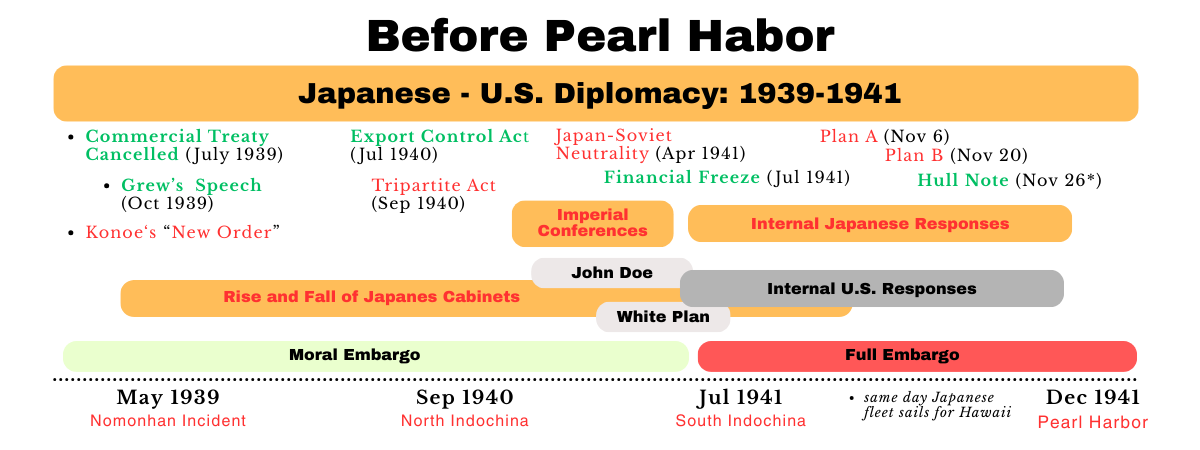
The previous post ended by comparing the current and flows of the events of 1941 as an “external and internal dynamics [that make] the path to diplomatic resolution akin to walking a moonless night in the wilderness with but only a lighted candle to show the way. There is light but its glow only reveals so much of the dark night. And as we will see in the next post, there are lots of things that “go bump in the night.” In the final months before Pearl Harbor we find one of those “bumps.”
In 1941 U.S.–Japanese diplomacy operated on two parallel planes. One was the formal, authorized negotiation between Japan’s Foreign Ministry and the U.S. State Department. The other was a private, unauthorized, and deeply fragile backchannel, involving two Maryknoll priests who sought out of moral urgency, without any official mandate, to open a path toward dialogue and de-escalation. The existence of this unofficial channel illuminates not only the desperation of late 1941, but also the fragmentation of authority, trust, and purpose within both governments. Examining the ebb and flow of this effort alongside the official negotiations reveals how diplomacy failed not for lack of contact, but because no shared political or moral common ground would be found. It either simply did not exist or was completely obfuscated by the many voices and channels working at cross purposes.
One way to describe the official diplomatic track is a system of increasing formalism and decreasing flexibility and imagination. By early 1941, official U.S.–Japanese diplomacy was already strained by mutual suspicion. Negotiations between Ambassador Kichisaburō Nomura (Ambassador to the U.S. and an acquaintance of President Roosevelt) and Secretary of State Cordell Hull were formal, cautious, and increasingly rigid. Nomura was not a diplomat; he was a retired admiral who had served as naval attache in Washington when Roosevelt was Assistant Secretary of the Navy in the 1920s. Hull was a career diplomat and a graduate of Yale and Havard Law who was connected in U.S. and international circles. While Japanese ambassadors came and went, Hull remained and consistently insisted on a principles-based approach—non-aggression, respect for sovereignty, and equality of trade—while Japanese negotiators often changed, were given differing instructions but often sought pragmatic accommodations that would preserve their position in China and Southeast Asia while asking immediate actions from the U.S. with delayed or vague actions on their part. Nomura arrives in Washington at the start of 1941 with no instructions at all.
As Japan moved into southern French Indochina in July 1941, the atmosphere hardened decisively. The U.S. freezing of Japanese assets and effective oil embargo transformed negotiations into a race against time, particularly for Tokyo. Within the U.S. government, confidence grew that Japan was negotiating in bad faith, using diplomacy to buy time for military preparations. Within Japan, civilian leaders feared economic collapse, while the military saw compromise as tantamount to surrender. This context is essential. By autumn 1941, official diplomacy would become procedural rather than exploratory. Notes were exchanged, positions clarified but over time imagination, trust, and risk-taking disappeared.
Maryknoll and John Doe
Against this bleak backdrop, two Maryknoll priests, Bishop James Walsh and Father James Drought became involved in a private initiative to foster dialogue. Maryknoll, as an American Catholic missionary order with deep experience in East Asia, occupied a unique moral and cultural position. Its members were neither diplomats nor intelligence officers, yet they were trusted by some Japanese interlocutors and respected within certain American circles, especially Irish Catholic Americans. The priests’ motivation was fundamentally pastoral and moral. They had already seen the devastation of combat in the Sino-Japanese war since 1937 in terms of 7 million Chinese deaths, devastation of major cities, and millions of millions of Chinese as refugees within their own country. They feared an expansion of the war if the U.S. were drawn into the war. They believed they could still find accommodation. Their effort was unauthorized, informal, and explicitly separate from official diplomatic channels, yet it unfolded in parallel with them, sometimes intersecting with individuals close to power.
As the Maryknoll effort developed in mid-winter and into the summer of 1941, it drew in a widening circle of intermediaries: Japanese civilians and former diplomats sympathetic to peace, American Catholic figures and lay intermediaries, and individuals connected indirectly to political leaders, including those who later were aware of Konoe’s last attempts to avoid war. All of these people shared a belief, already fading within governments, that personal trust and moral appeal might succeed where formal diplomacy had failed.
The Maryknoll contingent first proposed an outline of proposals to leaders in the Japanese government via Todao Ikawa, a senior banker and financier, thought to have a friendship with Prime Minister Konoe. In addition, the proposal was presented to Col. Hideo Iwakura, Chief of Military Affairs in the Ministry of the Army (War) said to be an important leader of the young officers and confidant of Army Minister Tojo. When the Maryknoll contingent left Japan in January 1941 they brought a concept of a Konoe-FDR summit, a clear message of Japan’s regional “Monroe Doctrine” aspirations, and a plan…that was not the same as they had presented in Japan (for reasons why, not clear).
Arriving in Washington DC, they bypassed the State Department and were able to secure a private meeting with FDR that lasted several hours. They assured the President that they had access to the moderates, the young conservative Army officers, and the Prime Minister. Soon after FDR pulled Ambassador Nomura into the conversation – but not Hull and the State Department.
Nomura found his naval attache, Capt. Yokoyoma, shared his perspective that a way to peace was necessary as Japan would ultimately lose in a war with the U.S. Nomura, Yokoyoma and two other staffers in the Washington DC embassy (unnamed and called “John Doe”) were then drawn into this parallel diplomacy effort.
The Maryknoll father’s Tokyo connections were in fact not that well connected, and did not represent either the moderates or the conservatives. But by March 1941, FDR had drawn Hull into the dialog. Long story short, in the end the stream of off-the-books diplomacy went nowhere. However it had three deleterious effects.
Nomura and Hull negotiated secretly. When the modified-Maryknoll proposal was presented to Tokyo and the Foreign Ministry, Nomura presented it as an American proposal without revealing the Maryknoll connection, sending inconsistent signals to Tokyo leading them to assume America’s resolve was weakening and that more concessions could be extracted.
In the end, Hull slowly morphed the draft to be the same as his four fundamental principles which asked for a permanent solution tied to concepts and lacking specificity. But it was understood that the U.S. wanted Japan to immediately withdraw from China – which was a not-starter for China.
It absorbed Secretary Hull’s time and energy from March to June when he realized this path was leading nowhere. In June he started an extended vacation and time away from Washington DC. Thus, he was not present in DC when Japan moved into Southern French Indochina (South Vietnam), the financial freeze was set, Dean Acheson slow-rolled the license approval in the FFCC, and the “oil embargo” began.
As we move into the summer of 1941 there are many dialogues and many distractions.
Image credit: various photographs from Naval Aviation Museum, National World War II Museum, and US Navy Archives. | Original timeline by G. Corrigan
Did you know that nearly one quarter of McDonald’s Filet-of-Fish sandwich sales take place during Lent, when many fast-food customers are abstaining from meat? “That’s exactly what the McDonald’s operator who first put the cheese-topped sandwich on his menu had in mind back in 1962. When Cincinnati McDonald’s franchise owner Lou Groen noticed that his heavily Catholic clientele was avoiding his restaurant on Fridays, he suggested to McDonald’s owner Ray Kroc that they add introduce a fish sandwich. That led to a wager between Groen and McDonald’s chief Ray Kroc, who had his own meatless idea. “He called his sandwich the Hula Burger,” Groen said. “It was a cold bun and a slice of pineapple and that was it. Ray said to me, ‘Well, Lou, I’m going to put your fish sandwich on (a menu) for a Friday. But I’m going to put my special sandwich on, too. Whichever sells the most, that’s the one we’ll go with.’ Friday came and the word came out. I won hands down. I sold 350 fish sandwiches that day. Ray never did tell me how his sandwich did.”
The Filet-of-Fish won, the rest is history, Groen’s restaurant thrived, and since then, the sandwich has been McDonald’s fixture, all year long.
This coming Sunday is the 2nd Sunday in Lent. In yesterday’s post we considered Peter’s response of offering to make three tents – one for Jesus as well as Moses and Elijah. Today, we listen to Jesus’ instructions to the disciples as well as his probing for their understanding of what they have just seen:“As they were coming down from the mountain, Jesus charged them, “Do not tell the vision to anyone until the Son of Man has been raised from the dead.” Then the disciples asked him, “Why do the scribes say that Elijah must come first?”
The disciples have just experienced the Transfiguration and heard Jesus’ prediction of his death and Resurrection – and then the disciples ask about Elijah. It may well seem an awkward shift in a conversation, but v.10 is not merely responding to v.9, but looks back at all of 16:13-17:9, portraying the advent of Jesus as the eschatological event, as the Messiah/Son of God who fulfills his ministry as the rejected and dying Son of Man, who will be vindicated by God at the resurrection. The disciples, who know already of Jesus’ identification of John as Elijah (11:10, 14), voice the objection of the scribal opponents of Matthew’s church to the Christian claims: How can the Christ have come already, since the Scripture says that Elijah must come first (Mal 3:23-34)?
In short, Jesus’ response is that Elijah has already come in the person of John the Baptist (vv.12-13). What is sometimes confusing is “Elijah will indeed come and restore all things” (v.11) Hadn’t Elijah/John already come? Boring offers four suggestions (365):
The future tense simply reflects the quotation from Malachi,
The future tense may reflect the scribal expectations rather than Jesus’ own understanding,
While Elijah/John had come the restoration in its fullness is still a future event
More likely, the future restoration of all things has already begun in the advent of John the Baptist.
That Elijah had already come is an important declaration. The understanding that Elijah has not yet come will appear again in this gospel (16:14, 27:45). Elijah/John is paralleled to Jesus: he was sent from God, was opposed and killed by members of the kingdom of this world, was Messianic in that he was the forerunner of the Messiah. And as it was with John, so with Jesus – this generation failed to recognize him because they were persuaded by the kingdom of this world. Beginning with John/Elijah, the disciples are forming the new citizenry of the kingdom of God.
Between 1939 and 1941, President Franklin D. Roosevelt confronted a central strategic dilemma: how to oppose Nazi Germany and keep Britain in the war while U.S. public opinion overwhelmingly opposed entering another European conflict. Roosevelt’s response was a policy of incremental engagement on economic, military, and political level, all designed to shift the balance of power without formally declaring war. This strategy succeeded in sustaining Britain and positioning the United States as the decisive future belligerent in Europe, but it also produced ambiguity and mixed signals both within his own administration and abroad, particularly affecting Secretary of State Cordell Hull and Japanese perceptions of U.S. priorities.
The Core Concerns
Roosevelt’s overriding concern after 1939 was that a German-dominated Europe would fundamentally threaten long-term American security. He believed that Britain’s survival was essential to prevent Nazi hegemony over the Atlantic world for reasons of democracy and international trade as well. He was convinced that a German victory would eventually force the United States into a far more dangerous war under worse conditions or would leave the U.S. isolated with fascist nations on the other side of two oceans.
Importantly, the U.S. needed time to build industrial and military capacity both of which were the nation’s most valuable strategic asset. In 1936 the Washington Naval Treaty, which had sharply limited the future growth of the U.S. Navy in the name of arms control, expired. Roosevelt let it lapse. He then ordered the Navy to launch its first major shipbuilding program in more than twelve years (one of the ships to come. In 1938 the Army Air Corps got the biggest authorization for buying planes in its history. From the fourth-biggest military force in the world in 1918, the United States Army shrank to number eighteen, just ahead of tiny Holland. By 1939 the Army Air Corps consisted of some seventeen hundred planes, all fighters and trainers, and fewer than 20,000 officers and enlisted men. Arthur Herman’s Freedom’s Forge is a fascinating account of the plan FDR put in place so by December 1941, the industrial capacity of the U.S. was well underway to achieving a war footing from an industrial base.
At the same time, Roosevelt faced a public with deep and recent memories of the costs of World War I resulting in a wide-spread suspicion of foreign entanglements. As a result there was a strong isolationist sentiment in Congress and among the public. This led Congress to pass the 1935 Neutrality Acts which stated the U.S. could trade with belligerents in foreign wars.
Escalation short of war
From 1939 to 1941, Roosevelt pursued a steady escalation of U.S. involvement short of becoming involved in the European war. Key elements of that escalation included:
Cash-and-carry (1939) allowed Britain and France to purchase arms.
Destroyers-for-bases (1940) provided Britain with vital naval assets.
Lend-Lease (1941) transformed the U.S. into the “arsenal of democracy.”
Naval patrols and Atlantic convoy escorts increasingly blurred the line between neutrality and belligerency.
The Atlantic Charter (August 1941) publicly aligned U.S. war aims with Britain.
Roosevelt understood that these actions made eventual conflict with Germany likely, but he judged that preserving Britain and buying time outweighed the risks. Importantly, he often moved faster than public opinion but slower than his own private convictions, using executive authority and rhetorical framing to narrow the gap.
Strategic Ambiguity
Roosevelt’s diplomacy depended on strategic ambiguity. He avoided explicit war commitments while steadily expanding U.S. involvement. This ambiguity was essential domestically but costly diplomatically. Publicly, Roosevelt repeatedly promised not to send American troops into foreign wars but framed the actions he took, often by executive authority, as defensive or humanitarian. At the same time, privately, he anticipated war with Germany as increasingly likely and prepared the military and economy accordingly. This dual-track approach was politically effective but institutionally destabilizing, especially for the State Department.
Secretary of State Cordell Hull favored clear, principle-based diplomacy rooted in international law, multilateralism, and formal commitments. He believed that clarity strengthened deterrence and credibility. Roosevelt, by contrast, preferred personal diplomacy, trial balloons, and backchannels. FDR accepted ambiguity as a tool. In discussion with Hull and others he sometimes explored hypothetical compromises without formal follow-through. This created confusion about presidential priorities and led to some elements taking a “wait and see” approach while others believed they had just been given the “go ahead.”
Hull worried that Roosevelt’s improvisational style undercut the coherence of U.S. foreign policy, sent mixed signals to adversaries, and encouraged tactical maneuvering rather than genuine compliance. Nowhere was this tension more visible than in Japan policy, where Roosevelt’s willingness to entertain personal diplomacy (such as a potential Konoe summit) clashed with Hull’s insistence on firm principles. While Hull was razor focused on Japan and the Far East, Roosevelt’s primary strategic focus remained Europe, even as tensions with Japan escalated. He viewed Japan largely through the prism of the wider global struggle. FDR was concerned that a Japan aligned with Germany threatened the Atlantic strategy. Above all, he wanted to avoid a two-ocean war and yet he was not willing to abandon Britain or China in the Asia-Pacific theatre. The President believed that diplomatic pressure on Japan had little success given their internal factions and fractures. He believed economic pressure on Japan could deter further expansion without immediate war. However, Roosevelt’s strategic ambiguities sent mixed signals to Japan.
From Japan’s point of view the U.S. Navy remained concentrated in the Pacific and was meant to be a deterrent to Japan. Yet Roosevelt’s rhetoric and actions increasingly emphasized Germany as the principal enemy. Japan concluded that U.S. restraint in Europe (no declaration of war) and inferred American caution or division. In addition, it was noted that Roosevelt was impatient with prolonged negotiations which suggested to some in Tokyo that the U.S. sought delay rather than confrontation. Some historians believe Japan mimicked that style; others held it suited their own style of delay and ambiguity. In any case, Japan’s response strengthened Hull’s already held belief that Japan was exploiting negotiations to buy time, much as Germany had exploited diplomacy in the 1930s. Roosevelt’s continued openness to dialogue even as U.S. policy hardened deepened Hull’s fear that ambiguity was now enabling aggression rather than restraining it.
1941- Crises Converge
By mid-1941, Roosevelt’s balancing act became increasingly unstable as Germany invaded the Soviet Union, Japan moved into southern French Indochina., the U.S. froze Japanese assets and imposed an oil embargo, and Atlantic naval incidents with Germany intensified. Roosevelt now faced two converging paths to war, but still lacked public authorization for either. The result was a tragic irony: a strategy designed to prevent premature war may have contributed to miscalculation, especially in Tokyo, even as it prepared the United States to fight and ultimately win the war Roosevelt believed was unavoidable.
Image credit: various photographs from Naval Aviation Museum, National World War II Museum, and US Navy Archives.
This coming Sunday is the 2nd Sunday in Lent. In yesterday’s post we looked at the theological elements of what Matthew likely intended in recounting the event. Today, we consider Peter’s response: Then Peter said to Jesus in reply, “Lord, it is good that we are here. If you wish, I will make three tents here, one for you, one for Moses, and one for Elijah.”
As in 16:13-20, Peter again responds, again without a full understanding. Consider Peter’s proposal to make three tents (skēnḗ; also “booth” or “tabernacle”). What did he intend? It has been variously understood as traveler’s hut, the “tent of meeting” where God spoke with Moses outside the camp (Exod 33:7), a more formal tent used in the Festival of Booths (cf. Lev 23:42–43; Zech 14:16ff), and even as the Jerusalem Temple tabernacle. It is this last image that Matthew may have in mind as background – notwithstanding Peter’s intention. It is the Temple tabernacle where the Shekinah, the fiery cloud that symbolized the continuing presence of God among the people, dwelt over the ark of the covenant. The response to Peter’s proposal is three-fold (Boring, 364)
The heavenly cloud of God’s presence appears, as on the tabernacle of Moses’ day and the later Temple. As of old, the heavenly voice comes from the cloud, and the God who had previously spoken on Mount Sinai only to Moses speaks directly tothem. The heavenly voice speaks in exactly the same words as at the baptism (see 3:17), confirming the identity and mission of Jesus declared there, and confirming the confession Peter himself had made in the preceding scene (16:16).
Although three transcendent figures are present, the heavenly voice charges the disciples to hear Jesus. As in the Shema (Deut 6:4), “hear” carries its OT connotation of “obey” and is the same command given with regard to the “prophet like Moses” whom God would send (Deut 18:15; cf. 13:57). The disciples fall on their faces in fearful response to the theophany, as in Exod 34:30; Dan 10:9; and Hab 3:2 LXX.
Jesus comes to them (only here and 28:18 in Matthew, another parallel between this scene and the resurrection appearances) and touches them, and they see no one but “Jesus alone.” To focus all attention on Jesus and to distinguish him from Moses and Elijah, who have now disappeared, Matthew subtly rewritten Mark so that the word alone might stand here as the emphatic closing word of the scene. The heavenly visitors depart, but Jesus stays—Jesus alone. Without heavenly companions, without heavenly glory, he is the “tabernacle” (skene), the reality of God’s abiding presence with us (cf. 1:23; 28:20). The disciples descend from the mountain into the mundane world of suffering and mission, accompanied by Jesus, God with us.
“Coming down from the mountain” corresponds to going up the mountain in 17:1 and rounds off vv. 1-9 as a complete scene. Jesus’ calling the event a “vision” (only so in Matthew) does not imply the modern contrast between subjective experience and objective reality, which reduces the event to the disciples’ subjectivity. Jesus raises no questions about the reality of the event. Rather, the designation “vision” relates the event to the visionary/apocalyptic tradition, as has 16:17 (cf. Dan 8:16-17; 10:9-12, 16-19). The mention of the Passion/Resurrection as the end of the scene is not an expression of the messianic secret, as in Mark, but it reminds the disciples of all the barriers they themselves have experienced in believing Jesus as Messiah will suffer and die. If they have had such problems comprehending and trusting Jesus’ revelation to them, then how much more so will others have trouble believing the good news. Yet, it will be from a post-Easter perspective that others will be called to identify themselves with the disciples in the story.
Also laying in the background, another lesson each disciple, good and faithful Jews, needed to absoirb was that as great as Moses and Elijah were, each was only God’s servant, not his Son (3:17). Moses was the prototypical prophet, but he spoke of Jesus as the definitive eschatological prophet whose words must be heeded (Deut 18:15–19). Elijah’s ministry courageously stood for the law of Moses, but Jesus as the definitive teacher of that law brings it to its ultimate goal (5:17–19).
In today’s first reading we hear from theBook of Jonah and Jesus’ reference to “the sign of Jonah.” I think we have been conditioned to think: “Jonah, three days in the belly of the whale. Jesus, three days in the tomb. Ok, the “sign of Jonah” must be Jesus’ Resurrection.” Maybe.


 Did you know that nearly one quarter of McDonald’s Filet-of-Fish sandwich sales take place during Lent, when many fast-food customers are abstaining from meat? “That’s exactly what the McDonald’s operator who first put the cheese-topped sandwich on his menu had in mind back in 1962. When Cincinnati McDonald’s franchise owner Lou Groen noticed that his heavily Catholic clientele was avoiding his restaurant on Fridays, he suggested to McDonald’s owner Ray Kroc that they add introduce a fish sandwich. That led to a wager between Groen and McDonald’s chief Ray Kroc, who had his own meatless idea. “He called his sandwich the Hula Burger,” Groen said. “It was a cold bun and a slice of pineapple and that was it. Ray said to me, ‘Well, Lou, I’m going to put your fish sandwich on (a menu) for a Friday. But I’m going to put my special sandwich on, too. Whichever sells the most, that’s the one we’ll go with.’ Friday came and the word came out. I won hands down. I sold 350 fish sandwiches that day. Ray never did tell me how his sandwich did.”
 friarmusings