
Christians around the world will gather to celebrate Jesus’ birth. The season is punctuated by carols, gatherings and parties, good cheer, brightly wrapped gifts, festive foods, and family traditions. In my parish we need ten Masses between Christmas Eve and Christmas Day to accommodate all the folks who come to celebrate the Nativity. At the masses the familiar and traditional gospel readings are proclaimed telling of angels, shepherds, and a child wrapped in swaddling born to save us. All of this on the same date each year: December 25th.
How did December 25 come to be associated with Jesus’ birthday? The Bible does not specify the date of the Nativity. Which is interesting in that the gospels are quite specific as regards the Last Supper, the Crucifixion and the Resurrection. Lots of people might offer, it can not have been December since shepherds were tending their flocks in pasture lands; that would be during the spring lambing season; in the cold month of December, on the other hand, sheep might well have been corralled. But then one should have a bit of caution when trying to exact a date from an incidental detail whose purpose is theological.
But it is interesting to note that the earlier New Testament scripture – St. Paul’s epistles and the Gospel of Mark – make no mention of Jesus’ birth. But the Gospels of Matthew and Luke provide us with the well known accounts, although without mentioning a date. The writings of the early Christian era, the first and second century, has no mention of birth celebrations in the writings of folks such as Irenaeus (c. 130–200), Tertullian (c. 160–225) or Origen of Alexandria (c. 165–264).
In the second century, we see additional details of Jesus’ birth and childhood – but they are written in books not considered part of the Canon of Sacred Scripture (apocryphal writings) such as the Infancy Gospel of Thomas and the Proto-Gospel of James. These texts provide everything from the names of Jesus’ grandparents to the details of his education, but not the date of his birth. In about 200 AD, Clement of Alexandria notes that several different days had been proposed by various Christian groups. Surprisingly, December 25 is not mentioned at all. The dates being bandied about were August 28th and May 20th. By the fourth century we find references to two dates, Dec 25 (West) and January 6 (East), that seemed to be celebrated in the Roman Empire. In time December 25 would prevail as the date for celebrating the Nativity, while January 6 eventually came to be known as the Feast of the Epiphany, commemorating the arrival of the magi in Bethlehem.
But why December 25th?
A popular theory is that the Christian Church borrowed from the pagan celebration of Sol Invictus (the Unconquered Sun), a Roman celebration established in 274 AD by the Roman emperor Aurelian. According to this theory, early Christians deliberately chose these dates to encourage the spread of Christmas and Christianity throughout the Roman world. Despite its popularity today, this theory of Christmas’s origins has its problems. It is not found in any ancient Christian writings. Some Christian authors of the time note a connection between the solstice and Jesus’ birth, but in connection with setting a calendar date. Rather they see the coincidence as a providential sign, as natural proof that God had selected Jesus over the false pagan gods.
It’s not until the 12th century that we find the first suggestion that Jesus’ birth celebration was deliberately set at the time of pagan feasts. A marginal note on a manuscript of the writings of the Syriac biblical commentator Dionysius bar-Salibi states that in ancient times the Christmas holiday was actually shifted from January 6 to December 25 so that it fell on the same date as the pagan Sol Invictus holiday. In the 18th and 19th centuries, Bible scholars spurred on by the new study of comparative religions latched on to this idea. They claimed that because the early Christians didn’t know when Jesus was born, they simply assimilated the pagan solstice festival for their own purposes, claiming it as the time of the Messiah’s birth and celebrating it accordingly. This line of argument was extended to show that many of the Christmas holiday’s traditions reflect pagan customs borrowed from pagan practices, e.g., the Christmas tree. But all of these traditions are from a much later period as Christianity expanded into northern and western Europe.
There are problems with this popular theory. Most significantly, the first mention of a date for Christmas (c. 200) and the earliest celebrations that we know about (c. 250–300) come in a period when Christians were not borrowing heavily from pagan traditions. In the first few centuries, the persecuted Christian minority was greatly concerned with distancing itself from the larger, public pagan religious observances, such as sacrifices, games and holidays. This was still true as late as the violent persecutions of the Christians conducted by the Roman emperor Diocletian between 303 and 312 C.E.
When Constantine came to power and converted to Christianity, Christianity took over pagan temples and converted them to churches, but there is no evidence of Christians adopting pagan festivals in the third century, at which point dates for Christmas were established. Thus, it seems unlikely that the date was simply selected to correspond with pagan solar festivals.
There is some evidence that the Donatist Christians in North Africa were celebrating the Nativity of the Lord on December 25th in the 3rd century before the age of Constantine and perhaps even before the establishment of Sol Invictus. Which still leaves us with: why December 25th?
Around 200 AD Tertullian of Carthage calculated that the date of Jesus’ death, given in the Gospel of John at 14th of Nissan, was equivalent to March 25th in the Roman calendar. That date should stand out as it is the date the Catholic Church celebrates the Feast of the Annunciation, Jesus’ conception. And yes, that date is 9 months prior to December 25.
An idea of the time was that Jesus was conceived and crucified on the same calendar date. The idea appears in an anonymous Christian treatise titled “On Solstices and Equinoxes”, which is likely from fourth-century North Africa. The treatise states: “Therefore our Lord was conceived on the eighth of the kalends of April in the month of March [March 25], which is the day of the passion of the Lord and of his conception. For on that day he was conceived on the same he suffered.” St. Augustine was familiar with this association. In On the Trinity (c. 399–419) he writes: “For he [Jesus] is believed to have been conceived on the 25th of March, upon which day also he suffered; so the womb of the Virgin, in which he was conceived, where no one of mortals was begotten, corresponds to the new grave in which he was buried, wherein was never man laid, neither before him nor since. But he was born, according to tradition, upon December the 25th.”
In Eastern Christianity the same idea was present, but rather than March 25th, the starting date was April 6th. Bishop Epiphanius of Salamis writes that on April 6, “The lamb was shut up in the spotless womb of the holy virgin, he who took away and takes away in perpetual sacrifice the sins of the world.” This led to the dating of the Nativity on January 6th. Thus, we have Christians in two parts of the world calculating Jesus’ birth on the basis that his death and conception took place on the same day (March 25 or April 6) and coming up with two close but different results (December 25 and January 6).
Connecting Jesus’ conception and death is an odd connection for us to make, but it reflects ancient and medieval understandings of the whole of salvation being bound up together. One of the most poignant expressions of this belief is found in Christian art. In numerous paintings of the angel’s Annunciation to Mary, the moment of Jesus’ conception, the baby Jesus is shown gliding down from heaven on or with a small cross; a visual reminder that the conception brings the promise of salvation through Jesus’ death.
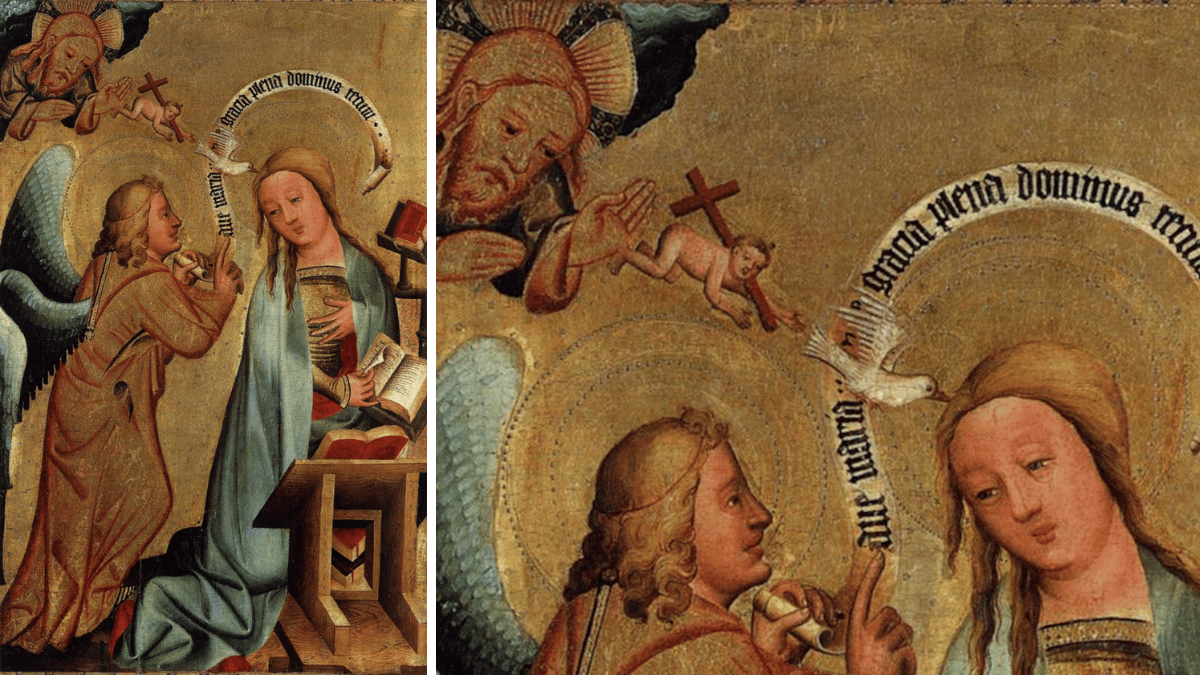
Image credit: The Annunciation | Master Bertram, 1379-1383 | Altarpiece at St Peter (Grabow) | Kunsthalle, Hamburg. Source credit: Andrew McGowan, Bible History Daily | July 10, 2025


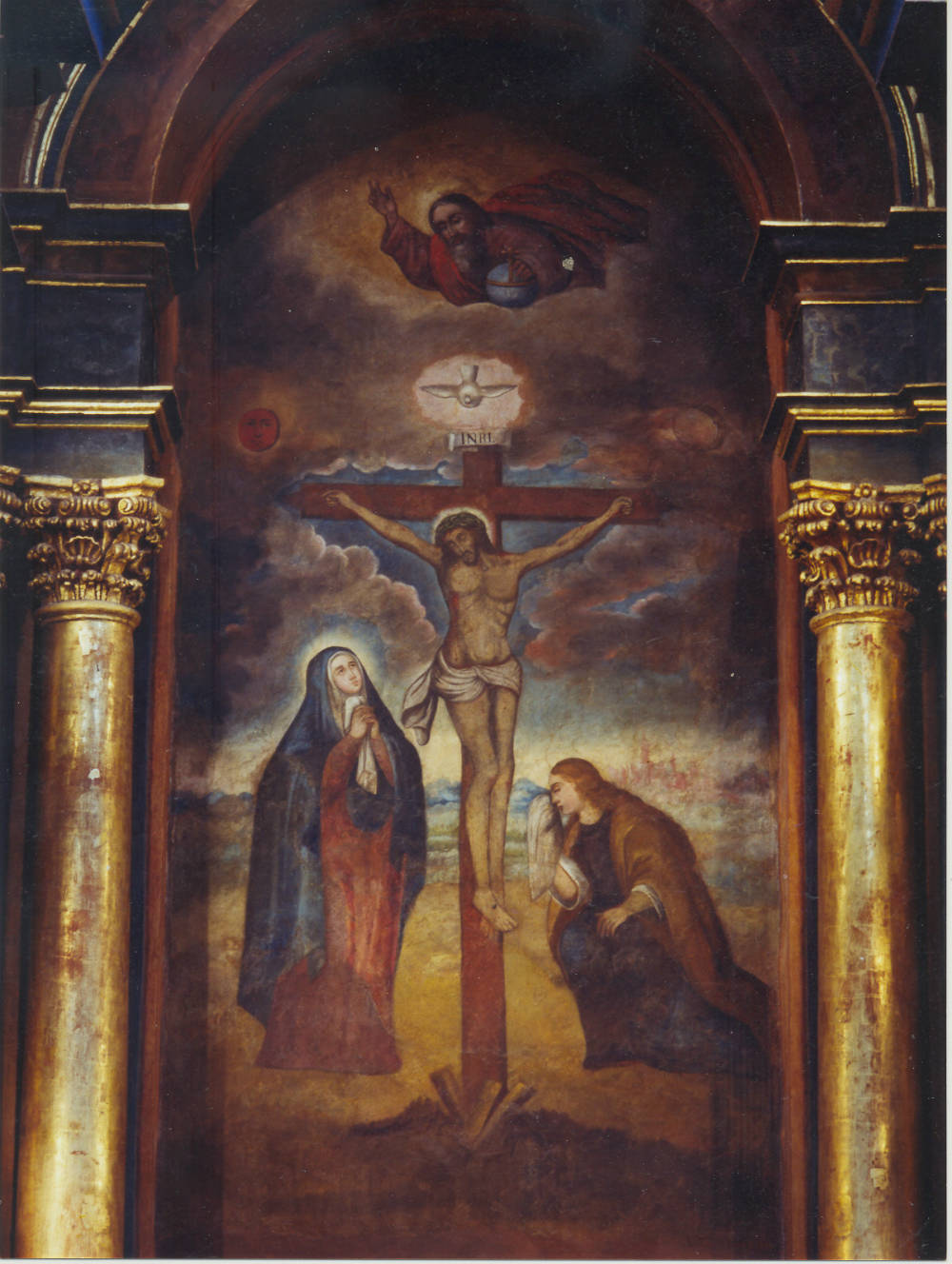 The Lord of Miracles (Señor de los Milagros) is an image painted of Jesus Christ that is venerated in Lima, Peru. The image was painted during the 17th century by Benito or Pedro Dalcon, an African taken from what is now Angola to Peru as a slave. An annual procession commemorating the image occurs every October. It is one of the oldest Catholic traditions in Peru. It is one of the largest religious processions in the world.
  friarmusings