
There are many stories that people remember about Francis of Assisi; in my experience, most of them are from a book, the Fioretti, The Little Flowers, a collection of stories about Francis. It is the name given to the classic collection of popular legends about the life of St. Francis of Assisi and his early companions. The earliest extant copy is from 1390, some 164 years after the death of Francis. Scholars agree that it was probably written earlier, but in any case not within 120 years of Francis’ death. It is a collection of hearsay, colorful anecdotes, stories of miracles and pious examples from the life of Francis. Are the accounts in the Fioretti history? Are the pious fables? Are they just hagiography? Continue reading
Francis and the Leper
1

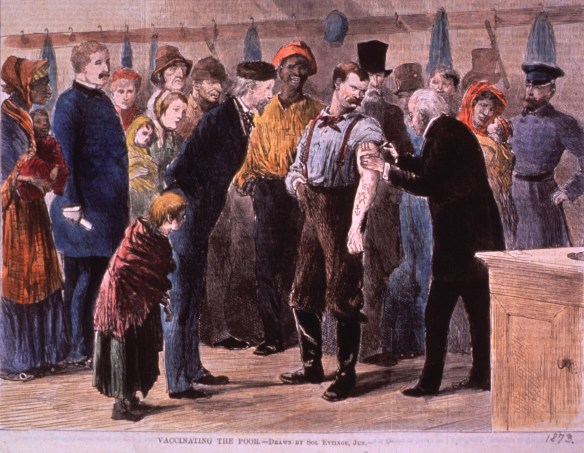 Maggie Astor of the New York Times posted an interesting piece – which was interesting all on its own, but is perhaps more interesting given President Biden’s announced covid-19 mandates and actions – and the inevitable push back against them. Ms. Astor’s point is essentially that we as a nation…. “been there, done that.” I would have linked to the article, but that was not feasible – and so I present her work.
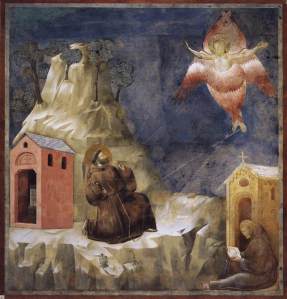 After Francis’ withdrawal from active ministerial leadership of the friars, he witnessed an inevitable evolution of the religious order, which had grown to over 5,000 brothers in 1223 from the humble beginnings in 1209 of Francis and four companions. The evolution of the Order, necessary on a number of levels, also began to change the life of the fraternity. Francis worried that the Spirit of prayer was being compromised and that the necessities of ministry were leading the brothers to increasing ties to material possessions. He lived and suffered in a “Time of Doubt,” as described in the previous article.
  August 11th, is the feast of St. Clare of Assisi. Clare was born July 16, 1194 as Chiara Offreduccio the eldest daughter of Favorino Scifi, Count of Sasso-Rosso and his wife Ortolana. There are many legends of how Clare and Francis met, but it is clear that Clare would have know about Francis and his movement of brothers seeking to embrace Holy Poverty.
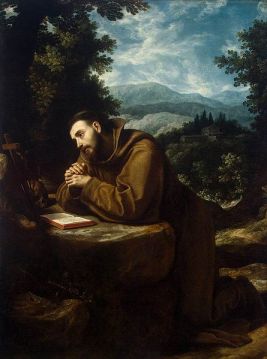 In the short span of 12 years (1209-1221), the Franciscans had grown from a small, Assisi-based fraternity consisting of Francis and four other brothers, to a large, “multi-national,” religious order with an approved Rule of Life, a Cardinal Protector (who would soon become Pope), and more than 5,000 brothers. There was nothing in Francis’ life that prepared him for leadership of such a far-flung fraternity, which was already spanning the European continent and parts of the Middle East and North Africa. He had been a spoiled dilatant, a would-be knight, a wounded warrior, a solitary figure, living a quasi-hermetical life, and now he was the “leader” of a growing, international community of brothers. In the beginning, things just seemed to unfold, signs appeared along the way, and Francis followed the path in faith. And people followed Francis. Now most Franciscans had never met Francis and Francis’ model of leadership by example, which worked in 1209, but was not the one needed in 1221. And so he stepped down as leader, leaving the Order in the care of the Church – at least as far as discipline and administration. Yet it was also clear that he hoped to preserve a superior authority, of a spiritual type, demonstrated in the way in which he lived the Rule of Life.
 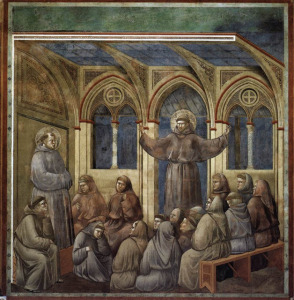 The year is 1221 and at the request of the “cardinal protector” of the friars, Cardinal Hugolino, Francis and several of his brothers have taken up the task of writing a formal rule of life. It was not clear that the Franciscans were actually a “religious order.” When Francis visited Pope Innocent III in 1209, the pope verbally approved (or did he?) a Rule of Life that was written down in few words. In 1216, the 4th Lateran Council ruled that no new religious orders could be formed: all new groups would be absorbed into existing religious orders. Hugolino recognized the uniqueness of the charism of St. Francis and his brothers and was determined that it not be lost to the church.
  friarmusings